

Israeli settlers turn archeological sites into political tools
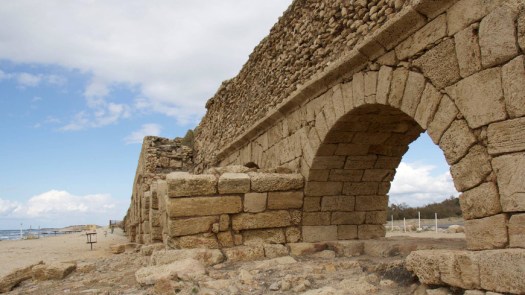
Every year, some 100,000 women, children and men visit the Biyar Aqueduct, built some 2,000 years ago to supply water to Jerusalem and the Jewish Temple.
By Akiva Eldar / Al-Monitor / Oct 3, 2017
“There is clear evidence at the Biyar Aqueduct — as there is at other sites — of the presence of the sons of the Judean Kingdom or of Jews at various periods. The problem is that these sites are being used as propaganda tools to establish the right of Jews to those lands, and the multicultural aspect of thousands of years of history is sidelined or even wiped out of the whole story.”
— Archaeologist Yonathan Mizrachi
The Israeli left made no bones about its glee over the empty bleachers at the September 27 jubilee celebration of the liberation of Judea, Samaria, the Jordan Valley and Golan Heights organized by the settlers in the occupied West Bank. The left views the photos of the empty seats as proof of the settlers’ failure to occupy the hearts and minds of the general Israeli public. The leftists argue that not only did the billions poured by successive Israeli governments into the settlements for 50 years lure fewer than 5% of Israelis to live there — about 400,000 according to the Israel Central Bureau of Statistics — the vast majority avoided the wasteful “liberation festival.”
Yet the pleasure taken by the left in the seeming failure of the settlers and their patrons is somewhat pathetic. Granted, the right-wing concept of a return to the land of the forefathers has not created a major demographic shift of Israelis moving to the settlements. Nonetheless, the notion has ingrained itself in the minds of broad swathes of the Israeli public and of tens of thousands of visitors from around the world. It happens daily in Jerusalem’s Old City and throughout the West Bank.
Continue reading “Israeli settlers turn archeological sites into political tools”
BBC Profile: Tent of Nations

The Christian family refusing to give up its Bethlehem hill farm.
By Daniel Silas Adamson / BBC News
June 18, 2014
[Ed. note: Although three years old, we thought this article by the BBC might be of interest to our readership.]
“My father always said, ‘We will never achieve peace in Palestine and Israel just by shaking hands — we need to work on people, to start with the grassroots.’ So what we do now, as a family, is fulfilling the dream of my father that people can build bridges, for hope, for understanding, reconciliation, dialogue, to achieve peace. This is the idea.”
— Amal Nassar
On his farm outside Bethlehem, Daher Nassar is picking apples from the ruins of the orchard he planted at least eight years ago. The fruit is scattered across ground freshly opened and imprinted with the tracks of a bulldozer. At the field’s edge, branches reach out from inside a mound of earth, the bark stripped and mangled, unripe almonds still clinging to the trees.
On 19 May [2014] a Palestinian shepherd from the village of Nahalin was out at first light and saw the bulldozer at work in the field, guarded by Israeli soldiers. By the time Nassar arrived the whole orchard — the best part of a decade’s work — was gone. His English is far from fluent, but there’s no mistaking the pain in his voice: “Why you broke the trees?”
A spokesperson for the Israeli military authorities in the West Bank said the trees were planted illegally on state land.
Nassar’s sister, Amal, has a different explanation. The government, together with the Israeli settlers who live around the farm, is “trying to push us to violence or push us to leave,” she says. Amal insists that her family will not move from the land, nor will they abandon their commitment to peaceful resistance.
“Nobody can force us to hate,” she says. “We refuse to be enemies.”
Mr. Friedman, Where Do You Stand on the Demolition of a Palestinian Village and School?

An open letter to Donald Trump’s nominee to be ambassador to Israel.
By Donna Baranski-Walker / Mondoweiss.net
March 8, 2017
My question: Do your own donations to support education in the Israeli settlement of Beit El and President Trump’s trust in you put you in a unique position to stop Israel’s demolition of Palestinian communities?
David Friedman, esq.
Nominee for U.S. Ambassador to Israel
Dear Mr. Friedman,
I am writing with urgency. I have asked my Senators Feinstein and Harris to forward my questions to you and request your reply. I am bringing these questions forward because although many speculate about what shape peace between Israelis and Palestinians will take in the future, I am most concerned with how you will assure a future for Palestinians who are being forced from their land right now.
The stakes were always high, but since January 2017, this situation is critical. These past two weeks, I have once again been urging everyone I know to write to their Senators and Representatives to urgently request that they call the Israeli Embassy and the U.S. State Department to prevent the imminent demolition of a West Bank Palestinian school and village, this time the village of Khan al Ahmar. Simultaneously we await word of the State of Israel’s position re the appeal by the Palestinian village of Susiya, calls are arriving from the village of Umm al Kheir about the Israeli Army’s demolition of water catchment cisterns in their area, and more.
Banksy’s Bethlehem Hotel with the “Worst View in the World”

Welcome to the “Walled Off Hotel,” the hotel with “worst view in the world.” Please be mindful of the million-dollar art on the walls.
By Russell Goldman / The New York Times
March 3, 2017
The elusive British street artist Banksy has decorated the interiors of the Walled Off Hotel, a nine-room guesthouse in the West Bank city of Bethlehem whose windows overlook the barrier that separates the territory from Israel.
Among the rooms decorated by the artist, who has earned a following for tagging walls around the world with witty illustrations and dark political commentaries, is the “Banksy Room.”
In the room, a mural on the wall above a king-size bed depicts a Palestinian and an Israeli locked in combat — only they are having a pillow fight.
Continue reading “Banksy’s Bethlehem Hotel with the “Worst View in the World””
The Middle East “peace process” was a myth — Donald Trump ended it

The final interment of the already moribund “two-state solution” would force all concerned to face what is obvious to any honest observer.
By Rashid Khalidi* / The Guardian
February 18, 2017
For decades, an imposed reality of one-state — the only sovereign entity enjoying total security control — has existed between the Jordan River and the Mediterranean. This one state is Israel. Irrespective of the label one uses for it, this is the only outcome that this Israeli government will accept, whatever subaltern, or helot, or “autonomous” status it deigns to allow the Palestinians.
“I’m looking at two-state and one-state, and I like the one that both parties like.” With these words at a joint press conference with Benjamin Netanyahu, Donald Trump may have finally dispelled the already receding mirage of any just solution.
Trump was clearly seeking to please his guest, spurred by the zealots in his government, four of whom, Public Safety Minister Gilad Erdan, Education Minister Naftali Bennett, Sports Minister Miri Regev, and Deputy Foreign Minister Tzipi Hotovley, just publicly came out against creation of a Palestinian state.
For decades, Israeli governments, pursuing the colonization of the entirety of “Eretz Israel,” have systematically destroyed the prerequisites for a solution involving a contiguous, sustainable, sovereign Palestinian state with Jerusalem as its capital. Nevertheless, the myth that a real Palestinian state is on offer, and that there actually is a genuine “peace process,” endures as one of the greatest examples of magical thinking in modern times.
Continue reading “The Middle East “peace process” was a myth — Donald Trump ended it”
U.N. Says Israeli Settlement Law Crosses “Thick Red Line”
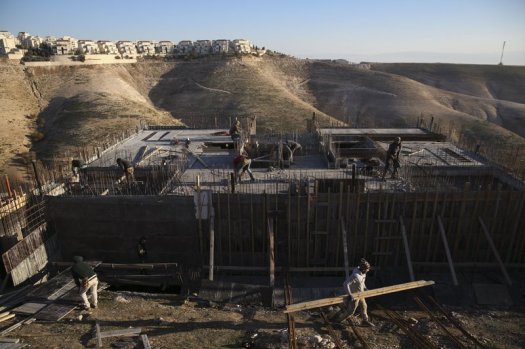
The United Nations condemns a new Israeli law legalizing dozens of unlawful West Bank settler outposts on illegally appropriated Palestinian land.
By Josef Federman / AP News
February 7, 2017
Nickolay Mladenov, the U.N.’s coordinator for the Middle East peace process, said the legislation “opens the floodgates to the potential annexation of the West Bank.” . . . It also marked the first time that the Israeli parliament has imposed Israeli law on Palestinian inhabitants of the West Bank. The area, captured by Israel in 1967, is not sovereign Israeli territory and Palestinians there are not Israeli citizens and do not have the right to vote.
The United Nations’ Mideast envoy on Tuesday said a new Israeli law legalizing dozens of unlawful West Bank settler outposts crossed a “very thick red line,” while Israeli rights groups said they would fight to overturn the measure in the Supreme Court.
The explosive law, approved by Israeli lawmakers late Monday night, was the latest in a series of pro-settler steps taken by Israel’s hard-line government since the election of Donald Trump as U.S. president. It is expected to trigger a number of challenges in the Supreme Court, while members of the international community have already begun to condemn it.
The law legalized dozens of outposts home built unlawfully on private Palestinian land in the occupied West Bank. According to the law, Palestinian landowners would be compensated either with money or alternative land, even if they did not agree to give up their property.
Continue reading “U.N. Says Israeli Settlement Law Crosses “Thick Red Line””
Netanyahu Makes Trump His Chump
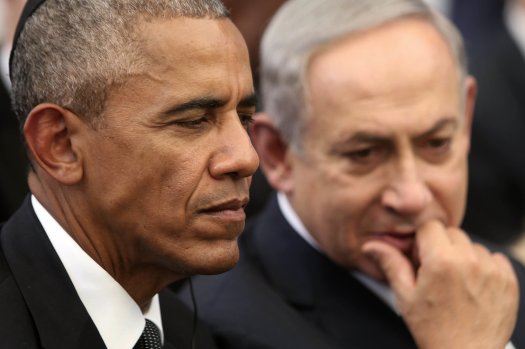
Friends don’t let friends drive drunk, and right now Obama and Kerry rightly believe that Israel is driving drunk.
By Thomas Friedman / The New York Times
December 28, 2016
Israel is driving drunk toward annexing the West Bank and becoming either a bi-national Arab-Jewish state or some Middle Eastern version of 1960’s South Africa, where Israel has to systematically deprive large elements of its population of democratic rights to preserve the state’s Jewish character.
For those of you confused over the latest fight between President Obama and Prime Minister Bibi Netanyahu of Israel, let me make it simple: Barack Obama and John Kerry admire and want to preserve Israel as a Jewish and democratic state in the Land of Israel. I have covered this issue my entire adult life and have never met two U.S. leaders more committed to Israel as a Jewish democracy.
But they are convinced — rightly — that Netanyahu is a leader who is forever dog paddling in the middle of the Rubicon, never ready to cross it. He is unwilling to make any big, hard decision to advance or preserve a two-state solution if that decision in any way risks his leadership of Israel’s right-wing coalition or forces him to confront the Jewish settlers, who relentlessly push Israel deeper and deeper into the West Bank.
The Annexation of Palestine Could Be Closer Than you Think
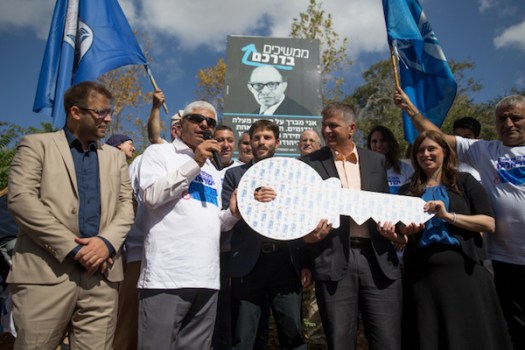
A perfect storm of domestic Israeli politics combined with the changing of the guard in Washington could create an opportunity for those advocating annexation to finally make their move.
By Michael Schaeffer Omer-Man / +972 Magazine
January 1, 2017
Since his election, President-elect Trump has been sending clear signals that his administration’s policy toward Israel, and especially the settlements, will be markedly different from that of Barack Obama, John Kerry, and, one would conclude, the previous eight American presidents since Israel occupied the Palestinian territories in 1967. The president-elect has not minced words, tweeting in response to John Kerry’s 75-minute admonition of Israel’s settlement policy: “Stay strong Israel, January 20th is fast approaching!”
Senior Israeli government minister Naftali Bennett announced on Sunday that he will introduce legislation to effectively annex Israel’s third-largest settlement in the West Bank, Ma’ale Adumim, by the end of January. It is safe to assume, that when Bennett says “by the end of January,” he means after the January 20 inauguration of Donald Trump.
Bennett’s desire to incrementally annex parts of the West Bank are neither new nor secret. The chairman of the Jewish Home party has run on a platform of annexation since he first ran for office in 2013 and in every election since. Through short videos and aggressive sound bites, the Israeli education minister has attempted shift the public discourse, in Israel and around the world, toward his annexationist aims. . . .
Ayelet Shaked, also of Bennett’s Jewish Home party and now Israel’s justice minister, in the past advocated annexing the Gush Etzion settlement bloc. More recently she announced plans to apply Israeli civil law to the occupied territories, which is considered de facto annexation (the West Bank is currently subject to Israeli military law). A few months ago Deputy Foreign Minister Tzipi Hotovely made a direct demand of her government. Similar pleas and plans can be heard on an almost daily basis throughout the Israeli government and ruling coalition, not to mention in right-wing circles and media outside the government. And while demands from within the government to advance annexation have become the new normal in recent years, for a variety of reasons they are often dismissed as fringe or unrealistic.
Continue reading “The Annexation of Palestine Could Be Closer Than you Think”
How Netanyahu’s Dangerously Twisted Words Hide the Truth
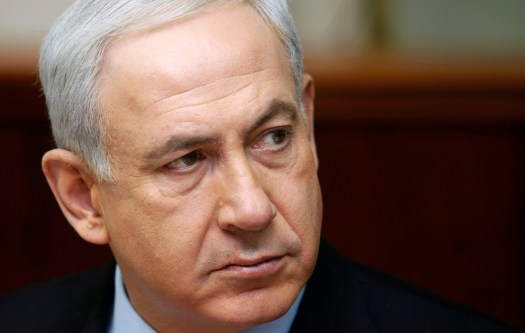
By Peter Beinart / The Forward
January 4, 2017
In the West Bank, Israel is not the “one true democracy in the Middle East.” It is not a democracy at all. It is not a democracy because Palestinians — who comprise the vast majority of the West Bank’s inhabitants — cannot vote for the government that controls their lives: the government of Israel. . . . If Israel really were a democracy in the West Bank, and millions of West Bank Palestinians could vote in Israeli elections, Netanyahu wouldn’t be Israel’s prime minister.
Last month, Prime Minister Benjamin Netanyahu issued two public statements. When the United Nations Security Council passed a resolution criticizing settlements, Netanyahu attacked it for not condemning Syria. When Secretary of State John Kerry defended the Obama administration’s decision to let the resolution pass, Netanyahu attacked him for not sufficiently condemning the Palestinians.
In both responses, the Israeli leader illustrated George Orwell’s famous insight: The abuse of human beings starts with the abuse of language.
“At a time when the Security Council does nothing to stop the slaughter of half a million people in Syria,” Netanyahu declared after the UN vote, “it disgracefully gangs up on the one true democracy in the Middle East, Israel.”
The first clause is a non-sequitur. Yes, Syrians in Aleppo and elsewhere are suffering more than Palestinians in the West Bank. Yes, the UN should be doing more to relieve their plight. But the test of whether Israeli settlement policy deserves international condemnation is whether Israeli settlement policy is morally wrong, not whether other governments deserve condemnation more.
Continue reading “How Netanyahu’s Dangerously Twisted Words Hide the Truth”
 HolyLandJustice.org
You must be logged in to post a comment.