Trump’s “One-State” Remarks Embolden Right-Wing Zionists — Jewish and Christian

3500
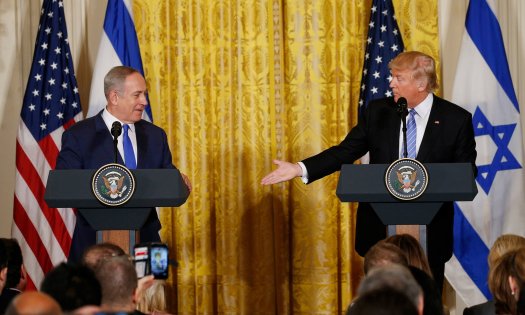
At a press conference with Benjamin Netanyahu, Donald Trump signaled openness to a one-state solution in the Middle East. (photo: Kevin Lamarque / Reuters)

President of oldest US pro-Israel group salutes “new sane era” as Trump’s views underscore divisions among Jews and influence of evangelical Christians.

By Ed Pilkington / The Guardian
February 17, 2017


Critics of the one-state solution point out that it would destroy the fundamental character of Israel as a democratic Jewish state: Arabs and Palestinians would numerically be dominant in a single state and that in turn would either eradicate the Jewish nature of the country or force it to forgo democracy by relegating the Palestinians to second-class status.


Donald Trump’s apparent readiness to accept a one-state solution to the Middle East conflict that would permanently rule out a Palestinian nation is emboldening rightwing Zionists in the US — both among Jewish Americans and the much larger pool of pro-Israeli evangelical Christians.

Some Zionist groups welcomed with delight the president’s unexpected comment on Wednesday that tore up the longstanding US adherence to a two-state solution in which Israel would coexist peacefully alongside a fully-formed Palestine.

“I’m looking at two-state and one-state and I like the one that both parties like,” he said.

Continue reading “Trump’s “One-State” Remarks Embolden Right-Wing Zionists — Jewish and Christian”
U.N. Says Israeli Settlement Law Crosses “Thick Red Line”

800
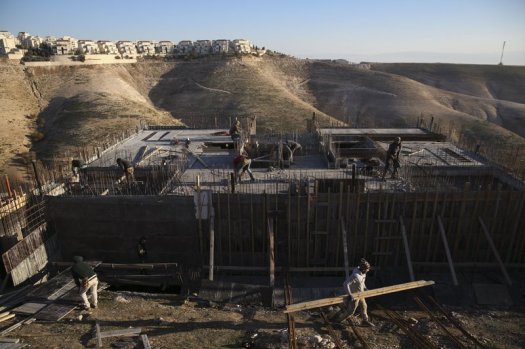
Laborers work at a new housing project in the Israeli settlement of Maale Adumim, near Jerusalem, Feb 7, 2017. (photo: Oded Balilty / AP)

The United Nations condemns a new Israeli law legalizing dozens of unlawful West Bank settler outposts on illegally appropriated Palestinian land.

By Josef Federman / AP News
February 7, 2017


Nickolay Mladenov, the U.N.’s coordinator for the Middle East peace process, said the legislation “opens the floodgates to the potential annexation of the West Bank.” . . . It also marked the first time that the Israeli parliament has imposed Israeli law on Palestinian inhabitants of the West Bank. The area, captured by Israel in 1967, is not sovereign Israeli territory and Palestinians there are not Israeli citizens and do not have the right to vote.


The United Nations’ Mideast envoy on Tuesday said a new Israeli law legalizing dozens of unlawful West Bank settler outposts crossed a “very thick red line,” while Israeli rights groups said they would fight to overturn the measure in the Supreme Court.

The explosive law, approved by Israeli lawmakers late Monday night, was the latest in a series of pro-settler steps taken by Israel’s hard-line government since the election of Donald Trump as U.S. president. It is expected to trigger a number of challenges in the Supreme Court, while members of the international community have already begun to condemn it.

The law legalized dozens of outposts home built unlawfully on private Palestinian land in the occupied West Bank. According to the law, Palestinian landowners would be compensated either with money or alternative land, even if they did not agree to give up their property.

Continue reading “U.N. Says Israeli Settlement Law Crosses “Thick Red Line””

One-State, Two-State

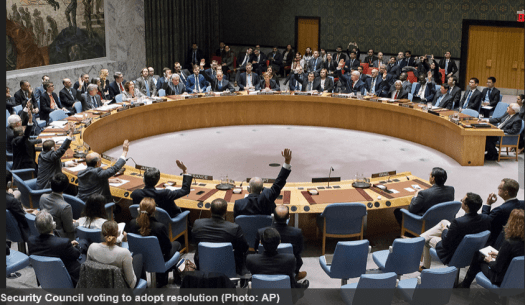
un-resolution2334-vote

By Sarah Robinson
December 31, 2016

[Sarah Robinson is a volunteer with the World Council of Churches who has written about Israel-Palestine since 2012. On Oct 17, 2016, she was refused entry to Israel at Ben Gurion International Airport in Tel Aviv and deported . — Ed.]


In my opinion, [no] solutions are viable without visionary leadership and the willingness to compromise. Recalling the experience of South Africa, bold leadership and compromise brought apartheid to an end, and I believe the same is needed in Israel and Palestine. . . . I believe the appetite of both populations indicates that they are willing to start these talks but the lack of real leadership is restraining any progress.


This week, the Israel-Palestine conflict was nudged into the international spotlight. Last Friday, the United Nations Security Council (UNSC) voted in favor of Resolution 2334 condemning the proliferation of settlement development and expansion in the occupied West Bank and East Jerusalem. Usually, the United States (US) vetoes such resolutions but on Friday they abstained from voting thereby allowing the resolution to pass. Israel was quick to respond with damning language, threatening rhetoric, and victimized aggression. Originally, Egypt put the resolution forward to the UNSC, but after receiving pressure from president-elect Donald Trump, withdrew the application. Thus, a random mix of countries, including New Zealand and Venezuela, resubmitted the resolution which went to a vote. Israel has since accused New Zealand of declaring war in their action to present Resolution 2334 to the UNSC.

On Wednesday, US Secretary of State John Kerry, gave a 1 hour 13-minute speech in Washington DC justifying the US choice to abstain, summarizing the history of US-Israel relations, UN resolutions, and peace negotiations, and outlining five principles to a solution and lasting peace. It was a good speech and it elicited swift condemnation from Israeli Prime Minister Benjamin Netanyahu, however, the speech was about twenty years too late. It rehashed positions and policies that have been ignored or bypassed for decades and although it sounded good, with less than three weeks remaining in the White House, the Obama administration is grasping at proverbial straws. Secretary Kerry pleaded with Israel to not execute the two-state solution but, in my opinion, the death of the two-state solution took place years ago, and this latest activity will not resuscitate it.

Continue reading “One-State, Two-State”

Ralph Nader: An Open Letter To President Obama

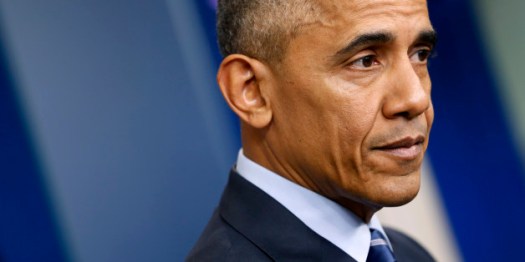
U.S. President Barack Obama participates in his last news conference of the year at the White House in Washington
(photo: Jonathan Ernst / Reuters)

Decision time for Israeli-Palestinian peace

By Ralph Nader / The Huffington Post
December 19, 2016


“[Recognizing Palestine]  is the best — now, perhaps, the only — means of countering the one-state reality that Israel is imposing on itself and the Palestinian people [and] that could destroy Israeli democracy and will result in intensifying international condemnation of Israel.
— Former U.S. President Jimmy Carter


Dear President Obama:

On November 28, 2016, Jimmy Carter, the President who negotiated the peace agreement between Israel and Egypt in 1978, wrote an op ed for the New York Times titled, “America Must Recognize Palestine.” His urgent plea was directed to you to take “the vital step . . . to grant American diplomatic recognition to the state of Palestine, as 137 countries have already done, and help it achieve full United Nations membership,” before you leave office on January 20, 2017.

Mr. Carter referenced your reaffirmation in 2009 of the Camp David agreement between Israel and Egypt and United Nations Resolution 242 when you called “for a complete freeze on settlement expansion on Palestinian territory that is illegal under international law.” He noted that in 2011 you made clear that, in your words, “the borders of Israel and Palestine should be based on the 1967 lines” and that “negotiations should result in two states, with permanent Palestinian borders with Israel, Jordan and Egypt, and permanent Israeli borders with Palestine.”

Former President Carter sees that the “combined weight of United States recognition, United Nations membership [for Palestine] and a UN Security Council resolution solidly grounded in international law would lay the foundation for future diplomacy.” Continue reading “Ralph Nader: An Open Letter To President Obama”

Israel Needs to Decide Its Own Policy

tzipi-livni
Tzipi Livni, a leader of the opposition in the Israeli parliament, at a 2015 summit in London. (photo: Stefan Wermuth/Reuters)

Q&A with former Israeli peace negotiator Tzipi Livni

By Ruth Eglash and William Booth / The Washington Post
December 6, 2016


We need to understand what we all are facing. This is against foreigners and Jews. Anti-Semitism is raising its ugly head in different parts of the world. All together we should fight terrorism, fight anti-Semitism, fight xenophobia and fight for our values. This is what makes Israel part of the free world. Instead of saying workers of the world unite, moderates of the world should unite.


The government of Prime Minister Benjamin Netanyahu is fretting over what President Obama may or may not do in the waning days of his administration.

Will Obama endorse a U.N. resolution enshrining a rough outline for what a two-state solution to the long-running Israel-Palestinian conflict should look like — regarding future borders, the fate of the Jewish settlements and Palestinian refugees, the sharing of Jerusalem?

Or maybe Obama will give a speech.

Or send Secretary of State John F. Kerry to Paris to mull the “French initiative” to push for an end to Israel’s 50-year military occupation, a conference that appears to be stalled.

Or. Or. Or.

Continue reading “Israel Needs to Decide Its Own Policy”

Jared Kushner’s Foundation Donated to Settlements

jared-kushner-1
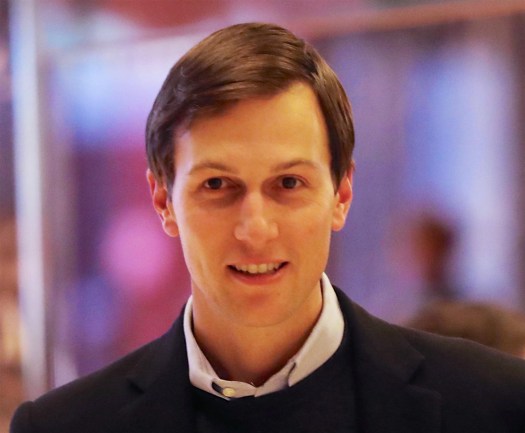
Jared Kushner, the son-in-law of President-elect Donald Trump, walks through the lobby of Trump Tower. (photo: Spencer Platt/Getty Images)

By Carol Morello / The Washington Post
December 5, 2016


“I imagine this will be the end of State Department statements for 50 years calling settlements illegal to illegitimate, unhelpful or obstacles to peace. American foreign policy is about to be dramatically shifted. . . . It’s not about one check from Jared Kushner, but a broad threat to 50 years of bipartisan support for the proposition that settlements are an obstacle to peace. Now, that could be declared dead. I’m very alarmed.”
— Jeremy Ben-Ami, President of J Street


Jared Kushner, who may become a Middle East peace envoy in his father-in-law’s administration, is a director of a family foundation that has made charitable donations to West Bank settlements.

The gifts totaled $58,500 between 2011 and 2013, a small portion of the almost $8.5 million the Seryl and Charles Kushner Family Foundation gave away in that period, according to IRS records first reported by the Israeli newspaper Haaretz and reviewed independently by The Washington Post. Kushner and his three siblings are directors, along with their parents, of the foundation.

President-elect Donald Trump has said he may make his son-in-law, who is married to Ivanka Trump, a broker for talks between Israelis and Palestinians, saying Kushner would be “very good” at working with both sides.

Continue reading “Jared Kushner’s Foundation Donated to Settlements”

Dark Clouds Over Palestine

OLYMPUS DIGITAL CAMERA

Deep divisions among the Palestinians are as damaging to their cause as the U.S.’s nauseating pandering to Israel

By Ramzy Baroud / Morning Star
November 24, 2016


Over his two terms, during which time thousands of innocent people — the vast majority of whom were Palestinians — were killed in Gaza and the West Bank, Obama purportedly worked to build a “middle ground.” However, the outcome of these policies were quite devastating — he sold Palestinians false hope while granting Israel most of its needs of military funding and technology and at the same time shielding it from international censure.


Fear and trepidation are slowly building up, as US president-elect Donald Trump is fortifying his transitional team with people capable of bringing about a nightmare scenario, not only for the US but for the rest of the world as well.

For Palestinians, however, the signs are even more ominous. From former New York mayor Rudy Giuliani to Republican leader Newt Gingrich the Trump team is filling up with dishonorable men who have made careers out of pandering to Israeli interests while discounting Palestinian rights.

In 2011 Gingrich had claimed that Palestinians are “invented” people, while Giuliani — according to the Jewish News Service — “is fondly remembered in the Jewish community for expelling Yasser Arafat, leader of the Palestine Liberation Organization (PLO) from a UN concert at the Lincoln Centre in 1995.”

Considering statements made by Trump last May, that the expansion of illegal Jewish settlements in the occupied West Bank “should keep moving forward,” to more recent comments by Trump’s spokesperson in Israel, Jason Greenblatt, that the illegal land occupations are “not an obstacle to peace,” it is fairly certain that the Trump administration will be decidedly anti-Palestinian and anti-peace.

[Continue reading here . . . ]

Jimmy Carter: America Must Recognize Palestine

29carter-master768-v2
Image: Vahram Muradyan / The New York Times

By Jimmy Carter / The New York Times
November 28, 2016


The Security Council should pass a resolution laying out the parameters for resolving the conflict. It should reaffirm the illegality of all Israeli settlements beyond the 1967 borders, while leaving open the possibility that the parties could negotiate modifications. Security guarantees for both Israel and Palestine are imperative, and the resolution must acknowledge the right of both the states of Israel and Palestine to live in peace and security. Further measures should include the demilitarization of the Palestinian state, and a possible peacekeeping force under the auspices of the United Nations.


We do not yet know the policy of the next administration toward Israel and Palestine, but we do know the policy of this administration. It has been President Obama’s aim to support a negotiated end to the conflict based on two states, living side by side in peace.

That prospect is now in grave doubt. I am convinced that the United States can still shape the future of the Israeli-Palestinian conflict before a change in presidents, but time is very short. The simple but vital step this administration must take before its term expires on Jan. 20 is to grant American diplomatic recognition to the state of Palestine, as 137 countries have already done, and help it achieve full United Nations membership. . . .

The primary foreign policy goal of my life has been to help bring peace to Israel and its neighbors. That September in 1978, I was proud to say to a joint session of Congress, “Blessed are the peacemakers, for they shall be called the children of God.” As Mr. Begin and Mr. Sadat sat in the balcony above us, the members of Congress stood and applauded the two heroic peacemakers.

I fear for the spirit of Camp David. We must not squander this chance.

[Continue reading here . . . ]

Israel to build 500 new settler homes in East Jerusalem

44f22246134e48ff99130bcab38f6c48_18
Photo: Al Jazeera

Palestinian leaders say Israel’s settlement movement is emboldened by the election of Donald Trump in the US.

By Al Jazeera News
November 24, 2016


“The real policy of the Israeli government is to destroy the very last opportunity to build a Palestinian state and kill the so-called two state solution.”


Israel has announced plans to move forward with the construction of 500 homes for Jewish settlers in occupied East Jerusalem, the first such move since the US presidential election.

“This morning, the local planning and building committee made the decision to advance [plans]… for 500 units in Ramat Shlomo,” the Ir Amim anti-settlement NGO said, referring to an ultra-Orthodox Jewish settlement near the Palestinian neighborhood of Shuafat.

More than 200,000 Israeli settlers now live in communities in East Jerusalem, which Israel has occupied along with the rest of the West Bank, the Gaza Strip and parts of Egypt and Syria since the 1967 war. More than half-a-million Israelis live in Jewish-only settlements throughout the West Bank, including East Jerusalem. They are considered illegal by international law.

[Continue reading here . . . ]


Obama’s only Israel-Palestine option

.
Photo: Miriam Alster / Flash90

When everyone believed Clinton was going to be the next president, Obama was rumored to be considering several last-minute options to advance Israeli-Palestinian peace. All that went out the window on November 8.

By Noam Sheizaf / +972 Magazine
November 11, 2016


The old peace process is officially toast. The people who led it won’t be part of the next administration. The policies they pursued are the furthest possible from a Trump administration’s agenda — be it isolationist or neo-con/interventionist. A final push on parameters would be a waste of political capital, and might actually cause more harm than good.


The Obama administration is probably trying to figure out how to protect its two signature achievements — Obamacare and the Iranian nuclear deal — for the next two years, when the White House and both chambers of Congress will be under Republican control. But it will also need to revisit other issues, such as a widely discussed final move on the Israeli-Palestinian issue. Specifically, the idea of laying out parameters for a final status agreement — either in the form of a major policy speech or via a UN Security Council resolution — might seem out of touch with the new political reality in Washington.

It is extremely difficult to predict what Donald Trump’s actual policies will be — common wisdom is that a weak and poorly informed president depends on the people around and below him — but it’s a pretty safe guess that Trump won’t continue efforts to broker a final agreement on a two-state solution. The GOP removed the very idea of Palestinian statehood from its platform ahead of the elections. Those around Trump have taken positions in favor of West Bank settlements and against previous efforts to push the Israeli government towards a deal with the Palestinians. Others in the president-elect’s circle — probably including Trump himself — have strong isolationist tendencies.

All that should cause the outgoing Obama administration to change its calculations. Much of its thinking on a final push on the peace process was clearly predicated on the assumption that Hillary Clinton would be the next president. The idea was not that a major policy speech or a UN Security Council resolution on parameters would generate an immediately response on the ground. It might, however, have laid solid groundwork for future negotiations, all while creating options for the next administration that relieved it of the need to spend actual political capital on the issue.

[Continue reading here . . . ]