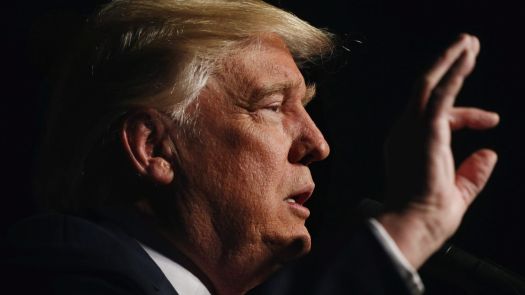
Palestine in the Age of Trump

khalidi-palestineintheageoftrump-1200
(photo: Brendan Smialowski / AFP / Getty)

With the advent in Washington of an Administration with radical new priorities regarding Israel, and a disdain for Palestinian rights, Palestine is facing a daunting reality.

By Rashid Khalidi / The New Yorker
January 19, 2017


It is abundantly clear that the United States, in the age of Trump, and Israel, in the age of Netanyahu, will do nothing to change this picture. In this context, the Palestinians face stark choices. They can either submit to the dictates of the U.S. and Israel or they can fundamentally and urgently redefine their national movement, their objectives, and their modes of resistance to oppression.


With the advent in Washington of an Administration with radical new priorities regarding Israel, and a disdain for Palestinian rights, Palestine is facing a daunting reality. In recent years, ascendant political currents in America and Israel had already begun to merge. We have now reached the point where envoys from one country to the other could almost switch places: the Israeli Ambassador in Washington, Ron Dermer, who grew up in Florida, could just as easily be the U.S. Ambassador to Israel, while Donald Trump’s Ambassador-designate to Israel, David Friedman, who has intimate ties to the Israeli settler movement, would make a fine Ambassador in Washington for the pro-settler government of Benjamin Netanyahu.

Whereas America’s solicitous concern for Israel and its disregard for the Palestinians were once cloaked behind evenhandedness, under Trump we are set to see a more complete convergence between America’s political leadership and the most chauvinistic, religious, and right-wing government in Israel’s history. It will be this Israeli government and its new American soul mates who will call the tune in Palestine for at least the next several years.

Continue reading “Palestine in the Age of Trump”

Trump Renews Vow for Jerusalem Embassy, a Gift of Uncertain Value

20jerusalem-master768
The United States Embassy in Tel Aviv, where all other countries have their embassies. (photo: Jack Guez / Agence France-Presse via Getty Images)

No other government has its embassy in Jerusalem.

By Ian Fisher and Isabel Kershner / the New York Times
January 19, 2017


“Why would a president-elect decide to begin his presidency by playing with the blood of Palestinians and Israelis? Why? For whose sake? . . . This will destroy us as Palestinian moderates. This will bring extremism to the region.”
— Saeb Erekat, chief Palestinian negotiator


It started, as it has in American presidential races for decades, as a campaign line, one that weary Israelis and Palestinians hear but rarely take seriously: Donald J. Trump promised to move his nation’s embassy to Jerusalem from Tel Aviv.

But by Thursday, the eve of Mr. Trump’s inauguration, those decades of promises seemed very real — with reverberations far beyond stone and cement.

Mr. Trump himself made perhaps his strongest statement on the issue on Thursday, telling a conservative Israeli news outlet, “You know I’m not a person who breaks promises.”

Continue reading “Trump Renews Vow for Jerusalem Embassy, a Gift of Uncertain Value”

Dear Trump Administration: Don’t Mess With Jerusalem

MIDEAST US ELECTIONS
Supporters of U.S. President-elect Donald Trump attend an election campaign rally, Jerusalem, Oct 26, 2016. (photo: Yonatan Sindel / Flash90)

Moving the U.S. Embassy from Tel Aviv to Jerusalem could ignite a spark that would set the entire region aflame. It’s just not worth it.

By James J. Zogby / +972 Magazine
January 17, 2017

[The author is the president of the Arab American Institute.]


Palestine may have dropped off the radar for a time, but it remains “the open wound in the heart, that never heals.” Violating Jerusalem and unrest in occupied Palestinian lands would rip the scab off that wound reminding Arabs of their vulnerability and their inability to control their history in the face of betrayal by the West. Ignore this passion and there will be consequences.


In just a matter of days, President-elect Donald Trump will have to decide on whether or not to make good on his promise to move the U.S. embassy in Israel from Tel Aviv to Jerusalem. As we approach Inauguration Day, liberal and conservative commentators alike have offered a number of ideas as to how he can proceed. Ranging from “too cute by half” to just plain dumb, they should all be rejected. More to the point, all of the proposals I have seen focus exclusively on Israeli concerns, ignoring or giving short shrift to Palestinian and broader Arab or Muslim concerns and sensitivities.

On the one side, there are proposals from hardliners who advise Trump to just go ahead and make the move. They argue that in fulfilling his campaign promise he will appease his base and gain international respect for being a strong and decisive leader. They dismiss Palestinian, Arab, and Muslim opinions, relying on the false assumptions that there is diminished concern across the Arab world for the Palestinian issue or making the racist case that Arabs respect strength and will ultimately become reconciled to a U.S. move.

Continue reading “Dear Trump Administration: Don’t Mess With Jerusalem”

An Israel-Palestine peace conference — without Israel or Palestine

20170121_map501
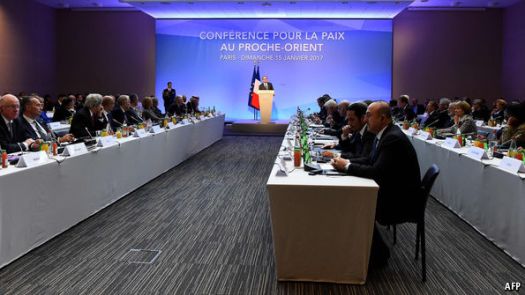
Israeli-Palestinian “peace talks” in Paris, Jan 15, 2017. (photo: AFP)

The futile talkfest in Paris aimed its message at America, not the Middle East.

The Economist
January 17, 2017


The Paris meeting felt less like a diplomatic summit than a farewell concert thrown by an aging rock band. . . . Diplomats promised to meet again in Paris later this year. It may be difficult to justify the trip.


It was, even by the dispiriting standards of Israeli-Palestinian diplomacy, a futile concept: a peace conference without either of the warring parties. On January 15th diplomats from more than 70 countries flew to Paris for a summit against which Israeli officials had inveighing for weeks. Binyamin Netanyahu, Israel’s prime minister, called it “rigged” and his defense minister, Avigdor Lieberman, compared it to the Dreyfus trial. So the French government, keen to avoid the embarrassment of having Israel refuse to attend, did not invite either side. It was “like a wedding without a bride and groom,” quipped Naftali Bennett, Israel’s right-wing education minister.

After a full day of debate, the diplomats issued a two-page declaration that urged both sides to “commit to the two-state solution . . . [and to] take urgent steps in order to reverse the current negative trends on the ground.” If that sounds familiar, it should. Parts of it were copied verbatim from the closing statement of the previous Paris peace conference, held in June.

Continue reading “An Israel-Palestine peace conference — without Israel or Palestine”

Dear Donald Trump: A letter from Palestine

7086cd8cf37f44e091ceb3fd45f60eec_18
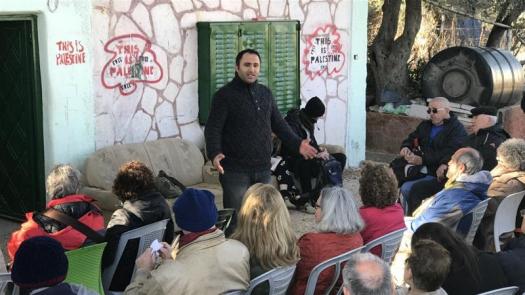
Palestinian human rights defender from the city of Hebron, Issa Amro. (photo: courtesy of Issa Amro)

The U.S. must start treating Palestinians as equals to Israelis.

By Issa Amro / Al Jazeera
January 17, 2017


“It was reading the works of giants such as Nelson Mandela, Mahatma Gandhi and your own civil rights pioneer, Martin Luther King, Jr., that convinced me to spend my life using nonviolent methods of resistance to forge a path forward for myself and my people. I owe a great deal of my fortitude and strategy to King and thinkers like him.”


My name is Issa Amro. I am a 36-year-old Palestinian human rights defender from the city of Hebron in the Israeli-occupied West Bank, where I work with an organization called Youth Against Settlements.

While we live thousands of kilometers apart and have never met, my fate is more closely linked to the office you will hold, and the choices a U.S. president makes, than many might think. The United States’ military, economic and diplomatic support has allowed Israel to continue its occupation of Palestinian lands, upholding their racist, apartheid regime.

I have not spent my youth thinking about my career or travelling the world, the Israeli chokehold on our society limits my opportunities on both those fronts. Instead, I have been engaged in near-daily confrontations with hostile settlers and an occupying army, both of whom want me, my family and my friends to leave our land and never return.

Continue reading “Dear Donald Trump: A letter from Palestine”

The Annexation of Palestine Could Be Closer Than you Think

.
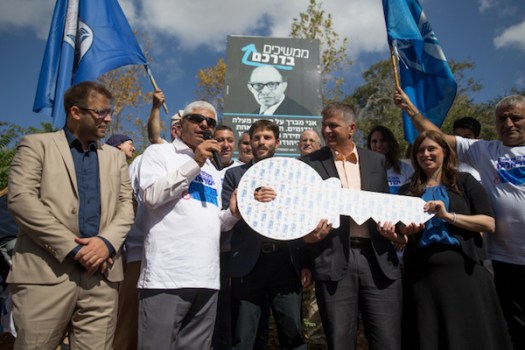
Members of Knesset from the Likud and Jewish Home parties, including Deputy Foreign Minister Tzipi Hotovely (R), take part in an event demanding the annexation of West Bank settlement Ma’ale Adumim, Jerusalem, October 31, 2016. (photo: Yonatan Sindel / Flash90)

A perfect storm of domestic Israeli politics combined with the changing of the guard in Washington could create an opportunity for those advocating annexation to finally make their move.

By Michael Schaeffer Omer-Man / +972 Magazine
January 1, 2017


Since his election, President-elect Trump has been sending clear signals that his administration’s policy toward Israel, and especially the settlements, will be markedly different from that of Barack Obama, John Kerry, and, one would conclude, the previous eight American presidents since Israel occupied the Palestinian territories in 1967. The president-elect has not minced words, tweeting in response to John Kerry’s 75-minute admonition of Israel’s settlement policy: “Stay strong Israel, January 20th is fast approaching!”


Senior Israeli government minister Naftali Bennett announced on Sunday that he will introduce legislation to effectively annex Israel’s third-largest settlement in the West Bank, Ma’ale Adumim, by the end of January. It is safe to assume, that when Bennett says “by the end of January,” he means after the January 20 inauguration of Donald Trump.

Bennett’s desire to incrementally annex parts of the West Bank are neither new nor secret. The chairman of the Jewish Home party has run on a platform of annexation since he first ran for office in 2013 and in every election since. Through short videos and aggressive sound bites, the Israeli education minister has attempted shift the public discourse, in Israel and around the world, toward his annexationist aims. . . .

Ayelet Shaked, also of Bennett’s Jewish Home party and now Israel’s justice minister, in the past advocated annexing the Gush Etzion settlement bloc. More recently she announced plans to apply Israeli civil law to the occupied territories, which is considered de facto annexation (the West Bank is currently subject to Israeli military law). A few months ago Deputy Foreign Minister Tzipi Hotovely made a direct demand of her government. Similar pleas and plans can be heard on an almost daily basis throughout the Israeli government and ruling coalition, not to mention in right-wing circles and media outside the government. And while demands from within the government to advance annexation have become the new normal in recent years, for a variety of reasons they are often dismissed as fringe or unrealistic.

Continue reading “The Annexation of Palestine Could Be Closer Than you Think”

What Could Happen if Trump Moves the U.S. Embassy to Jerusalem?

us-embassy-plot-jerusalem-20161224_map003_0
Proposed site of U.S. embassy in Jerusalem. (photo: Getty Images via Economist)

By Rebecca Shabad / CBS News
December 20, 2016


“Even though the peace process is, I think, comatose and is unlikely to advance in the near term, why overload the circuits and potentially take a step that could permanently undermine the prospects of a two-state solution? You’re simply going to feed Iranian propaganda, you’re going to feed Sunni-jihadi propaganda and most likely, you’re going to trigger a fair amount of violence and even terror.”
— Aaron David Miller, The Woodrow Wilson Center


Moving the U.S. embassy in Israel from Tel Aviv to Jerusalem may have been one of President-elect Donald Trump’s campaign promises, but experts and Palestinian officials are warning of serious consequences if he follows through.

“We will move the American embassy to the eternal capital of the Jewish people, Jerusalem — and we will send a clear signal that there is no daylight between America and our most reliable ally, the state of Israel,” Mr. Trump said in a speech to the powerful Jewish lobbying group, the American Israel Public Affairs Committee (AIPAC) in March.

Last week, in an indication of Mr. Trump’s seriousness, he announced that he would nominate bankruptcy lawyer David Friedman to serve as ambassador to Israel. Friedman, an Orthodox Jew, made clear in a statement that he looks forward to doing the job from “the U.S. embassy in Israel’s eternal capital, Jerusalem.”

Daniel Kurtzer, U.S. ambassador to Israel under President George W. Bush, called Friedman’s nomination a “serious mistake” in an op-ed in The New York Times over the weekend.

“The consequences of acting upon Mr. Friedman’s public suggestions are clearly dangerous. Moving the American Embassy to Jerusalem — not a pressing issue for most Israelis — will inspire riots across the Islamic world,” Kurtzer wrote. Continue reading “What Could Happen if Trump Moves the U.S. Embassy to Jerusalem?”

Trump’s Pick for Envoy to Israel Expects Embassy in Jerusalem

A general view of Jerusalem's old city shows the Dome of the Rock in the compound known to Muslims as Noble Sanctuary and to Jews as Temple Mount
A view of Jerusalem’s old city showing the Dome of the Rock. (photo: Amir Cohen / Reuters)

By Yara Bayoumy / Reuters
December 16, 2016


In an interview with Israeli left-leaning newspaper Haaretz, in June, Friedman was asked whether Trump would support the creation of an independent Palestinian state — a bedrock of U.S. foreign policy which supports a two-state solution. “The answer is: not without the approval of the Israelis. . . . He does not think it is an American imperative for it to be an independent Palestinian state.”


President-elect Donald Trump said on Thursday he will nominate bankruptcy attorney David Friedman as U.S. ambassador to Israel, and Friedman said he looked forward to taking up his post in Jerusalem, implying a move from Tel Aviv that would mark a break in longstanding U.S. foreign policy and anger the Muslim world.

While campaigning for the presidency, Trump pledged to switch the embassy from Tel Aviv, where it has been located for 68 years, to Jerusalem, all but enshrining the city as Israel’s capital regardless of international objections.

“[Friedman] has been a long-time friend and trusted advisor to me. His strong relationships in Israel will form the foundation of his diplomatic mission and be a tremendous asset to our country as we strengthen the ties with our allies and strive for peace in the Middle East,” Trump said in a statement issued by his team on Thursday.

The Republican made clear during his campaign that he would support Israel in a number of critical areas, said he would not put pressure on Israel to engage in talks with the Palestinians.

The United States and other powers do not regard Jerusalem as Israel’s capital. Other nations embassies are located in Tel Aviv — and do not recognize Israel’s annexation of Arab East Jerusalem following its capture in the 1967 Middle East war. Continue reading “Trump’s Pick for Envoy to Israel Expects Embassy in Jerusalem”

Friedman Isn’t a Hawk or a Dove — He’s an Ostrich

2562088553
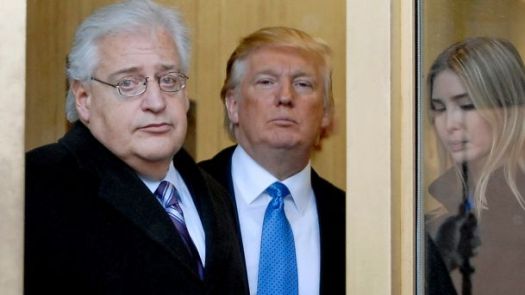
David M. Friedman, left, with Donald J. Trump and his daughter Ivanka in 2010. (photo: Bradley C. Bower / Bloomberg)

By appointing a leader of the Israeli settlement project to be his ambassador to Israel, Trump signals a retreat from America’s role as “honest broker” in the region. It’s not hard to see who stands to benefit.

By Jay Michaelson / The Daily Beast
December 18, 2016


Ironically, the appointment of one of the leaders of the Israeli settlement project in the West Bank (ruled illegal by the International Criminal Court and opposed by every American administration since Nixon), and an extreme Jewish nationalist may, in the end, be a catastrophe for Israel.


David Friedman, Donald Trump’s close confidante and ambassador-designate to Israel, is not a right-winger. To be on the right wing implies that one is on a continuum from liberal to conservative. But Friedman — together with around 15% of the Israeli Jewish population — inhabits a different world entirely. His appointment would represent a total realignment of American policy in the Middle East, with the biggest winner being (surprise) Vladimir Putin.

The normal continuum runs as follows. The consensus of the international community, the Israeli government, and every American government for a generation is that that there must be a state of Palestine alongside the state of Israel. Of course, within that consensus, there are hawks and doves, right-wingers and left. Some are willing to take more risks for peace, some are more mistrustful of the people they call “the Arabs” and want any peace process to be slow and gradual. But all agree that it’s not feasible to create an apartheid regime in which 7 million Jews rule over 10 million non-Jews.

But in the world of Friedman, the Zionist Organization of America, the settler wing of the Israeli Right, and some parts of the American Jewish community, the path forward is one state — Israel — led by Jews, favoring Jews legally, and running from the Jordan to the Mediterranean. It is an apartheid state, meaning a state wherein one population has civil rights that another does not; where one has freedom of movement and another does not; where one has the entire apparatus of the state in its control, and the other either cannot vote or is guaranteed a permanent minority. Continue reading “Friedman Isn’t a Hawk or a Dove — He’s an Ostrich”

The Grotesque anti-Semitic Turn of David Friedman

3958951307
U.S. President-elect Donald Trump. (photo: Lucas Jackson / Reuters)

You don’t even have to be a J Street fan to consider calling them “Kapos,” as David Friedman has done, as disqualifying for such a symbolic post for the U.S. Jewish community.

By David Schraub / Haaretz
December 18, 2016


One does not have to be a J Street member or even a fan to think that comparing them to “Kapos” is grotesque and marginalizing, and should be (what’s the word I’m looking for? Help me out, ADL) disqualifying for any administration post — much less one deeply symbolic for America’s Jewish population.


Early in the Trump transition phase, it looked as if Mike Huckabee would be appointed ambassador to Israel. Huckabee had recently accused Jews of plotting false flag hate crime hoaxes to frame Donald Trump supporters; he also has a bit of a history of tossing out casual Holocaust comparisons and then getting really angry when Jews cry foul.

But Huckabee will not be our ambassador. Instead, Trump has tapped close adviser David Friedman for the role. Friedman has called Barack Obama an “anti-Semite” and contended that J Streeters are “far worse than Kapos.” He also asserted, in the course of advocating “allegiance” standards for Israel’s Muslim citizens, that “In the United States, advocating to overthrow the government by force or violence can get you life in prison” (No, it can’t). And of course, he’s an opponent of the two-state solution.

It’s a little unnerving that the thing Trump looks for in an Israel ambassador is a propensity to frivolously toss out Nazi comparisons. It’s almost like he won’t actually be a real friend in the White House. Imagine that. Continue reading “The Grotesque anti-Semitic Turn of David Friedman”