A rally at Battery Park on Jan 29 protested President Trump’s executive order restricting immigration to the United States. (photo: Yana Paskova / The New York Times)
Few things would make the economic pie bigger than free flows of people from poor countries to rich ones. Immigration — not trade liberalization or the elimination of barriers to capital flows — offers the best shot at raising the incomes of the poor and increasing economic output around the world.
He may not be thinking in these terms. But as he barrels ahead with his promise to restrict immigration — barring people from some Muslim-majority countries, limiting work visas, expelling millions who are here illegally — the president might want to ponder how this fits the theme of making America “great again.”
For his plan, at the scale he promises, would shrink the American economy and impoverish the world. If greatness is what he pursues, a straightforward way to bulk up the economy — not to say bolster global growth — would be to allow many more immigrants in.
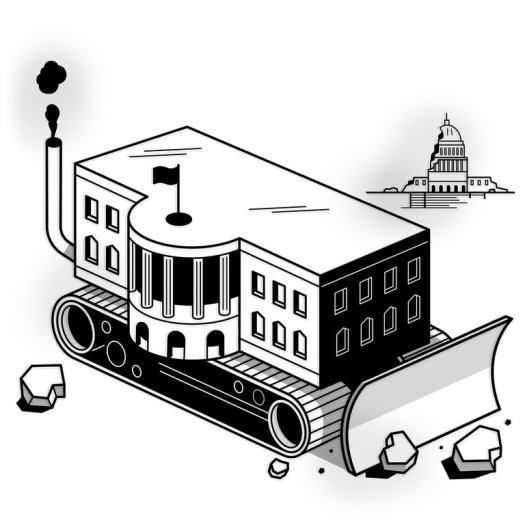
(illustration: Harry Campbell / The New York Times)
By John Yoo / The New York Times
February 6, 2017
As an official in the Justice Department, I followed in Hamilton’s footsteps, advising that President George W. Bush could take vigorous, perhaps extreme, measures to protect the nation after the Sept. 11 attacks, including invading Afghanistan, opening the Guantánamo detention center and conducting military trials and enhanced interrogation of terrorist leaders. . . . But even I have grave concerns about Mr. Trump’s uses of presidential power.
Faced with President Trump’s executive orders suspending immigration from several Muslim nations and ordering the building of a border wall, and his threats to terminate the North American Free Trade Agreement, even Alexander Hamilton, our nation’s most ardent proponent of executive power, would be worried by now.
Article II of the Constitution vests the president with “the executive power,” but does not define it. Most of the Constitution instead limits that power, as with the president’s duty “to take care that the laws are faithfully executed,” or divides that power with Congress, as with making treaties or appointing Supreme Court justices.
Hamilton argued that good government and “energy in the executive” went hand in hand. In The Federalist No. 70, he wrote that the framers, to encourage “decision, activity, secrecy and dispatch,” entrusted the executive power in a unified branch headed by a single person, the president.
“I do believe the world faces a serious and growing terrorist threat. But Trump, either by ignorance or malice, is distorting the nature of that threat by targeting very well-vetted immigrants, including legal permanent residents and refugees. He simply does not have a strong national-security case to make against these people, which is why it is reasonable to wonder if he has some ulterior motive for taking such extreme steps against them.” — Evan McMullin, former C.I.A. officer and Republican who ran for President as an independent candidate against Trump
Since September 11, 2001, ninety-four people have been killed in the United States in ten attacks carried out by a total of twelve radical Islamist terrorists. Each of the attackers was either an American citizen or a legal resident. More than half of the ninety-four murders occurred last year, when Omar Mateen, who was born on Long Island, killed forty-nine people at a night club in Orlando.
According to the comprehensive terrorism database maintained by the New America Foundation, since 9/11 there have been three hundred and ninety-six people involved in American terrorism cases, which New America defines as “individuals who are charged with or died engaging in jihadist terrorism or related activities inside the United States, and Americans accused of such activity abroad.” Eighty-three per cent of these individuals were American citizens or permanent residents. (Seventeen per cent were non-residents or had an unknown status.)
And yet, for more than two weeks, President Donald Trump and his top White House aides have been obsessed with highlighting a threat that does not exist: jihadist refugees and immigrants from Iran, Iraq, Libya, Somalia, Sudan, Syria, and Yemen.
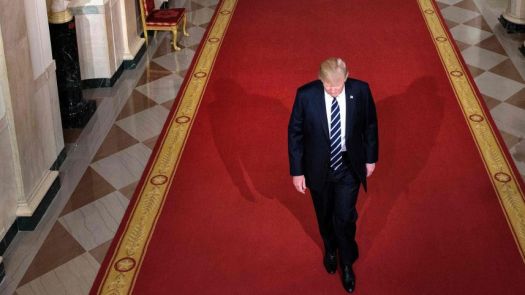
U.S. President Donald Trump walks through the White House on his way to nominate Neil Gorsuch to the Supreme Court, Jan 31, 2017. (photo: Brendan Smialowski / AFP)
It’s an inconceivably scary thought that the Trump administration is simply winging it without a plan. But here’s the even scarier possibility — that there is, in fact, a plan.
“We’re now, I believe, at the beginning stages of a global war against Islamic fascism.” — Steve Bannon, White House Chief Strategist
It’s an inconceivably scary thought that the Trump administration is simply winging it, breakneck, disrupting and detonating and taking America apart — and all of it without a plan.
But here’s the even scarier possibility — that there is, in fact, a plan.
A plan which would dramatically concentrate and expand Donald Trump’s power, inflame and mobilize his base, whip up and and leverage racism, Islamophobia and, at a later stage, if needed, anti-Semitism, in order to slough all shortcomings onto scapegoats.
Outside a home in Avondale Estates, GA, on Monday. (photo: Erik S. Lesser / European Pressphoto Agency)
We Americans should now condemn our own extremist.
By Nicholas Kristof / The New York Times
February 2, 2017
My dream is of the day when Jews protest Islamophobia, Muslims denounce the persecution of Christians and Christians stand against anti-Semitism. That’s why I apologize to Muslims, and it’s why ALL of us, not just Muslims, should stand up to condemn extremism in our midst.
Whenever an extremist in the Muslim world does something crazy, people demand that moderate Muslims step forward to condemn the extremism. So let’s take our own advice: We Americans should now condemn our own extremist.
In that spirit, I hereby apologize to Muslims. The mindlessness and heartlessness of the travel ban should humiliate us, not you. Understand this: President Trump is not America!
I apologize to Nadia Murad, the brave young Yazidi woman from Iraq who was made a sex slave — but since escaping, has campaigned around the world against ISIS and sexual slavery. She has been nominated for a Nobel Peace Prize, yet is now barred from the United States.
I apologize to Edna Adan, a heroic Somali woman who has battled for decades for women’s health and led the fight against female genital mutilation. Edna speaks at American universities, champions girls’ education and defies extremists — and she’s one of those inspiring me to do the same.
Protesters outside the White House on Sunday. (photo: Jim Lo Scalzo / European Pressphoto Agency)
What a difference a week makes.
By Charles M. Blow / The New York Times
January 30, 2017
Trump’s America is not America: not today’s or tomorrow’s, but yesterday’s. Trump’s America is brutal, perverse, regressive, insular and afraid. There is no hope in it; there is no light in it. It is a vast expanse of darkness and desolation.
When Barack Obama was in office — remember the good old days, just over a week ago, when we didn’t wake up every morning and wonder what new atrocity was emanating from the White House — Republicans were apoplectic about his use of executive orders. They called them “unilateral edicts” and “power grabs.” As Iowa Senator Charles Grassley once said in a floor speech: “The president looks more and more like a king that the Constitution was designed to replace.”
What a difference a week makes.
Now many of those Republicans are as quiet as church mice as Donald Trump pumps out executive orders at a fevered pitch, doing exactly what he said he’d do during the campaign, for all of those who were paying attention: advancing a white nationalist agenda and vision of America, whether that be by demonizing blacks in the “inner city,” Mexicans at the border or Muslims from the Middle East.
Trump’s America is not America: not today’s or tomorrow’s, but yesterday’s.
Trump’s America is brutal, perverse, regressive, insular and afraid. There is no hope in it; there is no light in it. It is a vast expanse of darkness and desolation.
President Trump defended his executive order on Twitter, writing that there is “nothing nice about searching for terrorists before they can enter our country.” (photo: Jabin Botsford / The Washington Post)
President Trump fired Acting Attorney General Sally Yates Monday night, after Yates ordered Justice Department lawyers Monday not to defend his immigration ban.
By Matt Zapotosky, Sari Horwitz and Mark Berman / The Washington Post
January 30, 2017
Yates felt she was in an “impossible situation” and had been struggling with what to do about a measure she did not consider lawful. A Justice official confirmed over the weekend that the department’s office of legal counsel had been asked to review the measure to determine if it was “on its face lawful and properly drafted.”
President Trump fired Acting Attorney General Sally Yates Monday night, after Yates ordered Justice Department lawyers Monday not to defend his immigration order temporarily banning entry into the United States for citizens of seven Muslim-majority countries and refugees from around the world.
In a press release, the White House said Yates had “betrayed the Department of Justice by refusing to enforce a legal order designed to protect the citizens of the United States.”
The White House has named Dana Boente, U.S. attorney for the Eastern District of Virginia, as acting attorney general. Boente told The Washington Post that he will agree to enforce the immigration order.
Earlier on Monday, Yates ordered Justice Department not to defend President Trump’s immigration order temporarily banning entry into the United States for citizens of seven Muslim-majority countries and refugees from around the world, declaring in a memo that she is not convinced the order is lawful.
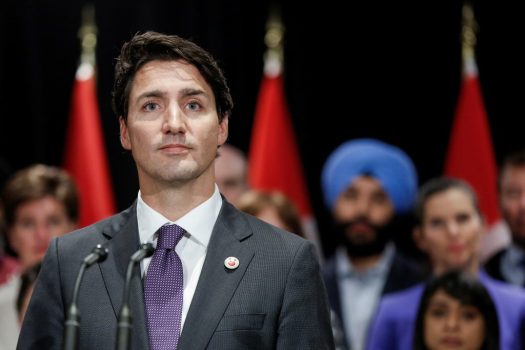
Canada’s Prime Minister Justin Trudeau (photo: Chris Bolin / Reuters)
By Rob Gillies / Associated Press
January 28, 2017
“To those fleeing persecution, terror & war, Canadians will welcome you, regardless of your faith. Diversity is our strength #WelcomeToCanada.” — Justin Trudeau on Twitter
Canadian Prime Minister Justin Trudeau has a message for refugees rejected by U.S. President Donald Trump: Canada will take you.
He also intends to talk to Trump about the success of Canada’s refugee policy.
Trudeau reacted to Trump’s ban of Muslims from certain countries by tweeting Saturday: “To those fleeing persecution, terror & war, Canadians will welcome you, regardless of your faith. Diversity is our strength #WelcomeToCanada.”
Congressman Don Beyer says, “We have a constitutional crisis” over refusal to release travellers from Muslim-majority countries after judge grants temporary stay.
“We continue to face border patrol’s noncompliance and chaos at airports around the country,” said Marielena Hincapie, director of the National Immigration Law Center. Officials, she said, were “Kafkaesque” in their confused responses, adding that Trump’s order “has already caused irrevocable harm, it has already caused chaos.”
Customs and Border Protection (CBP) agents defied the orders of federal judges regarding Donald Trump’s travel bans on Sunday, according to members of Congress and attorneys who rallied protests around the country in support of detained refugees and travellers from seven Muslim-majority countries.
On Sunday afternoon, four Democratic members of the House of Representatives arrived at Dulles airport in Virginia on word that people had been detained and denied access to lawyers.
“We have a constitutional crisis today,” representative Don Beyer wrote on Twitter. “Four members of Congress asked CBP officials to enforce a federal court order and were turned away.”
There should be nothing surprising about what Donald Trump has done in his first week — but he has underestimated the resilience of Americans and their institutions.
Some Americans can fight abuses of power and disastrous policies directly — in courts, in congressional offices, in the press. But all can dedicate themselves to restoring the qualities upon which this republic, like all republics depends: on reverence for the truth; on a sober patriotism grounded in duty, moderation, respect for law, commitment to tradition, knowledge of our history, and open-mindedness.
I am not surprised by President Donald Trump’s antics this week. Not by the big splashy pronouncements such as announcing a wall that he would force Mexico to pay for, even as the Mexican foreign minister held talks with American officials in Washington. Not by the quiet, but no less dangerous bureaucratic orders, such as kicking the chairman of the Joint Chiefs of Staff out of meetings of the Principals’ Committee, the senior foreign-policy decision-making group below the president, while inserting his chief ideologist, Steve Bannon, into them. Many conservative foreign-policy and national-security experts saw the dangers last spring and summer, which is why we signed letters denouncing not Trump’s policies but his temperament; not his program but his character.
We were right. And friends who urged us to tone it down, to make our peace with him, to stop saying as loudly as we could “this is abnormal,” to accommodate him, to show loyalty to the Republican Party, to think that he and his advisers could be tamed, were wrong. In an epic week beginning with a dark and divisive inaugural speech, extraordinary attacks on a free press, a visit to the CIA that dishonored a monument to anonymous heroes who paid the ultimate price, and now an attempt to ban selected groups of Muslims (including interpreters who served with our forces in Iraq and those with green cards, though not those from countries with Trump hotels, or from really indispensable states like Saudi Arabia), he has lived down to expectations.






 HolyLandJustice.org
You must be logged in to post a comment.