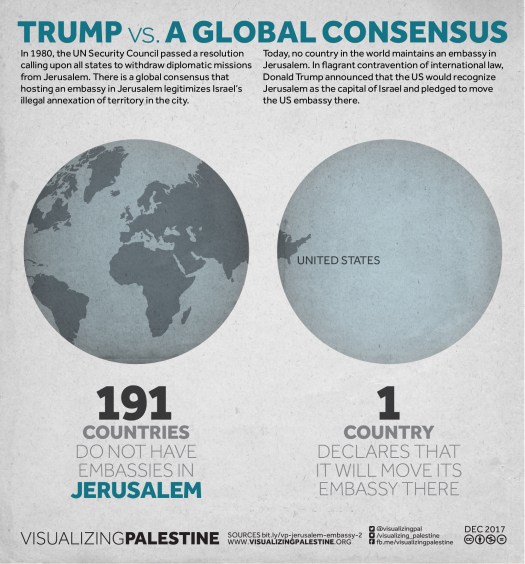
Abbas Calls Oslo Accords Dead

15abbas-master768
President Mahmoud Abbas of the Palestinian Authority, second from right, addressing the Palestinian Central Council in the West Bank city of Ramallah on Sunday. (photo: Majdi Mohammed / Associated Press)

Palestinian Authority leader vows to reject any American role in peace talks.

By David Halbfiner | The New York Times | Jan 14, 2018


“The deal of the century is the slap of the century.”
— Palestinian Authority president Mahmoud Abbas


President Mahmoud Abbas of the Palestinian Authority said on Sunday that Israel had killed the Oslo Accords and angrily assailed the Trump administration over its handling of the conflict. He vowed to reject American leadership of any peace talks and urged Palestinians to reconsider their signed agreements with Israel.

“We will not accept for the U.S. to be a mediator, because after what they have done to us — a believer shall not be stung twice in the same place,” Mr. Abbas said.

“The deal of the century is the slap of the century,” he added, mocking the still-undefined peace initiative that the Trump administration has been working on and promoting in the region. “However, we’ll get back at them.”

Mr. Abbas, 82, stopped well short of embracing an alternative to a two-state solution, the project around which he has built his career. The number of Israelis and Palestinians who hold out hope that such a solution can be achieved is dwindling, but Mr. Abbas said nothing about abandoning it.
Continue reading “Abbas Calls Oslo Accords Dead”

Emboldened by Trump, Israelis try redrawing Jerusalem’s boundaries

israel_likud_party_53721-6c7b5
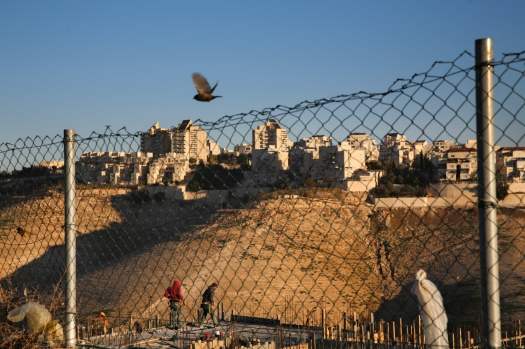
Palestinian laborers work at a construction site in a new housing project in the Israeli settlement of Maale Adumim, near Jerusalem, in Feb 2017. (photo: Oded Balilty / AP)

Israeli leaders are re-engineering Jerusalem’s demographic balance by redrawing the city’s map to exclude Arab neighborhoods and include Israeli settlements.

By Loveday Morris and Ruth Eglash | The Washington Post | Jan 12, 2018


The director of Israeli human rights group B’Tselem [says] there is a battle underway between those who want to continue “smart occupation,” which manages to “fly two inches below international outrage” while incrementally shifting facts on the ground, and those who advocate “dumb occupation” — moving forward with formal annexation.


Since becoming mayor of Maale Adumim more than 20 years ago, Benny Kashriel has doggedly campaigned for his community to be recognized as part of Israel.

Now, with President Trump in the White House, Kashriel thinks it may just happen.

His settlement is around four miles east of Jerusalem in the occupied West Bank. Most of the international community, including the United States, considers its construction to be illegal, built on land captured during the 1967 war.

Still, it has steadily grown from what began as a cluster of prefabricated buildings erected by 23 families in the 1970s into a burgeoning satellite city of Jerusalem. Palm trees line the wide roads of what looks like a Florida suburb. Red-roofed houses and high-rises are home to 42,000 people, who are served by all of the accoutrements of a modern city: schools, restaurants, cafes and a shopping mall.

Continue reading “Emboldened by Trump, Israelis try redrawing Jerusalem’s boundaries”

As the 2-State solution loses steam, a 1-state plan gains traction

merlin_130961651_7b205757-0f5f-4e40-b83d-1ed666aad56e-superjumbo
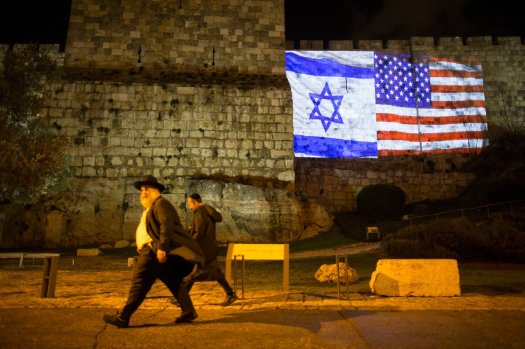
Israeli and American flags were projected on the walls of the Old City of Jerusalem last month just before President Trump recognized Jerusalem as Israel’s capital. (photo: Uriel Sinai / The New York Times)

Absorbing the nearly three million Palestinians on the West Bank would either spell the end of a Jewish state or destroy Israeli democracy if Palestinians were denied equal rights.

By David Halbfinger | The New York Times | Jan 5, 2018

“If the two-state solution dies, it will be the responsibility of Israel, not the Palestinians. But if the Israelis kill it, which they’re in the process of doing now, unfortunately with the help of Trump’s administration, then the only option will be for us to fight the apartheid system and bring it down, which means one state with equal rights for everybody.”
— Mustafa Barghouti, a physician who sits on the P.L.O.’s central council


The Israeli right, emboldened by President Trump’s recognition of Jerusalem as Israel’s capital, is not the only faction arguing for a single state between the Jordan River and the Mediterranean Sea.

The Palestine Liberation Organization has also begun to ask whether that might not be such a bad idea, though it has a radically different view of what that state would look like.

As momentum ebbs for a two-state solution to the Israeli-Palestinian conflict, both sides are taking another look at the one-state idea. But that solution has long been problematic for both sides.

For the Israelis, absorbing three million West Bank Palestinians means either giving up on democracy or accepting the end of the Jewish state. The Palestinians, unwilling to live under apartheid-like conditions or military occupation, have also seen two states as their best hope.

Now, for the first time since it declared its support for a Palestinian state side-by-side with Israel in 1988, the P.L.O. is seriously debating whether to embrace fallback options, including the pursuit of a single state.

Continue reading “As the 2-State solution loses steam, a 1-state plan gains traction”

Tapes reveal Egyptian leaders’ tacit acceptance of Jerusalem move

merlin_131695367_2ba55a6a-c40d-4fa3-b1e0-42e8985d5470-master675
As Palestinian protesters clashed with Israeli soldiers in the West Bank, an Egyptian intelligence officer was quietly working to persuade Egyptians to accept the decision. (photo: Shadi Hatem / European Pressphoto Agency)

Arab governments publicly condemned President Trump’s statement on Jerusalem but criticism in state-owned and pro-government media across the Arab world was muted.

By David D. Kirkpatrick | The New York Times | Jan 6, 2018


“How is Jerusalem different from Ramallah, really?”
— Egyptian intelligence officer Capt. Ashraf al-Kholi


As President Trump moved last month to recognize Jerusalem as the capital of Israel, an Egyptian intelligence officer quietly placed phone calls to the hosts of several influential talk shows in Egypt.

“Like all our Arab brothers,” Egypt would denounce the decision in public, the officer, Capt. Ashraf al-Kholi, told the hosts.

But strife with Israel was not in Egypt’s national interest, Captain Kholi said. He told the hosts that instead of condemning the decision, they should persuade their viewers to accept it. Palestinians, he suggested, should content themselves with the dreary West Bank town that currently houses the Palestinian Authority, Ramallah.

Continue reading “Tapes reveal Egyptian leaders’ tacit acceptance of Jerusalem move”

Israelis voice warnings, Palestinians talk of “blackmail” in wake of tweets by Trump

2018-01-02t230211z_793218804_rc1ccbf5a650_rtrmadp_3_usa-trump-israel-palestinians-2487
President Trump formally recognizes Jerusalem as the capital of Israel in an address from the White House on Dec 6, 2017. (photo: Kevin Lamarque / Reuters)

Cutting US aid would simultaneously weaken the Palestinian Authority, jeopardize Israeli security, and reduce the ability of the US to broker the peace process.

By Loveday Morris and Ruth Eglash | The Washington Post | Jan 3, 2018


“Cutting aid to the Palestinians at this stage would have the opposite effect to what the Americans want. . . . The situation in Gaza is terrible. If America cuts its aid, it would be catastrophic.”
— Moshe Maoz, an Israeli professor of Islamic and Middle Eastern studies at the Hebrew University of Jerusalem

“Traditionally, the Israeli defense establishment has resisted pressure by Israeli hawks who want to shut down UNRWA funding. They say, if it’s not UNRWA, then education will be provided by Hamas.”
— Ofer Zalzberg, a senior analyst at the International Crisis Group


President Trump’s threat to cut aid to the Palestinians has the potential to backfire, Israeli security officials and analysts warned Wednesday, saying it could weaken a Palestinian leadership that cooperates with Israel on security matters and fuel extremism by worsening already dire humanitarian conditions.

Palestinian officials accused the United States of using bullying tactics after both Trump and U.N. Ambassador Nikki Haley indicated that the administration may cut funding to the Palestinians if they do not enter into peace talks with Israel. Palestinians “will not be blackmailed,” said Hanan Ashrawi, a member of the Palestine Liberation Organization’s executive committee.

Continue reading “Israelis voice warnings, Palestinians talk of “blackmail” in wake of tweets by Trump”

Trump’s plan to move US embassy to Jerusalem angers Middle East Christians

2017-12-13t182717z_179724779_rc1be779c0b0_rtrmadp_3_usa-trump-israel
Christians in Amman, Jordan, protest President Trump’s recognition of Jerusalem as Israel’s capital on Dec 13, 2017. (photo: Muhammad Hamed / Reuters)

Religious leaders turned off Bethlehem’s Christmas tree lights to protest the White House announcement.

By Loveday Morris | The Washington Post | Dec 13, 2017


“When they talk about Christian minorities in danger, they talk about Iraq and other regions where ISIS is the threat. They never, ever address the issue of Palestinian Christians under Israeli occupation. . . . Our mere existence as Christians here is inconvenient as it means this conflict can’t be framed as a religious war between Jews and Muslims. It’s not about religion. It’s a political conflict over land and resources.”
— Rev. Mitri Raheb, a Lutheran pastor in Bethlehem


Some of the festive cheer was missing this weekend at a public Christmas tree lighting near the site where Christians believe an angel proclaimed Christ’s birth to local shepherds.

“Our oppressors have decided to deprive us from the joy of Christmas,” Patriarch Michel Sabbah, the former archbishop and Latin patriarch of Jerusalem, told the crowd in the town of Beit Sahour in the Israeli-occupied West Bank. “Mr. Trump told us clearly Jerusalem is not yours.”

The Trump administration’s decision to recognize Jerusalem as Israel’s capital and move the U.S. Embassy there has provoked widespread opposition among Christians across the Middle East. When Vice President Pence arrives next week on a trip touted as a chance to check on the region’s persecuted Christians, he will be facing an awkward backlash.

Continue reading “Trump’s plan to move US embassy to Jerusalem angers Middle East Christians”

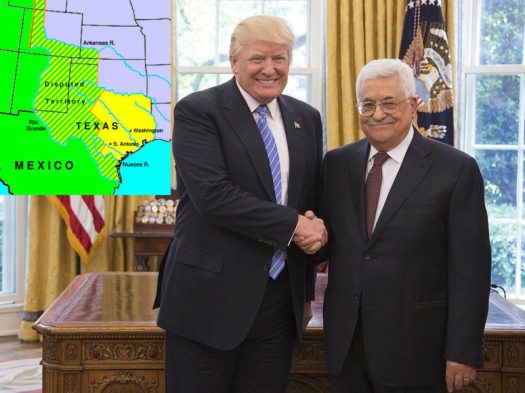
Palestinians recognize Texas as part of Mexico

trump-and-abbas-800x600

By Alex Huntley | The Beaverton | Dec 6, 2017


The Palestinian consulate in Mexico City will soon be moved to Houston to formally recognize the seized territory as part of Mexico.


In response to US President Donald Trump’s recognition of Jerusalem as the Israeli capital, the Palestinian National Authority has announced that it will recognize Texas as a state of Mexico since it was violently annexed by the United States in the 1840’s.

“The territory north and east of the Rio Grande is very important to the Mexican people,” explained a PNA spokesperson. “Before American settlers showed up and implemented slavery, Mexico oversaw this land. Then, President Polk sent his armies to invade the rest of these Mexican territories, and force the country to give up California, New Mexico, most of Arizona, Nevada, and Utah, and parts of Wyoming and Colorado. We may soon recognize these states as part of Mexico, too.”

Palestinian President Mahmoud Abbas says that this is a new approach to Mexican-US relations, and hopes it will help ease the tension between the two countries over security and immigration.

Continue reading “Palestinians recognize Texas as part of Mexico”

Did Trump kill off a two-state solution?

08two-state-print-master768
Palestinians demonstrating in Jerusalem, Dec 7, 2017. (photo: Uriel Sinai / The New York Times)

A one-state solution may now be the only viable option.

By Mark Lander, David Halbfinger and Isabel Kershner | The New York Times | Dec 7, 2017


“They’ve left us with no option [except a one-state solution],” he said. “This is the reality. We live here. Our struggle should focus on one thing: equal rights.”
— Saeb Erekat, the secretary general of the Palestine Liberation Organization


President Trump, in formally recognizing Jerusalem as the capital of Israel on Wednesday, declared that the United States still supported a two-state solution to settle the conflict between the Israelis and Palestinians, provided it was “agreed to by both sides.”

For the first time in his 26 years as a peacemaker, the chief negotiator for the Palestinians did not agree.

Saeb Erekat, the secretary general of the Palestine Liberation Organization and a steadfast advocate for a Palestinian state, said in an interview on Thursday that Mr. Trump and Prime Minister Benjamin Netanyahu of Israel “have managed to destroy that hope.” He embraced a radical shift in the P.L.O.’s goals — to a single state, but with Palestinians enjoying the same civil rights as Israelis, including the vote.

Continue reading “Did Trump kill off a two-state solution?”