
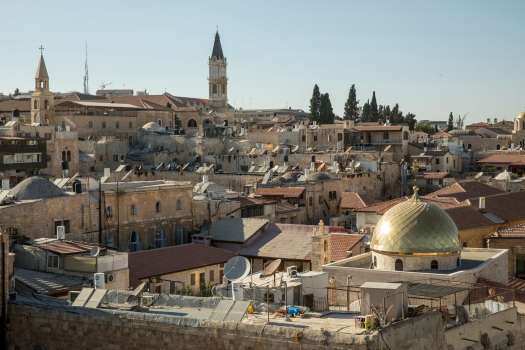
For its Season of Culture, the ancient capital has thrown open its rooftops to encourage residents to see beyond their blinkered boundaries. But the reality is a city where the divides are growing deeper.
By Hannah Ellis-Petersen / The Guardian / Oct 23, 2017
“All three religions are here on this roof. It is a holy place. Sometimes I sit here and I pray to God and I feel that the angels come and sit here with me. Up here it does not matter if you are a Muslim or a Jew: we are all just human beings. Real peace will only come when we remember this. And I’m talking about real peace — not the peace that politicians speak about — and that’s why I open up my house, to bring people together with food.”
— Abu Yehia
The rooftops of Jerusalem can be deceptive. From up here, the domes and towers of the hundreds of churches, mosques and synagogues glimmer on the skyline in what seems like peaceful coexistence; the neighborhoods below come together in a unified sprawl.
But down below, it is a city defined by barriers. They may not be as tangible as the towering security wall that divides Israel and the Palestinian territories a few miles east, but they are just as divisive and inviolable. Living side by side in Jerusalem are communities who exist with no interaction with one another — kept apart by fear, nationalism and religion.
Continue reading ““This land is just dirt”: A rooftop view of Jerusalem”
 HolyLandJustice.org
You must be logged in to post a comment.