Unacceptable and inhumane: A response to Rabbi Jill Jacobs

(photo: giligetz.com)

What will it take for the world to see Gazans as real, living breathing human beings rather than either incorrigible terrorists or simple puppets of Hamas?

By Rabbi Brant Rosen | Shalom Rav | May 25, 2018


In truth, it has been difficult to avoid the abject dehumanization of Gazans by the Israeli government and Israel advocates these past few months. In statement after statement, Palestinians have all but been blamed for their own mass murder.


I continue to be troubled by Rabbi Jill Jacobs’ recent Washington Post op-ed, “How to tell when criticism of Israel is actually anti-Semitism,” and frankly disappointed to witness how warmly it has been received in progressive Jewish circles. In context and content, I find it to be anything but progressive.

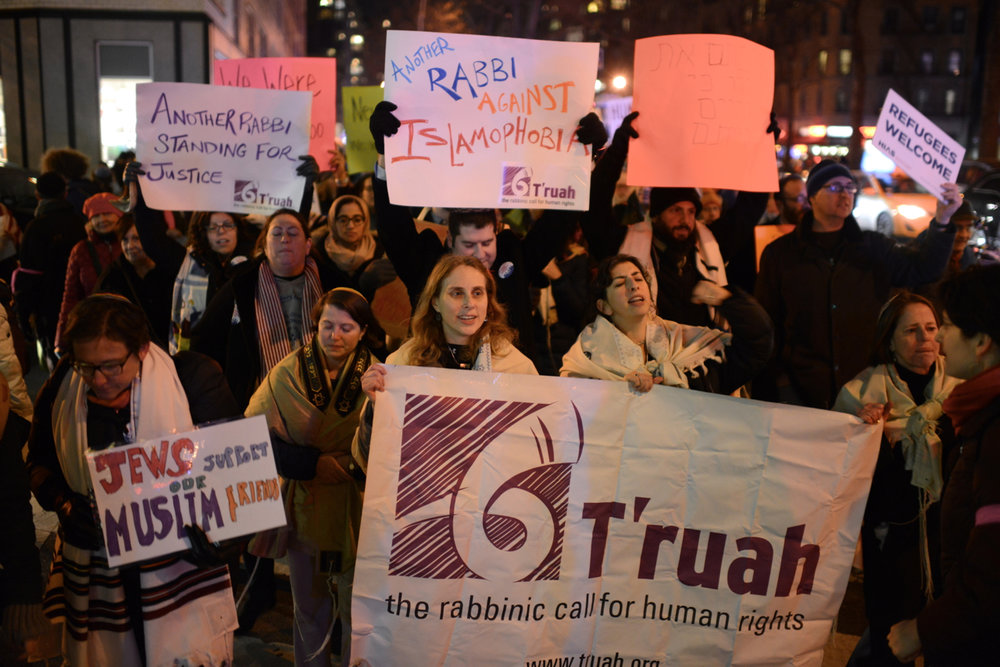
Jacob’s article was written in response to the Israeli military’s killing of over 100 Palestinians in demonstrations in Gaza since March 30, including 14 children, and injured over 3,500 with live fire. Certainly, as the Executive Director of Tru’ah — an American rabbinical organization that seeks to “protect human rights in North America, Israel and the occupied Palestinian territories” — one might have expected her to follow the lead of other human rights organizations and protest (or even call into question) Israel’s excessive use of force.

On the very same day as Jacobs’ op-ed, for instance, Human Rights Watch called for an international inquiry “into this latest bloodshed,” adding that “these staggering casualty levels (were) neither the result of justifiable force nor of isolated abuses; but foreseeable results of senior Israeli officials’ orders on the use of force.” For its part, Amnesty International called Israel’s actions “an abhorrent violation of international law” and Doctors Without Borders termed them “unacceptable and inhuman.”

Continue reading “Unacceptable and inhumane: A response to Rabbi Jill Jacobs”

Quakers, Jews and Israel’s BDS Blacklist

rs11675_evanjonesgaza1949-5812013620
AFSC volunteer Evan Jones meeting with Palestinian refugees, 1949. (photo: AFSC)

[subhead]

By Brant Rosen | Shalom Rav | Jan 11, 2018


“The AFSC helped thousands of people in the United States transfer small amounts of money to loved ones in French concentration camps, [and helped] hundreds of children, including Jewish refugees and the children of Spanish Republicans, come to the United States under the care of the US Committee for the Care of European Children in 1941–42.”
— US Holocaust Memorial Museum


Last Sunday, Israel revealed their list of 20 social justice groups from around the world it was henceforth banning from the country because of their support for the Boycott, Divestment and Sanctions (BDS) movement. For me, the list represented more than just another news item of the day. As staff person for one organization included on the list — the American Friends Service Committee (AFSC) — this news struck home personally as well as professionally

As a rabbi who works for AFSC, I’m proud of the important historical connections between Jewish community and this venerable Quaker organization. As the US Holocaust Memorial Museum itself has noted, AFSC was at the forefront of efforts to help and rescue Jewish refugees after 1938, “assisting individuals and families in need . . . helping people flee Nazi Europe, communicate with loved ones, and adjust to life in the United States.”

Continue reading “Quakers, Jews and Israel’s BDS Blacklist”

God hears the cry of the oppressed: A theology of BDS

right_to_bds_ap_img1
Demonstrators rally in New York City to protest anti-BDS legislation, Jun 9, 2016. (photo: Sipa USA via AP)

Remarks on BDS delivered during a session at the annual conference of the American Academy of Religion.

By Rabbi Brant Rosen | Shalov Rav | Nov 20, 2017

Ed note: On Nov 19, 2017, the American Academy of Religion cancelled a panel discussion on the ethical and theological motivations of BDS after several anti-BDS speakers withdrew from participation at the last moment. The Academy subsequently allowed several papers to be presented “informally,” but without discussion. One of those papers is presented here. Read details of the cancellation here →


Beyond the fears of BDS articulated by so many in the Jewish communal establishment, I think there’s an even deeper fear for many of us in the Jewish community: the prospect of facing the honest truth of Israel’s oppression of Palestinians. . . .

[With BDS], however, a nonviolent call for popular resistance has been placed before us. Thus, for those of us that believe God hears the cry of the oppressed and demands that we do the same, the BDS call represents a direct challenge to our faith. Will we be like God, and hearken to their cries, or will we be like Pharaoh and ignore them?


In my remarks to you today, I’d like to address one of the questions originally presented to the panelists of our session: “What, from your perspective, stands out as a particularly important element of religious ethics and theology that motivates those inspired to take up the cause of Boycott, Divestment and Sanctions?”

For me, this question is profoundly connected to one of the most important theological teachings of Jewish tradition: namely that God hears and hearkens to the cry of the oppressed. This teaching is needless to say, deeply imbedded in the Torah; in Genesis 18:20-21, God says to Abraham:

The outrage of Sodom and Gomorrah is so great, and their sin so grave! I will go down to see whether they have acted altogether according to the outcry that has reached Me. . . .” Later, at the outset of the Exodus story, God says to Moses, “Now the cry of the Israelites has reached Me; moreover I have seen how the Egyptians oppress them.” (Exodus 3:9)

It should be noted that Godly attributes in Jewish tradition are not mere academic concepts — they are nothing short of divine imperatives. God’s ways must be our ways as well.

Continue reading “God hears the cry of the oppressed: A theology of BDS”