Ahed Tamimi sentenced to 8 months in prison

ahed
Ahed Tamimi is seen before her hearing at Ofer Military Court near the West Bank city of Ramallah, Jan 17, 2018. (photo: Oren Ziv / Activestills.org)

The 17-year-old was filmed slapping an Israeli soldier on her patio shortly after her cousin was shot by Israeli soldiers. She has already spent three months in prison.

By +972 Magazine | Mar 21, 2018


In late February, the army arrested Ahed’s cousin Mohammed Tamimi — still awaiting surgery to reconstruct the part of his skull that was removed—in a pre-dawn raid. He was interrogated without a lawyer or a parent present, and released a few hours later after being pressured to confess that his head injury was caused by falling off a bicycle — and not by an Israeli rubber-bullet, fragments of which were extracted from his skull.


Ahed Tamimi, the teenager from Nabi Saleh arrested after a video of her attempting to push two armed Israeli soldiers off of her family’s porch went viral, signed a plea deal in Israeli military court on Wednesday, and will serve eight months in prison including three months time served.

Her mother, Nariman, and cousin, Nur, also signed plea deals. Nariman will serve eight months, and Nur was sentenced to time served.

The now-famous video of Ahed was filmed shortly after Israeli soldiers shot her cousin, Mohammed, in the head with a rubber-coated bullet and fractured his skull. An Israeli military court denied bail to Ahed and her mother, Nariman — the latter charged with incitement for live-streaming the video of Ahed and the soldiers — in January.

Continue reading “Ahed Tamimi sentenced to 8 months in prison”

Israel holding over 300 Palestinian minors in prison

ahed1
16-year-old Ahed Tamimi listens to her lawyer under a guard’s watchful eye before a hearing at Ofer military prison, near the West Bank city of Ramallah, Jan 15, 2018. (photo: Oren Ziv / Activestills.org)

There are hundreds of Palestinian children like Ahed Tamimi, held without bail until the end of their trials.

By Joshua Leifer | +972 Magazine | Jan 21, 2018


“The routine decision, prior to sentencing, to imprison a person who has not been convicted until the end of legal proceedings, in fact empties the legal process of substance.”
— Amit Gilutz, B’Tselem spokesperson


While the case of Ahed Tamimi has garnered international media attention, the Israeli military prison system’s treatment of Ahed and her mother is not unique. Israel Prison Service (IPS) statistics published by Israeli anti-occupation organization B’Tselem earlier in January reveal that Israel is holding over 300 Palestinian minors in prison. Over 180 of those minors are being held in detention until the end of legal proceedings, without having been convicted, like Tamimi.

According to IPS data handed over to B’Tselem, as of the end of November 2017 there were 5,881 Palestinians imprisoned by Israel, of whom 1,775 were being detained until the conclusion of legal proceedings. Over 400 were administrative detainees, including three women and two minors (aged 16 and 18). Administrative detention is a measure Israel uses to detain Palestinians (and some Jews) indefinitely without charge or trial. It is meant to be adopted rarely and with moderation. In practice, however, Israel uses administrative detention as a first, not last, resort.

In total, 2,200 Palestinians were being held in Israeli jails without having been convicted of any crime.

Continue reading “Israel holding over 300 Palestinian minors in prison”

Why the Occupation is No Accident

pappeex2gestureportlock
Ilan Pappé speaking at the conference The Israel Lobby and American Policy in Washington, DC, on March 24, 2017. (photo: Phil Portlock)

The Biggest Prison on Earth: A History of the Occupied Territories by Ilan Pappe, Oneworld Books (2017)

By Rod Such / The Electronic Intifada
September 18, 2017


Everything that followed the 1967 War, notes Pappe, follows the “logic of settler colonialism” and that logic in turn foresees the eventual elimination of the indigenous Palestinians. That outcome, however, is not inevitable. An alternative is possible, Pappe maintains, if Israel decolonizes and makes “way for the logic of human and civil rights.”


As early as 1963 — four years before the 1967 War — the Israeli government was planning the military and administrative takeover of the West Bank, according to The Biggest Prison on Earth, a new book by the Israeli historian Ilan Pappe.

The planning for that operation — codenamed Granit (granite) — took place over a month on the campus of Hebrew University in the Givat Ram neighborhood of western Jerusalem. Israeli military administrators responsible for overseeing Palestinians within Israel joined military legal officials, interior ministry figures and private attorneys to create the judicial and administrative decrees required to rule over the one million Palestinians then living in the West Bank.

These plans were part of a larger strategy for placing the West Bank under military occupation. That strategy was codenamed the Shacham Plan for the Israeli colonel, Mishael Shacham, who authored it, and was formally presented by the Israeli chief of general staff to the army on 1 May 1963.

Continue reading “Why the Occupation is No Accident”

The Longest-Serving Palestinian Prisoner in Israel

1474847845
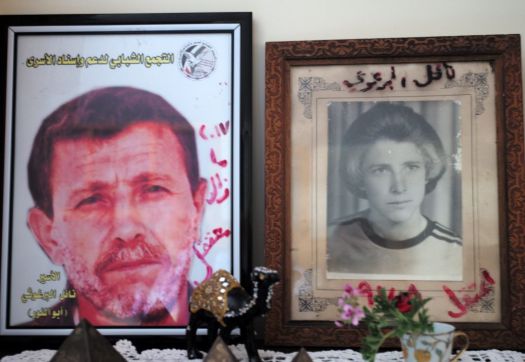
Nael Barghouti as a prisoner in 1993 (right) and as a long-haired youth in 1978. (photo: Alex Levac / Haaretz)

He was released in a prisoner swap after serving 33 years, then sent back in on a technicality.

By Gideon Levy / Haaretz
April 29, 2017


[After being returned to prison,] Nael was sentenced to 30 months in prison for violating the conditions of his release. But when that term ended, he was not set free. Then, two months ago came the astounding news that he would have to complete his life-plus-18-years sentence, originally meted out in 1978.


The three photographs on the chest of drawers at the entrance to the living room tell the whole unbelievable story. The first shot, from 1978, shows a long-haired youth. The second, taken 15 years later, is a portrait of a prisoner between his two aged parents, both of whom lean on canes. It was taken the last time they met. The third is of an elderly man, at the time of his release from prison.

Thirty-nine years separate the first and third images, and Nael Barghouti, the man in all of the photos, spent most of that time incarcerated in an Israeli prison for murdering Mordechai Yakoel, a bus driver, in 1978. There is no longer-serving prisoner than Barghouti, and no crueler arbitrary treatment by the authorities than that demonstrated in his case. Continue reading “The Longest-Serving Palestinian Prisoner in Israel”

New Entry Law Is a Reminder That Palestinians Live in Israel’s Prison

Bethlehem checkpoint
Palestinian workers stand in line next to a portion of the separation wall, waiting to cross through the checkpoint from Bethlehem into Israel. (Miriam Alster / Flash90)

The reality in the West Bank is one that resembles a prison, where Israel controls the law, the security, who can leave, and now who can visit.

By Noam Sheizaf / Local Call via +972 Magazine
March 7, 2017


There is no peace process, nor is there a real discussion over one state or two states. Even discussions on whether Israel is an apartheid state have become intellectual fodder for Jews and leftists. The reality is one that resembles a prison, and the prisoners will continue to be held by force . . . .


The Knesset passed a law Monday night denying entry visas or residency rights to foreign nationals who call for boycotts against Israel or the settlements. The law won’t have much of an effect on entry into Israel proper, but rather will mostly affect those trying to enter the West Bank — a solid reminder that the ban is yet another example of the way Israel holds Palestinians prisoners. After all, one can assume that most people who enter the Palestinian territories oppose the settlements or support some version of the boycott.

Because Israel controls every point of entry into areas under Palestinian control in the West Bank, Palestinians cannot leave (without a permit) or come back (without a permit). With the passage of the law, they are no longer allowed to have visitors. In other words: they are prisoners, and these restrictions are just the tip of the iceberg.

Continue reading “New Entry Law Is a Reminder That Palestinians Live in Israel’s Prison”