Palestinian Women Wage Peace

.
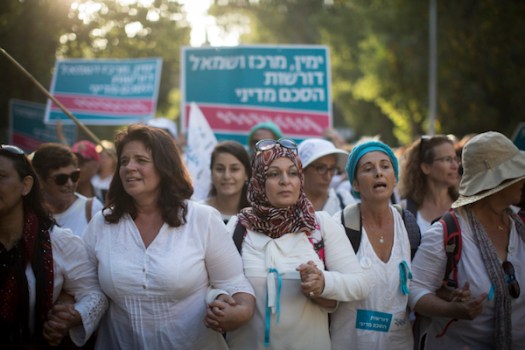
Photo courtesy of Hadas Parush / Flash90

How thousands of Palestinian and Israeli women are waging peace

By Riman Barakat / +972 Blog
October 25, 2016


“The thousands of Palestinian and Israeli women who marched in Jerusalem and Jericho this month are not only demanding peace from their societies, they are reaching through stereotypes and artificial boundaries to find true partners.”


Less than a year ago a group of Palestinian and Israeli women spent a weekend in Tantur, situated between Jerusalem and Bethlehem, brainstorming what we could possibly do to break the cycle of violence and political stagnation. Everyone had their own personal reason for being there, whether it was the Israeli mothers who had to send their children to war or the Palestinian women who were exhausted by the daily incursions of the Israeli army, checkpoints, and the inability to live freely and imagine a hopeful future for their children. Personally, I felt torn apart having seen Jerusalem split into a hundred pieces, a place that should be the inspiration for coexistence instead oozing with the blood of Palestinians and Israelis on a near daily basis. . . .

“We need to think outside of our surroundings,” Lily kept saying, and together we visualized the March of Hope, a march of togetherness — a cry to the whole world, coming from a mother’s womb, to stop the violence. We resolved not to stop, even in the midst of most terrible acts of violence. We met and shouted out, “ Enough! Enough!” in Arabic, Hebrew and English. We resolved to propose a shared language of hope, of humanity, of an unshakable commitment to peace, and we rejected the language of separation.

[Continue reading here . . . ]

.
Photo courtesy of Flash90

Israel’s Jewish Character?

300021720_bbc0fb9249_o
Photo courtesy of Rusty Stewart / CC

If Israel Lets in Palestinian Refugees, Will It Lose Its Jewish Character?

By Joshua Schreier and Mira Sucharov / The Forward
October 17, 2016


“Consider a post-peace Israel where refugee claims have been settled, where the everyday brutality of occupation no longer precludes normalcy, and where the work of truth and reconciliation has begun. While still remaining alert to outside threats, Israel would be able to relax its disproportionate focus on security. After all, war and occupation take a toll on creative expression, while massive defense spending diverts focus from cultural investment.”


We watched with admiration as Hagai El-Ad of B’Tselem and Lara Friedman of Americans for Peace Now appeared recently before the U.N. Security Council to urge action against the Israeli occupation. The session was framed as a discussion of settlements in the context of “peace” and a “two-state solution.” But behind the occupation lurks an even more vexing issue: that of the “right of return” for Palestinian refugees. We feel we need to unpack this issue — and the assumptions about demographics that animate it — if we’re going to make real headway on countering the occupation.

The vast majority of Israelis, even most on the Israeli left, argue that admitting the Palestinian refugees would lead Israel to lose its “Jewish character.” For them, a Jewish-majority state provides the Jewish people with a degree of security and justice. Yet many Palestinians and their increasingly numerous and vocal supporters in North America and Europe see no justice in Israel’s exclusionary policies allowing all Jews, but no Palestinians, to “return” to the country.

Israelis’ anxious focus on ethnic demographics inflicts harm on those within the state as well. An array of discriminatory laws and practices currently marginalize the 20% of Israeli citizens who are Palestinian. These laws and practices not only make it difficult for Palestinian citizens to embrace the state as their own, they also preclude justice, equality and peace.

[Continue reading here . . . ]