President Mahmoud Abbas of the Palestinian Authority, second from right, addressing the Palestinian Central Council in the West Bank city of Ramallah on Sunday. (photo: Majdi Mohammed / Associated Press)
Palestinian Authority leader vows to reject any American role in peace talks.
“The deal of the century is the slap of the century.”
— Palestinian Authority president Mahmoud Abbas
President Mahmoud Abbas of the Palestinian Authority said on Sunday that Israel had killed the Oslo Accords and angrily assailed the Trump administration over its handling of the conflict. He vowed to reject American leadership of any peace talks and urged Palestinians to reconsider their signed agreements with Israel.
“We will not accept for the U.S. to be a mediator, because after what they have done to us — a believer shall not be stung twice in the same place,” Mr. Abbas said.
“The deal of the century is the slap of the century,” he added, mocking the still-undefined peace initiative that the Trump administration has been working on and promoting in the region. “However, we’ll get back at them.”
Mr. Abbas, 82, stopped well short of embracing an alternative to a two-state solution, the project around which he has built his career. The number of Israelis and Palestinians who hold out hope that such a solution can be achieved is dwindling, but Mr. Abbas said nothing about abandoning it.
Without “armed struggle,” the national movement had no clear ideology, no specific discourse, no distinctive experience or character. In the absence of a genuine and independent state, it was unable to transform itself into a ruling party, as, for example, the African National Congress did, in South Africa. It remained incomplete and suspended: a liberation movement not doing much liberating, locked in a fruitless negotiating process, and denied the means of government by a combination of Israeli obduracy and its own inadequacies.
As President Trump prepares for yet another attempt to resolve the Palestinian-Israeli conflict, the ground is shifting under his feet. While Israel’s willingness to offer an acceptable deal is increasingly open to question, with nothing to suggest that its terms are likely to soften with time, the Palestinians are sliding toward the unknown. With the slow but sure decay of the Palestinian political scene, the President of the Palestinian Authority, Mahmoud Abbas (Abu Mazen), represents the last slender chance for a negotiated settlement: he is the sole remaining national leader of his people with sufficient, if dwindling, authority to sign and ratify a deal. For President Trump and his team, as well as for all those seeking to end this century-plus-old conflict, there should be no doubt about the moment’s urgency. After Abbas, there will be no other truly weighty representative and legitimate Palestinian leadership, and no coherent national movement to sustain it for a long time to come.
Over six days in late November and early December, 2016, Fatah, the Palestinian national liberation movement, convened its seventh congress in Ramallah, the de-facto capital of the Palestinian Authority. Despite the lengthy speeches and festive air, the conference did little to dispel what had become unmistakable: the slow expiry of a once vibrant movement. Long on show and short on substance, the meeting hardly touched on any of the mounting political challenges facing the Palestinian people. The Congress was no more than a confirmation of the current order and a reaffirmation of its total and unprecedented control over Fatah, the P.A., and its ostensible parent, the Palestine Liberation Organization.
The contemporary Palestinian national movement — founded and led by Yasser Arafat and embodied by the P.A., Fatah, and the P.L.O. over the past half century — is reaching its end. As its institutions wither and its leaders fade away, there is no obvious successor to take its place.
“Whether it’s a coincidence or it’s connected, I have one thing to say: The Palestinian leadership is afraid of this Hamas moderation. Because the [Palestinian Authority] and Fatah are afraid that by this moderation, Hamas presents itself as the true representation of the Palestinian people.” — Mkhaimar Abusada, political scientist at Al-Azhar University-Gaza
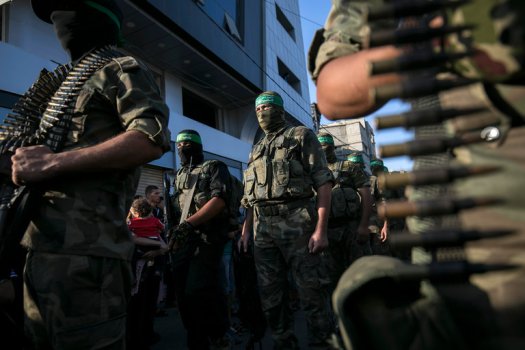
Hamas, the militant group built around violent resistance to Israel, sought on Monday to present a more moderate public face, taking its next shot in an intensifying struggle for leadership of the Palestinian cause and international recognition.
Released by Hamas just days before its chief rival, the Palestinian Authority leader Mahmoud Abbas, was to meet President Trump, a new document of principles for the group calls for closer ties to Egypt, waters down the anti-Semitic language from its charter, and accepts at least a provisional Palestinian state — though it still does not formally recognize Israel.
With its statement, Hamas is trying to offer a more mainstream-friendly version of its vision for the Palestinian cause, and to gain ground against Mr. Abbas, whose influence is growing more tenuous.



 HolyLandJustice.org
You must be logged in to post a comment.