Narendra Modi is visiting the Occupied Territories this week — here’s why Palestinians shouldn’t embrace him

anti-trump-protest-7
Modi will visit Ramallah, where there were mass anti-Trump protests after the US recognized Jerusalem as the capital of Israel. (photo: AFP / Getty)

Many will say Modi’s visit to Ramallah is an historic moment, but India buys 41 per cent of total Israeli arms exports.

By Umar Lateef Misgar | The Independent | Feb 7, 2018


India has gradually become Israel’s largest defense customer. According to the Stockholm International Peace Research Institute (SIPRI), between 2012 and 2016, India bought 41 per cent of total Israeli arms exports.


In an interview on Voice of Palestine radio station recently, Majid Khalidi, an adviser to Palestinian President Mahmoud Abbas, announced the visit of India’s Prime Minister Narendra Modi to the occupied Palestinian territories this weekend. Alongside a tour to Yasser Arafat Museum in Ramallah to honour the late Palestinian leader, the Prime Minister is expected to discuss issues related to information technology, tourism and health during this brief stopover on the broader Middle East tour.

Modi’s upcoming visit to Ramallah, a first for an Indian premier, is being hailed as historic by his Palestinian hosts. However, a closer scrutiny of New Delhi’s ties with Israel along with India’s own record of military control in places like Kashmir reveals an entirely different picture.

Continue reading “Narendra Modi is visiting the Occupied Territories this week — here’s why Palestinians shouldn’t embrace him”

Israel deports 14-year-old girl to Gaza, without telling her parents

erez
An electric cart provides transportation through the 900-meter caged terminal spanning the restricted access zone at the Erez border crossing between Israel and the Gaza Strip, Jul 2, 2012. (photo: Ryan Rodrick Beiler / Activestills.org)

Ghada had spent her entire life in the West Bank, yet somehow found herself deported to the Gaza Strip after being arrested by Border Police officers.

By Edo Konrad | +972 Magazine | Jan 31, 2018


“It should be noted that the girl and her father are illegal immigrants in Israel, and therefore she was sent to Erez Crossing . . . entered the Gaza Strip.”
— Israel Prison Service statement


Israeli authorities deported a 14-year-old epileptic Palestinian girl from the West Bank to the Gaza Strip earlier this month, without notifying her parents, and despite the fact that she has never lived there a day in her life.

Ghada, who was born in Ramallah where she has lived much of her life, was arrested by Israeli Border Police officers on January 13 for being in Jerusalem without a military permit. She was traveling back to her home in a-Ram, just northeast of Jerusalem where she lives with her mother and siblings, from her aunt’s home in the East Jerusalem neighborhood of Issawiya.

Her father, though originally from the Gaza Strip, currently lives in the West Bank as well, her mother told Israeli human rights group HaMoked, which is representing the family. When Ghada was born, Israeli authorities listed her address as Gaza for an unknown reason.

Continue reading “Israel deports 14-year-old girl to Gaza, without telling her parents”

As long as occupation exists, soldiers will continue to speak out

.
Palestinians clash with Israeli soldiers in Al-Fawwar refugee camp, south of the West Bank city of Hebron, Dec 31, 2017. (photo: Wisam Hashlamoun / Flash90)

We must make our voices heard sharply and clearly — speaking out is not merely an option, it is a moral duty.

By Avner Gvaryahu | +972 Blog | Jan 26, 2018


It [is] important to remind the Israeli public why soldiers continue to break their silence. After all, the central reason for breaking the silence is the occupation. As long as there is an occupation, there will be those who choose to expose what the government is trying so hard to hide.


Like many who served alongside me, I preferred to remain silent. I preferred to forget, not to speak about the Palestinian homes I broke into in the middle of the night, forgetting the violence I carried out at checkpoints and the passivity required of me when settlers freely broke the law. When I was released from the army, I preferred to repress those three years, to put them behind me.

Only after I joined a Breaking the Silence tour to the South Hebron Hills did my eyes open. Only then, I chose to speak. That is how I learned that I wasn’t alone. I learned there are others like me — soldiers who see the situation the same way and choose to take responsibility and change the way they and their society, our society, talk about the occupation.

Continue reading “As long as occupation exists, soldiers will continue to speak out”

One state or two states? You’re asking the wrong question

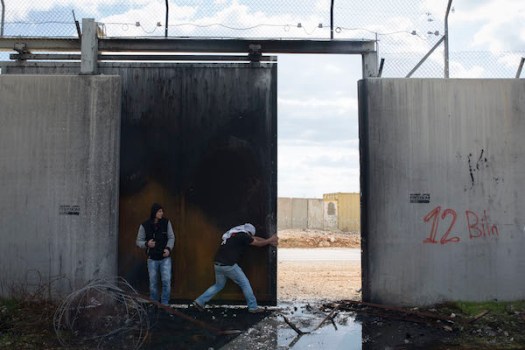
Protest marking 12 years for the struggle against the wall, Bil
A Palestinian youth opens a gate in the Israeli wall, during a protest marking 12 years for the struggle against the wall and the occupation in the West Bank village of Bil’in, Feb 17, 2017.

We desperately need to go back to basics and recognize that guaranteeing Palestinians’ rights is the foundation for any political solution.

By Haggai Matar | +972 Magazine | Jan 29, 2018


During a recent trip to the US . . . I found devoted activists, all of them committed to resisting occupation and supporting peace . . . who refused to speak to each other solely based on the question of how many states we should have in this piece of land. I suggest that we hold off on that question and focus on the heart of the matter.


A new poll reveals that following Trump’s Jerusalem declaration there has been a drop in support for the two-state solution among both Israeli Jews and Palestinians in the occupied territories — with both communities dipping below the 50 percent level. Only Palestinians with Israeli citizenship who live inside the Green Line show overwhelming support for this solution.

The poll also shows that in tandem with this ongoing downward shift, there is a significant rise in the hostility of each group toward the other, as well as increasing support for armed struggle or a “decisive war” as a solution to the conflict. Conducted by veteran pollsters Dr. Khalil Shikaki and Walid Ladadwa from the Palestinian Center for Policy and Survey Research (PSR), along with Israeli pollster and +972 Magazine writer Dr. Dahlia Scheindlin and the Tami Steinmetz Center for Peace Research (TSC) — this is a poll to be taken seriously.

These new findings have significant value, as they expose Trump’s devastating impact on the chance to end the occupation in the foreseeable future, while sounding the alarm bells over the hopelessness of both sides, such that violence and bloodshed are actually gaining traction as possible solutions to our troubles.

And yet, we must not view the poll results as a harbinger of “the end of the two-state solution” or “final proof that one state is the only way to go.” One state? Two states? You’re asking the wrong question.

Continue reading “One state or two states? You’re asking the wrong question”

What I learned about UN aid to Palestinians growing up in Gaza

gettyimages-860514962-15166456701

UNRWA schools provide a generous hand to overcome the tribulations of life in the beleaguered Gaza Strip, encouraging students to dream big despite the obstacles around them.

By Muhammad Shehada | Forward | Jan 22, 2018


Each semester, UNRWA supplied free medical glasses to shortsighted students and ran periodic medical and dental examinations; they also provided vaccinations to all students. For many years, UNRWA provided students with healthy meals on a daily basis, handing out fruit, sandwiches, milk and homemade pastries that employed thousands of people in a project funded by Mercy USA. These meals helped many poor students, who had no food at home, to focus better; a few children wouldn’t eat these meals, but would hold on to them, taking them home to share with their starving families.


Last week, the US announced its decision to start defunding UNRWA, the United Nations Reliefs and Works Agency. If defunded, an immediate catastrophe will surely follow.

UNRWA, which provides aid to Palestinians through a combination of food, schools, medical and other services, means life to more than two thirds of Gaza’s two million residents — as it did for me. I grew up studying in UNRWA schools.

I can still clearly remember the happiness and excitement in my late father’s eyes on my first day of school, the same UNRWA school where he studied himself as a child. He put me in his old classroom, and even sat me down in the same old wooden bench were he sat 30 years before. I remember so clearly the dream in his eyes, that I’d be as successful in life as he was.

Continue reading “What I learned about UN aid to Palestinians growing up in Gaza”

Why the Palestinians are boycotting the Trump administration

wright-husam-zomlot
Husam Zomlot, the Palestinian Authority’s Ambassador in Washington, Dec 2017. (photo: Andrew Harnik / AP)

An interview with Husam Zomlot, the Palestinian Authority ambassador to Washington.

By Robin Wright | The New Yorker | Jan 21, 2018


“You didn’t take Jerusalem off the table. You took the table altogether.”


Husam Zomlot is the Palestinian front man in Washington. Born in a Gaza refugee camp, he has a doctorate in economics from the University of London and was a research fellow at Harvard’s Belfer Center. Now in his mid-forties, he represents a new generation of Palestinian politicians.

Last spring, he arrived in the United States on a wave of optimism that President Trump would reinvigorate peace negotiations, led by his adviser and son-in-law, Jared Kushner. Zomlot had unusual diplomatic access to Kushner and others in the White House.

But relations between the United States and the Palestinian Authority plummeted to their lowest point in a quarter century — since the historic Oslo Accord, in 1993 — after Trump’s decision, on December 6th, to recognize Jerusalem as Israel’s capital and move the U.S. Embassy there.

The announcement enraged the octogenarian Palestinian President, Mahmoud Abbas, who declared that Washington was no longer an honest broker of peace. Abbas is refusing to see Vice-President Mike Pence during his visit to Israel on Sunday, Monday, and Tuesday.

On the eve of Pence’s trip, Zomlot reflected on the state of diplomacy. The interview has been edited and condensed for length.

Continue reading “Why the Palestinians are boycotting the Trump administration”

Holy city of sterile streets

merlin_116869667_adb6540b-1ee6-48c3-ad08-7d30ed597c2c-master768
An Israeli soldier on a street that separates an Israeli settlement and a Palestinian neighborhood in the West Bank city of Hebron. (photo: Chris McGrath / Getty Images)

To settlers, this is the first Jewish city in the biblical hills of Judea; to the Palestinian majority, this is their centuries-old home under relentless military occupation.

By Roger Cohen | The New York Times | Jan 20, 2018


“You are treating families in a way you would not want your own family to be treated. It’s as simple as that.”
— Anonymous IDF soldier


The Israeli soldier stands at the entrance to Shuhada Street. The street is deserted, its stores shuttered, doors welded shut. The old center of Hebron has been a ghost town for many years. The Israel Defense Forces refer to “tzir sterili,” or sterile roads, because no Palestinian is allowed on them, whether in a car or on foot.

The occupation of the West Bank is a half-century old. That’s a long time. Jews did not go to the Holy Land to deploy for another people the biological metaphors of classic racism that accompanied their persecution over centuries. But the exercise of overwhelming power is corrupting, to the point that “sterile” streets, presumably freed of disease-ridden natives, enter the lexicon.

The soldier at the checkpoint is a young man with a ready smile. He tells me he’s visited New York. He asks where I bought my watch. I ask him what he’s done to merit the punishment of Hebron. He laughs, a little uneasily. He’s clearly uncomfortable with his mission, enforcing segregation, and wants to connect. No doubt he’d rather be on the beach in Tel Aviv enjoying a beer.

Continue reading “Holy city of sterile streets”

US to open Jerusalem embassy in 2019

Pence
Vice President Pence in Cairo, Jan 20, 2018. (photo: Getty Images)

Pence announces plans to accelerate the move in a speech to the Israeli Knesset.

By Oliver Holmes | The Guardian | Jan 22, 2018


Q&A: What will US recognition of Jerusalem mean for the peace process?

The peace process has been at death’s door since the former secretary of state John Kerry’s peace mission ended in failure in 2014. But the international community — apart from the US — is united in saying recognition of Jerusalem as the capital of Israel is disastrous for any hopes of reviving meaningful talks. The status of Jerusalem is one of the pivotal issues that diplomats and peacemakers have said must be agreed between the two parties in negotiations.

Palestinians will see Trump’s announcement as the end of their hopes and demands for East Jerusalem as a capital of a future independent state. While few want a return to violence, many will feel diplomatic efforts have got them no closer to a state of their own.

The Israeli government will be thrilled. Ever since it captured (and later annexed) East Jerusalem in the 1967 six-day war, Israel has claimed the city as its “eternal and undivided” capital, and has longed for international recognition. Some 200,000 Israelis living in illegal settlements will also celebrate.


The US will open its embassy in Jerusalem by the end of 2019, ahead of schedule, the vice-president, Mike Pence, has said. Arab-Israeli politicians were ejected from the Knesset at the start of Pence’s speech for heckling.

“In the weeks ahead, our administration will advance its plan to open the US embassy in Jerusalem – and that United States embassy will open before the end of next year,” he said in a speech to roaring applause in the Israeli Knesset.

Speaking during a two-day visit, Pence said Donald Trump had “righted a 70-year wrong” by recognizing Jerusalem as the capital of Israel.

Continue reading “US to open Jerusalem embassy in 2019”

Israel holding over 300 Palestinian minors in prison

ahed1
16-year-old Ahed Tamimi listens to her lawyer under a guard’s watchful eye before a hearing at Ofer military prison, near the West Bank city of Ramallah, Jan 15, 2018. (photo: Oren Ziv / Activestills.org)

There are hundreds of Palestinian children like Ahed Tamimi, held without bail until the end of their trials.

By Joshua Leifer | +972 Magazine | Jan 21, 2018


“The routine decision, prior to sentencing, to imprison a person who has not been convicted until the end of legal proceedings, in fact empties the legal process of substance.”
— Amit Gilutz, B’Tselem spokesperson


While the case of Ahed Tamimi has garnered international media attention, the Israeli military prison system’s treatment of Ahed and her mother is not unique. Israel Prison Service (IPS) statistics published by Israeli anti-occupation organization B’Tselem earlier in January reveal that Israel is holding over 300 Palestinian minors in prison. Over 180 of those minors are being held in detention until the end of legal proceedings, without having been convicted, like Tamimi.

According to IPS data handed over to B’Tselem, as of the end of November 2017 there were 5,881 Palestinians imprisoned by Israel, of whom 1,775 were being detained until the conclusion of legal proceedings. Over 400 were administrative detainees, including three women and two minors (aged 16 and 18). Administrative detention is a measure Israel uses to detain Palestinians (and some Jews) indefinitely without charge or trial. It is meant to be adopted rarely and with moderation. In practice, however, Israel uses administrative detention as a first, not last, resort.

In total, 2,200 Palestinians were being held in Israeli jails without having been convicted of any crime.

Continue reading “Israel holding over 300 Palestinian minors in prison”

Ahed Tamimi and her mother to remain in prison

ahed
Ahed Tamimi is seen before her hearing at Ofer Military Court near the West Bank city of Ramallah, Jan 17, 2018. (photo: Oren Ziv / Activestills.org)

The 16-year-old Palestinian girl was arrested for slapping an Israeli soldier who had come to the family home after shooting a cousin. Her mother was arrested after going to the police station to check on her daughter.

By Oren Ziv | +972 Magazine | Jan 17, 2018


“I don’t trust this court, [the Israeli military court where the Tamimis are being tried], I don’t trust this legal system, all of which is built to punish the Palestinians. My sister [was] killed inside one of these courts in 1993. My daughter and wife are in the hands of my enemy.”
— Bassam Tamimi, Ahed’s father


An Israeli military appeals court on Wednesday denied bail to Ahed Tamimi, the Palestinian girl who was filmed slapping an Israeli soldier at the entrance to her home, and her mother Nariman, ordering them held in prison until the conclusion of their respective trials.

Tamimi is charged with five counts of assaulting security forces, as well as with incitement. Her mother is accused of incitement via social media.

Military Judge Haim Baliti rejected most of the arguments put forth by Attorney Gaby Lasky, who is representing both Ahed and Nariman. In a hearing on Monday, Lasky had challenged the military prosecution’s assertion that both Ahed and Nariman posed a danger to the security of the area, questioned why Ahed was subject to a different legal system than Israeli minors in the West Bank, and called the arrests politically motivated.

Continue reading “Ahed Tamimi and her mother to remain in prison”