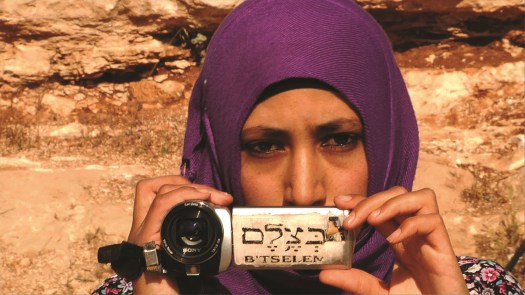
Film: In the Image (Friday)

amneh

Pushing for Change: Mideast Focus Ministry Film Series V

This film explores the daily lives of Palestinian women living in the West Bank. It portrays their stories in a novel and eye-opening manner through footage captured by the women themselves. Their courage is inspiring as they persist in working for change — and to pave the way for future peace in the region.

Date: Friday, Apr 13, 2018
Time: 7:00 – 9:00 pm
Location: Bloedel Hall
St. Mark’s Cathedral
1245 10th Ave E
Seattle, WA  98102
Information: Event website
Admission: Free

Event Details

Our concern is to help balance the limited and confusing media coverage of the Holy Land. We use compelling films as an entry point for reflection and discussion. As Christians, we respond to Christ’s call to seek justice and love the oppressed. As Americans, we ask: Can we reconcile this calling with our government’s massive financial support of Israeli military operations? We hope the time will come when Jews, Muslims and Christians will again come together in harmony in the Holy Land.

In this series, we see how people pushed to bring about a safe country for the Jewish people, and how today others are still push- ing for safety and change. Do our efforts for change lead to peace and justice . . . or not?
More information here →

Israel’s Gaza nightmare

rtx5f45p-870
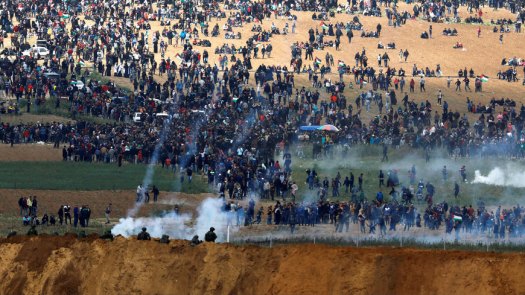
Israeli soldiers shoot tear gas from the Israeli side of the Israel-Gaza border as Palestinians protest in Gaza, Mar 30, 2018. (photo: Amir Cohen / Reuters)

The Israel Defense Forces consider “only” 16 casualties a “very significant achievement.”

By Ben Caspit | Al-Monitor | Apr 2, 2018


“Just imagine what could have happened. Picture the outcome if they would have burst through the fence, even at a single point, and begun marching into Israel. It would have ended in a bloodbath. . . . We would have no choice but to employ enormous force, and that would have resulted in dozens, if not hundreds, of casualties. The images would have been a huge victory for the Palestinians.”
— Senior Israeli defense official, speaking anonymously


The March 30 Great March of Return to the Gaza border fence was nothing more than Act 1 of an unfolding drama, a dress rehearsal or possibly a pilot for what one can expect to see in the very near future. The Israel Defense Forces (IDF) are now preparing for April 17, Palestinian Prisoners Day, also the eve of Israel’s Memorial Day for Fallen Soldiers, and for May 15, Nakba Day, also the day after the United States is expected to open its new embassy in Jerusalem. Further complicating matters, the latter event coincides with the start of the Islamic holy month of Ramadan. The Great March of Return was initiated and orchestrated by Hamas in an attempt to change the rules of the game, create a new balance of power and send a message to Palestinian President Mahmoud Abbas that the struggle for the hearts and minds of the Palestinian people is far from over. Hamas is alive and kicking, and it is marching as well.

Hamas is in the process of losing its tunnels as a weapon. The IDF and Egypt have also successfully prevented the group from smuggling into Gaza rockets, missiles and other arms that could break the balance of power. Facing the most threatening dead end ever, Hamas found a way to reinvent itself: a popular, mass march by tens of thousands of people, all heading to the Israeli border at the Erez checkpoint, where they would trample the fence, break the Israeli siege and move on toward Jerusalem or at least to the southern town of Ashkelon. Images of IDF tanks and helicopters firing at civilians marching for their freedom would be Israel’s worst imaginable nightmare.

That is why the IDF has decided not to let that happen.

Continue reading “Israel’s Gaza nightmare”

Film: Junction 48 (Fri, Apr 20)

2017-03-09-junction

Pushing for Change: Mideast Focus Ministry Film Series V

This Israeli narrative film gives us an Arab’s eye view of contemporary life in Israel. It tells the story of an emerging Palestinian Rap Artist who has issues with his family and confrontations with rival Israeli rappers. Fraught with complexities and confusions in Lyd (Lod) — we get a sense of how diffcult it is to get a footing to push for change.

Date: Friday, Apr 20, 2018
Time: 7:00 – 9:00 pm
Location: Bloedel Hall
St. Mark’s Cathedral
1245 10th Ave E
Seattle, WA  98102
Information: Event website
Admission: Free

Event Details

Our concern is to help balance the limited and confusing media coverage of the Holy Land. We use compelling films as an entry point for reflection and discussion. As Christians, we respond to Christ’s call to seek justice and love the oppressed. As Americans, we ask: Can we reconcile this calling with our government’s massive financial support of Israeli military operations? We hope the time will come when Jews, Muslims and Christians will again come together in harmony in the Holy Land.

In this series, we see how people pushed to bring about a safe country for the Jewish people, and how today others are still push- ing for safety and change. Do our efforts for change lead to peace and justice . . . or not?

More information here →

Israel faces historic decision as new population figures emerge

rtsipv-870
An ultra-Orthodox Jewish man walks next to Palestinian women in Jerusalem’s Old City, Sep 10, 2015. (photo: Ammar Awad / Reuters)

Israel is far from being an apartheid state currently, but if it opts for minority rule of an Arab majority, it will have no choice but to adopt apartheid methods.

By Yossi Beilin | Al-Monitor | Apr 3, 2018


The updated population data have once again placed the inherent tension between Israel’s Jewish and democratic nature in the forefront of the political arena. While Israeli liberal-minded political forces argue that there is no contradiction and that Israel can be both Jewish and democratic, others on the political right and the left reject the idea.


The Israeli political right was caught off guard by the surprising official figures presented on March 26 at the Knesset by a representative of the Civil Administration, the army unit coordinating the Israeli government’s activities in the occupied territories. The representative indicated that the number of Jews and Arabs living under Israeli control in the area between the Jordan River and the Mediterranean had reached parity at 6.5 million for each side.

Over the years, the Zionist left kept warning about the prospect of a Jewish minority in Israel controlling a Palestinian majority, with only a small number of them enjoying full civil rights. Yet the Israeli right kept dismissing these warnings. It countered with imaginary data showing that some 3 million Palestinians live in Israel and the occupied territories, compared with 6.5 million Jews. However, from the moment the true numbers were communicated to the Knesset’s Foreign Affairs and Defense Committee with the new data last week by the Israel Defense Forces, the leadership of the political right can no longer argue that political bias is skewing the figures. It is now forced to confront the figures. . . .

Continue reading “Israel faces historic decision as new population figures emerge”

Should Israeli settlers be considered civilians?

Mideast  Israel Palestinians
An Israeli Jewish settler shoots in the air as Palestinians protest against a plan to resettle Israel’s Palestinian Bedouin minority from their villages in the Negev Desert, near the Israeli settlement of Bet El, north of the West Bank city of Ramallah. (photo: Majdi Mohammed / AP)

About 50% of the West Bank has been annexed by settlements, and 90% of the West Bank’s water is stolen from underneath the Palestinians.

By Robert Inlakesh | Mint Press News | Mar 29, 2018


“The Occupying Power shall not deport or transfer parts of its own civilian population into the territory it occupies.”
— Article 49, Fourth Geneva Convention


It is time to pose a question: Are Israeli settlers civilians? Or are they illegal occupiers? A group of Israeli settlers made the move to seize land in East Hebron (al-Khalil) last Monday (Mar 6, 2018), setting up camp — adjacent to the “Kharsina settlement” — backed by an entourage of heavily armed soldiers.

This move threatens three Palestinian families, with fears that they will soon be dispossessed of their land and homes. Those at risk of being cleansed and their property stolen, are the Eida, Jwihan and the al-Halawa families. The initiative to take this land came from the settlers themselves, who now occupy the 70-dunums. The settlers are living in four newly purchased caravans.

The above example clearly illustrates the way in which illegally established settlements, in the West Bank, come to their fruition.

Continue reading “Should Israeli settlers be considered civilians?”

“He had no gun, no Molotov” — he was just running away with a tire

crop_90abdel_fattah
Abdul Fattah Abdul Nabi, a 19-year-old Palestinian, moments before he was killed during Friday’s protests in the Gaza Strip. (photo: Mahmoud Abu Salama / The Washington Post)

An unarmed civilian was shot in the back of the head by an Israeli sniper while running away from the border fence.

By Loveday Morris and Hazem Balousha | The Washington Post | Mar 31, 2018


“These are the predictable outcomes of a manifestly illegal command: Israeli soldiers shooting live ammunition at unarmed Palestinian protesters. What is predictable, too, is that no one — from the snipers on the ground to top officials whose policies have turned Gaza into a giant prison — is likely to be ever held accountable.”
— Amit Gilutz, spokesman for the Israeli human rights group B’Tselem


The morning after burying 19-year-old Abdul Fattah Abdul Nabi, his family gathered in a tent set up to receive mourners, watching and re-watching a video of the moment they say Israeli soldiers shot him in the back of the head.

The video appears to show the teenager, dressed in black, running away from Gaza’s border fence with Israel carrying a tire. Just before reaching a crowd, he crumples under gunfire.

“He had no gun, no molotov, a tire. Does that harm the Israelis, a tire?” asked his brother Mohamed Abdul Nabi, 22. “He wasn’t going toward the Israeli side. He was running away.”

Continue reading ““He had no gun, no Molotov” — he was just running away with a tire”

Palestinian march along Israel’s border turns deadly on day one

lead_960_540
Israeli military vehicles are seen Friday next to the border on the Israeli side of the Israel-Gaza border, as Palestinians demonstrate in Gaza. (photo: Amir Cohen / Reuters)

At least 15 people have been killed at the outset of a massive protest expected to last another month and a half.

By Krishnadev Calamur | The Atlantic | May 30, 2018


If the demonstrations continue, and Israel responds the way it did today, there is a significant risk that the death count will rise, and an already complicated situation will get worse.


Israeli troops opened fire Friday at Palestinians near the Gaza Strip’s border with the Jewish state, killing at least 15 people and wounding many more. The numbers came from the Palestinian health ministry, which put the number of those injured at more than 1,000.

The Palestinian demonstration at the border, dubbed the Great March of Return, was billed as peaceful and nonviolent. Protesters pitched tents near the border with Israel and demanded that refugees be allowed to return to homes they left behind in 1948 during the creation of the state of Israel. Israel, which estimates that 17,000 Palestinians have gathered near the border at six locations, said its troops were enforcing “a closed military zone.” The Israeli army also said it opened fire toward the “main instigators” of what it called rioters who were “rolling burning tires and hurling stones at the security fence and at” Israeli troops. Israel had warned Gaza residents against protesting, and said Hamas, the militant group that governs Gaza, was “cynically” sending women and children “to the security fence and endangering their lives.”

The date the protest began, March 30, is the anniversary of Land Day, a 1976 event in which Israelis killed six Palestinians who were protesting the confiscation of their lands. The protests are expected to last until May 15, the anniversary of the creation of the state of Israel, which the Palestinians view as a “naqba” or “catastrophe” for their people.

Continue reading “Palestinian march along Israel’s border turns deadly on day one”

Film: In the Image (Fri, Apr 13)

amneh

Pushing for Change: Mideast Focus Ministry Film Series V

This film explores the daily lives of Palestinian women living in the West Bank. It portrays their stories in a novel and eye-opening manner through footage captured by the women themselves. Their courage is inspiring as they persist in working for change — and to pave the way for future peace in the region.

Date: Friday, Apr 13, 2018
Time: 7:00 – 9:00 pm
Location: Bloedel Hall
St. Mark’s Cathedral
1245 10th Ave E
Seattle, WA  98102
Information: Event website
Admission: Free

Event Details

Our concern is to help balance the limited and confusing media coverage of the Holy Land. We use compelling films as an entry point for reflection and discussion. As Christians, we respond to Christ’s call to seek justice and love the oppressed. As Americans, we ask: Can we reconcile this calling with our government’s massive financial support of Israeli military operations? We hope the time will come when Jews, Muslims and Christians will again come together in harmony in the Holy Land.

In this series, we see how people pushed to bring about a safe country for the Jewish people, and how today others are still push- ing for safety and change. Do our efforts for change lead to peace and justice . . . or not?

More information here →

Palestinians set to reject US peace plan

rts1miz1-870
A girl holds a Palestinian flag in front of Israeli troops during clashes in Ramallah, Mar 7, 2018. (photo: Mohamad Torokman / Reuters)

The peace plan contemplated by the Trump Administration will offer Palestinians limited sovereignty over limited territory.

By Uri Saver | Al-Monitor | Mar 25, 2018


The plan is much closer to the Israeli position than the Palestinian:

  • Two states
  • Palestine would comprise about half the West Bank
  • Gaza would be included if Hamas disarms
  • Israel would control West Bank security and border crossings
  • East Jerusalem would be part of Palestine, but not the Old City
  • No right of return

Despite growing tensions with the Palestinians, US President Donald Trump still intends to reveal a US peace plan for the Middle East. The plan will apparently be divulged right after the US Embassy moves to Jerusalem and after Trump’s meeting with North Korean leader Kim Jong Un.

According to a senior US diplomat in Tel Aviv, the fact that Palestinian President Mahmoud Abbas refuses any contact on the matter with US officials and that he had bad mouthed David Friedman, the US ambassador to Israel, has not altered Trump’s determination. Actually, messages on the evolving plans are conveyed nowadays to Ramallah by Egypt, Jordan and Saudi Arabia. More so, the March 20 meeting in Washington between Trump and Saudi Crown Prince Mohammed bin Salman was largely dedicated to two major topics: the common front against Iran in the region (including the Iran nuclear deal issue) and Israeli-Palestinian peace.

Continue reading “Palestinians set to reject US peace plan”

Quick facts about the Nakba

nakba-afp
Haganah fighters expelling Palestinians from Haifa, May 12, 1948. (photo: AFP / Getty Images)

Today Palestinians in Gaza will take part in the March of Return to mark the 70th anniversary of the Nakba, when some 750,000 Palestinians were expelled from the newly-created State of Israel.

By Institute for Middle East Understanding | May 13, 2015


  • The “Nakba” (“catastrophe” in Arabic) refers to the mass expulsion of Palestinian Arabs from British Mandate Palestine during Israel’s creation (1947–49).
  • The Nakba was not an unintended result of war. It was a deliberate and systematic act necessary for the creation of a Jewish majority state in historic Palestine, which was overwhelmingly Arab prior to 1948.
  • The Nakba’s roots lay in the emergence of political Zionism in 19th-Century Europe, when some Jews, influenced by the nationalism then sweeping the continent, began emigrating as colonists to the Holy Land, displacing indigenous Palestinians in the process.
  • The Nakba did not end in 1948. It continues today, in the form of Israel’s ongoing appropriation of Palestinian land for Jewish settlements in the West Bank and for Jewish communities inside Israel.

Tomorrow, Palestinians in Gaza will take part in the March of Return to mark the 70th anniversary of the Nakba (“catastrophe” in Arabic), when some 750,000 Palestinians were ethnically cleansed to make way for a Jewish-majority state of Israel. Many of the participants will be Nakba survivors and their descendants, who have been denied their internationally-recognized legal right of return to the lands they were expelled from during Israel’s establishment.

Here are some quick facts about the Nakba.

Continue reading “Quick facts about the Nakba”