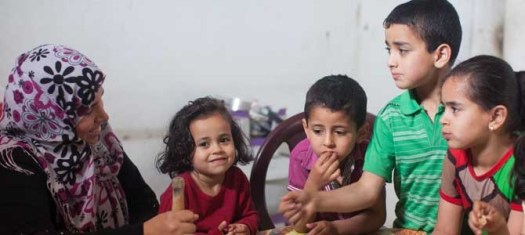
Gaza Blockade Enters its 10th Year

news_article_41136_28196_1477031402
Image courtesy of UNRWA

By Bo Schack, Director of UNRWA Operations in Gaza
October 21, 2016


“I have survived the past three wars, but that is not the problem. In this place, wars come and go. The bigger struggle is not to lose hope. The only way I can do that is to retreat, and create my own world, and become oblivious.”
— Ali, age 36, waiter in Gaza City


Ali was born in Gaza and for almost ten years has been living under a tight blockade on air, land and sea, entering its tenth year in June 2016. The blockade keeps him and the rest of the 1.8 million people of Gaza isolated and locked into a tiny 365 square kilometers-enclave — the Gaza Strip has one of the highest population densities in the world — tormented by extreme poverty and dilapidated by repeated conflicts.

Chronic fuel and electricity shortages, with power cuts between 18 and 22 hours per day, extreme water pollution  — 95 per cent of the Gaza groundwater is undrinkable — and devastated infrastructure, as a dire reminder of repeated cycles of armed violence, are the daily reality. Gaza’s people are denied a human standard of living. This was not always the case: before the imposition of restrictions on movements of people and goods, the Gaza Strip was a relatively developed society with a productive base and a thriving economy.

Blockade and occupation have reversed this process, accelerated by repeated Israeli military operations and widespread destruction, and today Gaza is subject to what the UN calls de-development. Located at the Mediterranean Sea between Egypt and Israel, Gaza could be famous for its palm trees, fruits and white beaches. Instead, it is known for a sewage and hygiene crisis titled by the Time magazine a “ticking global-health time bomb.

[Continue reading here . . . ]

World Food Programme in Palestine

World Food Programme Country Brief, State of Palestine
September 2016

eman_gz_6-3
© WFP/Eman Mohammed

The Numbers:

  • 1.6 million food-insecure Palestinians in need of food assistance
  • 745,000 non-refugees in need of food assistance
  • 65,000 internally displaced persons (IDP’s) in Gaza following the 2014 war

Decades of occupation coupled with severe restrictions on the movement of people and goods have undermined the living conditions and reduced access to livelihoods for Palestinians. Food insecurity is mostly due to a lack of economic access: food prices are mainly driven by Israel and out of reach for many poor households — the GDP per capita in Palestine (USD 4,700) is six times less than that of Israel (USD 30,000).

The impact of the 2014 conflict in Gaza continues to be devastating to the Palestinian people and economy. Against this backdrop, more than 27 percent of the population — or 1.6 million people — suffers from food insecurity. In Gaza, one in two is food insecure, and one in three is severely affected.

As poor and vulnerable Palestinians spend more than half of their income on food, WFP’s assistance is critical to meet their food needs. This prevents further deteriorations in food security and livelihood status, and prevents negative coping mechanisms. WFP targets 600,000 of the most vulnerable, food insecure non-refugees in Palestine who have been affected by the ongoing conflict and occupation, a fiscal crisis and a steady decline in living standards. WFP has been present in Palestine since 1991.

[Read more here . . . ]

[Download the country brief here. . . ]


The Land That Remains: Photographing Nostalgia and Existence

Source: Palestine Square | ميدان فلسطين

The land has been swept away, her history has been broken by another’s reality.


Italian photographer Federico Busonero recalls an allegorical moment: Traveling along the West Bank’s Route 60, he came across a Palestinian man sitting on a cement block on the side of the road apparently waiting for a ride. Next to him were three bags; from one protruded an old-fashioned black wall clock. The man spoke neither Italian nor English, and Busonero speaks no Arabic. The photographer signaled to the man that he would like to photograph him by pointing to his camera. The man agreed to Busonero’s request. For 15 minutes, Busonero relayed, the man sat there with “his hands crossed on his legs, pensive eyes looking at me. Everything was halted (…). The man did not move.” Neither, of course, did the clock. [Continue reading here . . . ]

Shepherding under Occupation

By the Jordan Valley team, Ecumenical Accompaniment Programme in Palestine and Israel (EAPPI)

“We have been living next to the settlement for many years and we don’t do any harm to anyone, we just want to live and to be able to walk with our sheep and have access to the land”


We arrived early, just after sunrise. We met with Abu Sami [pseudonym] and his family along with members of Ta’yush, an joint Israeli and Palestinian organization. Abu Sami lives close to a settlement in the North of Jordan Valley and his family looked very afraid of the consequences of the land action that was about to take place. Abu Sami and his family were preparing to graze their sheep on land that the settlers have taken control of in Khirbet Tell el Himma. The land is privately owned by a Palestinian family and Abu Sami rents it from them to graze his sheep, however, because of frequent harassment from settlers, the family are no longer able to use it. Today was going to be different. [Continue reading . . .]

USAid in Palestine

“It’s not about solving the world’s problems but people’s daily ones.”

Former USAid Mission Director in Palestine, Dave Harden, talks about the challenges of achieving effective development in the West Bank and Gaza over his long career with USAid. (The Guardian, Oct 3, 2016)


Looking back on the decade he spent supporting development in Palestine, Dave Harden says the challenge was “getting people past the psychological barrier.”

Harden joined USAid’s West Bank and Gaza mission in 2006 as its deputy head, before becoming its leader in 2013. It was a time of particular tension — in 2005, the Israelis had pulled out of occupying the Gaza strip, withdrawing their troops along with 10,000 settlers. Power was meant to be left to a united Palestinian Authority, governed by the moderate Fatah party in the West Bank.

But in 2006, in a surprise twist, the militant organization Hamas was democratically elected to power. Their refusal to recognize Israel as a state, and a civil war with the Fatah party, led to Hamas governing Gaza and Fatah controlling the West Bank. A blockade of Gaza by Israel soon followed, as did three conflicts, three new peace envoys and Congress freezing USAid funding temporarily in 2011, reportedly because of the Palestinians’ appeal to the United Nations for statehood.

All of this only intensified a longstanding political and humanitarian crisis [pdf] across the Palestinian territories. Today 80% of Gaza’s residents and more than 50% of the West Bank are reliant on humanitarian aid.

[Continue reading here. . . ]