Swift Reaction to U.N. “Apartheid State” Report

3461261913
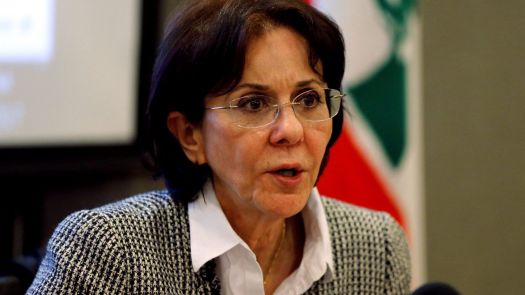
U.N. Under-Secretary General and ESCWA Executive Secretary Rima Khalaf was fired after refusing to withdraw a report declaring Israel an “apartheid state.” (photo: Mohamed Azakir / Reuters)

Heads roll after publication of damning report.

March 26, 2017

Reaction has been fast and furious to the publication of the report, “Israeli Practices Toward the Palestinian People and the Question of Apartheid,” by the U.N. Economic and Social Commission for Western Asia (UN-ESCWA).

This report concludes that Israel has established an apartheid regime that dominates the Palestinian people as a whole. Aware of the seriousness of this allegation, the authors of the report conclude that available evidence establishes beyond a reasonable doubt that Israel is guilty of policies and practices that constitute the crime of apartheid as legally defined in instruments of international law.

Israel and its allies condemned the report and its authors. (Independent)

“The attempt to smear and falsely label the only true democracy in the Middle East by creating a false analogy is despicable and constitutes a blatant lie.”
—Danny Danon, Israeli Ambassador to the U.N.

“The United Nations secretariat was right to distance itself from this report, but it must go further and withdraw the report altogether.”
— Nikki Haley, U.S. Ambassador to the U.N.

Newly-installed U.N. Secretary General Antonió Guterres demanded the retraction of the report, which U.N. Undersecretary General Rima Khalaf, Executive Secretary of the UN-ESCWA, refused. She was subsequently dismissed, and the report was withdrawn. Read her resignation letter here. (New York Times, Haaretz)

After giving the matter due consideration, I realized that I too have little choice. I cannot withdraw yet another well-researched, well-documented U.N. work on grave violations of human rights, yet I know that clear instructions by the Secretary-General will have to be implemented promptly. A dilemma that can only be resolved by my stepping down to allow someone else to deliver what I am unable to deliver in good conscience.

Richard Falk, one of the authors of the report, Princeton University professor and former U.N. Special Rapporteur on human rights in Palestine, describes the thorough process behind the report in an editorial. (The Nation)

Our report concludes that Israel has deliberately fragmented the Palestinian people . . . relying on systematic discrimination . . . to maintain its control, while continuing to expand territorially at the expense of the Palestinian people. On the basis of these findings — backed up by detailed presentations of empirical data, including reliance on Israeli official sources — we conclude that the allegation of apartheid as applied to the Palestinian people is well founded.

palestinian_woman_idf_rtr_img
A Palestinian woman argues with Israeli soldiers at a West Bank checkpoint south of Hebron on Aug 16, 2016. (photo: Mussa Qawasma / Reuters)

Continue reading “Swift Reaction to U.N. “Apartheid State” Report”

New Entry Law Is a Reminder That Palestinians Live in Israel’s Prison

Bethlehem checkpoint
Palestinian workers stand in line next to a portion of the separation wall, waiting to cross through the checkpoint from Bethlehem into Israel. (Miriam Alster / Flash90)

The reality in the West Bank is one that resembles a prison, where Israel controls the law, the security, who can leave, and now who can visit.

By Noam Sheizaf / Local Call via +972 Magazine
March 7, 2017


There is no peace process, nor is there a real discussion over one state or two states. Even discussions on whether Israel is an apartheid state have become intellectual fodder for Jews and leftists. The reality is one that resembles a prison, and the prisoners will continue to be held by force . . . .


The Knesset passed a law Monday night denying entry visas or residency rights to foreign nationals who call for boycotts against Israel or the settlements. The law won’t have much of an effect on entry into Israel proper, but rather will mostly affect those trying to enter the West Bank — a solid reminder that the ban is yet another example of the way Israel holds Palestinians prisoners. After all, one can assume that most people who enter the Palestinian territories oppose the settlements or support some version of the boycott.

Because Israel controls every point of entry into areas under Palestinian control in the West Bank, Palestinians cannot leave (without a permit) or come back (without a permit). With the passage of the law, they are no longer allowed to have visitors. In other words: they are prisoners, and these restrictions are just the tip of the iceberg.

Continue reading “New Entry Law Is a Reminder That Palestinians Live in Israel’s Prison”

Israel Closes Palestinian Office Tracking Illegal Settlements

israelpalestinians-01cf3
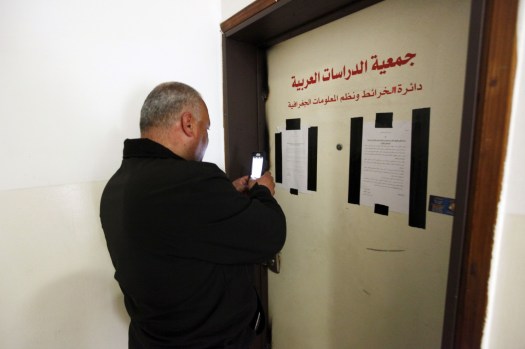
A man takes a photo of the sealed offices of Khalil Tufagji, a prominent Palestinian cartographer, in East Jerusalem. Israeli police raided Tufagji’s office on Mar 14, 2017. His office is to remain closed for six months. (photo: Mahmoud Illean / Associated Press)

Israel briefly detains Palestinian cartographer, confiscates computers and files, and closes his office for six months.

By Joseph Federman / AP and The Washington Post
March 14, 2017


Tufagji is considered the foremost Palestinian expert on Israeli settlement activity in the occupied West Bank and East Jerusalem, areas claimed by the Palestinians for a future state. . . . More than 200,000 Israelis now live in East Jerusalem, along with a similar number of Palestinians. Israel considers its developments to be neighborhoods of its capital, but the Palestinians and most of the international community label them as illegal settlements.


Israeli police on Tuesday burst into the offices of a Palestinian cartographer who tracks Jewish settlement expansion in the West Bank and East Jerusalem and detained him for several hours, accusing him of illegally working for the Palestinian Authority.

It was believed to be the first arrest of its kind since Israel banned the Palestinian Authority from carrying out official business in East Jerusalem in 2001. It also illustrated the deep sensitivities over East Jerusalem, an area with deep religious and strategic significance claimed by both Israel and the Palestinians.

Khalil Tufagji, a former Palestinian negotiator, said police entered his office early Tuesday and confiscated computers and files before taking him away. He was released after several hours. Tufagji denied working for the Palestinian Authority.

Continue reading “Israel Closes Palestinian Office Tracking Illegal Settlements”

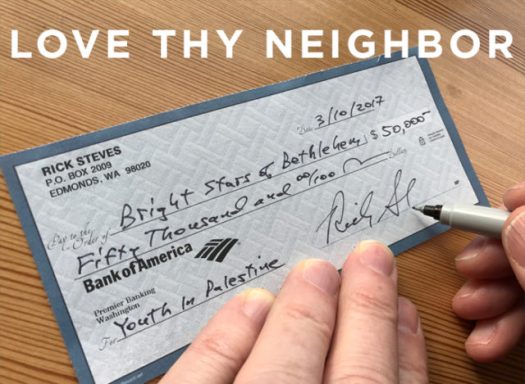
Rick Steves Donates $50,000 to Palestinian Cultural Center

03-13-love-thy-neighbor-640x469
(photo: ricksteves.com)

By Rick Steves / ricksteves.com
March 13, 2017


When I think about the “love thy neighbor” ethic and Golden Rule that is a common denominator of the three great religions that share the region we call the Holy Land, and then hear the leader of my country declare “America first,” I’m troubled by the disconnect.


Over the past weeks, millions of Americans have been inspired, in their own way, to celebrate and defend what they believe makes our country so . . . American. Last Wednesday, I declared that I’d give a donation to an organization helping the youth of Palestine equal to the amount spent on travel gear through last Thursday at ricksteves.com/shop.

More than 600 of you responded, spending a total of $33,287 on our Rick Steves guidebooks, DVDs, accessories, and travel bags. That’s triple our normal total!

As promised, I’m matching your collective shopping spree. And — further motivated by our government’s threat to drastically cut domestic and foreign aid programs — I’m upping my gift to an even $50,000. Thinking about how this money will help that community in such a troubled region brings me (and hopefully all of us) real joy.

Continue reading “Rick Steves Donates $50,000 to Palestinian Cultural Center”

Perhaps the Messiah Will Come

uri-avnery
Uri Avnery (photo: countercurrents.org)

The only real solution is the much-maligned “Two States for Two peoples,” the one declared dead many times. It’s either that solution or the destruction of both peoples.

by Uri Avnery / antiwar.com
March 11, 2017


Right after the foundation of the State of Israel, God appeared to David Ben-Gurion and told him, “You have done good by my people. Utter a wish and I shall grant it.”
“I wish that Israel shall be a Jewish and a democratic state and encompass all the country between the Mediterranean and the Jordan,” Ben-Gurion replied.
“That is too much even for me!” God exclaimed. “But I will grant you two of the three.”


If someone had told me 50 years ago that the rulers of Israel, Jordan and Egypt had met in secret to make peace, I would have thought that I was dreaming.

If I had been told that the leaders of Egypt and Jordan had offered Israel complete peace in return for leaving the occupied territories, with some exchanges of territory and a token return of refugees, I would have thought that the Messiah had come. I would have started to believe in God or Allah or whoever there is up there.

Yet a few weeks ago it was disclosed that the rulers of Egypt and Jordan had indeed met in secret last year with the Prime Minister of Israel in Aqaba, the pleasant sea resort where the three states touch each other. The two Arab leaders, acting de facto for the entire Arab world, had made this offer. Benyamin Netanyahu gave no answer and went home.

So did the Messiah.

Continue reading “Perhaps the Messiah Will Come”

Dear Donald Trump: A letter from Palestine

7086cd8cf37f44e091ceb3fd45f60eec_18
Palestinian human rights defender from the city of Hebron, Issa Amro. (photo: courtesy of Issa Amro)

The U.S. must start treating Palestinians as equals to Israelis.

By Issa Amro / Al Jazeera
January 17, 2017


“It was reading the works of giants such as Nelson Mandela, Mahatma Gandhi and your own civil rights pioneer, Martin Luther King, Jr., that convinced me to spend my life using nonviolent methods of resistance to forge a path forward for myself and my people. I owe a great deal of my fortitude and strategy to King and thinkers like him.”


My name is Issa Amro. I am a 36-year-old Palestinian human rights defender from the city of Hebron in the Israeli-occupied West Bank, where I work with an organization called Youth Against Settlements.

While we live thousands of kilometers apart and have never met, my fate is more closely linked to the office you will hold, and the choices a U.S. president makes, than many might think. The United States’ military, economic and diplomatic support has allowed Israel to continue its occupation of Palestinian lands, upholding their racist, apartheid regime.

I have not spent my youth thinking about my career or travelling the world, the Israeli chokehold on our society limits my opportunities on both those fronts. Instead, I have been engaged in near-daily confrontations with hostile settlers and an occupying army, both of whom want me, my family and my friends to leave our land and never return.

Continue reading “Dear Donald Trump: A letter from Palestine”

Ralph Nader: An Open Letter To President Obama

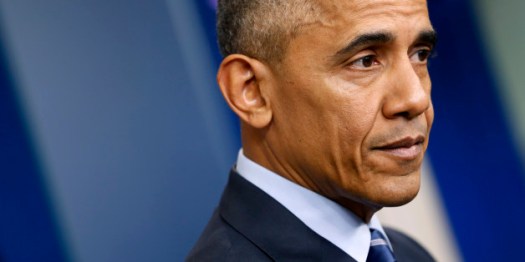
U.S. President Barack Obama participates in his last news conference of the year at the White House in Washington
(photo: Jonathan Ernst / Reuters)

Decision time for Israeli-Palestinian peace

By Ralph Nader / The Huffington Post
December 19, 2016


“[Recognizing Palestine]  is the best — now, perhaps, the only — means of countering the one-state reality that Israel is imposing on itself and the Palestinian people [and] that could destroy Israeli democracy and will result in intensifying international condemnation of Israel.
— Former U.S. President Jimmy Carter


Dear President Obama:

On November 28, 2016, Jimmy Carter, the President who negotiated the peace agreement between Israel and Egypt in 1978, wrote an op ed for the New York Times titled, “America Must Recognize Palestine.” His urgent plea was directed to you to take “the vital step . . . to grant American diplomatic recognition to the state of Palestine, as 137 countries have already done, and help it achieve full United Nations membership,” before you leave office on January 20, 2017.

Mr. Carter referenced your reaffirmation in 2009 of the Camp David agreement between Israel and Egypt and United Nations Resolution 242 when you called “for a complete freeze on settlement expansion on Palestinian territory that is illegal under international law.” He noted that in 2011 you made clear that, in your words, “the borders of Israel and Palestine should be based on the 1967 lines” and that “negotiations should result in two states, with permanent Palestinian borders with Israel, Jordan and Egypt, and permanent Israeli borders with Palestine.”

Former President Carter sees that the “combined weight of United States recognition, United Nations membership [for Palestine] and a UN Security Council resolution solidly grounded in international law would lay the foundation for future diplomacy.” Continue reading “Ralph Nader: An Open Letter To President Obama”

Trump presidency bodes ill for Israel-Palestine peace process

4096
Photo: Jim Hollander / EPA

With president-elect likely to be either maximalist pro-Israel or isolationist, the question is whether stagnant process can survive

By Peter Beaumont / The Guardian
November 17, 2016


What is clear, for all the muddle, is that the centre of gravity in US thinking is lurching from the two-state solution as it has been understood by US politicians and diplomats for more than 20 years seemingly towards one of two extremes: a maximalist pro-Israel administration or, equally risky, a minimalist and disconnected isolationist position.


As Donald Trump continues to ponder his choice for secretary of state, and other key foreign policy positions, one thing seems clear: the impact on the peace process between Israelis and Palestinians is likely to be serious and retrograde.

The question now is whether the moribund process, which has weathered presidents both Republican and Democrat since it was sealed in 1993 with the aim of securing a two-state solution, can survive the Trump era at all.

The signs are not encouraging. Israel’s far right has greeted Trump’s success with ecstasy, hailing his promises to recognize Jerusalem as the country’s capital and move the US embassy to the city, as well as suggestions from his team he would not stand in the way of Israeli settlement construction.

The frontrunners for the secretary of state nomination — Rudy Giuliani and John Bolton — have both been vocal opponents of the idea of a Palestinian state.

Trump’s own pronouncements have swerved wildly between suggesting he would be “neutral” on the question, promising to be Israel’s “best friend,” and even suggesting he could secure the best peace deal ever.

Meanwhile his advisers have fueled a sense of deep confusion by making a series of highly contradictory statements.

[Continue reading here . . . ]

You Can’t Say We Didn’t Know

Some Perspectives on Israel, Palestine, and the Conflict

Episcopal Bishop’s Committee for Israel/Palestine
Diocese of Olympia
October 2016


In preparation for the 2016 Annual Convention of the Episcopal Diocese of Olympia, the Bishop’s Committee for Israel/Palestine prepared a book of essays, You Can’t Say We Didn’t Know: Some Perspectives on Israel, Palestine, and the Conflict.

These essays are presented here for the general reader. Each author takes full responsibility for what has been written. The material has been thoughtfully researched, and is offered in the spirit of seeking peace through understanding.

We humbly thank you for your interest in learning more about Israel and Palestine, and pray for our guidance toward a peaceful resolution. Continue reading “You Can’t Say We Didn’t Know”

Privatizing the Occupation

loewensteinkennard20161114_img
Photo courtesy of Mohamad Torokman / Reuters

 How Israel is privatizing its occupation of Palestine — enriching the security industry and allowing the country to evade accountability for human-rights violations

By Antony Loewenstein and Matt Kennard / The Nation
October 27, 2016


 “Earlier this year, Human Rights Watch (HRW) released a report, ‘Occupation Inc.,’ that detailed how ‘Israeli and international businesses have helped to build, finance, service, and market settlement communities.’ It added, ‘In many cases, businesses are “settlers” themselves.’”


It is 4:30 a.m. with the moon still high in the sky, but Palestinians from across the West Bank are already disembarking from buses outside the Qalandia checkpoint near Jerusalem. They’re about to begin a day’s work on the other side of the separation wall, in Israel.

Qalandia is one of the busiest checkpoints through which Palestinians with the required work documents can travel from the occupied Palestinian territories to Israel. With unemployment around 26 percent in the West Bank (in Gaza, it’s far worse — among the highest in the world, according to the United Nations), it’s always extremely busy at this early hour, because Palestinians need work, which is more readily available in Israel, especially in construction, manufacturing, and agriculture. . . .

The warehouse-like checkpoint looks like a cattle pen on the inside: Metal bars on either side and above form a narrow chute, enclosing and herding the workers—many of whom have traveled from villages more than an hour away—toward the point where their documents will be checked by Israeli officials. They then wait on the Israeli side for transport from their employers.

For years, these checkpoints were manned by personnel from the Israel Defense Forces (IDF) and the Israeli Border Police. But starting in January 2006, gun-toting private security guards joined the soldiers and police. Today, there are 12 checkpoints in the West Bank and two on the Gaza border that use such guards. Israel is slowly privatizing its occupation.

[Continue reading here . . . ]