

What is BDS?
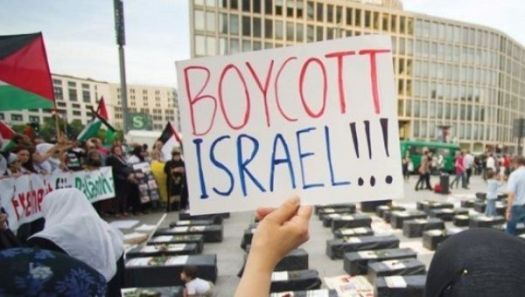
BDS is a global non-violent movement using economic pressure to oppose to Israel’s military occupation of the West Bank and Gaza.
By Ramzy Baroud / Telesur / Oct 1, 2017
What are the goals of BDS?
- End the military occupation of the West Bank, Gaza, and other Palestinian lands.
- Allow Palestinian refugees to return to their homes.
- Assure equal rights for all Israeli citizens, regardless of ethnicity or religion.
The BDS Movement was the outcome of several events that shaped the Palestinian national struggle and international solidarity with the Palestinian people.
BDS stands for Boycott, Divestment and Sanctions. The BDS Movement was the outcome of several events that shaped the Palestinian national struggle and international solidarity with the Palestinian people following the Second Uprising (Intifada) in 2000.
Building on a decades-long tradition of civil disobedience and popular resistance, and invigorated by growing international solidarity with the Palestinian struggle as exhibited in the World Conference against Racism in Durban, South Africa in 2001, Palestinians moved into action.
Israeli settlers turn archeological sites into political tools
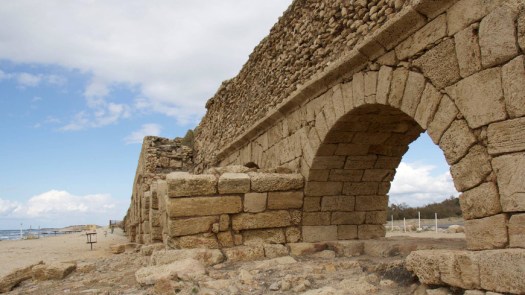
Every year, some 100,000 women, children and men visit the Biyar Aqueduct, built some 2,000 years ago to supply water to Jerusalem and the Jewish Temple.
By Akiva Eldar / Al-Monitor / Oct 3, 2017
“There is clear evidence at the Biyar Aqueduct — as there is at other sites — of the presence of the sons of the Judean Kingdom or of Jews at various periods. The problem is that these sites are being used as propaganda tools to establish the right of Jews to those lands, and the multicultural aspect of thousands of years of history is sidelined or even wiped out of the whole story.”
— Archaeologist Yonathan Mizrachi
The Israeli left made no bones about its glee over the empty bleachers at the September 27 jubilee celebration of the liberation of Judea, Samaria, the Jordan Valley and Golan Heights organized by the settlers in the occupied West Bank. The left views the photos of the empty seats as proof of the settlers’ failure to occupy the hearts and minds of the general Israeli public. The leftists argue that not only did the billions poured by successive Israeli governments into the settlements for 50 years lure fewer than 5% of Israelis to live there — about 400,000 according to the Israel Central Bureau of Statistics — the vast majority avoided the wasteful “liberation festival.”
Yet the pleasure taken by the left in the seeming failure of the settlers and their patrons is somewhat pathetic. Granted, the right-wing concept of a return to the land of the forefathers has not created a major demographic shift of Israelis moving to the settlements. Nonetheless, the notion has ingrained itself in the minds of broad swathes of the Israeli public and of tens of thousands of visitors from around the world. It happens daily in Jerusalem’s Old City and throughout the West Bank.
Continue reading “Israeli settlers turn archeological sites into political tools”
Administrative detention “worst of all possible worlds”
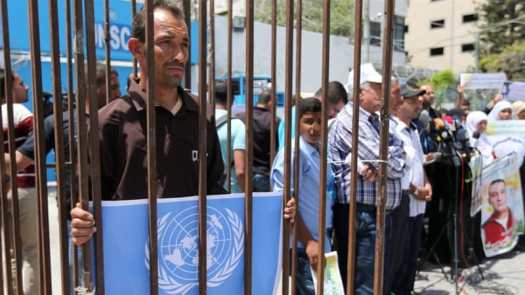
Critics blast Israel’s practice of holding Palestinians on secret evidence, without charge or trial.
By Dalia Hatuqa / Al Jazeera / Oct 3, 2017
“For the last 50 years, Israeli authorities have been using administrative detention as a substitute for criminal proceedings in cases where there’s not enough evidence [for formal proceedings].”
— Magdalena Mughrabi, Amnesty International deputy director for the Middle East and North Africa
At first glance, a legislator, a circus performer and an NGO worker might not appear to have much in common. But all three Palestinians are former or current political prisoners who have been subjected to an obscure legal procedure called administrative detention, which allows Israel to imprison people without charge or trial for an indefinite amount of time.
Israeli authorities have been using this procedure for more than half a century, basing it on secret evidence. The Palestinian Prisoners Society, a detainee support group, noted a sharp rise in administrative detentions in August, with more Palestinians held without trial than during any other month this year. The rise, to 84 detentions, came amid increased tensions in the occupied West Bank after the stabbing of three Israeli settlers by a Palestinian on July 21.
As of September, there were 449 administrative detainees being held in prisons inside Israel, almost all of them Palestinian, according to data provided to rights group Hamoked by the Israel Prison Service.
Continue reading “Administrative detention “worst of all possible worlds””
The Israeli Right’s “coexistence” in the West Bank

The “colonialists” accept the status quo, the “apartheidists” want complete separation, and the “transferists” openly await a third Nakba.
By Naam Sheizaf / +972 Magazine / Sep 11, 2017
The Right’s imagined coexistence in the occupied territories is uncannily similar to the kind whites dreamed of in Rhodesia. That is, we can get our cars fixed for cheap, and they can come work for us, bereft of any rights. In the meantime, they can continue living in their crowded cities and squalid refugee camps.
There is nothing the Israel Right loves more than adopting the criticism of its rivals on the Left in order to justify its rule. Strangely, this criticism has turned into a main aspect of the language settlers use when describing their “coexistence” with the Palestinians in the occupied territories.
Their argument goes as such: while Tel Aviv is a bubble where rich, liberal Jews love Arabs in theory only, in the West Bank we truly see the Palestinians as humans and as neighbors. The Left fantasizes about peace agreements with people it doesn’t even know, but the Right’s version of coexistence includes real people — who are sometimes filled with hate and sometimes are not, who work and live together but want to keep their own culture, and who see each other as equals.
Sounds great, doesn’t it?
Continue reading “The Israeli Right’s “coexistence” in the West Bank”
Is it bad for Israel that Palestine joined Interpol?
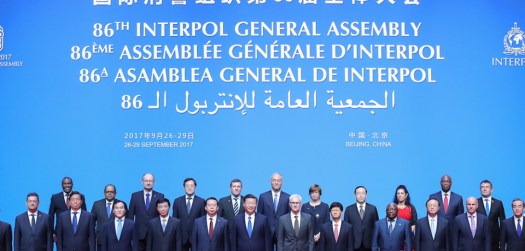
Palestine’s membership shouldn’t pose a new concern for Israel.
By Bethany Allen-Ebrahimian / Foreign Policy / Sep 27, 2017
“Almost every country in the world is a member of Interpol, with the notable exception of North Korea. Saudi Arabia, Eritrea, Syria, Yemen, Iran — these are all member countries I’m assuming that, for Israel, would be not particularly friendly countries.”
— Bruno Min, a legal and policy officer at Fair Trials
Interpol, the international police organization, has voted to accept Palestine as a member country — which will heighten fears in Israel that Palestine could use Interpol to target Israeli officials.
Interpol membership will bring several benefits to Palestinian police. They’ll get access to information that other police agencies around the world have shared about criminal activity and will be able to issue red notices, which function as international nonbinding warrants requesting the extradition of criminal fugitives.
And that’s what makes Israel nervous.
Continue reading “Is it bad for Israel that Palestine joined Interpol?”
State of Palestine joins Interpol
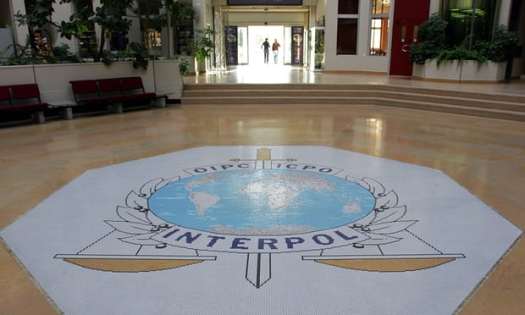
Despite strong opposition from Israel, the international police organization approves Palestine’s membership by a vote of 75–24.
By Peter Meaumont / The Guardian / Sep 27, 2017
Israel campaigned to block the Interpol move and made a series of procedural moves in an attempt to prevent the issue coming to a vote. . . . After Israel blocked the last Palestinian attempt to join Interpol — at last year’s annual general meeting in Indonesia — the Israeli prime minister, Benjamin Netanyahu, said his country’s diplomatic efforts had secured a major victory. The Israeli foreign ministry made no immediate comment on Wednesday’s decision.
Interpol has voted to admit Palestine as a full member, dealing a significant diplomatic blow to Israel, which has strenuously lobbied against Palestinian admission.
In a secret vote of representatives of the international police organization’s members in China, Palestinian membership was approved by 75 to 24 votes, with 34 abstentions — exceeding the two-thirds requirement of yes to no votes.
“The State of Palestine and the Solomon Islands are now Interpol member countries,” the organization tweeted after the ballot.
Event: Reception for Naim Ateek, Liberation Theologist

Naim Ateek is a Palestinian priest in the Anglican Church and founder of the Sabeel Ecumenical Liberation Theology Center in Jerusalem.
| Date: | Thursday, October 12, 2017 | ||
| Time: | 2:30–4:00 p.m. | ||
| Location: | Episcopal Diocesan House 1551 10th Ave E Seattle, WA 98102 |
||
| Information: | Email questions here | ||
| Tickets: | Free |
Event Details
We are pleased to welcome the Reverend Naim Ateek, founder of Sabeel, and Tarek Abuta, Executive Director of Friends of Sabeel North America (FOSNA), to Seattle. Rev. Ateek and Mr. Abuta will be in town to mark the launch of the Bishop Edmund Lee Browning Memorial Fund, honoring the former Presiding Bishop of the Episcopal Church. Bishop Browning was instrumental in the founding of FOSNA and one of the strongest supporters of Sabeel.
Continue reading “Event: Reception for Naim Ateek, Liberation Theologist”
Gonzaga Sends Students to Israel and Palestine
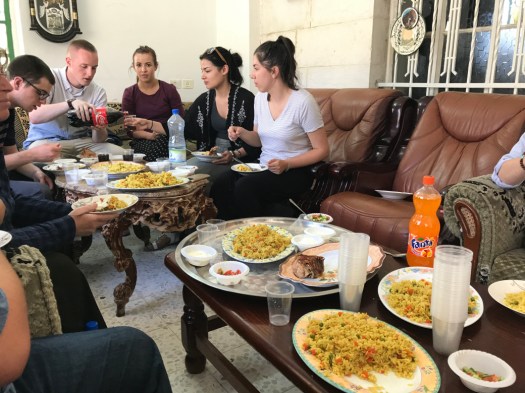
Study abroad program sends students to Israel, plans for program to return in 2019.
By Emily Klein / The Gonzaga Bulletin
August 30, 2017
“The students appreciated a place that I had never been before [The Tent of Nations outside Bethlehem in the West Bank] and this is my 10th time going to Israel. For me it was a very emotional experience, too, because I felt like it’s such a model, it’s such a lesson in life where when you’re stuck in these horrible situations you have to consider how to stand up and be a human being. They could have become suicide bombers, they could have become people who lie in garbage. They said that they were going to find another way. I think that lesson, for the students, was absolutely profound. It was for me, too.”
— Dr. Elizabeth Goldstein, Associate Professor of Religious Studies
Controversies are often told or experienced in a one-sided manner. Israel, its history and the Israeli-Palestinian conflict associated with it is often susceptible to such exclusive perspectives.
Every aspect of the Gonzaga-in-Israel program avoided limited perspectives by embracing duality and empathy.
Dr. Elizabeth Goldstein, associate professor of religious studies and a rabbi, proposed the creation of the Israel study abroad experience with dual purposes and perspectives in mind.
“I feel like Israel and knowledge of the Middle East is an important part of a full approach to both the background of the Old Testament/Hebrew Bible as well as anything to do with contemporary Judaism,” Goldstein said. “I also felt that it was a part of the mission of the university to look at issues of social justice between Israel and Palestine.”
Continue reading “Gonzaga Sends Students to Israel and Palestine”
U.N. Reiterates Support for Two-State Solution

In Palestine, the U.N. Secretary-General says a two-state solution “only way to guarantee peace.”
By U.N. News Centre
August 29, 2017
“I have a dream, a dream to see in the Holy Land two states: A Palestinian state and an Israeli state, living together in peace and security, in mutual recognition and allowing for this kind of suffering not to be possible anymore.”
— U.N. Secretary-General António Guterres
United Nations Secretary-General António Guterres today reiterated his call for a political solution to the Middle East conflict that would end Israel’s occupation of Palestinian land and would create an independent Palestinian state, living side by side with Israel in peace and security.
“It is my deep belief that it is essential to restart a serious and credible political process of negotiation aiming at that objective — the two-state solution — as it is also important to create conditions on the ground to improve the situation of Palestinian populations,” Mr. Guterres said at a press conference in Ramallah after meeting with Palestinian Prime Minister Rami Hamdallah.
“A two-state solution that will end the occupation and, with the creation of conditions, also the suffering even to the Palestinian people, is in my opinion the only way to guarantee that peace is established and, at the same time, that two states can live together in security and in mutual recognition,” Mr. Guterres said.
He said that Israel’s settlement activity represented a major obstacle to the implementation of the two-state solution although there are other obstacles.
Continue reading “U.N. Reiterates Support for Two-State Solution”
 HolyLandJustice.org
You must be logged in to post a comment.