Christians in Jerusalem’s Old City “under threat” from settlers

3500
The Greek Orthodox patriarch of Jerusalem, Theophilos III, speaks in front of the closed doors of the Church of the Holy Sepulchre in Jerusalem’s Old City. (photo: Amir Cohen / Reuters)

Church leaders claim priests are being verbally abused and spat at while property is being vandalized in ancient walled city.

By Harriet Sherwood | The Guardian | May 1, 2018


“Today the church faces a most severe threat at the hands of certain settler groups. The settlers are persistent in their attempts to erode the presence of the Christian community in Jerusalem. These radical settler groups are highly organized. Over the last years we have witnessed the desecration and vandalism of an unprecedented number of churches and holy sites and receive growing numbers of reports from priests and local worshippers who have been assaulted and attacked. Where the authorities are concerned, this behavior goes largely unchecked and unpunished.”
— Theophilos III, the Greek Orthodox patriarch of Jerusalem


Christians in Jerusalem’s Old City say their presence at the geographical heart of their faith is under threat from intimidation and aggressive property acquisition by hardline Jewish settlers.

According to church leaders, priests are being verbally abused and spat at, and property vandalized.

Tensions have risen this year in the Christian and Armenian quarters of the one square kilometer ancient walled city, which includes the Church of the Holy Sepulchre, the holiest place in Christianity where Jesus was believed to be crucified and resurrected. The Old City is also home to places of critical religious importance to Jews and Muslims.

Continue reading “Christians in Jerusalem’s Old City “under threat” from settlers”

Israel builds checkpoint tower at Damascus Gate

462421c
Newly constructed watch tower at the Damascus Gate to the Old City of Jerusalem. (photo: Ma’an New Agency)

In June 2017, Israeli officials approved a new security strategy at the Damascus Gate after Netanyahu suggested it be turned into a “sterile area” [an area without Palestinians].

By Ma’an News Agency | Feb 17, 2018


Certain routes will be specified for entering the Old City at the Damascus Gate, and more technological devices will be installed and used at the area to maintain Israeli police’s control and surveillance over the area. . . . Palestinians will only be allowed to enter the Old City through Damascus Gate via specific routes, where they will undergo “thorough searches.”


Israeli authorities have completed the construction of a watchtower checkpoint at the entrance of Damascus Gate, the main gate into the Muslim Quarter of occupied East Jerusalem’s Old City.

The watchtower checkpoint is one of three that Israel began to install last month, drawing criticism from Palestinian residents of the Old City, who say the construction watchtower is aimed at further restricting Palestinian access to the area and solidifying an already constant presence of Israeli forces in the area.

Continue reading “Israel builds checkpoint tower at Damascus Gate”

Jerusalem: It’s tense, crowded and can feel like a jail

10jerusalem4-superjumbo
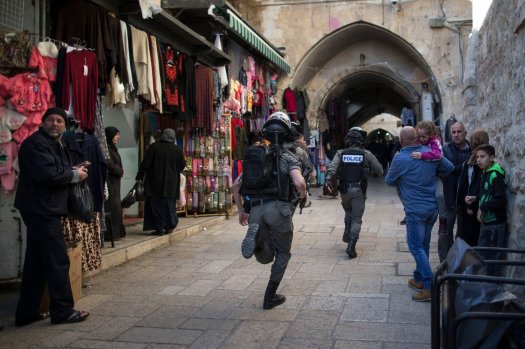
Israeli border police officers responding to a disturbance in the Muslim Quarter after Friday prayers. (photo: Uriel Sinai / The New York Times)

This is a tense city on a good day.

By David Halbfinger | The New York Times | Dec 9, 2017


“There’s a big religion problem in Jerusalem. It’s a city of racism. Once there’s a little bit of balagan [chaos] between Jews and Arabs, Jews won’t go in my taxi, and Arabs won’t go to the mall. And if I go into a religious neighborhood and they find out I’m Arab, they’ll stone my car. . . . There will never be peace here. If they take all the Arabs away, the Jews would eat each other. And the same thing with us.”
— Jerusalem taxi driver Muhammad Ziada


You feel it behind the wheel: The traffic signals turn red and yellow to alert a coming green. Hesitate a half-second before accelerating? A honking horn. Schoolgirls gesture at motorists as they step into a crosswalk, fingertips bunched and faces scowling: Will you wait, or what?

You see it in the crowding: Overstuffed apartments spilling onto one another, in teeming Palestinian neighborhoods, and in ghetto-like ultra-Orthodox enclaves, a few blocks apart on either side of the Green Line, the pre-1967 boundary with the West Bank.

You hear it in the way people talk — “The Arabs,” “The Jews” — about people with whom they have been sentenced to share a tiny patch of soil atop a ridge with no strategic value, over which the world has been battling for thousands of years, and negotiating on and off for decades, with no end in sight.

Continue reading “Jerusalem: It’s tense, crowded and can feel like a jail”

Jewish Youth Riot in Muslim Quarter of Old City

3655806653
Jewish youth rampaging through the Muslim Quarter of Jerusalem on Oct 11, 2017. (photo: Haaretz)

Palestinian shopkeeper is hospitalized after being beaten; police make no arrests.

By Nir Hasson / Haaretz / Oct 13, 2017


“If it were Palestinians who were rioting, they would have sent for reinforcements, and probably shot tear gas and stun grenades.”
— Louis Zorba, a resident of the Muslim Quarter


A Palestinian shop owner was hospitalized after hundreds of Jewish teenagers reportedly rioted in the Muslim Quarter of Jerusalem’s Old City on Wednesday night.

According to Palestinian eyewitnesses, approximately 400 youths marched through the Old City from the Western Wall towards the Muslim Quarter’s Damascus Gate, allegedly shouting, beating the doors of houses and shops, throwing rocks and smashing car windows.

As they approached Damascus Gate, the youths stormed an open shop and attacked the shop’s Palestinian owner. The owner was taken to Hadassah University Hospital to be treated for his wounds and was released in the morning, his injuries described as “light.”

Continue reading “Jewish Youth Riot in Muslim Quarter of Old City”

Holy Sepulchre Guarded by Muslim Families

imrs
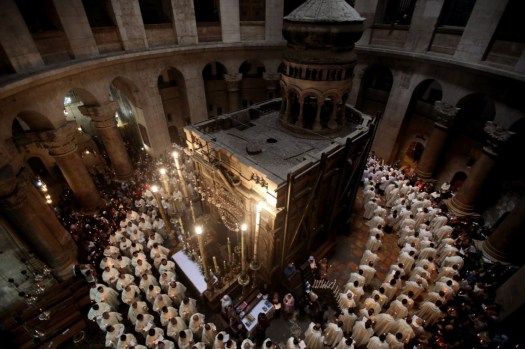
Image courtesy of Gali Tibbon / AFP / Getty Images

Why Christianity’s holiest shrine is guarded by two Muslim families

By Ishaan Tharoor / The Washington Post
November 1, 2016


“For me, the source of coexistence for Islamic and Christian religions is the Church of the Holy Sepulchre.”
— Adeeb Joudeh, the current keeper of the key


The Church of the Holy Sepulchre in Jerusalem’s Old City is Christianity’s most hallowed shrine. It’s believed that the rock-cut tomb at the heart of the church was where the body of Jesus Christ was once laid.

Over the past week, for the first time in centuries, a team of conservationists and researchers removed a marble slab that lay in a rotunda, known as the Edicule, at the center of the complex. It’s the spot, as my colleague William Booth put it earlier this year, when the renovation project first began, “where millions of pilgrims have knelt and prayed, where the salt of tears and the wet of sweat have smoothed and worried the hardest stone.”

“I’m absolutely amazed. My knees are shaking a little bit because I wasn’t expecting this,” Fredrik Hiebert, National Geographic’s archaeologist-in-residence, is quoted by the publication’s website. “We can’t say 100 percent, but it appears to be visible proof that the location of the tomb has not shifted through time, something that scientists and historians have wondered for decades.”

[Continue reading here . . . ]

[See related National Geographic article with photos here . . . ]

UNESCO Resolution on Jerusalem

The facts lost in the PR frenzy

mughrabi-gate-site-1
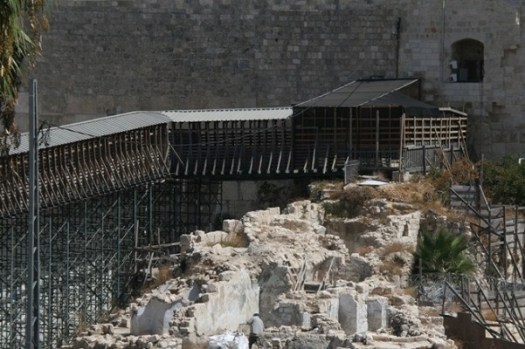
Image courtesy of Palestine Unbound

Justine Berg / Palestine Square
October 25, 2016


“The resolution prompted Israel to suspend cooperation with UNESCO, however an analysis of its actions reveals that Israel has not been keen on cooperating with the world cultural organization for almost ten years. In fact, the drama Israel has caused around this resolution may be a way to entrench its continued non-compliance with UNESCO decisions.”


In the days leading up to the adoption of a UNESCO resolution on Occupied Palestine, the media has focused almost exclusively on Israel’s allegation that the resolution denies Jewish heritage in the Old City of Jerusalem. A deeper look at the text of the resolution, as well as a review of developments in the Old City over the past decade, offer insight into the possible reasons for the creation of this media narrative. Simply put, it is part of a long series of repeated Israeli attempts to deflect attention from the ways in which Tel Aviv has refused to comply with previous UNESCO decisions on Jerusalem.

The flurry of news articles following the acceptance of the resolution on October 18th have continuously recycled Israeli claims that it is “contentious” and “anti-Israel” because it “ignores” and “denies” Jewish connection to Jerusalem’s holy sites. The text, however, specifically “[affirms] the importance of the Old City of Jerusalem and its Walls for the three monotheistic religions,” and references other UNESCO documents that do the same. (For instance document 200 EX/25, which states “the Old City of Jerusalem is the sacred city of the three monotheistic religions — Judaism, Christianity and Islam, and . . . each of its communities has a right to the explicit recognition of their history and relationship with the city.”)

The resolution prompted Israel to suspend cooperation with UNESCO, however an analysis of its actions reveals that Israel has not been keen on cooperating with the world cultural organization for almost ten years. In fact, the drama Israel has caused around this resolution may be a way to entrench its continued non-compliance with UNESCO decisions.

[Continue reading here . . . ]


“Israel, the occupying Power, had not complied with any of the 12 decisions of the UNESCO Executive Board as well as six decisions of the World Heritage Committee that request the implementation of the reactive monitoring mission to the Old City of Jerusalem and its Walls.”