Even in peace, the occupation will never end

1-5888288-694992067
Israeli Prime Minister Benjamin Netanyahu speaking at the Economic Club of Washington, Mar 7, 2018. (photo: Jose Luis Magana / AP)

Netanyahu envisions a future of permanent military occupation of the West Bank.

By Michael Schaeffer Omer-Man | +972 Magazine | Mar 8, 2018


“I don’t want the Palestinians as citizens of Israel and I don’t want them as subjects of Israel. So I want a solution where they have all the powers they need to govern themselves but none of the powers that would threaten us. What that means is that whatever the solution is, the area west of the Jordan — that includes the Palestinian areas — would be militarily under Israel.”
— Israeli Prime Minister Benjamin Netanyahu


He’s said it countless times before in myriad ways. But he usually only says it in Hebrew. This week, however, Israeli Prime Minister Netanyahu said in English, and on camera, that under his leadership Israel will never end the occupation of Palestine.

Speaking at the Economic Club of Washington earlier this week, Netanyahu dodged a question about whether he supports a one- or two-state solution, and outlined a vision that sounds a lot like an entrenched and enhanced version of the occupation as it exists today.

Continue reading “Even in peace, the occupation will never end”

“It’s What We Do: A Play About the Occupation”

The play, adapted from the testimony of Israeli soldiers, was recently produced in Washington, DC.

By Pam Bailey | Mondoweiss | Feb 6, 2018


This oppression is destructive for everyone: Palestinian civilians obviously suffer daily, and the Israeli soldiers — who are told “your mission is to disrupt lives” — are forced to stop thinking and do what they are ordered to do, even when the must carry out actions that are inhumane. This is called “mind occupation,” and I’m glad that some soldiers have managed to free their minds and break the silence.


This video is a production called “It’s What We Do: A Play About the Occupation,” produced and directed by Pam Nice, a member of the Washington, DC, chapter of Jewish Voice for Peace.

Although it is a drama, the dialogue of the soldiers is adapted from the actual testimonies of Israeli soldiers from Breaking the Silence, whose vivid memories continue to haunt them. The target audience is Jewish viewers. But several We Are Not Numbers writers, who have been “targets” of Israeli soldiers, watched the video, curious to see how far the the soldiers were willing to go in their confessions. It was difficult for many of them to watch, and their reactions varied. But they all agreed the video should be required viewing for people everywhere.

Continue reading ““It’s What We Do: A Play About the Occupation””

As long as occupation exists, soldiers will continue to speak out

.
Palestinians clash with Israeli soldiers in Al-Fawwar refugee camp, south of the West Bank city of Hebron, Dec 31, 2017. (photo: Wisam Hashlamoun / Flash90)

We must make our voices heard sharply and clearly — speaking out is not merely an option, it is a moral duty.

By Avner Gvaryahu | +972 Blog | Jan 26, 2018


It [is] important to remind the Israeli public why soldiers continue to break their silence. After all, the central reason for breaking the silence is the occupation. As long as there is an occupation, there will be those who choose to expose what the government is trying so hard to hide.


Like many who served alongside me, I preferred to remain silent. I preferred to forget, not to speak about the Palestinian homes I broke into in the middle of the night, forgetting the violence I carried out at checkpoints and the passivity required of me when settlers freely broke the law. When I was released from the army, I preferred to repress those three years, to put them behind me.

Only after I joined a Breaking the Silence tour to the South Hebron Hills did my eyes open. Only then, I chose to speak. That is how I learned that I wasn’t alone. I learned there are others like me — soldiers who see the situation the same way and choose to take responsibility and change the way they and their society, our society, talk about the occupation.

Continue reading “As long as occupation exists, soldiers will continue to speak out”

Holy city of sterile streets

merlin_116869667_adb6540b-1ee6-48c3-ad08-7d30ed597c2c-master768
An Israeli soldier on a street that separates an Israeli settlement and a Palestinian neighborhood in the West Bank city of Hebron. (photo: Chris McGrath / Getty Images)

To settlers, this is the first Jewish city in the biblical hills of Judea; to the Palestinian majority, this is their centuries-old home under relentless military occupation.

By Roger Cohen | The New York Times | Jan 20, 2018


“You are treating families in a way you would not want your own family to be treated. It’s as simple as that.”
— Anonymous IDF soldier


The Israeli soldier stands at the entrance to Shuhada Street. The street is deserted, its stores shuttered, doors welded shut. The old center of Hebron has been a ghost town for many years. The Israel Defense Forces refer to “tzir sterili,” or sterile roads, because no Palestinian is allowed on them, whether in a car or on foot.

The occupation of the West Bank is a half-century old. That’s a long time. Jews did not go to the Holy Land to deploy for another people the biological metaphors of classic racism that accompanied their persecution over centuries. But the exercise of overwhelming power is corrupting, to the point that “sterile” streets, presumably freed of disease-ridden natives, enter the lexicon.

The soldier at the checkpoint is a young man with a ready smile. He tells me he’s visited New York. He asks where I bought my watch. I ask him what he’s done to merit the punishment of Hebron. He laughs, a little uneasily. He’s clearly uncomfortable with his mission, enforcing segregation, and wants to connect. No doubt he’d rather be on the beach in Tel Aviv enjoying a beer.

Continue reading “Holy city of sterile streets”

You don’t have to be anti-Zionist to listen to Palestinian voices

gettyimages-691410588-1511965609
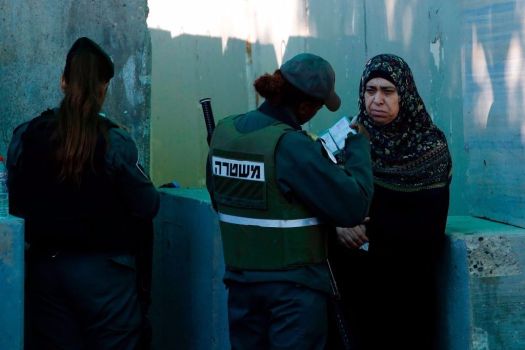
A Palestinian woman at an Israeli checkpoint. (photo: Getty Images)

An essay on “admitting Israel’s imperfections.”

By Matthew Gindin | The Forward | Nov 29, 2017


Harassment and inhumane conduct sometimes practiced by members of the IDF towards Palestinians has been well documented. It should horrify us, and we should make no excuses for it.


On November 27, the Forward published an opinion piece by Palestinian activist and journalist Mariam Barghouti, who asserted that one cannot be both a feminist and a Zionist. Despite the fact that the Forward’s opinion section published, on the same day, an essay promoting the point of view of “Zioness,” a feminist Zionist organization, The Forward’s opinion editor, Batya Ungar-Sargon, was besieged by hate mail from Jewish writers, including a threat to “rape and behead” her, as well as one calling her a “demented scumbag kapo.”

Although I am proud to write for an outlet that is committed to a pluralism of opinions and that publishes Palestinian voices, I don’t agree with Barghouti’s fundamental thesis. I do think one can be a feminist and Zionist, though of course, as many commentators pointed out, it depends on how you define Zionism and how you define feminism. In her essay, Barghouti makes feminism synonymous with general humanism. As she writes, “Fundamentally speaking, feminism cannot support racism, supremacy and oppressive domination in any form.”

Continue reading “You don’t have to be anti-Zionist to listen to Palestinian voices”

Israel’s last chance to end the occupation

4252698236
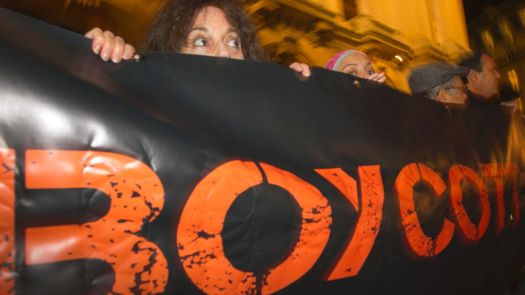
BDS supporters protest in Paris, Oct 31, 2012. (photo: Jacques Brinon / AP)

Paradoxically, the anti-BDS bill could very well hasten the end of the repression and subjugation of the Palestinian people.

Ilana Hammerman and Dmitry Shumsky | Haretz | Dec 05, 2017


Only when all of us, men and women, Israelis who are partners in and responsible for the continuation of the occupation, begin to pay a real price for it will Israel receive a chance to be a sane and civilized country with diplomatically recognized and moral borders based on international law. Without that we will not have security or peace.


If the new bill is passed imposing a seven-year sentence on activists in the BDS movement against Israel and its products for harming the country and its foreign relations, it will mark a giant step in the constitutional revolution the right-wing nationalist government has been making in recent years.

This revolution is progressing at a terrifying pace under the patronage of a fraud that’s second to none. It’s as if the struggle for human rights (and not the attacks on them) could be considered harming the country; as if a country and its policies, citizenship and ideology were one. As if ideologies hadn’t yet brought about the destruction of countries in which power was awarded to the ideologues.

Continue reading “Israel’s last chance to end the occupation”

Planning the ethnic cleansing of Palestine

1779340329
Then-Prime Minister Levi Eshkol and Defense Minister Moshe Dayan onboard a helicopter while touring army installations in the West Bank, Sep 1967. (photo: Ilan Bruner / GPO)

Newly declassified Israeli Security Cabinet documents show government ministers planning to force Palestinians from their land.

By Ofer Aderet | Haaretz | Nov 17, 2017


“We should deal with this issue quietly, calmly and covertly, and we should work on finding a way for [the Palestinians] to emigrate to other countries and not just over the Jordan [River]. Perhaps if we don’t give them enough water they won’t have a choice, because the orchards will yellow and wither. Perhaps we can expect another war and then this problem will be solved.”
— Israeli Prime Minister Levi Eshkol, 1967


“Empty” the Gaza Strip, “thin out” the Galilee, rewrite textbooks and censor political cartoons in Haaretz: These are among the proposals discussed by cabinet ministers after the Six-Day War that will be available to the public in a major release of declassified government documents by the Israel State Archives on Thursday.

The material being posted on the state archives’ website includes hundreds of pages of minutes from meetings of the security cabinet between August and December 1967. From reading them, it is clear that in the several months that followed the June 1967 war, members of the security cabinet were perplexed, confused and sometimes helpless in the face of the new challenges to the state.

Israel conquered East Jerusalem, the West Bank, the Gaza Strip, the Golan Heights and the Sinai Peninsula in under a week. It was not even remotely prepared for this scenario, and had to hit the ground running. Continue reading “Planning the ethnic cleansing of Palestine”

50 years of occupation, 50 years of labor struggle

e8c9be4435eec35baa4905f2702379
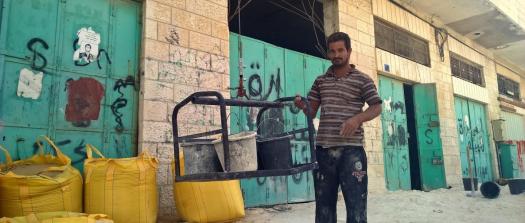
A Palestinian worker on a construction site in the city of Bethlehem, in the southern occupied West Bank, Sep 27, 2017. (photo: Chloé Benoist / Equal Times)

The land isn’t the only thing that is occupied in Palestinian — so is the economy.

By Chloé Benoist | Equal Times | Nov 17, 2017


The hundreds of thousands of Palestinians who found themselves under Israeli military control in 1967 quickly became a source of blue-collar labor for the Israeli economy, performing jobs that few Israelis were willing to do, for far less money and with far fewer legal protections.


Despite having spent 30 years of his life working as a carpenter in Israel, and the past 17 years as a farmer in the southern part of occupied West Bank, Mohammad Issa Salah, 70, still finds himself struggling to make ends meet.

“Here, the cost of living is like Europe, but the wages are like Africa,” the elderly Palestinian from the village of al-Khader tells Equal Times, in what little English he remembers from school.

The old man’s situation is hardly an exception. With a quarter of Palestinians living under the poverty line, and a similar unemployment rate, Palestinians have struggled for decades to make a living and assert their rights in the workplace.

Continue reading “50 years of occupation, 50 years of labor struggle”

Why the Occupation is No Accident

pappeex2gestureportlock
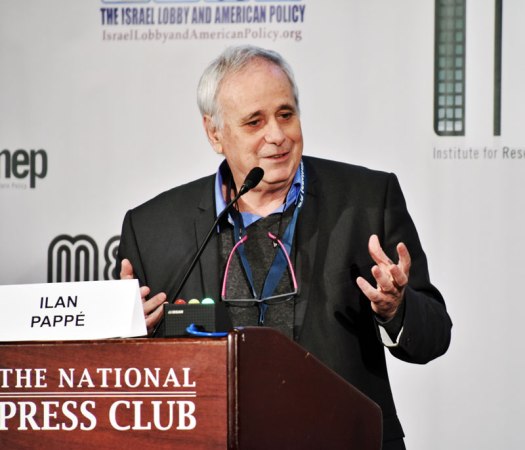
Ilan Pappé speaking at the conference The Israel Lobby and American Policy in Washington, DC, on March 24, 2017. (photo: Phil Portlock)

The Biggest Prison on Earth: A History of the Occupied Territories by Ilan Pappe, Oneworld Books (2017)

By Rod Such / The Electronic Intifada
September 18, 2017


Everything that followed the 1967 War, notes Pappe, follows the “logic of settler colonialism” and that logic in turn foresees the eventual elimination of the indigenous Palestinians. That outcome, however, is not inevitable. An alternative is possible, Pappe maintains, if Israel decolonizes and makes “way for the logic of human and civil rights.”


As early as 1963 — four years before the 1967 War — the Israeli government was planning the military and administrative takeover of the West Bank, according to The Biggest Prison on Earth, a new book by the Israeli historian Ilan Pappe.

The planning for that operation — codenamed Granit (granite) — took place over a month on the campus of Hebrew University in the Givat Ram neighborhood of western Jerusalem. Israeli military administrators responsible for overseeing Palestinians within Israel joined military legal officials, interior ministry figures and private attorneys to create the judicial and administrative decrees required to rule over the one million Palestinians then living in the West Bank.

These plans were part of a larger strategy for placing the West Bank under military occupation. That strategy was codenamed the Shacham Plan for the Israeli colonel, Mishael Shacham, who authored it, and was formally presented by the Israeli chief of general staff to the army on 1 May 1963.

Continue reading “Why the Occupation is No Accident”

Finding a Voice Under Occupation

2016-12-13 youngpalestiniansspeak-72

Young Palestinians Speak: Living Under Occupation, by Anthony Robinson and Annemarie Young (2017).

By Fouad Moughrabi / The Electronic Intifada
August 28, 2017


This is a unique book showcasing the voices of young Palestinians who look and sound like other children throughout the world. They live in difficult conditions but nevertheless attempt to lead normal lives and dare to dream of a better future.


This book is a labor of love about young people who are born in the perpetual insecurity of a conflict zone. What does it mean to live under military occupation, when soldiers raid your home in the middle of the night and drag your brother or father to jail?

Words have limited power to accurately describe the fear that grips a child when soldiers come to detain him or her. Media accounts of the Israeli occupation, illegal Jewish settlements, checkpoints and Israel’s wall in the West Bank fail to give the reader a feel for what these words really mean or what they may entail for people in their daily life.

Palestinians as regular human beings are largely absent from mainstream media; they usually simply appear as statistics, or are portrayed as anti-Israeli or as terrorists.

Young Palestinians Speak is an attempt to correct this injustice.

Continue reading “Finding a Voice Under Occupation”