The Auschwitz-Birkenau Concentration Camp in Poland. (photo: Isaac Harari / Flash90)
Poland’s attempt to scrub clean its role in the murder of European Jewry is, at its core, no different from Israel’s attempt to erase the catastrophe that befell the Palestinians in 1948.
The new [Polish] law, which criminalizes any researcher who dares publish the truth [about Polish involvement in the Holocaust], is an attempt at historical revisionism. . . . So how is this law any different from the [Israeli] Nakba Law, which would withhold state funds from cultural and educational institutions that commemorate the horrors that befell the Palestinians in 1948?
The responses coming from Israel to the new Polish law, which forbids discussing war crimes committed by the Polish people during the holocaust, are nothing if not paradoxical. While the Israeli establishment, from the Right to the Left, denies the identity, history, and catastrophe of the Palestinian people, it reprimands those who deny responsibility for the fate of the Jews during the Holocaust.
The Holocaust, a monstrous, well-planned genocide, was possible not only because of the Nazis’ nightmarishly meticulous implementation, but also because those who stood aside as it was happening. The Germans had willing accomplices, including many Poles, who took an active part in the persecution and murder. The history books talk about the “hunt for the Jews,” which led to the murder of hundreds of thousands of Jews, both directly and indirectly, during the Second World War.
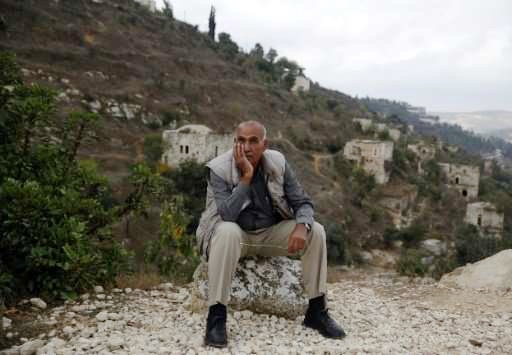
Yacoub Odeh, a 77-year-old Palestinian, who grew up in the ghost village of Lifta, before fleeing during the 1948 war and the creation of Israel. (photo: phys.org)
The 13th-Century-BCE village is on a list of tentative UNESCO World Heritage sites, but is slated for commercial development.
“It is frozen evidence of the issue of the destroyed villages. That’s why it annoys the Israeli land authority, because they don’t want it turned into a sort of non-official monument for the destroyed villages.”
— architect Shmuel Groag
Near the stone ruins of the home where he says he lived as a boy, Yacoub Odeh laments that his native village on Jerusalem’s hillside may soon be transformed forever.
“I want to come back to my home, to my house, to my village, to my land,” the 77-year-old said.
Lifta, an abandoned former Palestinian village in a bucolic spot at the entrance to Jerusalem, is at the centre of a preservation fight over an Israeli plan to build villas there.
It is a rare example of a village that still exists after its Palestinian inhabitants fled in the 1948 war surrounding the creation of Israel, though its history extends much farther back in time.
The village, in mainly Jewish West Jerusalem, is on a tentative list of UNESCO World Heritage sites, and the World Monuments Fund organization has put it on its list of sites under threat. Continue reading “Ghost village in Jerusalem may soon vanish”
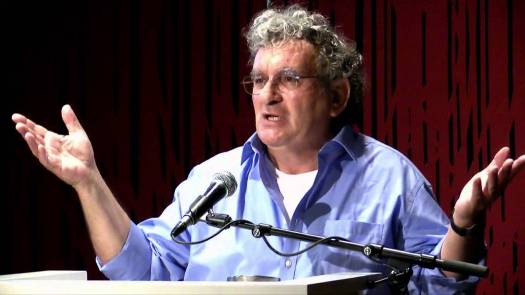
Benny Morris, professor of history at Ben-Gurion University of the Negev, speaking in Oslo, Oct 6, 2014. (photo: Med Israel for fred)
A revisionist Israeli historian revisits his country’s origins.
By David Remnick / The New Yorker
May 5, 2008
[Ed. note: In anticipation of Ilan Pappé’s visit to Seattle next month, we are touching on some of the Israeli “new historians.” This 2008 piece from the New Yorker reviews Benny Morris’s book, 1948: A History of the First Arab-Israeli War, which provides an in-depth analysis of the origins of Israel. Morris’s early work, Righteous Victims: A History of the Zionist-Arab Conflict, 1881-2001, was the seminal work among the “new historians,” and is arguably one of the best histories of the Israeli-Palestinian conflict.]
In “1948,” the assembled compendium of aspiration, folly, aggression, hypocrisy, deception, bigotry, violence, suffering, and achievement is so comprehensive and multilayered that no reader can emerge without a feeling of unease — which is to say, a sense of the moral and historical intricacy of the conflict.
For thirteen centuries, between 1200 B.C. and the second century A.D., the Jews lived in, and often ruled, the land of Israel. The population was clustered mainly in Judaea, Samaria, and Galilee. The Jews’ dominion was long but not eternal. The Romans invaded and, after suppressing revolts in A.D. 66-73 and 132-135, killed or expelled much of the Jewish population and renamed the land Palaestina, for the Philistines who had lived along the southern seacoast. After the conquest, some Jews stayed behind, and the faith of the Hebrews remained a religio licita, a tolerated religion, throughout the Roman Empire.
By the nineteenth century, Palestine had been ruled by Romans, Persians, Byzantines, Arabs, Christian Crusaders, and Ottoman Turks. When Mark Twain visited in 1867, his imagination soaked with the Biblical imagery of milk and honey, he discovered to his surprise “a hopeless, dreary, heartbroken land . . . desolate and unlovely.” Jericho was “accursed,” Jerusalem “a pauper village.” Twain’s passages on Palestine in “The Innocents Abroad” have, over the decades, been exploited by propagandists to echo Lord Shaftesbury’s notion that, before the return of the Jews to Zion, Palestine was a land without a people for a people without a land. Twain and Shaftesbury, as it turned out, were hardly alone in failing to recognize a substantial Arab population in the Judaean hills and beyond.
“Yes, 100 years have passed since the notorious Balfour Declaration, by which Britain gave, without any right, authority or consent from anyone, the land of Palestine to another people. That declaration paved the road for the Nakba of the Palestinian people and their dispossession and displacement from their land.”
At last month’s gathering of the U.N. General Assembly, Palestinian leader Mahmoud Abbas placed the responsibility for the 50-year-long Israeli occupation of his people squarely on the shoulders of the British.
“Yes, 100 years have passed since the notorious Balfour Declaration, by which Britain gave, without any right, authority or consent from anyone, the land of Palestine to another people,” he said. That declaration, Abbas said, “paved the road for the Nakba of the Palestinian people and their dispossession and displacement from their land.” Nakba, or the catastrophe, is the term used by the Palestinians in reference to the 1948 war.
Abbas was referring to a letter from November 1917 sent by the British foreign secretary at the time, Arthur James Balfour, to Walter Rothschild, a British Jewish community leader, stating that the British government will support the “establishment in Palestine of a national home for the Jewish people.”
A poll released this week by the Center for Opinion Polls and Survey Studies at An-Najah National University in Nablus of Palestinian attitudes to peace and their own leadership showed that the majority of Palestinians agree with Abbas.
Among the questions asked of 1,362 Palestinians in the Gaza Strip and the West Bank ages 18 and older was whether they “support or reject the call from President Mahmoud Abbas on Britain to accept the historical, legal, political, material and moral responsibilities relating to the consequences of Belfour Declaration including offering an apology to the Palestinian people for the catastrophes and injustice committed against them?”
The majority, 75 percent, said they did. When asked whether they consider Britain responsible for the catastrophes that befell the Palestinian people, 79 percent said yes.



 HolyLandJustice.org
You must be logged in to post a comment.