Muslim and Jewish Women Join Together

06unity-4-master768
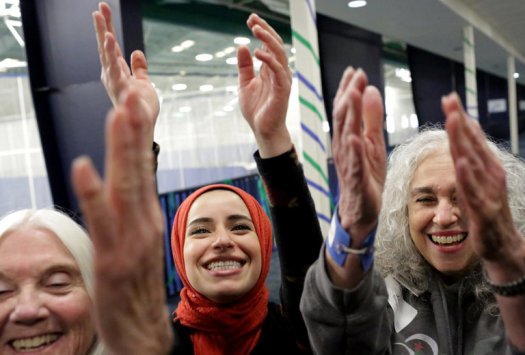
Women dance during a workshop at a Sisterhood of Salaam Shalom conference at Drew University in Madison, N.J. (photo: Yana Paskova / The New York Times)

Both Feeling Threatened, American Muslims and Jews Join Hands

By Laurie Goodstein / The New York Times
December 5, 2016


“If Muslims have to register, we’re all going to register . . . Jews know what it means to be identified and tagged, to be registered and pulled aside. It evokes very deep emotions in the Jewish community. . . . All of us have heard the story of the Danish king who said if his country’s Jews had to wear a gold star, all of Denmark would, too.”


Jolted into action by a wave of hate crimes that followed the election victory of Donald J. Trump, American Muslims and Jews are banding together in a surprising new alliance.

They are putting aside for now their divisions over Israel to join forces to resist whatever may come next. New groups are forming, and interfaith coalitions that already existed say interest is increasing.

Vaseem Firdaus, a Muslim who has lived in the United States for 42 years, spent Friday night at a Shabbat dinner for members of a women’s group called the Sisterhood of Salaam Shalom, in a home here filled with Jewish art and ritual objects.

Until Mr. Trump was elected president, Ms. Firdaus, who is 56 and a manufacturing manager at Exxon Mobil, felt secure living as a Muslim in America. She has a daughter who is a doctor and a son who is an engineer, and she recently traveled to Tampa with her husband looking to buy a vacation home. But Mr. Trump’s victory has shaken her sense of comfort and security.
Continue reading “Muslim and Jewish Women Join Together”

Interfaith Leaders Turn Conflict Into Trust

29fixesweb-master768
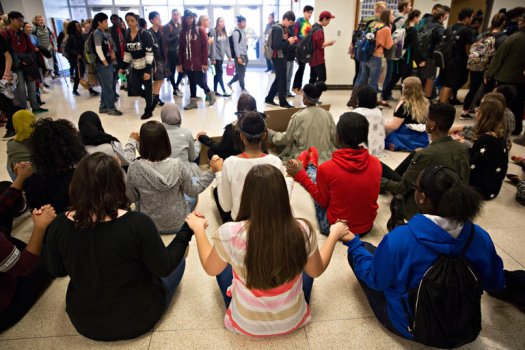
Photo: Daniel Acker / The New York Times

By David Bornstein / The New York Times
November 29, 2016


Democracy is not just a place where you elect representatives; it’s a society where you can make personal convictions public. And diversity isn’t just the things we like. Diversity is also the things you don’t like. . . . What are ways in which I can understand my fellow citizens? What qualities do they possess that I would admire? And what are fundamental things that we can work on together?


This month, the F.B.I. reported that hate crimes against Muslims in 2015 reached their highest level since 2001. In New York City this year, hate crimes are tracking one-third higher than last year; against Muslims they have more than doubled.

The election of Donald J. Trump has highlighted religious tensions in America, particularly with Trump’s proposals to bar Muslims from entering the country and to create a registry of Muslims living in the United States. But these tensions did not begin with Trump. In America, virtually every form of faith or belief has at some point suffered unfavorable reception by others; the victims include Roman Catholics, Mormons, evangelical Christians, Jews and atheists, alongside Muslims.

Four years ago, I reported on the Interfaith Youth Core, which trains leaders to build relationships and respect between diverse faith communities. The work has expanded considerably. The organization now has more than 350 active campuses in its network, and more than 1,000 colleges have used its resources. This year its founder, Eboo Patel, explained in a book, Interfaith Leadership, what this type of leadership entails and why he considers it vital in today’s world. Patel, who is Muslim, recently spoke with me about democracy, the responsibilities of citizens, and his fears and hopes after this year’s election.

[Continue reading here . . . ]

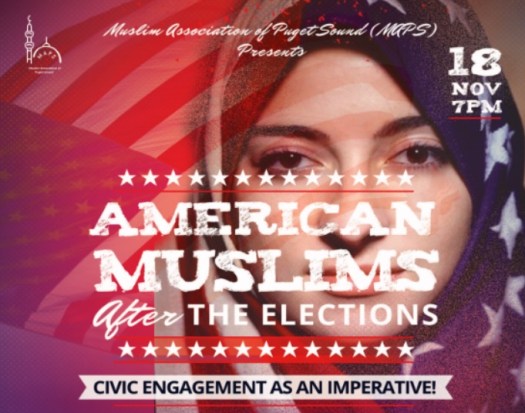
American Muslims After the Election

2016-11-09-american-muslis-after-the-election-cropped-1

Please join our brothers and sisters at the Muslim Association of Puget Sound (MAPS) for this important event.

Date: Friday, November 18, 2016
Time: 7:00 p.m. – 10:00 p.m.
(refreshments and social at 6:30 p.m.)
Location: Muslim Association of Puget Sounds (MAPS)
17550 NE 67th Ct
Redmond, WA 98052
Cost: Free (register here)
Information: Event website
Questions: 425-861-9555
manager@mapsredmond.org

Agenda

  1. The Political Maqasid and Its Application Today
    Prof Jasser Auda, Founding Director of Al-Maqasid Research Centre in the Philosophy of Islamic Law & Al Shatibi Chair of Maqasidi Studies, International Peace College of South Africa
  2. Countering Extremism Online — Immunizing the Youth!
    Dr Houda Abadi, Carter Center, Associate Director, MENA Region Projects – Conflict Resolution Program
  3. Being American and Being Muslim — Lessons from South Africa
    Ambassador Ebrahim Rasool, Founder Director of the World for All Foundation & Distinguished Scholar in Residence at the Al Waleed bin Talal Center for Muslim-Christian Understanding, Georgetown University

[More information here . . . ]

Jerusalem Bans Muslim Call to Prayer

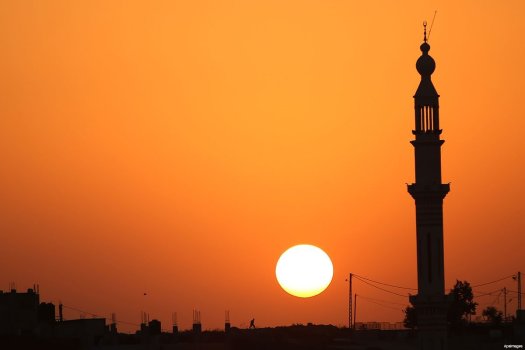
palestinian-mosque-palestinian-minaret-2
Photo courtesy of Shadi Hatem / ApaImages

Israel bans Muslim call for dawn prayer from 3 mosques in Jerusalem

Middle East Monitor
November 5, 2016


The events in Abu Dis came a day after a number of Israeli settlers from the illegal settlement of Pisgat Zeev protested in front of the house of Israeli Mayor of Jerusalem Nir Barakat over the “noise pollution” caused by the Muslim call to prayer.


Israeli authorities reportedly banned the Muslim call to dawn prayer from being made from three mosques in the Jerusalem district town of Abu Dis today, according to local sources.

Lawyer Bassam Bahr, head of a local committee in Abu Dis, told Ma’an that Israeli forces raided the town just before the dawn prayer this morning.

According to Bahr, Israeli forces raided the Al-Rahman, Al-Taybeh and Al-Jamia mosques in the town, and informed the muezzins, the men responsible for the call to prayer — also known as the athan, which is broadcast five times a day from mosques — that the call for dawn prayer through the loudspeakers was banned.

Bahr added that the forces did not provide any reason for the ban, and also prevented locals living in the eastern part of the town from reaching the Salah Al-Din mosque for dawn prayers.

[Continue reading here . . . ]