Ed. note: “Price tag” attacks are acts of vandalism by Jewish fundamentalist settler youths aimed Palestinians, Christians, left-wing Israeli Jews, Israeli security forces, and others seen as opposing the settlement enterprise.
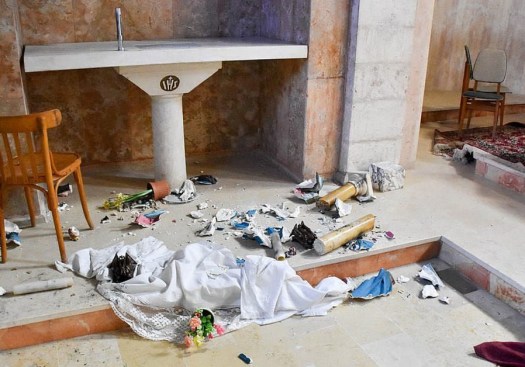
According to the Latin Patriarchate of Jerusalem, vandals on Wednesday night shattered stained-glass windows depicting passages from Jesus; destroyed a statue of the Virgin Mary; and damaged furniture.
Bishop Boulos Marcuzzo, patriarchal vicar in Jerusalem, called for tolerance after deeming the ransacking “not only an act of vandalism, but an action against the sacredness of the holy places and the faith of people.”
“The Holy Land is deep [in] faith and culture,” Marcuzzo said in a Friday statement. “We must live together with the diversity of beliefs. It is absolutely necessary to accept others, to accept each other in our diversity.”
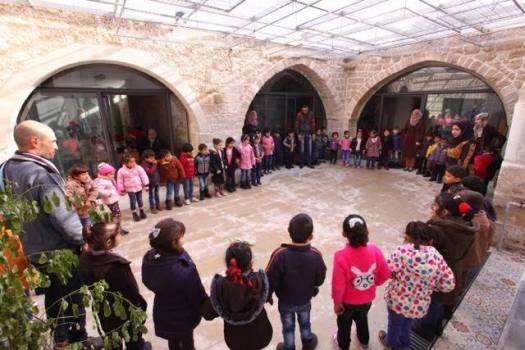
Children participate in psychosocial support activities at Maqam Al-Khidir, also know as the Saint George Monastery, in the Gaza Strip. (photo: Palestine Square)
“Some people feel that their stories, suffering, and lives are being exploited. I wanted them to feel that they own and would benefit from the project through their own contributions. I was overwhelmed by the support.” — Reem Abu Jaber, Executive Director of NAWA for Culture and Arts
After decades of neglect, archaeological sites in the Gaza Strip are finally receiving needed attention. The ancient Saint George Monastery, locally known as Maqam Al-Khidir (sometimes Al-Khudr), is now open to the public following extensive restoration by a local NGO in Deir Al-Balah, NAWA for Culture and Arts, an organization that provides pyschosocial support for children.
While historical information about the site are scarce, the Survey of Western Palestine, carried out by the British Corps of Royal Engineers in 1872, suggests that the ancient Greek inscriptions found at the monastery reveal it was built during the late sixth century. The site has long been revered for spiritual and meditation purposes by both Muslims and Christians. Over the centuries, however, it fell into ruins and lost its significance. Situated in the city of Deir Al-Balah, Arabic for “Monastery of the Palms,” the site extends across an area of 200 square meters. Three domes top the monastery, which is surrounded by stonewalls. The main chapel is located underground, ten paces down a small flight of stairs to an area that houses three apses, where an historic water well was once used for drinking and baptism. In addition to two ancient Greek inscriptions, a stone tomb has also been found.
Reem Abu Jaber, Executive Director of NAWA, said the site restoration idea came about almost unintentionally. Her organization, which was founded in the Spring of 2014 by a group of young people, 80% of whom are female, works to provide psychosocial support for the city’s children through a wide range of cultural activities. Once the organization received proper accreditation, “I shared a post on Facebook inviting people to donate books to establish a small reading place in the area,” Abu Jaber explained. At the height of school vacation season, NAWA received 200 children within the first week.

 HolyLandJustice.org
You must be logged in to post a comment.