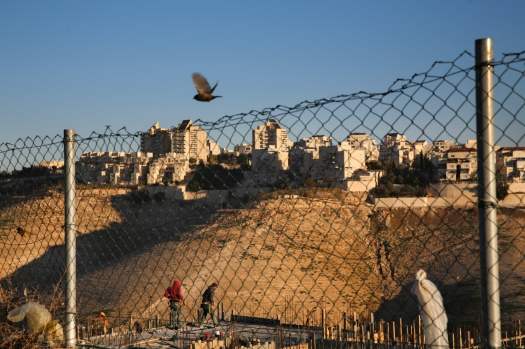
Israel builds checkpoint tower at Damascus Gate

462421c
Newly constructed watch tower at the Damascus Gate to the Old City of Jerusalem. (photo: Ma’an New Agency)

In June 2017, Israeli officials approved a new security strategy at the Damascus Gate after Netanyahu suggested it be turned into a “sterile area” [an area without Palestinians].

By Ma’an News Agency | Feb 17, 2018


Certain routes will be specified for entering the Old City at the Damascus Gate, and more technological devices will be installed and used at the area to maintain Israeli police’s control and surveillance over the area. . . . Palestinians will only be allowed to enter the Old City through Damascus Gate via specific routes, where they will undergo “thorough searches.”


Israeli authorities have completed the construction of a watchtower checkpoint at the entrance of Damascus Gate, the main gate into the Muslim Quarter of occupied East Jerusalem’s Old City.

The watchtower checkpoint is one of three that Israel began to install last month, drawing criticism from Palestinian residents of the Old City, who say the construction watchtower is aimed at further restricting Palestinian access to the area and solidifying an already constant presence of Israeli forces in the area.

Continue reading “Israel builds checkpoint tower at Damascus Gate”
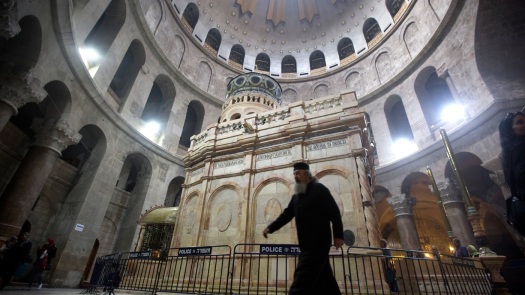
Church of the Holy Sepulchre closed to protest Jerusalem taxes

81102
Jesus’s tomb inside the Church of the Holy Sepulchre in the Old City of Jerusalem. (photo: Lior Mizrahi / Getty Images)

Reversing centuries of precedent, Jerusalem municipal authorities are placing liens on churches to collect $186 million in taxes.

By Griffin Paul Jackson | Christianity Today | Feb 25, 2018


“These actions breach existing agreements and international obligations which guarantee the rights and the privileges of the churches, in what seems as an attempt to weaken the Christian presence in Jerusalem.”
— The Patriarchs and Heads of Churches in Jerusalem

“All of our assets are frozen. We can’t pay for food, salaries, administration, nothing.”
— Anonymous official of the Greek Orthodox Patriarchate


In an action not seen in more than a century, the leaders of Jerusalem’s churches closed the doors of the Church of the Holy Sepulchre on Sunday in a show of united protest. The dramatic decision comes in response to moves by Jerusalem authorities to begin collecting tens of millions of dollars in taxes from churches, as well as proposed legislation to confiscate church-owned land.

The Church of the Holy Sepulchre — considered by many Christians to be the site of Jesus’ crucifixion, tomb and resurrection — is jointly managed by a cadre of Orthodox and Catholic churches. It is one of the most-visited sites in Israel, and its closure came as a sudden shock, especially with Easter celebrations approaching.

In a defiant statement released at the time of the closure, church leaders called the municipality’s new policy a “systematic campaign against the churches and the Christian community in the Holy Land,” according to The Jerusalem Post.  Continue reading “Church of the Holy Sepulchre closed to protest Jerusalem taxes”

Take down that wall in East Jerusalem

1-5827503-2643718793
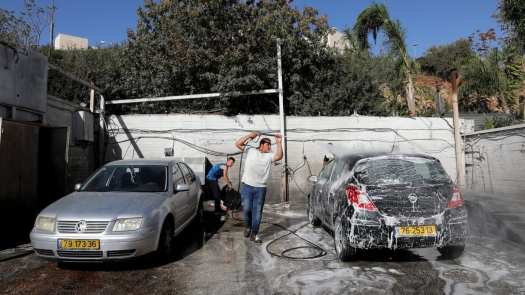
Palestinian teenagers work at a carwash in the East Jerusalem neighborhood of Wadi al-Joz, Nov 17, 2017. (photo: Ammar Awad / Reuters)

The municipality of Jerusalem is considering changing the city’s boundaries to exclude Palestinian refugee camps.

By Moshe Arens | Haaretz | Feb 19, 2018


[Jerusalem officials] are concerned that the influx of Palestinians . . . has substantially changed the demographic balance between Jews and Palestinians in Jerusalem. Some demographic projections indicate that in time Palestinians might even constitute a majority in the city.


In one of the impetuous acts he was known for, Prime Minister Ariel Sharon approved the building of a wall — the separation barrier — within the municipal boundaries of Jerusalem, Israel’s capital, separating the Shoafat refugee camp and the Kafr Aqab neighborhood from the rest of Jerusalem. Like the infamous Berlin Wall, it divided one part of the city from the other.

The result causes great inconvenience to the local people, who must go through checkpoints to enter Jerusalem’s other areas. This includes not only those who work in Jerusalem’s other areas but also children attending schools away from where their families reside.

But that wall brought about another regrettable result. Whereas East Jerusalem’s residential areas have suffered criminal neglect for 50 years, with the wall Shoafat and Kafr Aqab have been completely abandoned by the municipality and the police. They in effect have become a no-man’s-land where drug trafficking and other crime flourish, and anarchy prevails. Neither the government nor the municipality seemed to care about the fate that befell the residents, most of whom are by law recognized as permanent residents of Jerusalem and thereby of Israel, and continue to have the option of applying for Israeli citizenship.

Continue reading “Take down that wall in East Jerusalem”

US will move embassy to Jerusalem in May, to be funded by Sheldon Adelson

merlin_131242068_08808a91-e992-4b82-8ab9-9be6c3801984-master768
Eighty-seven countries have embassies in Israel, none of them are in Jerusalem. (photo: Abir Sultan / European Pressphoto Agency)

The move would coincide with the 70th anniversary of the founding of the State of Israel, as well as the 70th anniversary of the “Nakba,” the expulsion of 750,000 Palestinians from their homes.

By Peter Baker and Gardiner Harris | The New York Times | Feb 23, 2018


“The decision of the US administration to recognize Jerusalem as the capital of Israel and to choose the anniversary of the Nakba of the Palestinian people for carrying out this step expresses a flagrant violation of the law.”
— Saeb Erekat, secretary general of the Palestine Liberation Organization


Sheldon G. Adelson, one of the most hawkish supporters of Israel among American Jews, has offered to help fund the construction of a new American Embassy in Jerusalem, according to the State Department, which on Friday said it was reviewing whether it could legally accept the donation.

The total price tag to build the new embassy to replace the current one in Tel Aviv is estimated at around $500 million, according to one former State Department official. While private donors have previously paid for renovations to American ambassadors’ overseas residences, Mr. Adelson’s contribution would be likely to far surpass those gifts — and could further strain American diplomacy in the Middle East.

Before the embassy is built, the Trump administration plans to open a temporary one in Jerusalem. On Friday, it said that it was accelerating the projected opening in time to mark the 70th anniversary of the creation of the State of Israel on May 14.

Continue reading “US will move embassy to Jerusalem in May, to be funded by Sheldon Adelson”

Jerusalem municipality freezes millions from UN and church bank accounts

f081214kap02-e1380608183108-640x400
The Dormition church on Mount Zion in Jerusalem. (photo: Anna Kaplan / Flash90)

Jerusalem mayor using international organizations in budget dispute with Finance Ministry.

By Michael Bachner | The Times of Israel | Feb 4, 2018


Jerusalem enjoys an annual “capital grant” from the [Israeli Finance Ministry] that helps it offset low tax revenue due to large populations with relatively high percentages that are not part of the taxpaying workforce, including roughly a third of the city’s population that is made up of ultra-Orthodox Jews and another third of Palestinian Arabs.


The Jerusalem municipality has handed out fines totaling millions of dollars to properties owned by the United Nations and by churches, citing a new legal opinion that says the properties are not legally defined as places of worship and therefore aren’t entitled to exemptions from property tax.

The step appeared to be an escalation of a dispute between the municipality and the Finance Ministry over funds. Mayor Nir Barkat has been conducting a high-profile campaign against Finance Minister Moshe Kahlon that included instructing workers to dump trash at the entrance to the ministry offices in Jerusalem and threatening to lay off more than 2,000 city employees.

Continue reading “Jerusalem municipality freezes millions from UN and church bank accounts”

US to open Jerusalem embassy in 2019

Pence
Vice President Pence in Cairo, Jan 20, 2018. (photo: Getty Images)

Pence announces plans to accelerate the move in a speech to the Israeli Knesset.

By Oliver Holmes | The Guardian | Jan 22, 2018


Q&A: What will US recognition of Jerusalem mean for the peace process?

The peace process has been at death’s door since the former secretary of state John Kerry’s peace mission ended in failure in 2014. But the international community — apart from the US — is united in saying recognition of Jerusalem as the capital of Israel is disastrous for any hopes of reviving meaningful talks. The status of Jerusalem is one of the pivotal issues that diplomats and peacemakers have said must be agreed between the two parties in negotiations.

Palestinians will see Trump’s announcement as the end of their hopes and demands for East Jerusalem as a capital of a future independent state. While few want a return to violence, many will feel diplomatic efforts have got them no closer to a state of their own.

The Israeli government will be thrilled. Ever since it captured (and later annexed) East Jerusalem in the 1967 six-day war, Israel has claimed the city as its “eternal and undivided” capital, and has longed for international recognition. Some 200,000 Israelis living in illegal settlements will also celebrate.


The US will open its embassy in Jerusalem by the end of 2019, ahead of schedule, the vice-president, Mike Pence, has said. Arab-Israeli politicians were ejected from the Knesset at the start of Pence’s speech for heckling.

“In the weeks ahead, our administration will advance its plan to open the US embassy in Jerusalem – and that United States embassy will open before the end of next year,” he said in a speech to roaring applause in the Israeli Knesset.

Speaking during a two-day visit, Pence said Donald Trump had “righted a 70-year wrong” by recognizing Jerusalem as the capital of Israel.

Continue reading “US to open Jerusalem embassy in 2019”

Pence and Jordan’s king “agree to disagree” on Jerusalem

merlin_132626039_47fc660b-6df7-4dd0-b94f-405aedf7fd86-master768
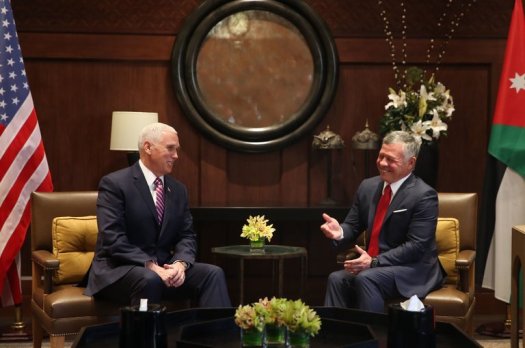
Vice President Mike Pence, left, had a “very frank discussion” with King Abdullah II of Jordan, right, in Amman on Sunday. (photo: Khalil Mazraawi / AFP / Getty Images)

Pence had delayed his trip to the region amid the furor over Trump’s decisions, which were seen as pro-Israel and a slap in the face to Palestinians.

By Rana Sweis | The New York Times | Jan 21, 2018


“Trump and Israel want to end the Palestinian cause; they want to erase the idea of Palestinian refugees. They want to pressure Jordan, the Palestinians and others to give into the demands of an imaginary peace process that benefits only Israel, and that is unacceptable.”
— Abdul Rahman Qanas, 52, a resident of the Baqaa, the largest refugee camp in Jordan


Vice President Mike Pence met with King Abdullah II of Jordan on Sunday, telling reporters afterward that they had “agreed to disagree” on the American recognition of Jerusalem as Israel’s capital.

The meeting in Amman, on the second day of Mr. Pence’s visit to the Middle East, came as tension has increased between the two allies over President Trump’s decision on Jerusalem last month and his decision last week to withhold aid to the United Nations agency that serves Palestinian refugees.

Speaking before the meeting with Mr. Pence at Al Husseiniya Palace in Amman, King Abdullah reiterated his support for “East Jerusalem as a capital of an independent Palestinian state living side by side with a secure and recognized Israel,” Petra, Jordan’s official news agency, reported.

Jordan is also home to more than two million Palestinian refugees who could be affected by the cut in American aid to the United Nations agency.

Mr. Pence said the two leaders had a “very frank discussion.”

Continue reading “Pence and Jordan’s king “agree to disagree” on Jerusalem”

US role as Mideast peace broker may be over

3883
Mike Pence, an evangelical Christian, has visited Israel four times before and pushed for Trump’s inflammatory policies in the Middle East. (photo: Alex Brandon / AP)

Under Trump, relations between the Palestinian leadership and Washington have soured – and Pence’s trip is expected to confirm the enmity.

By Oliver Holmes | The Guardian | Jan 20, 2018


Trump has said he wants to revitalize long-stalled peace talks in pursuit of what he has described as the “ultimate deal.” Yet when Pence touches down in Tel Aviv on Sunday evening, the US’s role as mediator in the conflict may be over for good.


It’s not the trip to the Holy Land that Mike Pence might have imagined. For a start, the US vice-president — an evangelical Christian — is no longer welcome in Jesus’s birthplace of Bethlehem.

Donald Trump doomed Pence’s chances of a visit to the West Bank when he reversed decades of US policy last month by recognising Jerusalem as Israel’s capital. This broke a longstanding international consensus that the issue would be negotiated in peace talks with the Palestinians, who also claim parts of the city.

While Trump did not rule out a future division of Jerusalem, the Palestinian president, Mahmoud Abbas, swiftly rescinded Pence’s invitation to meet him and visit Bethlehem, while senior Christian clerics in Egypt — where Pence arrives on Saturday at the start of his four-day trip ­— also cancelled planned events.

Continue reading “US role as Mideast peace broker may be over”

Jerusalem: It’s tense, crowded and can feel like a jail

10jerusalem4-superjumbo
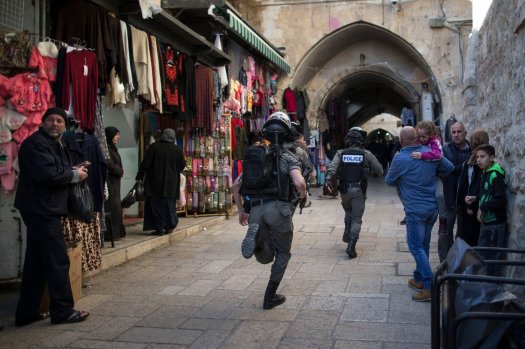
Israeli border police officers responding to a disturbance in the Muslim Quarter after Friday prayers. (photo: Uriel Sinai / The New York Times)

This is a tense city on a good day.

By David Halbfinger | The New York Times | Dec 9, 2017


“There’s a big religion problem in Jerusalem. It’s a city of racism. Once there’s a little bit of balagan [chaos] between Jews and Arabs, Jews won’t go in my taxi, and Arabs won’t go to the mall. And if I go into a religious neighborhood and they find out I’m Arab, they’ll stone my car. . . . There will never be peace here. If they take all the Arabs away, the Jews would eat each other. And the same thing with us.”
— Jerusalem taxi driver Muhammad Ziada


You feel it behind the wheel: The traffic signals turn red and yellow to alert a coming green. Hesitate a half-second before accelerating? A honking horn. Schoolgirls gesture at motorists as they step into a crosswalk, fingertips bunched and faces scowling: Will you wait, or what?

You see it in the crowding: Overstuffed apartments spilling onto one another, in teeming Palestinian neighborhoods, and in ghetto-like ultra-Orthodox enclaves, a few blocks apart on either side of the Green Line, the pre-1967 boundary with the West Bank.

You hear it in the way people talk — “The Arabs,” “The Jews” — about people with whom they have been sentenced to share a tiny patch of soil atop a ridge with no strategic value, over which the world has been battling for thousands of years, and negotiating on and off for decades, with no end in sight.

Continue reading “Jerusalem: It’s tense, crowded and can feel like a jail”

Emboldened by Trump, Israelis try redrawing Jerusalem’s boundaries

israel_likud_party_53721-6c7b5
Palestinian laborers work at a construction site in a new housing project in the Israeli settlement of Maale Adumim, near Jerusalem, in Feb 2017. (photo: Oded Balilty / AP)

Israeli leaders are re-engineering Jerusalem’s demographic balance by redrawing the city’s map to exclude Arab neighborhoods and include Israeli settlements.

By Loveday Morris and Ruth Eglash | The Washington Post | Jan 12, 2018


The director of Israeli human rights group B’Tselem [says] there is a battle underway between those who want to continue “smart occupation,” which manages to “fly two inches below international outrage” while incrementally shifting facts on the ground, and those who advocate “dumb occupation” — moving forward with formal annexation.


Since becoming mayor of Maale Adumim more than 20 years ago, Benny Kashriel has doggedly campaigned for his community to be recognized as part of Israel.

Now, with President Trump in the White House, Kashriel thinks it may just happen.

His settlement is around four miles east of Jerusalem in the occupied West Bank. Most of the international community, including the United States, considers its construction to be illegal, built on land captured during the 1967 war.

Still, it has steadily grown from what began as a cluster of prefabricated buildings erected by 23 families in the 1970s into a burgeoning satellite city of Jerusalem. Palm trees line the wide roads of what looks like a Florida suburb. Red-roofed houses and high-rises are home to 42,000 people, who are served by all of the accoutrements of a modern city: schools, restaurants, cafes and a shopping mall.

Continue reading “Emboldened by Trump, Israelis try redrawing Jerusalem’s boundaries”