The events in Abu Dis came a day after a number of Israeli settlers from the illegal settlement of Pisgat Zeev protested in front of the house of Israeli Mayor of Jerusalem Nir Barakat over the “noise pollution” caused by the Muslim call to prayer.
Israeli authorities reportedly banned the Muslim call to dawn prayer from being made from three mosques in the Jerusalem district town of Abu Dis today, according to local sources.
Lawyer Bassam Bahr, head of a local committee in Abu Dis, told Ma’an that Israeli forces raided the town just before the dawn prayer this morning.
According to Bahr, Israeli forces raided the Al-Rahman, Al-Taybeh and Al-Jamia mosques in the town, and informed the muezzins, the men responsible for the call to prayer — also known as the athan, which is broadcast five times a day from mosques — that the call for dawn prayer through the loudspeakers was banned.
Bahr added that the forces did not provide any reason for the ban, and also prevented locals living in the eastern part of the town from reaching the Salah Al-Din mosque for dawn prayers.
“For me, the source of coexistence for Islamic and Christian religions is the Church of the Holy Sepulchre.”
— Adeeb Joudeh, the current keeper of the key
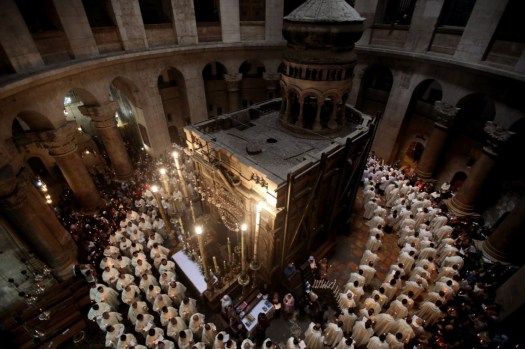
The Church of the Holy Sepulchre in Jerusalem’s Old City is Christianity’s most hallowed shrine. It’s believed that the rock-cut tomb at the heart of the church was where the body of Jesus Christ was once laid.
Over the past week, for the first time in centuries, a team of conservationists and researchers removed a marble slab that lay in a rotunda, known as the Edicule, at the center of the complex. It’s the spot, as my colleague William Booth put it earlier this year, when the renovation project first began, “where millions of pilgrims have knelt and prayed, where the salt of tears and the wet of sweat have smoothed and worried the hardest stone.”
“I’m absolutely amazed. My knees are shaking a little bit because I wasn’t expecting this,” Fredrik Hiebert, National Geographic’s archaeologist-in-residence, is quoted by the publication’s website. “We can’t say 100 percent, but it appears to be visible proof that the location of the tomb has not shifted through time, something that scientists and historians have wondered for decades.”
“The resolution prompted Israel to suspend cooperation with UNESCO, however an analysis of its actions reveals that Israel has not been keen on cooperating with the world cultural organization for almost ten years. In fact, the drama Israel has caused around this resolution may be a way to entrench its continued non-compliance with UNESCO decisions.”
In the days leading up to the adoption of a UNESCO resolution on Occupied Palestine, the media has focused almost exclusively on Israel’s allegation that the resolution denies Jewish heritage in the Old City of Jerusalem. A deeper look at the text of the resolution, as well as a review of developments in the Old City over the past decade, offer insight into the possible reasons for the creation of this media narrative. Simply put, it is part of a long series of repeated Israeli attempts to deflect attention from the ways in which Tel Aviv has refused to comply with previous UNESCO decisions on Jerusalem.
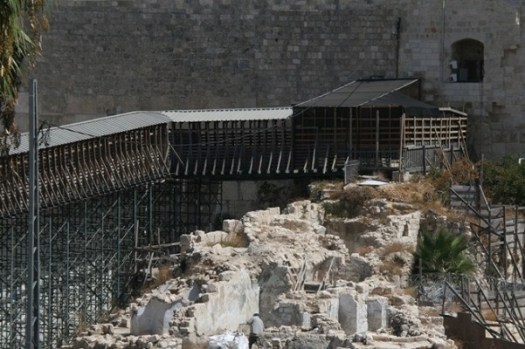
The flurry of news articles following the acceptance of the resolution on October 18th have continuously recycled Israeli claims that it is “contentious” and “anti-Israel” because it “ignores” and “denies” Jewish connection to Jerusalem’s holy sites. The text, however, specifically “[affirms] the importance of the Old City of Jerusalem and its Walls for the three monotheistic religions,” and references other UNESCO documents that do the same. (For instance document 200 EX/25, which states “the Old City of Jerusalem is the sacred city of the three monotheistic religions — Judaism, Christianity and Islam, and . . . each of its communities has a right to the explicit recognition of their history and relationship with the city.”)
The resolution prompted Israel to suspend cooperation with UNESCO, however an analysis of its actions reveals that Israel has not been keen on cooperating with the world cultural organization for almost ten years. In fact, the drama Israel has caused around this resolution may be a way to entrench its continued non-compliance with UNESCO decisions.
“Israel, the occupying Power, had not complied with any of the 12 decisions of the UNESCO Executive Board as well as six decisions of the World Heritage Committee that request the implementation of the reactive monitoring mission to the Old City of Jerusalem and its Walls.”
“In these difficult days, we are providing a place where youth from both sides of the conflict can meet each other, find a partner for peace, and take charge of their future.”
Kids4Peace is excited to announce a two-year, $800,000 cooperative agreement with the US Agency for International Development (USAID) to strengthen and expand the constituency for peace in Jerusalem.
The Interfaith Jerusalem Project will connect youth and parents from East and West Jerusalem, and neighboring West Bank communities in programs that foster civic involvement, celebrate the religious diversity of Jerusalem, and encourage key populations to support a pro-peace agenda.
Project activities include cross-border dialogue groups; workshops about parenting youth in the midst of conflict; community service projects, and town hall meetings that connect youth with community leaders. Kids4Peace will also host community events during religious holidays and facilitate opportunities for Jewish and Arab residents of Jerusalem to visit each other’s homes.
“We are grateful to USAID for this opportunity to strengthen and grow the pro-peace community in Jerusalem,” said Fr. Josh Thomas, International Executive Director of Kids4Peace. “In these difficult days, we are providing a place where youth from both sides of the conflict can meet each other, find a partner for peace, and take charge of their future.” [Continue reading here . . . ]



 HolyLandJustice.org
You must be logged in to post a comment.