
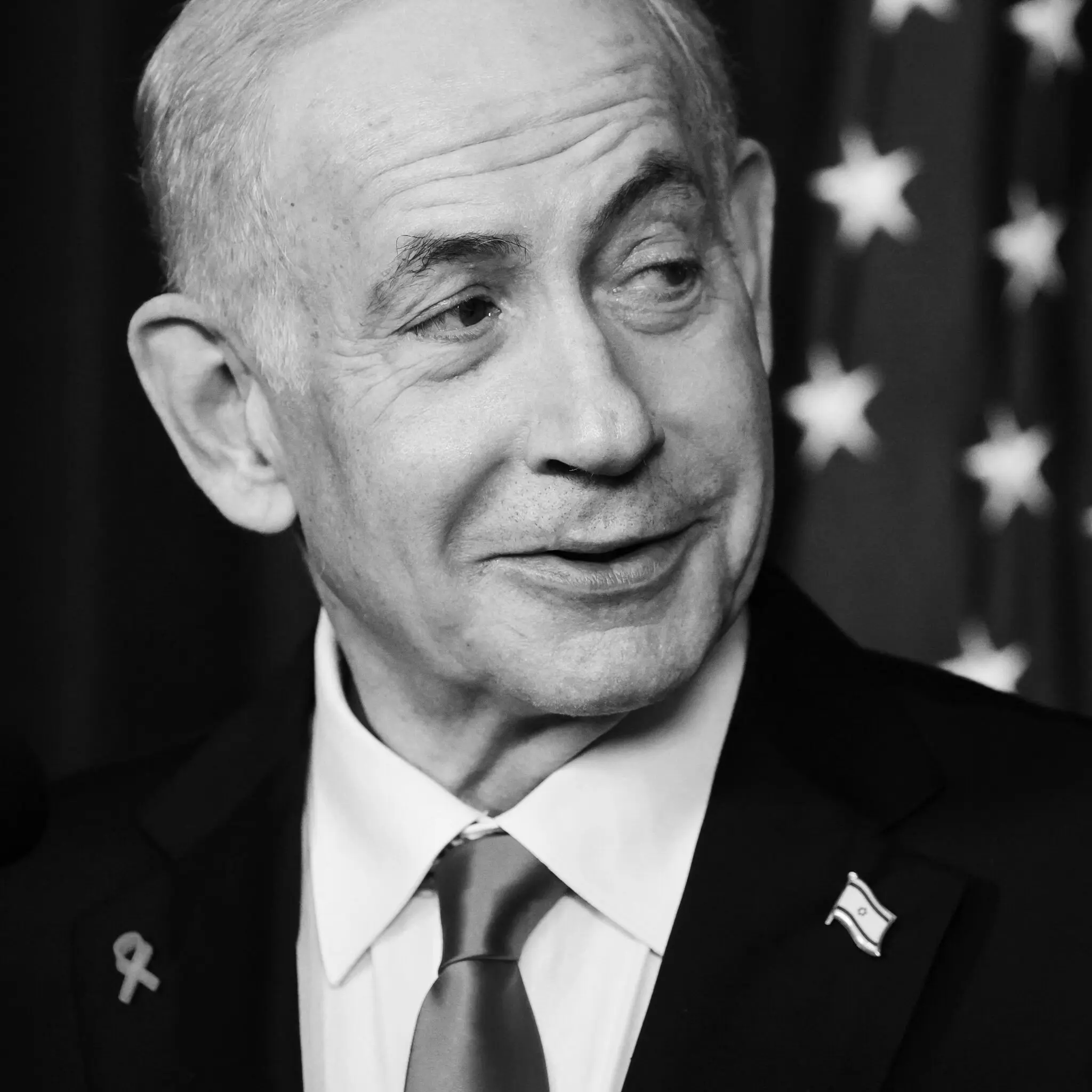
Jonathan Ernst/Reuters
By Thomas L. Friedman
Opinion Columnist, published in New York Times, 2/27/2026
Let’s stop beating around the bush: Israel’s far-right government, led by Prime Minister Benjamin Netanyahu, is spitting in America’s face and telling us it’s raining. It’s not raining. Bibi is playing both President Trump and American Jews for fools. And if the U.S. lets him get away with it, we are fools.
While keeping Trump focused on the Iranian missile and nuclear threat — which, though reduced, is still very real and will have to be dealt with diplomatically or militarily — Bibi is fundamentally threatening broader U.S. interests in the Middle East, not to mention the security of Jews all over the world. In what way? I cannot put it any more succinctly than Ehud Olmert, the former Israeli prime minister, did.
“A violent and criminal effort is underway to ethnically cleanse territories in the West Bank,” he wrote in an essay in Haaretz this month. “Gangs of armed settlers persecute, harm, wound and even kill Palestinians living there. The rampages include burning olive groves, houses and cars; breaking into homes; and physically assaulting people.” He continued: “The rioters, the Jewish terrorists, storm Palestinians with hate and violence with one objective: to force them to flee from their homes. All this is done in the hopes that the land will then be prepared for Jewish settlement, en route to realizing the dream of annexing all the territories.”
Israel’s accelerating attempts toward annexation of the West Bank and to permanently remain in Gaza — and deny Palestinians political rights in both areas — are as morally reckless and demographically insane as would be the U.S. annexing Mexico.
If it were just Israelis who were going to be hurt by the crazy fantasy that some seven million Israeli Jews can control about seven million Palestinian Arabs in perpetuity, I might be tempted to say that if Israel’s leaders want to commit national suicide, I can’t stop them.
But the effects will not be confined to Israel. I believe that this messianically driven endeavor will make today’s Israel permanently indistinguishable from apartheid South Africa and will have seriously detrimental implications for both American interests and the interests and security of Jews all over the world.
If Netanyahu’s government stays on this course, it will rip apart Jewish institutions everywhere as members of the Jewish diaspora are forced to decide whether to stand with or against an apartheidlike Israel. It will also accelerate the trend begun by Israel’s devastation of Gaza wherein growing numbers of young Democrats and Republicans in the U.S. are turning against Israel and, at the fringes, against Jews in general.
Jewish parents around the globe will soon be in a position they never dreamed of: watching their children and grandchildren learn what it’s like to be Jewish in a world where the Jewish state is a pariah state.
A poll by the Institute for Middle East Understanding Policy Project, conducted by YouGov in November, found that 51 percent of Republican voters under age 45 said they preferred to support a candidate in the 2028 presidential primary who favored reducing taxpayer-funded weapon transfers to Israel. Only 27 percent favored a candidate who would increase or maintain weapon supplies. Democratic candidates today who do not describe Israel’s war in Gaza as a genocide face real headwinds with young progressive voters.
At the Munich Security Conference last week, Representative Alexandria Ocasio-Cortez was asked if she thought “the Democratic presidential candidate in the 2028 elections should re-evaluate military aid to Israel.” She answered: “I think that, personally, the idea of completely unconditional aid, no matter what one does, does not make sense. I think it enabled a genocide in Gaza.”
As I said when I began, Netanyahu has played Trump for a sucker, as well as the pro-Israel lobby led by the American Israel Public Affairs Committee and many other so-called American Jewish leaders. He has gotten them to focus on Iran and ignore the fact that everything he is doing in Gaza, in the West Bank and inside Israel will strain ties between the U.S. and its major Middle East allies, including Egypt, Jordan, Saudi Arabia, the United Arab Emirates, Turkey and Qatar.
Yes, Iran remains a reduced but very real nuclear threat after Israeli and U.S. airstrikes hit its nuclear enrichment and ballistic missile facilities in June. It has already largely rebuilt its stock of ballistic missiles that could do real physical damage to Israel if war resumes. I take that very seriously.
But focusing exclusively on the external threat from Iran ignores the internal threat Netanyahu’s government poses to Israel and its standing as a rule-of-law democracy and unified society. Netanyahu has been engaged in a three-year effort, even during the war in Gaza, to carry out a judicial coup that would all but eliminate the separation of powers in Israel — one that enables its Supreme Court to check the excesses of the governing political party. Is Iran responsible for that? No.
Has Iran been engaged in a relentless effort to purge or disempower Israel’s courageous, independent attorney general, Gali Baharav-Miara? No, but Bibi has. That attorney general, backed by the Supreme Court, is the only thing standing in the way of further assaults on a rules-based government: the dismissal of Netanyahu’s corruption trial, as well as Bibi’s efforts to politicize civil service appointments and a wholesale exemption from military service for the ultra-Orthodox Jews who keep him in power.
Has Iran blocked establishment of an independent commission of inquiry into the incredible intelligence and leadership failure before Hamas’s murderous Oct. 7 invasion? No, but Bibi has. That invasion not only happened on Netanyahu’s watch but also was clearly caused in part by his efforts to prove to the world that Israel could have peace with the Arab states without making peace with the Palestinians.
Hamas grew in strength thanks to Netanyahu’s long efforts to prop up Hamas with Qatari money so the Palestinian leadership would always be divided between Hamas in Gaza and the Palestinian Authority in the West Bank. That way Bibi could tell every U.S. president that he was so sorry that he had no unified Palestinian peace partner to negotiate with.
Did Iran nominate inexperienced Bibi cronies to run Israel’s most important security organizations — the Shin Bet and Mossad? No, Bibi did.
What prompted Trump to publicly demand that the president of Israel, Isaac Herzog, pardon Netanyahu — even before a verdict — for the corruption charges he has been indicted on? It would be a terrible blow to the rule of law in Israel. It certainly was not Iran.
And here is what is truly crazy. Israel today has never been more militarily feared and technologically admired by its Arab neighbors, because of the blows that it dealt Iran, Hezbollah and Hamas. If Netanyahu engaged in negotiations for a two-state solution with the Palestinian Authority — on any reasonable terms — it would pave the way for peace between Israel and Saudi Arabia, Lebanon, Syria and Iraq.
The whole neighborhood, and the whole Muslim world beyond it, would open up to Israel; Iran would be totally isolated. Israeli technology and Arab energy would create an amazing synergy for the age of A.I.
That would be a huge boon to U.S. interests. While some complications would surely persist, the Middle East would essentially be making peace under an American umbrella. And the reduction in tensions between Israel and the Arab world would allow the Trump administration to do what the past several U.S. administrations have craved: reduce its military presence in the region and shift its focus to counterbalancing China in Asia. Unfortunately, Bibi has other priorities.
The annexationist ambitions of the Netanyahu cabinet directly clash with Trump’s 20-point plan, which imagines a two-state solution one day. The “Board of Peace,” Trump created to oversee that plan, is holding its inaugural meeting in Washington on Thursday, but Netanyahu is skipping it.
Bibi’s finance minister, Bezalel Smotrich, said on Tuesday that after elections this fall, he would in his next term be “encouraging the migration” of Palestinians from the West Bank and the Gaza Strip.
Meanwhile on Tuesday, all of America’s key Arab allies and Turkey, which are central to Trump’s Gaza cease-fire deal, got together on a statement strongly condemning Israel’s decision to designate land in the occupied West Bank as Israeli state land.
When Israel is engaged in de facto annexation, with what human rights groups describe as ethnic cleansing in Gaza and the West Bank, it is turning itself into a major contributor to permanent conflict in the region. None of that is in America’s interest, but it is greatly appreciated by Iran.
Tehran’s Islamo-fascist rulers pose a very real threat to Israel. They lead a terrible regime whose downfall would be a blessing to its people and the region. But please — please — spare me the nonsense that Iran is the only threat to Israel today.
Iran is not the greatest threat to Israel as a democracy governed by the rule of law. It is not the greatest threat to U.S.-Israeli relations. It is not the greatest threat to the unity and security of Jews around the world. It is not the reason so many talented Israeli technologists, engineers and doctors are moving away. And it is not the biggest reason Israel is becoming an apartheid state by not only refusing to try anymore to create a separate Palestinian state but also by working instead to make that impossible.
That title goes to the government of messianic zealots, Arab-hating nationalists and anti-modern ultra-Orthodox Israelis put together by Benjamin Netanyahu to keep himself in power.
Thomas L. Friedman is the foreign affairs Opinion columnist. He joined the New York Times in 1981 and has won three Pulitzer Prizes. He is the author of seven books, including “From Beirut to Jerusalem,” which won the National Book Award.





You must be logged in to post a comment.