House of Bishops statement on Gaza

The House of Bishops, which has been meeting in York this week, has issued a statement on the situation in Gaza. (May 22, 2025)

“Blessed are the peacemakers, for they shall be called children of God.” (Matthew 5:9)

Recalling our Easter statement (April 14, 2025) following the Government of Israel’s bombing of the Anglican Al Ahli Hospital, we cry out in protest at the death, destruction and suffering that men, women and children have endured in Gaza, Israel and the region these last 20 months. We abhor war in all its forms and see it as a sign of human brokenness.

Nothing justifies the heinous terror attacks committed by Hamas on October 7 2023. In such circumstances nations have a right to self-defence in line with international law, and to hold perpetrators to account.

Yet, the Government of Israel has shown through its statements and actions that this is no longer a defensive war, but a war of aggression. We strongly affirm that the Palestinian inhabitants of Gaza and the West Bank have a right to live in peace and security in their homeland. Any forced displacement of people would constitute an egregious breach of international humanitarian law.

We have watched with horror and outrage as siege and starvation are used as a weapon of war in Gaza, and as hospitals and health facilities have been systemically targeted. Over the last three months, the Israeli government’s deliberate denial of food and medical aid to an entire civilian population is an atrocity that defies our common humanity. It is the very definition of collective punishment and has no moral justification.

We note that the Israeli Government has been challenged before the International Court of Justice. Starving children cannot wait for legal rulings given that every country has an obligation to prevent crimes against humanity. As Bishops we are compelled to state clearly and unequivocally that the death, suffering and destruction being inflicted on Gaza is a grave sin that violently assaults God-given human dignity and the very integrity of God’s creation.

We call on all sides to end the war. We call on relevant UN bodies to be allowed to administer all necessary aid in line with long standing humanitarian principles. We call for the immediate release of all hostages without condition. The continued expansion of settlements in the West Bank, the appalling levels of settler violence, and the forced displacements and house demolitions must cease.

We support and applaud all those Jewish voices, both inside and outside of Israel, that are courageously pressing the Israeli Government to end the war. We add our voices to those urging the Government of Israel to turn away from its current trajectory and to affirm life and human dignity for all.

We welcome the British Government’s decision (May 20 2025) to suspend negotiations with the Israeli government on a new free trade agreement. This is a necessary first step. Fuelling this war by the selling of arms to Israel does not serve the ends of peace consistent with international humanitarian law. The use of dehumanising language by members of the current Israeli government is dangerous and must be challenged. To maintain the hope of a long-lasting peaceful solution, governments should now formally recognise Palestine as a sovereign and independent state. To delay further invites despair.

For our own part, we commit to pray and to work for an end to this war, the release of all hostages and to support efforts to secure a long-term settlement that delivers security, justice and peace for Israelis and Palestinians.

We are deeply conscious of the real sense of fear that many within the Jewish community here feel at this moment. We treasure our relations with our Jewish brothers and sisters and will continue to condemn antisemitic rhetoric or action in all its forms. We condemn the shocking and senseless murder of two Israeli embassy staff in Washington DC.

We encourage dioceses and parishes to continue supporting the ongoing appeal for the Diocese of Jerusalem, including the restoring of medical facilities and the buildings of the Al Ahli Anglican Hospital in Gaza. Such efforts reassure our Palestinian Christian brothers and sisters and all other Christian communities that they are not forgotten. We give thanks for their steadfastness and faithful witness, and invite churches across the country to join us in praying for their ministry in sharing the light of Christ in such dark times. 

The End of This Road: The Decline of the Palestinian National Movement

agha-khalidi_the-end-of-the-road-palestine-leaders
(photo: Simona Ghizzoni / Contrasto / Redux)

As their institutions wither and their leaders fade away, young Palestinians will redefine previous generations’ aspirations and agenda.

By Hussein Agha and Ahmad Samih Khalidi / The New Yorker
August 6, 2017


Without “armed struggle,” the national movement had no clear ideology, no specific discourse, no distinctive experience or character. In the absence of a genuine and independent state, it was unable to transform itself into a ruling party, as, for example, the African National Congress did, in South Africa. It remained incomplete and suspended: a liberation movement not doing much liberating, locked in a fruitless negotiating process, and denied the means of government by a combination of Israeli obduracy and its own inadequacies.


As President Trump prepares for yet another attempt to resolve the Palestinian-Israeli conflict, the ground is shifting under his feet. While Israel’s willingness to offer an acceptable deal is increasingly open to question, with nothing to suggest that its terms are likely to soften with time, the Palestinians are sliding toward the unknown. With the slow but sure decay of the Palestinian political scene, the President of the Palestinian Authority, Mahmoud Abbas (Abu Mazen), represents the last slender chance for a negotiated settlement: he is the sole remaining national leader of his people with sufficient, if dwindling, authority to sign and ratify a deal. For President Trump and his team, as well as for all those seeking to end this century-plus-old conflict, there should be no doubt about the moment’s urgency. After Abbas, there will be no other truly weighty representative and legitimate Palestinian leadership, and no coherent national movement to sustain it for a long time to come.

Over six days in late November and early December, 2016, Fatah, the Palestinian national liberation movement, convened its seventh congress in Ramallah, the de-facto capital of the Palestinian Authority. Despite the lengthy speeches and festive air, the conference did little to dispel what had become unmistakable: the slow expiry of a once vibrant movement. Long on show and short on substance, the meeting hardly touched on any of the mounting political challenges facing the Palestinian people. The Congress was no more than a confirmation of the current order and a reaffirmation of its total and unprecedented control over Fatah, the P.A., and its ostensible parent, the Palestine Liberation Organization.

The contemporary Palestinian national movement — founded and led by Yasser Arafat and embodied by the P.A., Fatah, and the P.L.O. over the past half century — is reaching its end. As its institutions wither and its leaders fade away, there is no obvious successor to take its place.

Continue reading “The End of This Road: The Decline of the Palestinian National Movement”

In Palestinian Power Struggle, Hamas Moderates Talk on Israel

02hamas-master768
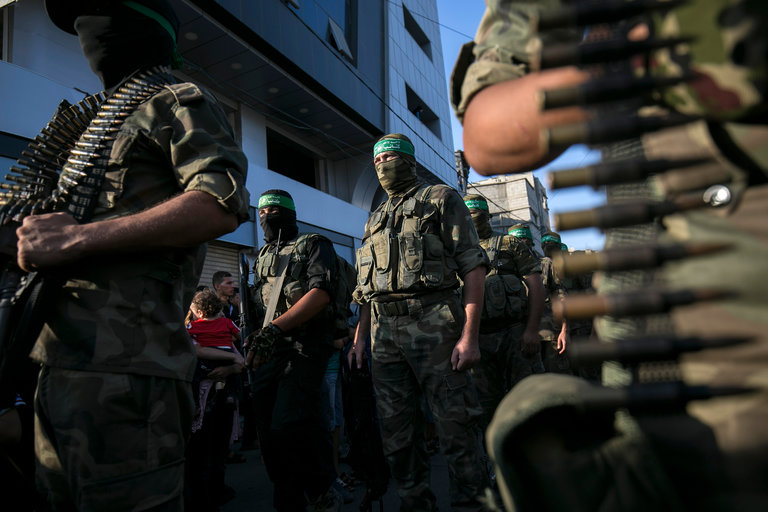
Members of the Qassam Brigades, the armed wing of the Hamas movement, in the Gaza Strip last year. (photo; Said Khatib / AFP / Getty Images)

Hamas presents new charter accepting a Palestine based on 1967 borders.

By Ian Fisher / The New York Times
May 1, 2017


“Whether it’s a coincidence or it’s connected, I have one thing to say: The Palestinian leadership is afraid of this Hamas moderation. Because the [Palestinian Authority] and Fatah are afraid that by this moderation, Hamas presents itself as the true representation of the Palestinian people.”
— Mkhaimar Abusada, political scientist at Al-Azhar University-Gaza

Hamas, the militant group built around violent resistance to Israel, sought on Monday to present a more moderate public face, taking its next shot in an intensifying struggle for leadership of the Palestinian cause and international recognition.

Released by Hamas just days before its chief rival, the Palestinian Authority leader Mahmoud Abbas, was to meet President Trump, a new document of principles for the group calls for closer ties to Egypt, waters down the anti-Semitic language from its charter, and accepts at least a provisional Palestinian state — though it still does not formally recognize Israel.

With its statement, Hamas is trying to offer a more mainstream-friendly version of its vision for the Palestinian cause, and to gain ground against Mr. Abbas, whose influence is growing more tenuous.

Continue reading “In Palestinian Power Struggle, Hamas Moderates Talk on Israel”