Palestinian Man Reports Sexual Assault; International Activists Allegedly Tied and Beaten by Israeli Settlers
Reported by Ryan P. Cruz in the Santa Barbara Independent Tue Mar 24, 2026
Warning: This article includes graphic content, including mentions of sexual assault.
A Santa Barbara activist volunteering in the occupied West Bank was among a group of people reportedly attacked, zip-tied, and beaten by Israeli settlers in a violent incident in which one Palestinian man was allegedly sexually assaulted, according to detailed accounts of the attack provided to the Independent.
The 24-year-old activist, a Santa Barbara community member who asked to be identified only by her first name, Ava, had been volunteering with Palestinian families in a shepherding village in the northern Jordan Valley for nearly two months when the incident took place in the early-morning hours on March 13.
Ava told the Independent that she and another international activist had been volunteering with the family of Qusai Abu al-Kebash in the village of Khirbet Humsa, where the family has lived off sheep dairy for generations. In recent months, she said, the family of shepherds has experienced increasing “harassment, theft, property destruction, assault” from Israeli settlers.
Ava said she was startled awake around 1:20 a.m. to find a large group of Israeli settlers, armed with clubs and knives, surrounding the tent she shared to keep night watch with the Palestinian father and the other activist. “They immediately beat the three of us to the ground, smashing our faces with their fists and clubs,” Ava said. “They zip-tied our hands and feet and were yelling things like ‘We are going to kill you!’”
The Palestinian man and the activists were all zip-tied at the wrists and ankles, and the attackers confiscated all phones, wallets, passports, and one of the activists’ bags. Ava said she was hit in the face when she could not immediately locate her phone in the chaos.
As this was happening, Ava said she saw the attackers aggressively strip Abu al-Kebash from the waist down before they zip-tied his genitals tightly, “poured water all over his naked bottom half,” and “brutally beat him into the dirt” with a club.
“All he could do was curl into the fetal position and scream,” Ava said.
Abu al-Kebash described the attack in a video interview with CNN, saying the settlers zip-tied his penis and dragged him around the village in an act of public humiliation.
Ava described fearing for her life as she was dragged out of the tent by her hair so forcefully that chunks were torn out. The activists and the father were hit with clubs and forced to the center of the property, where they saw the group of 30 Israeli settlers had let loose the family’s flock of more than 350 sheep. She said the settlers were “running around beating the rest of the Palestinian family,” and she could only hear shouting as she was whisked off into another tent.
In this tent, Ava and the other activists were forcefully shoved to the ground with the Palestinian men in the village. The children, she said, were huddled in the rear of the tent, whimpering and whispering prayers as the settlers beat and kicked the activists and men. Ava said the Palestinian men received the worst of the blows, with the patriarch curled up nearly unconscious with a “bleeding gash on his swollen cheek” from being hit with a rock.
Ava said a cloth was thrown over her face so she could no longer see. She said she heard the settlers taunting and threatening the family, telling them they would return if the family didn’t leave the land. The settlers forced the two activists to remove their rings, threatening to break their fingers and continuing to strike them in the face.
Ava said she was terrified of being sexually assaulted after seeing what the attackers did to the father of the family. “One settler messed with my belt, and I screamed because I thought they were going to rape me,” she said. “The whole time, I thought we were going to be raped.”
Then suddenly, she said, the group of attackers cut off their zip-ties and retreated. Ava described the chaotic scenes following the attack, with family members scrambling to gather any remaining sheep from the surrounding hills while women tended to the injured men with the few available flashlights. The settlers had cut off the electricity, Ava learned, and they had stolen hundreds of the family’s sheep — their main source of income — worth the equivalent of hundreds of thousands in U.S. dollars.
When the family eventually was able to get access to a phone, Ava said it became apparent how limited the options were for Palestinians in need of emergency resources in the occupied West Bank. The family could call the Israeli forces and risk being detained, arrested, or imprisoned. The Palestinian Authority has limited jurisdiction and would have no ability to investigate or prosecute Israeli settlers.
“All they could do was hope that the ambulance arrived soon, and pray that the sunrise would bring some fleeting semblance of security,” Ava said.
The family waited more than four hours before the Red Crescent ambulance arrived. Before that, two other international activists came to provide support, and the Israeli military came to question the men and speak with the injured.
Four of the men were transported to the hospital with major head injuries or other trauma wounds. The two activists were treated for minor injuries, with Ava sustaining bruises on her back and behind.
Ava said when the victims finally received medical treatment, she processed her emotions as the first light of dawn was just coming over the hills. She said the incident made her consider the impacts of Israel’s control over the land that the Abu al-Kebash family has tended for centuries.
“I cried for their land,” Ava said. “If they choose to remain, they are simply waiting for the next settler attack, but the human body and nervous system can only take so much trauma. Yet they have no where else to go; they’ve lived on their land since before they can remember. And they may never return if they are forcibly displaced.”
The attacks on Palestinian families in the Jordan Valley have increased in number over the past several months, Ava said. And the lack of arrests or convictions in violence committed against Palestinians has forced many to consider leaving the region. At the end of February, Israeli forces issued demolition orders for at least 10 farms in the area, and multiple families in the surrounding villages have left out of fear in the past few weeks alone.
Activists in the region fear that Israeli forces have accelerated conflicts in the West Bank since the start of the war in Iran. A day before the attack at Khirbet Humsa, two other nearby families were attacked by settlers; that same week, another Palestinian family was gunned down in the village of Tammun, just 30 minutes away from the Abu al-Kebash family land. According to the Palestinian Ministry of Health, nine Palestinians in the region have been killed by either Israeli military or settlers since the start of the Iran war.
Israeli authorities told CNN they were investigating the alleged attack on the Abu al-Kebash family and the theft of hundreds of sheep. They could not provide details into the investigation due to a gag order.
Ava said she hopes that people back home in Santa Barbara will consider the impacts of the U.S. government’s involvement in foreign military aid. Israel is the largest recipient of military aid since WWII, with more than $300 billion in aid over the course of its history.
“It is easy to call this the worst fucking night of my life,” Ava said. “But for Palestinians, it was but another violent injustice imposed by Israel on an infinitely long list of human rights abuses. Israel’s ethnic cleansing campaign must be stopped. It is one of the greatest evils of our time.”
Article by David Smith, published in The Guardian, 30 Jan 2026
First is وسام اياد محمد ابو فسيفس, or Wesam Iyad Mohammed Abu Fsaife, a 14-year-old boy. Last is صباح عمر سعد المصري, or Sabah Omar Saad al-Masri, an eight-year-old girl.
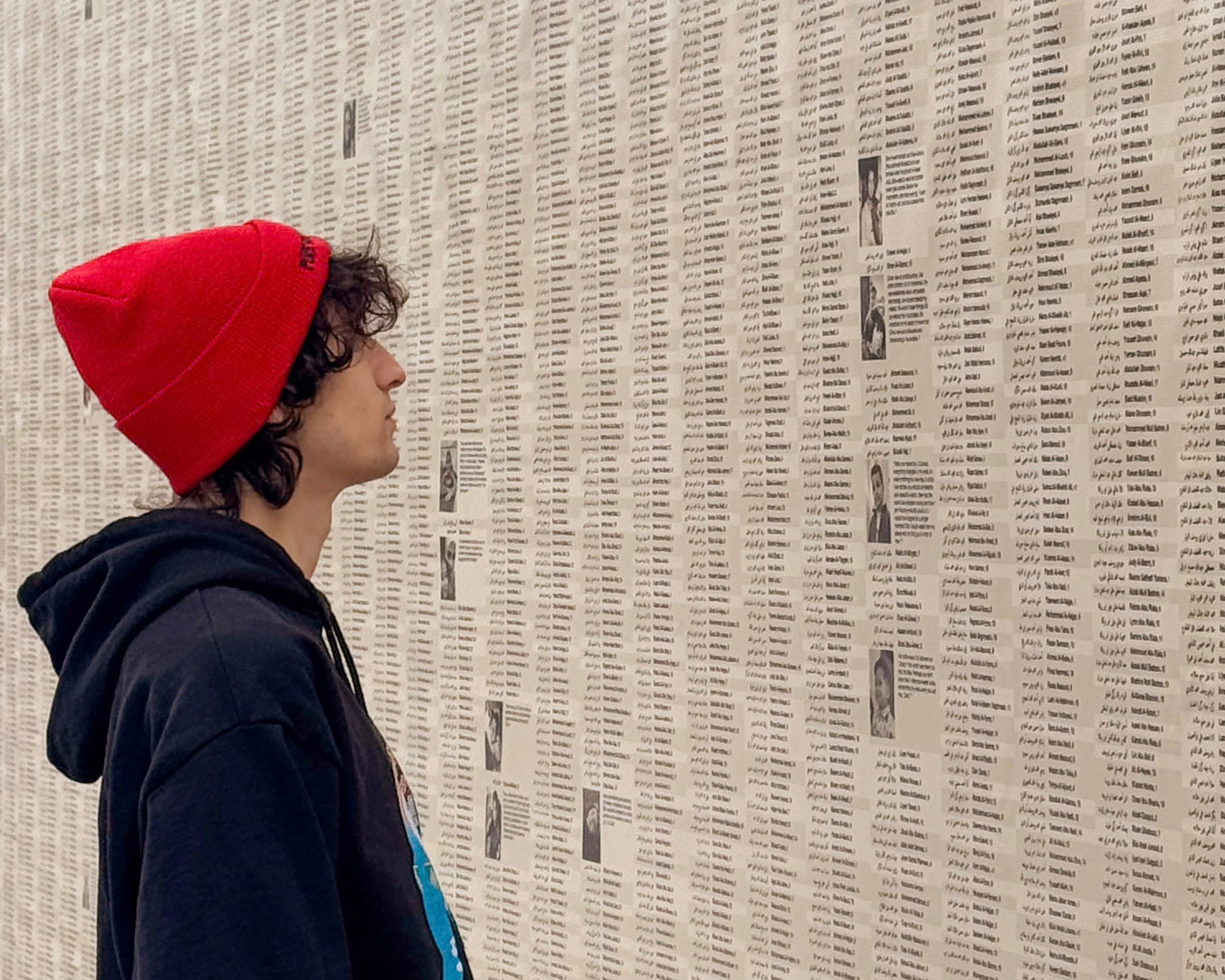
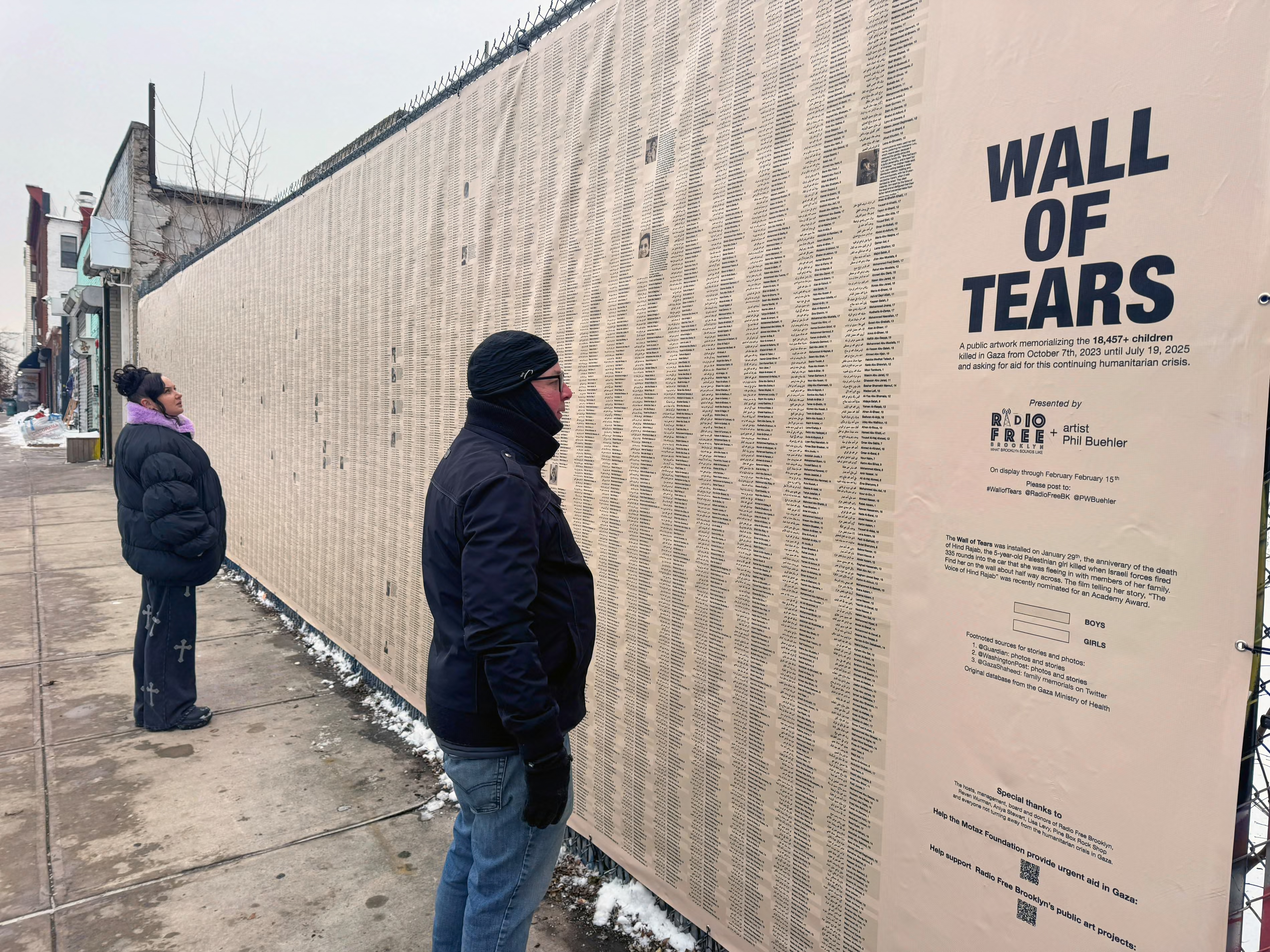
These names of two children mark the beginning and end of the Wall of Tears, a massive art installation paying homage to the 18,457 children killed in Gaza between 7 October 2023 and 19 July 2025. Created by artist Phil Buehler, it opened next to Pine Box Rock Shop bar at 12 Grattan Street in Brooklyn, New York, on Thursday.
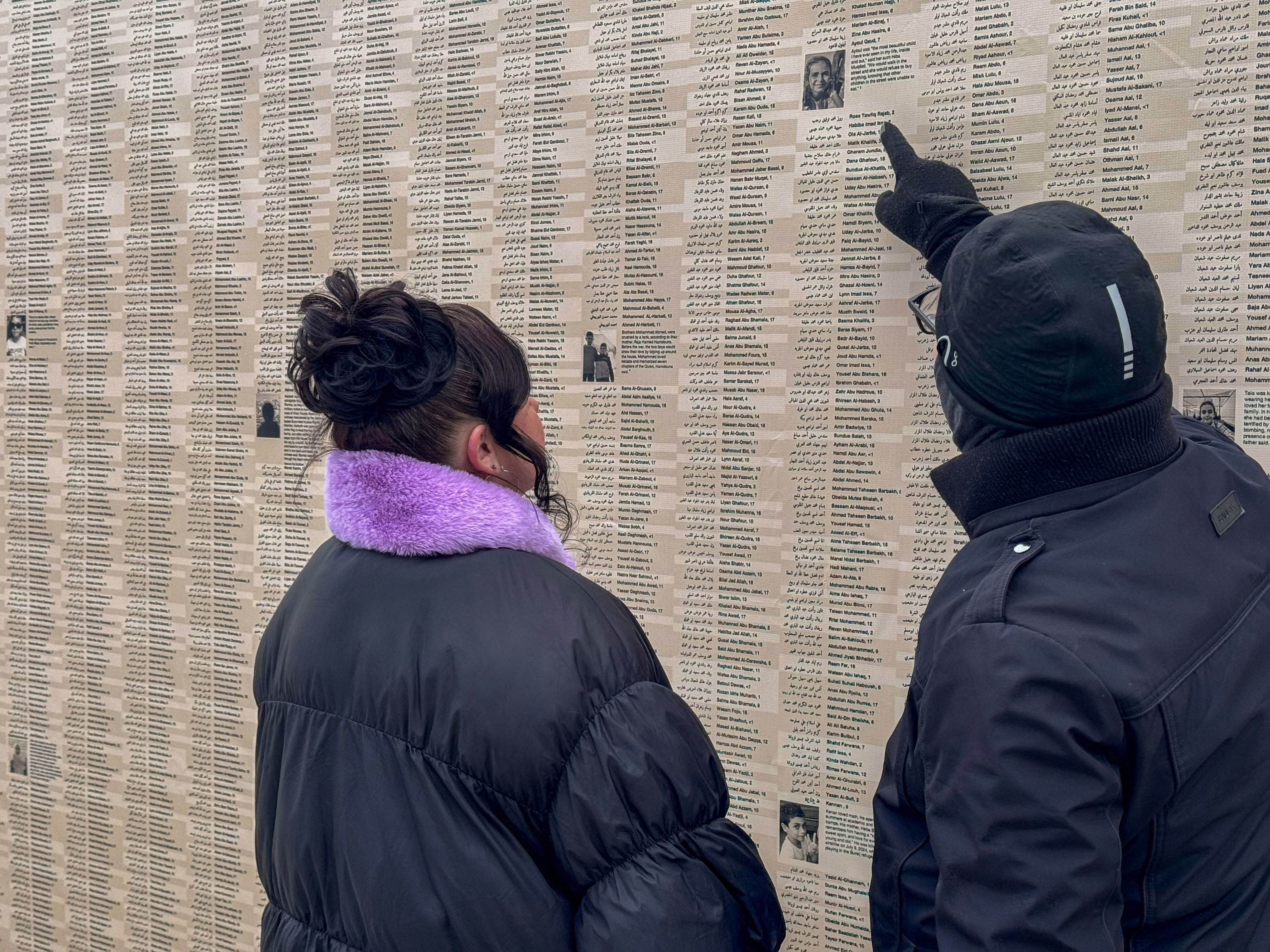
Made of waterproof and UV-coated vinyl, the 50ft long, 10ft tall sand-coloured mural lists the children killed in Gaza by the order in which they died, based on data from the Gaza health ministry. This will be punctuated by photos and stories of individual children, drawing on reports by the Guardian and Washington Post newspapers.
“If you approach from a distance, it looks like almost an abstract painting and that draws people in to see, what is that?” Buehler, 69, says by phone. “Then you’ll see they’re names of the children killed in Gaza since 7 October and there are thousands of them stretching down the block.
“Then you’ll be drawn in further, I hope, to see the faces, read the stories of some of the few dozen I’ve scattered throughout the fence. That’s the part that gets me when I look at it. You see these faces full of joy and hope, snapshots from graduations and birthday parties and family gatherings and knowing that these kids’ lives were just cut short.”
The artist reflects: “You can’t not think about your own kids and your own families. I hope that might lead people to think about how they might help, even if it’s just, take a photo of the mural and pass it along on their social media to their friends and family because hearing something from someone you know is important.”
Buehler has previously designed huge murals including Wall of Lies, displaying more than 20,000 lies told by Donald Trump during his first term as president; the Wall of Liars and Deniers, listing 381 Republican election deniers running in the 2022 midterms; the Wall of Shame, chronicling the actions of more than 1,500 January 6 rioters; and Empty Beds, highlighting the abduction of nearly 20,000 Ukrainian children by Russia.
Photograph: Phil Buehler
He worked on the Wall of Tears with his regular collaborator, the non-profit Radio Free Brooklyn. The project is necessarily out of date before it opens: it only records deaths up until last July because that was the most recent update to the Gaza health authorities’ database; hundreds more children have been killed since then, even after an October ceasefire.
“This is probably one of the hardest ones I’ve worked on emotionally,” Buehler says. “I always think of this quote attributed to Stalin, that a single death is a tragedy, a million deaths is a statistic. People can relate to one person’s suffering but then they tune out or get overwhelmed by thousands and the destruction and death in Gaza is one of those stories.
“I hope with this piece, the Wall of Tears, you can both understand the scale of these 18,457 children’s deaths by seeing their names stretching down the street 50 ft and empathise with their surviving families.”
Despite harsh weather, Buehler opened the installation on Thursday to coincide with the second anniversary of the death of Hind Rajab, a five-year-old left to bleed out among the bodies of six family members after their car was targeted by an Israeli tank, leaving it with 335 bullet holes, according to the Forensic Architecture research group.
The Palestine Red Crescent Society released audio recordings of Hind’s final hours, documenting repeated, urgent requests for rescue and call handlers, increasingly distressed themselves, assuring her that help was on the way. This real-life audio can be heard in the The Voice of Hind Rajab, a Tunisian film by the director Kaouther Ben Hania that has been nominated for an Oscar in the international feature category.
Photograph: Phil Buehler
Buehler says: “The film is incredibly gut-wrenching and it does deserve an Academy award because it’s a re-enactment of the call, where the Red Crescent are taking the call, but the voice is hers.She’s on the phone. She’s five and she’s pleading, come get me. This innocent five-year-old kid has become the image of the tragedy there.”
The war in Gaza has been a divisive issue in New York, which with nearly 1 million Jews has the biggest Jewish population outside Israel. Efforts to brand Zohran Mamdani, a champion of Palestinian rights, as antisemitic, fell flat as he won election to become New York’s first Muslim mayor.
Buehler rejects the notion that opposition to the war equates to antisemitism. “Conflating those two things makes it more difficult to talk about,” he says. “You can’t have that conversation at all. I worry a little bit about that with this piece.
“I talked to a lot of both Palestinian and Jewish friends. Most of my Jewish friends are liberal Jews and their reaction was, it’s a tragedy, their heart goes out for these kids and these families, but they are afraid bringing attention to it will bounce back as antisemitism.
“So Jews are afraid of bringing attention to it and Palestinians are afraid of bringing attention to it because it bounces back against them. This moment in time in our culture and our world is not one for open dialogue. It’s so split, so tribal. ‘If you are against killing the kids in Gaza then you must be against Jews.’ That’s not true.”
I am writing you an open letter since you have seen fit to communicate the recent decisions of the board of trustees and the administration in a similar fashion.
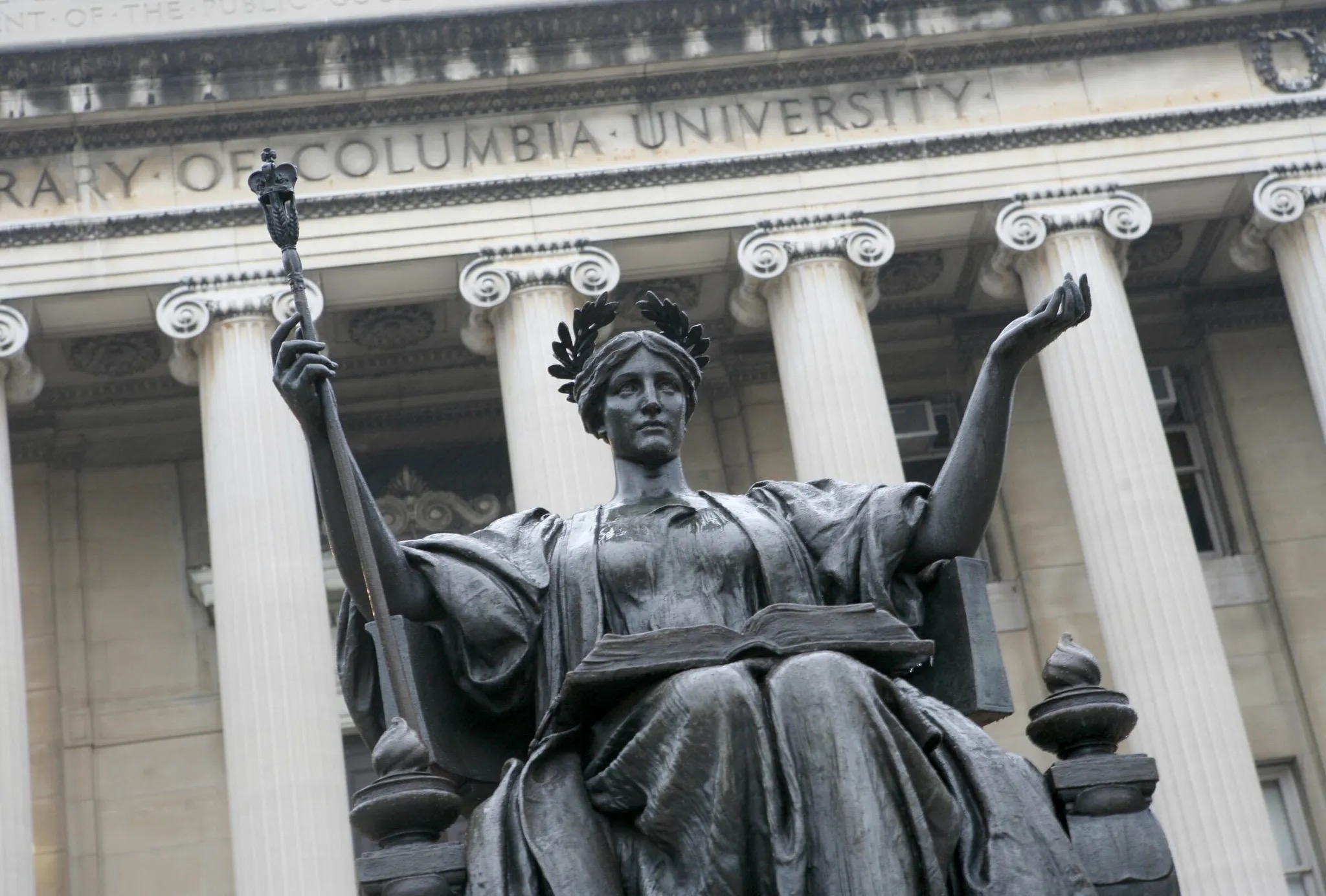
These decisions, taken in close collaboration with the Trump administration, have made it impossible for me to teach modern Middle East history, the field of my scholarship and teaching for more than 50 years, 23 of them at Columbia. Although I have retired, I was scheduled to teach a large lecture course on this topic in the fall as a “special lecturer”, but I cannot do so under the conditions Columbia has accepted by capitulating to the Trump administration in June.
Specifically, it is impossible to teach this course (and much else) in light of Columbia’s adoption of the International Holocaust Remembrance Alliance (IHRA) definition of antisemitism. The IHRA definition deliberately, mendaciously and disingenuously conflates Jewishness with Israel, so that any criticism of Israel, or indeed description of Israeli policies, becomes a criticism of Jews. Citing its potential chilling effect, a co-author of the IHRA definition, Professor Kenneth Stern, has repudiated its current uses. Yet Columbia has announced that it will serve as a guide in disciplinary proceedings.
Under this definition of antisemitism, which absurdly conflates criticism of a nation-state, Israel, and a political ideology, Zionism, with the ancient evil of Jew-hatred, it is impossible with any honesty to teach about topics such as the history of the creation of Israel, and the ongoing Palestinian Nakba, culminating in the genocide being perpetrated by Israel in Gaza with the connivance and support of the US and much of western Europe.
The Armenian genocide, the nature of the absolute monarchies and military dictatorships that blight most of the Arab world, the undemocratic theocracy in Iran, the incipient dictatorial regime in Türkiye, the fanaticism of Wahhabism: all of these are subject to detailed analysis in my course lectures and readings. However, a simple description of the discriminatory nature of Israel’s 2018 Nation State Law – which states that only the Jewish people have the right of self-determination in Israel, half of whose subjects are Palestinian – or of the apartheid nature of its control over millions of Palestinians who have been under military occupation for 58 years would be impossible in a Middle East history course under the IHRA definition of antisemitism.
It is not only faculty members’ academic freedom and freedom of speech that is infringed upon by Columbia’s capitulation to Trump’s diktat. Teaching assistants would be seriously constrained in leading discussion sections, as would students in their questions and discussions, by the constant fear that informers would snitch on them to the fearsome apparatus that Columbia has erected to punish speech critical of Israel, and to crack down on alleged discrimination – which at this moment in history almost invariably amounts simply to opposition to this genocide. Scores of students and many faculty members have been subjected to these kangaroo courts, students such as Mahmoud Khalil have been snatched from their university housing, and Columbia has now promised to render this repressive system even more draconian and opaque.
You have stated that no “red lines” have been crossed by these decisions. However, Columbia has appointed a vice-provost initially tasked with surveilling Middle Eastern studies, and it has ordained that faculty and staff must submit to “trainings” on antisemitism from the likes of the Anti-Defamation League, for whom virtually any critique of Zionism or Israel is antisemitic, and Project Shema, whose trainings link many anti-Zionist critiques to antisemitism. It has accepted an “independent” monitor of “compliance” of faculty and student behavior from a firm that in June 2025 hosted an event in honor of Israel. According to Columbia’s agreement with the Trump administration, this “Monitor will have timely access to interview all Agreement-related individuals, and visit all Agreement-related facilities, trainings, transcripts of Agreement-related meetings and disciplinary hearings, and reviews”. Classrooms are pointedly NOT excluded from possible visits from these external non academics.
The idea that the teaching, syllabuses and scholarship of some of the most prominent academics in their fields should be vetted by such a vice-provost, such “trainers” or an outside monitor from such a firm is abhorrent. It constitutes the antithesis of the academic freedom that you have disingenuously claimed will not be infringed by this shameful capitulation to the anti-intellectual forces animating the Trump administration.
I regret deeply that Columbia’s decisions have obliged me to deprive the nearly 300 students who have registered for this popular course – as many hundreds of others have done for more than two decades – of the chance to learn about the history of the modern Middle East this fall. Although I cannot do anything to compensate them fully for depriving them of the opportunity to take this course, I am planning to offer a public lecture series in New York focused on parts of this course that will be streamed and available for later viewing. Proceeds, if any, will go to Gaza’s universities, every one of which has been destroyed by Israel with US munitions, a war crime about which neither Columbia nor any other US university has seen fit to say a single word.
Columbia’s capitulation has turned a university that was once a site of free inquiry and learning into a shadow of its former self, an anti-university, a gated security zone with electronic entry controls, a place of fear and loathing, where faculty and students are told from on high what they can teach and say, under penalty of severe sanctions. Disgracefully, all of this is being done to cover up one of the greatest crimes of this century, the ongoing genocide in Gaza, a crime in which Columbia’s leadership is now fully complicit.
– Rashid Khalidi
Rashid Khalidi is the Edward Said professor emeritus of modern Arab studies at Columbia University and author of The Hundred Years’ War on Palestine
July 16, Wednesday at 7pm – Movie Night – We will be showing No Other Land, a 2024 documentary film. The film was recorded between 2019 and 2023 and shows the destruction of a Palestinian community in the occupied West Bank, which had been resisting forced displacement after an Israeli “firing zone” was declared on their land. The film won Best Documentary Feature Film at the 97th Academy Awards.
August 6, Wednesday at 7pm – Movie Night – The Settlers, A BBC documentary by Louis Theroux that examines the Israeli settler movement in the West Bank and its impact on Palestinians. The movie interviews and observes both Palestinians living in the occupied West Bank and members of the Israeli settler movement. The documentary explores the daily lives of various characters living on the most contested land in the world.
August 13, Wednesday at 6pm – Dinner and short film night – The Present is a 2020 short film about a father and daughter in the Palestinian enclaves of the Israeli-occupied West Bank trying to buy a wedding anniversary gift. It won the BAFTA Award for Best Short Film in addition to being nominated for the Academy Award for Best Live Action Short Film. We will be serving a delicious middle eastern dinner (vegetarian options available) at 6pm and the short film at 7pm.
August 17, Sunday at 11:45pm approx. – Coffee hour speaker –Dr. Liora Halperin, a Professor of International Studies and History, and Distinguished Endowed Chair of Jewish Studies, at the University of Washington will be our speaker. She is an historian of Israel/Palestine with particular interests in nationalism and collective memory, Jewish cultural and social history, language ideology and policy, and the politics of colonization and settlement.
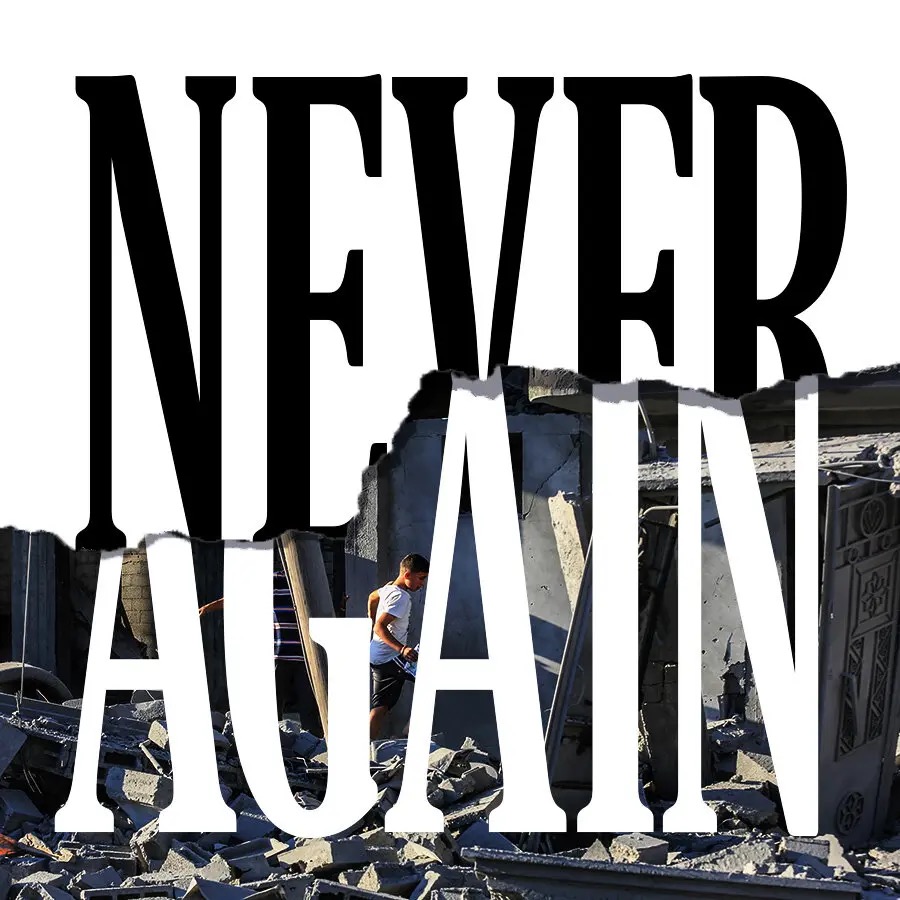
Photo illustration by Kristie Bailey/The New York Times; source images from Iryna Veklich, Anadolu/Getty Images
By Omer Bartov
Dr. Bartov is a professor of Holocaust and genocide studies at Brown University.
A month after the Hamas attack on Israel on Oct. 7, 2023, I believed there was evidence that the Israeli military had committed war crimes and potentially crimes against humanity in its counterattack on Gaza. But contrary to the cries of Israel’s fiercest critics, the evidence did not seem to me to rise to the crime of genocide.
By May 2024, the Israel Defense Forces had ordered about one million Palestinians sheltering in Rafah — the southernmost and last remaining relatively undamaged city of the Gaza Strip — to move to the beach area of the Mawasi, where there was little to no shelter. The army then proceeded to destroy much of Rafah, a feat mostly accomplished by August.
At that point it appeared no longer possible to deny that the pattern of I.D.F. operations was consistent with the statements denoting genocidal intent made by Israeli leaders in the days after the Hamas attack. Prime Minister Benjamin Netanyahu had promised that the enemy would pay a “huge price” for the attack and that the I.D.F. would turn parts of Gaza, where Hamas was operating, “into rubble,” and he called on “the residents of Gaza” to “leave now because we will operate forcefully everywhere.”
Mr. Netanyahu had urged his citizens to remember “what Amalek did to you,” a quote many interpreted as a reference to the demand in a biblical passage calling for the Israelites to “kill alike men and women, infants and sucklings” of their ancient enemy. Government and military officials said they were fighting “human animals” and, later, called for “total annihilation.” Nissim Vaturi, the deputy speaker of Parliament, said on X that Israel’s task must be “erasing the Gaza Strip from the face of the earth.” Israel’s actions could be understood only as the implementation of the expressed intent to make the Gaza Strip uninhabitable for its Palestinian population. I believe the goal was — and remains today — to force the population to leave the Strip altogether or, considering that it has nowhere to go, to debilitate the enclave through bombings and severe deprivation of food, clean water, sanitation and medical aid to such an extent that it is impossible for Palestinians in Gaza to maintain or reconstitute their existence as a group.
My inescapable conclusion has become that Israel is committing genocide against the Palestinian people. Having grown up in a Zionist home, lived the first half of my life in Israel, served in the I.D.F. as a soldier and officer and spent most of my career researching and writing on war crimes and the Holocaust, this was a painful conclusion to reach, and one that I resisted as long as I could. But I have been teaching classes on genocide for a quarter of a century. I can recognize one when I see one.
This is not just my conclusion. A growing number of experts in genocide studies and international law have concluded that Israel’s actions in Gaza can only be defined as genocide. So has Francesca Albanese, the U.N. special rapporteur for the West Bank and Gaza, and Amnesty International. South Africa has brought a genocide case against Israel at the International Court of Justice.
The continued denial of this designation by states, international organizations and legal and scholarly experts will cause unmitigated damage not just to the people of Gaza and Israel but also to the system of international law established in the wake of the horrors of the Holocaust, designed to prevent such atrocities from happening ever again. It is a threat to the very foundations of the moral order on which we all depend.
***
The crime of genocide was defined in 1948 by the United Nations as the “intent to destroy, in whole or in part, a national, ethnical, racial or religious group, as such.” In determining what constitutes genocide, therefore, we must both establish intent and show that it is being carried out. In Israel’s case, that intent has been publicly expressed by numerous officials and leaders. But intent can also be derived from a pattern of operations on the ground, and this pattern became clear by May 2024 — and has since become ever clearer — as the I.D.F. has systematically destroyed the Gaza Strip.
Most genocide scholars are cautious about applying this term to contemporary events, precisely because of the tendency, since it was coined by the Jewish-Polish lawyer Raphael Lemkin in 1944, to attribute it to any case of massacre or inhumanity. Indeed, some argue that the categorization should be entirely discarded, because it often serves more to express outrage than to identify a particular crime.
Yet as Mr. Lemkin recognized, and as the United Nations later agreed, it is crucial to be able to distinguish the attempt to destroy a particular group of people from other crimes under international law, such as war crimes and crimes against humanity. This is because, while other crimes entail indiscriminate or deliberate killing of civilians as individuals, genocide denotes the killing of people as members of a group, geared at irreparably destroying the group itself so that it would never be able to reconstitute itself as a political, social or cultural entity. And, as the international community signaled by adopting the convention, it is incumbent upon all signatory states to prevent such an attempt, to do all they can to stop it while it is occurring and to subsequently punish those who were engaged in this crime of crimes — even if it occurred within the borders of a sovereign state.
The designation has major political, legal and moral ramifications. Nations, politicians and military personnel suspected of, indicted on a charge of or found guilty of genocide are seen as beyond the pale of humanity and may compromise or lose their right to remain members of the international community. A finding by the International Court of Justice that a particular state is engaged in genocide, especially if enforced by the U.N. Security Council, can lead to severe sanctions.
Politicians or generals indicted on a charge of or found guilty of genocide or other breaches of international humanitarian law by the International Criminal Court can face arrest outside of their country. And a society that condones and is complicit in genocide, whatever the stand of its individual citizens may be, will carry this mark of Cain long after the fires of hatred and violence are put out.
***
Israel has denied all allegations of war crimes, crimes against humanity and genocide. The I.D.F. says it investigates reports of crimes, although it has rarely made its findings public, and when breaches of discipline or protocol are acknowledged, it has generally meted light reprimands to its personnel. Israeli military and political leaders repeatedly describe the I.D.F. as acting lawfully, say they issue warnings to civilian populations to evacuate sites about to be attacked and blame Hamas for using civilians as human shields.
In fact, the systematic destruction in Gaza not only of housing but also of other infrastructure — government buildings, hospitals, universities, schools, mosques, cultural heritage sites, water treatment plants, agriculture areas, and parks — reflects a policy aimed at making the revival of Palestinian life in the territory highly unlikely.
According to a recent investigation by Haaretz, an estimated 174,000 buildings have been destroyed or damaged, accounting for up to 70 percent of all structures in the Strip. So far, more than 58,000 people have been killed, according to Gazan health authorities, including more than 17,000 children, who make up nearly a third of the total fatality count. More than 870 of those children were less than a year old.
More than 2,000 families have been wiped out, the health authorities said. In addition, 5,600 families now count only one survivor. At least 10,000 people are believed to still be buried under the ruins of their homes. More than 138,000 have been wounded and maimed.
Gaza now has the grim distinction of having the highest number of amputee children per capita in the world. An entire generation of children subjected to ongoing military attacks, loss of parents and long-term malnutrition will suffer severe physical and mental repercussions for the rest of their lives. Untold additional thousands of chronically ill persons have had little access to hospital care.
The horror of what has been happening in Gaza is still described by most observers as war. But this is a misnomer. For the last year, the I.D.F. has not been fighting an organized military body. The version of Hamas that planned and carried out the attacks on Oct. 7 has been destroyed, though the weakened group continues to fight Israeli forces and retains control over the population in areas not held by the Israeli Army.
Today the I.D.F. is primarily engaged in an operation of demolition and ethnic cleansing. That’s how Mr. Netanyahu’s own former chief of staff and minister of defense, the hard-liner Moshe Yaalon, in November described on Israel’s Democrat TV and in subsequent articles and interviews the attempt to clear northern Gaza of its population.
On Jan. 19, under pressure from Donald Trump, who was a day away from resuming the presidency, a cease-fire went into effect, facilitating the exchange of hostages in Gaza for Palestinian prisoners in Israel. But after Israel’s breaking of the cease-fire on March 18, the I.D.F. has been executing a well-publicized plan to concentrate the entire Gazan population in a quarter of the territory in three zones: Gaza City, the central refugee camps and the Mawasi coastline in the Strip’s southwestern edge.
Using large numbers of bulldozers and huge aerial bombs supplied by the United States, the military appears to be trying to demolish every remaining structure and establish control over the other three-quarters of the territory.
This is also being facilitated by a plan that provides — intermittently — limited aid supplies at a few distribution points guarded by the Israeli military, drawing people to the south. Many Gazans are killed in a desperate attempt to obtain food, and the starvation crisis deepens. On July 7, Defense Minister Israel Katz said the I.D.F. would build a “humanitarian city” over the ruins of Rafah to initially accommodate 600,000 Palestinians from the Mawasi area, who would be provisioned by international bodies and not allowed to leave.
Some might describe this campaign as ethnic cleansing, not genocide. But there is a link between the crimes. When an ethnic group has nowhere to go and is constantly displaced from one so-called safe zone to another, relentlessly bombed and starved, ethnic cleansing can morph into genocide.
This was the case in several well-known genocides of the 20th century, such as that of the Herero and Nama in German South West Africa, now Namibia, that began in 1904; the Armenians in World War I; and, indeed, even in the Holocaust, which began with the German attempt to expel the Jews and ended up with their murder.
To this day, only a few scholars of the Holocaust, and no institution dedicated to researching and commemorating it, has issued a warning that Israel could be accused of carrying out war crimes, crimes against humanity, ethnic cleansing or genocide. This silence has made a mockery of the slogan “Never again,” transforming its meaning from an assertion of resistance to inhumanity wherever it is perpetrated to an excuse, an apology, indeed, even a carte blanche for destroying others by invoking one’s own past victimhood.
This is another of the many incalculable costs of the current catastrophe. As Israel is literally trying to wipe out Palestinian existence in Gaza and is exercising increasing violence against Palestinians in the West Bank, the moral and historical credit which the Jewish State has drawn on until now is running out.
Israel, created in the wake of the Holocaust as the answer to the Nazi genocide of the Jews, has always insisted that any threat to its security must be seen as potentially leading to another Auschwitz. This provides Israel with license to portray those it perceives as its enemies as Nazis — a term used repeatedly by Israeli media figures to depictHamas and, by extension, all Gazans, based on the popular assertion that none of them are “uninvolved,” not even the infants, who would grow up to be militants.
This is not a new phenomenon. As early as Israel’s invasion of Lebanon in 1982, Prime Minister Menachem Begin compared Yasir Arafat, then hunkered down in Beirut, to Adolf Hitler in his Berlin bunker. This time, the analogy is being used in connection with a policy aimed at uprooting and removing the entire population of Gaza.
The daily scenes of horror in Gaza, from which the Israeli public is shielded by its own media’s self-censorship, expose the lies of Israeli propaganda that this is a war of defense against a Nazi-like enemy. One shudders when Israeli spokespeople shamelessly utter the hollow slogan of the I.D.F. being the “most moral army in the world.”
Some European nations, such as France, Britain and Germany, as well as Canada, have feebly protested Israeli actions, especially since it breached the cease-fire in March. But they have neither suspended arms shipments nor taken many concrete and meaningful economic or political steps that might deter Mr. Netanyahu’s government.
For a while, the United States government seemed to have lost interest in Gaza, with President Trump initially announcing in February that the United States would take over Gaza, promising to turn it into “the Riviera of the Middle East,” and then letting Israel get on with the Strip’s destruction and turning his attention to Iran. At the moment, one can only hope that Mr. Trump will again pressure a reluctant Mr. Netanyahu to at least reach a new cease-fire and put an end to the relentless killing.
***
How will Israel’s future be affected by the inevitable demolition of its incontestable morality, derived from its birth in the ashes of the Holocaust?
Israel’s political leadership and its citizenry will have to decide. There seems to be little domestic pressure for the urgently needed change of paradigm: the recognition that there is no solution to this conflict other than an Israeli-Palestinian agreement to share the land under whatever parameters the two sides agree on, be it two states, one state or a confederation. Robust external pressure from the country’s allies also appears unlikely. I am deeply worried that Israel will persist on its disastrous course, remaking itself, perhaps irreversibly, into a full-blown authoritarian apartheid state. Such states, as history has taught us, do not last.
Another question arises: What consequences will Israel’s moral reversal have for the culture of Holocaust commemoration, and the politics of memory, education and scholarship, when so many of its intellectual and administrative leaders have up to now refused to face up to their responsibility to denounce inhumanity and genocide wherever they occur?
Those engaged in the worldwide culture of commemoration and remembrance built around the Holocaust will have to confront a moral reckoning. The wider community of genocide scholars — those engaged in the study of comparative genocide or of any one of the many other genocides that have marred human history — is now edging ever closer toward a consensus over describing events in Gaza as a genocide.
In November, a little more than a year into the war, the Israeli genocide scholar Shmuel Lederman joined the growing chorus of opinion that Israel was engaged in genocidal actions. The Canadian international lawyer William Schabas came to the same conclusion last year and has recently described Israel’s military campaign in Gaza as “absolutely” a genocide.
Other genocide experts, such as Melanie O’Brien, president of the International Association of Genocide Scholars, and the British specialist Martin Shaw (who has also said that the Hamas attack was genocidal), have reached the same conclusion, while the Australian scholar A. Dirk Moses of the City University of New York described these events in the Dutch publication NRC as a “mix of genocidal and military logic.” In the same article, Uğur Ümit Üngör, a professor at the Amsterdam-based NIOD Institute for War, Holocaust and Genocide Studies, said there are probably scholars who still do not think it’s genocide, but “I don’t know them.”
Most Holocaust scholars I know don’t hold, or at least publicly express, this view. With a few notable exceptions, such as the Israeli Raz Segal, program director of Holocaust and genocide studies at Stockton University in New Jersey, and the Hebrew University of Jerusalem historians Amos Goldberg and Daniel Blatman, the majority of academics engaged with the history of the Nazi genocide of the Jews have stayed remarkably silent, while some have openly denied Israel’s crimes in Gaza, or accused their more critical colleagues of incendiary speech, wild exaggeration, well poisoning and antisemitism.
In December the Holocaust scholar Norman J.W. Goda opined that “genocide charges like this have long been used as a fig leaf for broader challenges to Israel’s legitimacy,” expressing his worry that “they have cheapened the gravity of the word genocide itself.” This “genocide libel,” as Dr. Goda referred to it in an essay, “deploys a range of antisemitic tropes,” including “the coupling of the genocide charge with the deliberate killing of children, images of whom are ubiquitous on NGO, social media, and other platforms that charge Israel with genocide.”
In other words, showing images of Palestinian children ripped apart by U.S.-made bombs launched by Israeli pilots is, in this view, an antisemitic act.
Most recently, Dr. Goda and a respected historian of Europe, Jeffrey Herf, wrote in The Washington Post that “the genocide accusation hurled against Israel draws on deep wells of fear and hatred” found in “radical interpretations of both Christianity and Islam.” It “has shifted opprobrium from Jews as a religious/ethnic group to the State of Israel, which it depicts as inherently evil.”
***
What are the ramifications of this rift between genocide scholars and Holocaust historians? This is not merely a squabble within academe. The memory culture created in recent decades around the Holocaust encompasses much more than the genocide of the Jews. It has come to play a crucial role in politics, education and identity.
Museums dedicated to the Holocaust have served as models for representations of other genocides around the world. Insistence that the lessons of the Holocaust demand the promotion of tolerance, diversity, antiracism and support for migrants and refugees, not to mention human rights and international humanitarian law, is rooted in an understanding of the universal implications of this crime in the heart of Western civilization at the peak of modernity.
Discrediting genocide scholars who call out Israel’s genocide in Gaza as antisemitic threatens to erode the foundation of genocide studies: the ongoing need to define, prevent, punish and reconstruct the history of genocide. Suggesting that this endeavor is motivated instead by malign interests and sentiments — that it is driven by the very hatred and prejudice that was at the root of the Holocaust — is not only morally scandalous, it provides an opening for a politics of denialism and impunity as well.
By the same token, when those who have dedicated their careers to teaching and commemorating the Holocaust insist on ignoring or denying Israel’s genocidal actions in Gaza, they threaten to undermine everything that Holocaust scholarship and commemoration have stood for in the past several decades. That is, the dignity of every human being, respect for the rule of law and the urgent need never to let inhumanity take over the hearts of people and steer the actions of nations in the name of security, national interest and sheer vengeance.
What I fear is that in the aftermath of the Gaza genocide, it will no longer be possible to continue teaching and researching the Holocaust in the same manner we did before. Because the Holocaust has been so relentlessly invoked by the State of Israel and its defenders as a cover-up for the crimes of the I.D.F., the study and remembrance of the Holocaust could lose its claim to be concerned with universal justice and retreat into the same ethnic ghetto in which it began its life at the end of World War II — as a marginalized preoccupation by the remnants of a marginalized people, an ethnically specific event, before it succeeded, decades later, to find its rightful place as a lesson and a warning for humanity as a whole.
Just as worrisome is the prospect that the study of genocide as a whole will not survive the accusations of antisemitism, leaving us without the crucial community of scholars and international jurists to stand in the breach at a time when the rise of intolerance, racial hatred, populism and authoritarianism is threatening the values that were at the core of these scholarly, cultural and political endeavors of the 20th century.
Perhaps the only light at the end of this very dark tunnel is the possibility that a new generation of Israelis will face their future without sheltering in the shadow of the Holocaust, even as they will have to bear the stain of the genocide in Gaza perpetrated in their name. Israel will have to learn to live without falling back on the Holocaust as justification for inhumanity. That, despite all the horrific suffering we are currently watching, is a valuable thing, and may, in the long run, help Israel face the future in a healthier, more rational and less fearful and violent manner.
This will do nothing to compensate for the staggering amount of death and suffering of Palestinians. But an Israel liberated from the overwhelming burden of the Holocaust may finally come to terms with the inescapable need for its seven million Jewish citizens to share the land with the seven million Palestinians living in Israel, Gaza and the West Bank in peace, equality and dignity. That will be the only just reckoning.
The House of Bishops, which has been meeting in York this week, has issued a statement on the situation in Gaza. (May 22, 2025)
“Blessed are the peacemakers, for they shall be called children of God.” (Matthew 5:9)
Recalling our Easter statement (April 14, 2025) following the Government of Israel’s bombing of the Anglican Al Ahli Hospital, we cry out in protest at the death, destruction and suffering that men, women and children have endured in Gaza, Israel and the region these last 20 months. We abhor war in all its forms and see it as a sign of human brokenness.
Nothing justifies the heinous terror attacks committed by Hamas on October 7 2023. In such circumstances nations have a right to self-defence in line with international law, and to hold perpetrators to account.
Yet, the Government of Israel has shown through its statements and actions that this is no longer a defensive war, but a war of aggression. We strongly affirm that the Palestinian inhabitants of Gaza and the West Bank have a right to live in peace and security in their homeland. Any forced displacement of people would constitute an egregious breach of international humanitarian law.
We have watched with horror and outrage as siege and starvation are used as a weapon of war in Gaza, and as hospitals and health facilities have been systemically targeted. Over the last three months, the Israeli government’s deliberate denial of food and medical aid to an entire civilian population is an atrocity that defies our common humanity. It is the very definition of collective punishment and has no moral justification.
We note that the Israeli Government has been challenged before the International Court of Justice. Starving children cannot wait for legal rulings given that every country has an obligation to prevent crimes against humanity. As Bishops we are compelled to state clearly and unequivocally that the death, suffering and destruction being inflicted on Gaza is a grave sin that violently assaults God-given human dignity and the very integrity of God’s creation.
We call on all sides to end the war. We call on relevant UN bodies to be allowed to administer all necessary aid in line with long standing humanitarian principles. We call for the immediate release of all hostages without condition. The continued expansion of settlements in the West Bank, the appalling levels of settler violence, and the forced displacements and house demolitions must cease.
We support and applaud all those Jewish voices, both inside and outside of Israel, that are courageously pressing the Israeli Government to end the war. We add our voices to those urging the Government of Israel to turn away from its current trajectory and to affirm life and human dignity for all.
We welcome the British Government’s decision (May 20 2025) to suspend negotiations with the Israeli government on a new free trade agreement. This is a necessary first step. Fuelling this war by the selling of arms to Israel does not serve the ends of peace consistent with international humanitarian law. The use of dehumanising language by members of the current Israeli government is dangerous and must be challenged. To maintain the hope of a long-lasting peaceful solution, governments should now formally recognise Palestine as a sovereign and independent state. To delay further invites despair.
For our own part, we commit to pray and to work for an end to this war, the release of all hostages and to support efforts to secure a long-term settlement that delivers security, justice and peace for Israelis and Palestinians.
We are deeply conscious of the real sense of fear that many within the Jewish community here feel at this moment. We treasure our relations with our Jewish brothers and sisters and will continue to condemn antisemitic rhetoric or action in all its forms. We condemn the shocking and senseless murder of two Israeli embassy staff in Washington DC.
We encourage dioceses and parishes to continue supporting the ongoing appeal for the Diocese of Jerusalem, including the restoring of medical facilities and the buildings of the Al Ahli Anglican Hospital in Gaza. Such efforts reassure our Palestinian Christian brothers and sisters and all other Christian communities that they are not forgotten. We give thanks for their steadfastness and faithful witness, and invite churches across the country to join us in praying for their ministry in sharing the light of Christ in such dark times.
Palestinian girls look at the rubble of the Abou Mahadi family destroyed in Israeli strikes in Beit Lahia in the northern Gaza Strip on April 28, 2025. (Bashar Taleb/AFP/Getty Images North America/TNS)
No words can better capture the reality in Gaza today than this: We are dying.
Every day, in every imaginable way, we die. Death comes by missile, by gunshot, by collapsed building, by lack of medicine and by fear. And now, once again, it will come by hunger as Israel has closed off humanitarian supplies— with the agreement of not just the Trump administration but also the tacit support of the people of the U.S. and Europe who elected governments not committed to the rule of law and to stopping atrocities.
Many are responsible for the small wasted bodies that will soon be seen again on Western television screens.
Israeli Prime Minister Benjamin Netanyahu and President Donald Trump met again this month — from positions of power and comfort, deciding the fate of people they will never meet. In their decisions, Gaza’s children are reduced to collateral. Mothers, fathers and whole families are figures on a chessboard, disposable.
Our kitchens used to smell like home — warm spices, olive oil, bread baking in the early afternoon. Now they smell like nothing. Just metal cans and whatever dried goods we can scavenge. Stocks that were able to come in at scale during the ceasefire “have practically run out,” according to John Whyte of the United Nations relief agency for Palestinians.
For six weeks, no aid has entered Gaza because of the ongoing Israeli blockade. The United Nations World Food Program said Friday that it had run out of food in Gaza. More than 2.1 million people are trapped, bombed and starved.
When we can eat, it is only to survive, not to be full. Not to feel joy. Children line up for charity meals holding out plastic containers. Mothers break down while trying to quiet their babies’ hungry cries. Fathers stare at the ground, ashamed to be unable to provide for their families. We try to turn next to nothing into something, but even the imagination is tired.
Fruit, vegetables, meat — these are memories now. In the past, even under siege, we shared what little we had. But this time is different. Our shelves are bare.
How did it come to this? How did the world get to a place where the collective punishment of starvation is used as leverage to shape the terms of a ceasefire?
This isn’t a consequence of war. It’s a strategy. A deliberate and systematic Israeli effort — with Western acceptance — to make hunger a form of control. A way to turn a people into a population too weakened to resist oppression. This is not rationing. It’s removal.
And still, we remember who we are. We remember 1948, when our grandparents were forced from their homes. We remember 1967, when we were uprooted again. In every chapter, we held onto the land, planted in its soil.
But this time, Israel has taken the fields too. Israel has taken the water, the seeds and the hands that once tilled them. According to the human rights group Al-Haq, more than 70% of Gaza is now inaccessible to its residents, with reports indicating that Israel has seized more than 37% of the land.
And yet, how would you know? I am told CNN rarely covers us anymore. The people of Gaza don’t appear in breaking news alerts. We are made invisible by the editorial decisions of people who find our lives too political, too inconvenient — whose audiences have accepted our suffering as unremarkable.
Have you seen a mother dividing a single piece of bread among five children? Have you heard of the child who died from scalding after being knocked into a pot of food as a crowd scrambled for one meal? The stories sound unreal, but they’re not.
Even my cat is starving, and I don’t know how to help her. But some people can watch entire communities starve and feel nothing.
The same nations that speak of human rights in news conferences remain silent when those rights are trampled in Gaza. Even when South Africa brought a genocide case to the International Court of Justice, the court responded carefully — not a judgment, but a request: Stop bombing civilians, let aid in.
Even that was ignored. The bombs fell anyway. The aid was blocked. The request was drowned out by Israel’s allies — France, Germany, the U.S. — urging the court not to say the word “genocide.” As if language could hide the bodies.
This isn’t just about Gaza. It’s about the collapse of the very idea of justice. If the law bows to power, what is left for those without it?
People must choose what kind of legacy they want to leave behind. Will it be one of silence in the face of starvation and Israeli abuses? Or one of courage, where justice is more than just rhetoric?
We don’t need pity. We don’t need sympathy. We need rights. We need food. We need safety. A ceasefire is only the beginning. The siege, the apartheid, the multiple displacements — these are not footnotes. They are the story.
And one day, when this is over — when the horror is fully brought to light — the world will be asked: How did you let this happen?
Nour Khalil AbuShammala: is a Palestinian trainee lawyer and human rights advocate based in Gaza City.
Opinion by Michelle Goldberg, printed in The New York Times
on April 28, 2025
About a decade ago, conservatives would often denounce Muslim immigration on the grounds that it threatened Western progress on gay rights. This posture, sometimes called homonationalism, got its start in Europe, then made its way into American politics with Donald Trump’s first presidential campaign. In his acceptance speech at the 2016 Republican National Convention, Trump decried the murder of 49 people in a gay nightclub in Orlando, Fla., by the Islamist Omar Mateen. “As your president, I will do everything in my power to protect our L.G.B.T. citizens from the violence and oppression of a hateful foreign ideology,” he said. A month later he unveiled his proposal for the “extreme vetting” of Muslim immigrants, which would exclude anyone who failed to “embrace a tolerant American society.”
It should have been clear at the time that Trump’s putative concern for the safety of sexual minorities was simply a convenient wedge to try to divide the Democratic coalition. During his first term, he stacked the courts with judges who had opposed the rights of gay and transgender people and rolled back some of their workplace protections. Last year he used a growing backlash to trans rights to propel himself back to power, where his administration has been on a crusade to strip federal funding from almost anything with “L.G.B.T.” in it.
Trump’s treatment of L.G.B.T. people should have been a lesson to anyone tempted to take his campaign against antisemitism seriously, when it is screamingly obvious that it’s just a pretext to attack liberal institutions. Trump and his allies, after all, have mainstreamed antisemitism to an astonishing degree. Elon Musk, to whom Trump has outsourced the remaking of the federal government, is perhaps the world’s largest purveyor of antisemitic propaganda, thanks to his website X. (My “for you” feed recently served me a post of a winsome young woman speaking adoringly of “the H man,” or Hitler.) Robert F. Kennedy Jr., the secretary of health and human services, once said the unvaccinated had it worse than Anne Frank. Just last month Leo Terrell, the head of Trump’s antisemitism task force, shared a social media post by a prominent neo-Nazi gloating that Trump had the power to take away Senator Chuck Schumer’s “Jew card.” Trump himself, of course, dined with the Hitler-loving rapper Kanye West and the white nationalist Nick Fuentes.
Yet I’ve been astonished to learn that some people believe that when the administration attacks academia for its purported antisemitism, it’s acting in good faith. Speaking on CNBC last week, Jonathan Greenblatt, the head of the Anti-Defamation League, cheered Trump’s attempt to exercise political control over Harvard, saying, “It is a good thing that President Trump is leaning in.” In a shocking interview with The New Yorker’s Isaac Chotiner, the Holocaust historian Deborah Lipstadt, who served as a special envoy to combat antisemitism under Joe Biden, praised Trump’s assaults on academia and its attempts to deport some pro-Palestinian activists. While in some cases she thinks the administration has gone overboard, she suggested that those who don’t give the president credit for standing up for Jews suffer from “Trump derangement syndrome.”
It seems to me that there’s another sort of derangement at play here, rooted in the way Israel’s defenders conflate all but the mildest criticism of Israel with antisemitism. There have certainly been incidents of crude anti-Jewish bigotry in the protests that followed Hamas’s attack on Israel on Oct. 7, 2023. But too many backers of Israel can’t seem to imagine a reason besides antisemitic animus for impassioned opposition to Israel’s merciless war on Gaza. This leads them to vastly overstate the scale of antisemitism on the left and, in turn, to rationalize away Trump’s authoritarianism as he attempts to crush progressive redoubts.
As I write this, Israel has been blocking food, medicine and fuel from entering Gaza for more than 50 days. The U.N. World Food Program has delivered its last stocks of food to Gaza’s soup kitchens, which will shortly run out of supplies. “As aid has dried up, the floodgates of horror have reopened,” Secretary General António Guterres said this month. “Gaza is a killing field — and civilians are in an endless death loop.”
There are a couple of ways to interpret his words. One is that they’re true. The other is that, as a spokesperson for Israel’s foreign minister said, Guterres is “spreading slander against Israel,” just like all the protesters, many of them Jewish, now being punished at the administration’s behest. In this view, escalating opposition to Israel can be understood only as the product of a kind of antisemitic conspiracy, one so vast and entrenched that extreme measures might be needed to thwart it. Many Jews, said Lipstadt, “disappointed by how universities have behaved since Oct. 7,” are relieved to see “a strong — to use Passover terminology — a strong hand being used.” In the Exodus narrative, the “strong hand” belongs to God. In Lipstadt’s analogy, then, Trump is an agent of the divine.
It seems clear to me that if your presuppositions about Israel lead you to sanctify Trump, they bear rethinking. But even Jews who continue to delight in Trump’s animosity toward the Palestinians should be aware of the bargain they’re making. In the right-wing nationalist movement that Trump leads, gutter antisemitism is often considered a cheeky transgression and a sign of in-group belonging. Holocaust denial has started cropping up on major podcasts like Tucker Carlson’s and Joe Rogan’s. A decade ago, it served Trump to align himself with gay rights; now his administration either bans or discourages the mere use of the word “gay” or the abbreviation “L.G.B.T.” I’m not sure why anyone, let alone a scholar of the Holocaust, thinks Jews will fare better.
Posted on
The irony of the exploitation of Jewish fear
By Daniel Weiner
Special to The Seattle Times
God created the world with the words, “Let there be light.” And we Jews haven’t stopped reading, writing and talking ever since. And so, the study and creative interpretation of texts, and the serious debate over the meaning of words, have been essential to Jewish morality and behavior. The sanctity of speech and centrality of education have sustained the Jewish people through millennia of trial and tumult. And the freedoms associated with words and learning have come to define our humanity and to reflect the spark of God within us.
For the last few centuries, Jews have flourished in the acceptance and prosperity afforded by liberal democracy. And the hallmarks of that value system emerged from a vigilant defense of the rights to speak, to learn, to teach and to believe. And so, with the current rise of a new brand of American authoritarianism, unprecedented attacks on these civil liberties pose unique threats to Jews as citizens of this nation and as members of a faith community.
In the few years before Oct. 7, antisemitism was a mutating and metastasizing menace that percolated through the fissures of our culture at a time of increased tribalism and polarization. Since Oct. 7, a generation of Jews who have only known relative quiet and acceptance were shocked out of complacency into a state of hypervigilance and justified concern. But those genuine fears are being manipulated for a troubling agenda.
The attempted deportation of student-activist Mahmoud Khalil without due process, and the embargoing of $400 million in federal funds against Columbia University for its failures, are a canary-in-the-coal mine moment for lovers of liberty. It is clear that Khalil’s activism was a noxious attack on the state of Israel that most likely crossed the line into antisemitism. And it is equally clear that among the many universities that failed to protect Jews after Oct. 7, Columbia was negligent to the point of institutional malpractice.
But the current attacks on Khalil and Columbia strike at the heart of the democratic system that has sustained American Jews for centuries. Speech and opinions alone cannot be punished without careening down the slippery slope of censorship. And a haphazard cutting off of government funding to universities will most likely eviscerate the least ideologically driven science departments — the engines of our medical research — while little affecting the crisis within the humanities.
But the bitterest irony is the way this assault on civil rights has been justified in the name of fighting antisemitism. Jewish fear is being exploited and leveraged to undermine the Constitution and the rule of law. And too many Jews are willing to sacrifice systematic freedoms for a fleeting sense of momentary comfort. This cloaking of authoritarianism in the guise of religious freedom is dividing the Jewish community and alienating it from the larger society in which we live. If the abuse of accusations of racism and transphobia are the cudgels of the illiberal left in imposing its ideological purity, the same is true with the misuse of claims of antisemitism from the right.
By CNN’s International Investigations and Visuals teams | Updated May 11, 2024
We were told they were not allowed to move. They should sit upright. They’re not allowed to talk. Not allowed to peek under their blindfold. — An Israeli whistleblower recounting his experience at Sde Teiman
Sde Teiman, IsraelCNN —
At a military base that now doubles as a detention center in Israel’s Negev desert, an Israeli working at the facility snapped two photographs of a scene that he says continues to haunt him.
Rows of men in gray tracksuits are seen sitting on paper-thin mattresses, ringfenced by barbed wire. All appear blindfolded, their heads hanging heavy under the glare of floodlights.
A putrid stench filled the air and the room hummed with the men’s murmurs, the Israeli who was at the facility told CNN. Forbidden from speaking to each other, the detainees mumbled to themselves.
“We were told they were not allowed to move. They should sit upright. They’re not allowed to talk. Not allowed to peek under their blindfold.”
Guards were instructed “to scream uskot” – shut up in Arabic – and told to “pick people out that were problematic and punish them,” the source added.
CNN spoke to three Israeli whistleblowers who worked at the Sde Teiman desert camp, which holds Palestinians detained during Israel’s invasion of Gaza. All spoke out at risk of legal repercussions and reprisals from groups supportive of Israel’s hardline policies in Gaza.
They paint a picture of a facility where doctors sometimes amputated prisoners’ limbs due to injuries sustained from constant handcuffing; of medical procedures sometimes performed by underqualified medics earning it a reputation for being “a paradise for interns”; and where the air is filled with the smell of neglected wounds left to rot.





 HolyLandJustice.org
You must be logged in to post a comment.