Enough already — not all criticism of Israel is anti-Semitism

UCberkeley
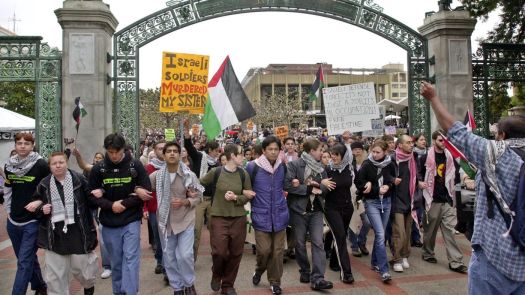
Pro-Palestinian demonstrators march through Sather Gate on the University of California, Berkeley campus. (photo: Paul Sakuma / Associated Press)

The Anti-Semitism Awareness Act of 2018 should be shelved.

By The Times Editorial Board | Los Angeles Times | Jun 8, 2018


Is it necessarily anti-Semitic to harshly criticize the Jewish state or to do so without, in the same breath, criticizing Saudi repression?


Freedom of speech on college campuses is under enough pressure without the federal government adding to the problem by threatening to withdraw funding to punish people for expressing their political opinions. That would be a real possibility if Congress enacted and President Trump signed a bill called the Anti-Semitism Awareness Act of 2018.

The legislation, which has recently been reintroduced in both chambers, purports to target harassment of Jewish students on college campuses, which has occurred in California and elsewhere.

But this proposal would blur the distinction between unacceptable, intimidating expressions of intolerance directed against Jews with criticism of the state of Israel. The latter, even when expressed in intemperate terms, is protected by the 1st Amendment. . . .

Continue reading “Enough already — not all criticism of Israel is anti-Semitism”

The Palestine exception to free speech on campus

Entrance to the University of Chicago quad. (photo: University of Chicago)

University of Chicago’s commitment to protecting free speech doesn’t extend to students advocating for Palestine.

By University of Chicago Students for Justice in Palestine | The Chicago Maroon | Jun 8, 2018


Running contrary to much of current American political discourse and foreign policy, SJP’s position is exactly the type which needs the support of an institution devoted to free speech.


At about 12:00 pm on May 16, Students for Justice in Palestine (SJP) at the University of Chicago set up an installation on Bartlett quad to mark the 70th anniversary of the Nakba, the Palestinian Catastrophe, when over 700,000 Palestinians were forcibly removed from their land by Zionist forces in an act of brutal settler-colonial ethnic cleansing.

Our installation consisted of 70 flags, each with a fact about Palestine, Israel, and the Nakba. These facts were carefully researched and rendered in the installation. Though we are a political organization and make no claims to a mythical “neutral objectivity,” there were no falsehoods. Our goal was to educate, raise awareness, and foster discussion.

The installation was thoroughly scrutinized in advance by the University administration and approved of. By 3:00 pm the same day, the installation had been vandalized, 10 of the flags were missing, and a hastily-written note was left, accusing us of anti-Semitism. This accusation is patently false. As has always been the case, we vehemently oppose anti-Semitism, just as we oppose all forms of racism. By 1:00 am the following morning, all of the flags had been stolen.

Continue reading “The Palestine exception to free speech on campus”

Arizona State’s ban on Israel boycotters tests DOJ’s free speech commitment

5a9da2851f00002d0016939d
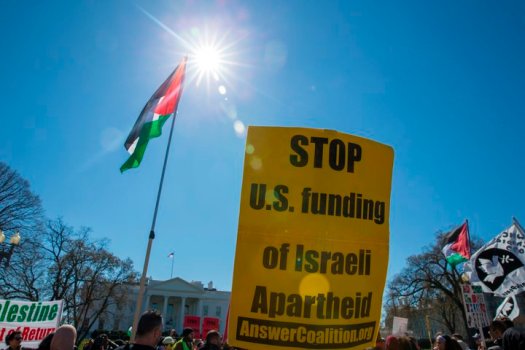
A sign is held by demonstrators calling for an independent Palestinian state during a protest held outside the White House in Washington, DC, on Mar 4, 2018. (photo: Alex Edelman / AFP / Getty Images)

So far, the Justice Department has focused its efforts on free speech cases involving conservatives and Christians.

By Rowaida Abdelaziz and Ryan Reilly | HuffPost | Mar 5, 2018


“Universities have been a beacon of free speech and thought — that is what they have been for all these years, but only certain students are afforded that right to free speech.”
— Imraan Siddiqi, the executive director of CAIR-Arizona


A lawsuit against one of America’s largest public universities could pose a major test for the Justice Department’s commitment to campus free speech.

The Council on American-Islamic Relations (CAIR) filed a lawsuit in federal court last week against Arizona State University, accusing the school of violating Muslim students’ right to free speech and rights to equal protection by enforcing a ban on speakers who call for boycotting Israel.

The suit was filed on behalf of American Muslims for Palestine and its founder, Hatem Bazian, shortly after Arizona State’s Muslim Students Association invited him to speak at what is billed as an “educational event regarding Palestinian perspectives on Middle East conflict” on April 3.

Bazian, a senior lecturer at University of California in Berkeley, said he could not agree to the school’s speaker’s contract because of a “no boycott of Israel” clause that essentially bars him and others from participating “solely because they engage in and advocate for economic boycotts of Israel as a means to promote Palestinians’ human rights,” according to the lawsuit.

Continue reading “Arizona State’s ban on Israel boycotters tests DOJ’s free speech commitment”

Washington State Anti-BDS Legislation

 We’ve won this round: a letter from Cindy Corrie.

March 28, 2017

Dear friends and allies at the Bishop’s Committee,

Your calls and emails to the governor and state legislators of Washington are working. None of the anti-BDS measures threatened during the 2017 session are moving forward. The deadline for introducing bills has passed for this session. House Joint Memorials 4004 and 4009, both condemning BDS, died in committee. Senator Baumgartner (R-Spokane) never formally introduced the anti-BDS bill that he announced in December. Governor Inslee has not signed the Governors Against BDS statement that more than forty other state governors have signed. We’re grateful for all your individual activism and also to the long list of WA groups and organizations that joined our campaign against these measures.

We may have won this round in Washington State, but we have every reason to believe that anti-BDS measures will be introduced again in 2018, with all the same state legislators in office. Anti-BDS measures like these have passed in at least fourteen other states, and an anti-BDS bill has been introduced in the United States Senate.

We have to continue our campaign to make sure that our state legislators know that they should not endorse or vote for any measures that curtail our free speech by prohibiting or penalizing boycotts.

  • IN PERSON MEETINGS are among the most effective ways to influence our legislators. Anti-BDS advocates are lobbying in person, and we can’t leave the field to them. This is especially important if your WA legislator was among the 36 sponsors of HJM 4004 and 4009. Click here to find out if your legislator was a sponsor.

Are you able to meet with your WA legislators, either in Olympia over the next month, or in your home city over following months? Would you like to connect with others in your district who might be able to join you in a meeting?

Let us help. Contact us at FreeSpeechWA@gmail.com for help in setting up a meeting and gathering information for the 2018 legislative session.

  • OTHER ALLIES: Do you know other organizations that will share our concern for these threats to free speech and our right to boycott? Let us know at FreeSpeechWA.org and we’ll reach out to them to join our campaign.

Thank you for taking action in defense of our civil liberties and the BDS Movement for justice and equal rights.

— Cindy Corrie

Free Speech Washington
FreeSpeechWA.org
FreeSpeechWA@gmail.com