
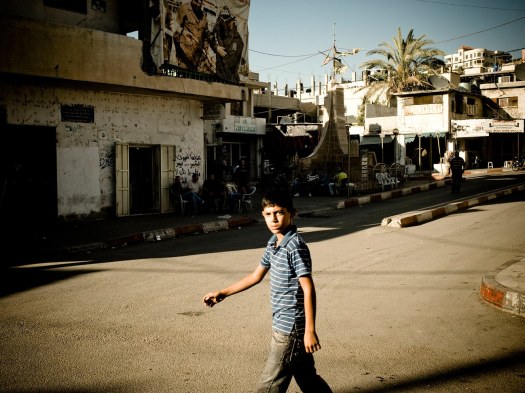
As their institutions wither and their leaders fade away, young Palestinians will redefine previous generations’ aspirations and agenda.
By Hussein Agha and Ahmad Samih Khalidi / The New Yorker
August 6, 2017
Without “armed struggle,” the national movement had no clear ideology, no specific discourse, no distinctive experience or character. In the absence of a genuine and independent state, it was unable to transform itself into a ruling party, as, for example, the African National Congress did, in South Africa. It remained incomplete and suspended: a liberation movement not doing much liberating, locked in a fruitless negotiating process, and denied the means of government by a combination of Israeli obduracy and its own inadequacies.
As President Trump prepares for yet another attempt to resolve the Palestinian-Israeli conflict, the ground is shifting under his feet. While Israel’s willingness to offer an acceptable deal is increasingly open to question, with nothing to suggest that its terms are likely to soften with time, the Palestinians are sliding toward the unknown. With the slow but sure decay of the Palestinian political scene, the President of the Palestinian Authority, Mahmoud Abbas (Abu Mazen), represents the last slender chance for a negotiated settlement: he is the sole remaining national leader of his people with sufficient, if dwindling, authority to sign and ratify a deal. For President Trump and his team, as well as for all those seeking to end this century-plus-old conflict, there should be no doubt about the moment’s urgency. After Abbas, there will be no other truly weighty representative and legitimate Palestinian leadership, and no coherent national movement to sustain it for a long time to come.
Over six days in late November and early December, 2016, Fatah, the Palestinian national liberation movement, convened its seventh congress in Ramallah, the de-facto capital of the Palestinian Authority. Despite the lengthy speeches and festive air, the conference did little to dispel what had become unmistakable: the slow expiry of a once vibrant movement. Long on show and short on substance, the meeting hardly touched on any of the mounting political challenges facing the Palestinian people. The Congress was no more than a confirmation of the current order and a reaffirmation of its total and unprecedented control over Fatah, the P.A., and its ostensible parent, the Palestine Liberation Organization.
The contemporary Palestinian national movement — founded and led by Yasser Arafat and embodied by the P.A., Fatah, and the P.L.O. over the past half century — is reaching its end. As its institutions wither and its leaders fade away, there is no obvious successor to take its place.
Continue reading “The End of This Road: The Decline of the Palestinian National Movement”
 HolyLandJustice.org
You must be logged in to post a comment.