“In May of this year, we will celebrate Israel’s 70th anniversary, and under my instructions two days after the United States moves its embassy, Guatemala will return and permanently move its embassy to Jerusalem.”
— Guatemalan President Jimmy Morales
Guatemala will relocate its embassy to Jerusalem in May, two days after the United States is slated to make the same move, the country’s president said Sunday.
“It is important to be among the first, but it is more important to do what it right,” he said.
Morales first announced the move in late December, following in the footsteps of the Trump administration. Guatemala was one of nine countries to vote against a December United Nations resolution rejecting the U.S. recognition of Jerusalem as Israel’s capital.
“They deliberately chose a tragic day in Palestinian history, the Nakba, as an act of gratuitous cruelty adding insult to injury.”
— Hanan Ashrawi
Israel declared independence on May 14, 1948, so why is it celebrating its 70th anniversary on April 18?
And why are Palestinians infuriated by the Trump administration’s decision to move the American Embassy in Israel from Tel Aviv to Jerusalem on May 14?
The answer lies in two calendars.
Israel marks its public holidays using the Hebrew calendar. May 14, 1948, corresponds to the fifth day of the Jewish month of Iyar in the year 5708.
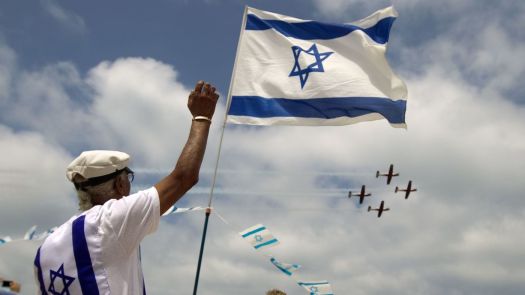
This spring the fifth day of Iyar — in the year 5778 — lines up with April 18. Israel will celebrate with parties, barbecues, fireworks over the Knesset, Israel’s parliament, and an air force flyover along Tel Aviv’s shore.
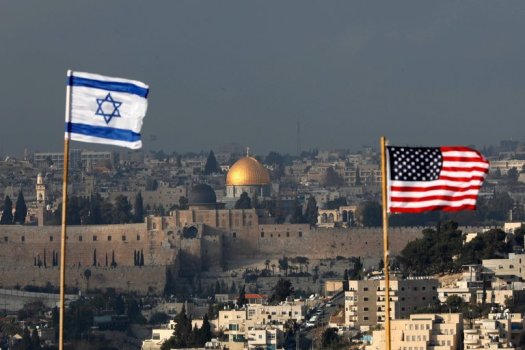
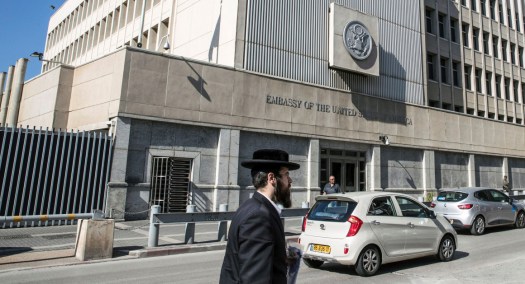
Eighty-seven countries have embassies in Israel, none of them are in Jerusalem. (photo: Abir Sultan / European Pressphoto Agency)
The move would coincide with the 70th anniversary of the founding of the State of Israel, as well as the 70th anniversary of the “Nakba,” the expulsion of 750,000 Palestinians from their homes.
“The decision of the US administration to recognize Jerusalem as the capital of Israel and to choose the anniversary of the Nakba of the Palestinian people for carrying out this step expresses a flagrant violation of the law.”
— Saeb Erekat, secretary general of the Palestine Liberation Organization
Sheldon G. Adelson, one of the most hawkish supporters of Israel among American Jews, has offered to help fund the construction of a new American Embassy in Jerusalem, according to the State Department, which on Friday said it was reviewing whether it could legally accept the donation.
The total price tag to build the new embassy to replace the current one in Tel Aviv is estimated at around $500 million, according to one former State Department official. While private donors have previously paid for renovations to American ambassadors’ overseas residences, Mr. Adelson’s contribution would be likely to far surpass those gifts — and could further strain American diplomacy in the Middle East.
Before the embassy is built, the Trump administration plans to open a temporary one in Jerusalem. On Friday, it said that it was accelerating the projected opening in time to mark the 70th anniversary of the creation of the State of Israel on May 14.
Q&A: What will US recognition of Jerusalem mean for the peace process?
The peace process has been at death’s door since the former secretary of state John Kerry’s peace mission ended in failure in 2014. But the international community — apart from the US — is united in saying recognition of Jerusalem as the capital of Israel is disastrous for any hopes of reviving meaningful talks. The status of Jerusalem is one of the pivotal issues that diplomats and peacemakers have said must be agreed between the two parties in negotiations.
Palestinians will see Trump’s announcement as the end of their hopes and demands for East Jerusalem as a capital of a future independent state. While few want a return to violence, many will feel diplomatic efforts have got them no closer to a state of their own.
The Israeli government will be thrilled. Ever since it captured (and later annexed) East Jerusalem in the 1967 six-day war, Israel has claimed the city as its “eternal and undivided” capital, and has longed for international recognition. Some 200,000 Israelis living in illegal settlements will also celebrate.
The US will open its embassy in Jerusalem by the end of 2019, ahead of schedule, the vice-president, Mike Pence, has said. Arab-Israeli politicians were ejected from the Knesset at the start of Pence’s speech for heckling.
“In the weeks ahead, our administration will advance its plan to open the US embassy in Jerusalem – and that United States embassy will open before the end of next year,” he said in a speech to roaring applause in the Israeli Knesset.
Speaking during a two-day visit, Pence said Donald Trump had “righted a 70-year wrong” by recognizing Jerusalem as the capital of Israel.
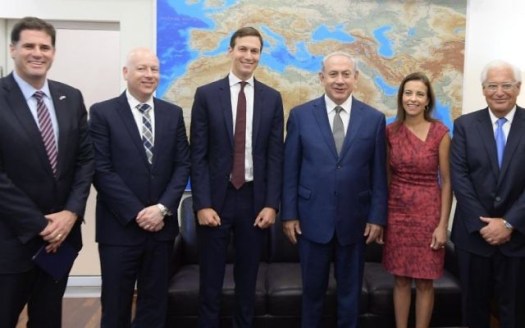
L-R: Israeli Ambassador to the U.S.. Ron Dermer, U.S. Middle East envoy Jason Greenblatt, White House Senior Adviser Jared Kushner, Prime Minister Benjamin Netanyahu, U.S. Deputy National Security Adviser for Strategy Dina Powell. and U.S. Ambassador to Israel David Friedman meet in Tel Aviv on August 24, 2017. (photo: Amos Ben Gershom / GPO)
Hot-button issue was “brought up by both sides” in discussions last week between the PM and US envoys Kushner and Greenblatt.
[Ed. note: The U.N. Security Council has consistently maintained that East Jerusalem, captured in the 1967 War, is occupied territory subject to the Geneva Convention. The Security Council has declared Israel’s attempt to make Jerusalem the “eternal and indivisible” capital of Israel to be in violation of international law. There are 82 foreign embassies in Israel, none of them is located in Jerusalem.]
“Needless to say, the [U.S.] administration’s policy is ‘when not if.’”
Senior members of the Trump administration and Israeli officials renewed talks over the possibility of moving the US embassy from Tel Aviv to Jerusalem, a promise repeatedly made by the president in the 2016 election campaign, during high-level meetings in Israel last week, the Times of Israel has learned.
Senior White House adviser Jared Kushner, peace envoy Jason Greenblatt and Deputy National Security Adviser for Strategy Dina Powell met with Prime Minister Benjamin Netanyahu on Thursday as part of a visit to the region in a bid to revive Israeli-Palestinian peace efforts.
During that meeting, the embassy move “was brought up by both sides as part of a productive broad conversation about a number of issues,” a US source familiar with the discussions said Sunday, declining to reveal the specifics of discussion.
Trump backtracked on the pledge in June, signing a waiver which pushed off moving the embassy for at least another six months.
[President Trump] could authorize the move because he wants to keep his campaign promise, because America prides itself in doing the honorable thing or just because it makes sense. But he shouldn’t do it as a misplaced favor to the people of Israel. They can live without it. Especially now, in light of new allegations about Trump sharing confidential data with Russia, it’s clear that efforts to build Israeli confidence in his leadership can be invested more intelligently.
[Ed. note: There are 82 foreign embassies in Israel, none of them in Jerusalem.]
Presidents are used to receiving unsolicited advice. Here’s something for President Donald Trump to ponder as he packs his bags for Israel: Many Israelis really don’t care whether the United States moves its embassy to Jerusalem.
Latest reports now suggest that Trump has decided to forestall such a move for the forseeable future. His path to this destination, after indications that he would eschew the example of all his predecessors, has been tortuous.
Celebrating Israel’s 69th independence day at the White House, Vice President Mike Pence recently reprised administration rhetoric on the matter. “The president of the United States, as we speak,” he told applauding party-goers in the Indian Treaty Room, “is giving serious consideration into moving the American embassy in Tel Aviv to Jerusalem.” Secretary of State Rex Tillerson struck a more tentative figure over the weekend, possibly foreshadowing Trump’s plans to indeed exercise his presidential waiver and leave the embassy where it stands. When Tillerson tried passing the buck, suggesting that Israel might view the move as “perhaps a distraction” to a peace initiative, Prime Minister Benjamin Netanyahu fired back that “the contrary” was in fact true. Adding to the confusion, U.S. Ambassador to the United Nations Nikki Haley told the Christian Broadcasting Network on Tuesday, “Obviously, I believe that the capital should be Jerusalem and the embassy should be moved to Jerusalem because if you look at all their government is in Jerusalem. So much of what goes on is in Jerusalem and I think we have to see that for what it is.”
“The president of the United States, as we speak, is giving serious consideration into moving the American embassy in Tel Aviv to Jerusalem. . . . To be clear, the president has also personally committed to resolving the Israeli and Palestinian conflict.” — Vice President Mike Pence
President Donald Trump is giving “serious consideration” to moving the U.S. Embassy to Jerusalem from Tel Aviv, Vice President Mike Pence said Tuesday, the day before a scheduled White House visit by Palestinian President Mahmoud Abbas.
Trump is also “personally committed” to becoming the U.S. president who finally ends the long-running Israeli-Palestinian conflict, Pence said.
Moving the U.S. Embassy to Jerusalem is a politically charged act that would anger Palestinians who want east Jerusalem, which was captured in 1967, as a future capital and part of their sovereign territory. Such a move would also distance the U.S. from most of the international community, including its closest allies in Western Europe and the Arab world.
[Editor’s note: There are 82 foreign embassies in Israel, none of which are in Jerusalem.]
“Why would a president-elect decide to begin his presidency by playing with the blood of Palestinians and Israelis? Why? For whose sake? . . . This will destroy us as Palestinian moderates. This will bring extremism to the region.” — Saeb Erekat, chief Palestinian negotiator
It started, as it has in American presidential races for decades, as a campaign line, one that weary Israelis and Palestinians hear but rarely take seriously: Donald J. Trump promised to move his nation’s embassy to Jerusalem from Tel Aviv.
But by Thursday, the eve of Mr. Trump’s inauguration, those decades of promises seemed very real — with reverberations far beyond stone and cement.
Mr. Trump himself made perhaps his strongest statement on the issue on Thursday, telling a conservative Israeli news outlet, “You know I’m not a person who breaks promises.”
[The author is the president of the Arab American Institute.]
Palestine may have dropped off the radar for a time, but it remains “the open wound in the heart, that never heals.” Violating Jerusalem and unrest in occupied Palestinian lands would rip the scab off that wound reminding Arabs of their vulnerability and their inability to control their history in the face of betrayal by the West. Ignore this passion and there will be consequences.
In just a matter of days, President-elect Donald Trump will have to decide on whether or not to make good on his promise to move the U.S. embassy in Israel from Tel Aviv to Jerusalem. As we approach Inauguration Day, liberal and conservative commentators alike have offered a number of ideas as to how he can proceed. Ranging from “too cute by half” to just plain dumb, they should all be rejected. More to the point, all of the proposals I have seen focus exclusively on Israeli concerns, ignoring or giving short shrift to Palestinian and broader Arab or Muslim concerns and sensitivities.
On the one side, there are proposals from hardliners who advise Trump to just go ahead and make the move. They argue that in fulfilling his campaign promise he will appease his base and gain international respect for being a strong and decisive leader. They dismiss Palestinian, Arab, and Muslim opinions, relying on the false assumptions that there is diminished concern across the Arab world for the Palestinian issue or making the racist case that Arabs respect strength and will ultimately become reconciled to a U.S. move.
The “let’s make a deal” approach assumes that each negotiating party has a series of material things that can be traded off. In this approach, both sides understand they will be better off with more than they currently have. But that doesn’t apply to a place like Jerusalem, or to conflicts like it.
President-elect Donald Trump has set the foreign policymaking world on edge with his and his team’s repeated insistence that as president he will move the U.S. Embassy from Tel Aviv to Jerusalem. The goal: support Israel’s claim to the city as its “undivided, eternal capital.” By nominating David Friedman — who agrees with that position — to be ambassador to Israel, Trump apparently emphasizes this commitment.
The Israeli-Palestinian conflict has resisted resolution for decades. But Trump has insisted that “a deal is a deal” and that because he is “a negotiator,” he will be successful where others were not. In this case, presumably Trump plans to offer the Palestinians compensation to accept Israel’s claims to Jerusalem.





 HolyLandJustice.org
You must be logged in to post a comment.