
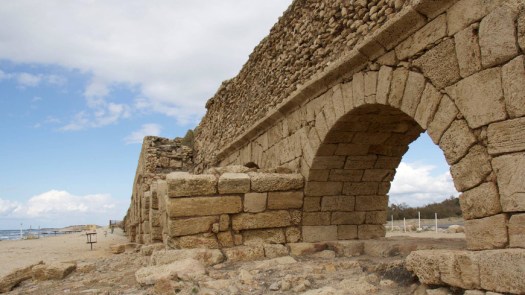
Every year, some 100,000 women, children and men visit the Biyar Aqueduct, built some 2,000 years ago to supply water to Jerusalem and the Jewish Temple.
By Akiva Eldar / Al-Monitor / Oct 3, 2017
“There is clear evidence at the Biyar Aqueduct — as there is at other sites — of the presence of the sons of the Judean Kingdom or of Jews at various periods. The problem is that these sites are being used as propaganda tools to establish the right of Jews to those lands, and the multicultural aspect of thousands of years of history is sidelined or even wiped out of the whole story.”
— Archaeologist Yonathan Mizrachi
The Israeli left made no bones about its glee over the empty bleachers at the September 27 jubilee celebration of the liberation of Judea, Samaria, the Jordan Valley and Golan Heights organized by the settlers in the occupied West Bank. The left views the photos of the empty seats as proof of the settlers’ failure to occupy the hearts and minds of the general Israeli public. The leftists argue that not only did the billions poured by successive Israeli governments into the settlements for 50 years lure fewer than 5% of Israelis to live there — about 400,000 according to the Israel Central Bureau of Statistics — the vast majority avoided the wasteful “liberation festival.”
Yet the pleasure taken by the left in the seeming failure of the settlers and their patrons is somewhat pathetic. Granted, the right-wing concept of a return to the land of the forefathers has not created a major demographic shift of Israelis moving to the settlements. Nonetheless, the notion has ingrained itself in the minds of broad swathes of the Israeli public and of tens of thousands of visitors from around the world. It happens daily in Jerusalem’s Old City and throughout the West Bank.
Continue reading “Israeli settlers turn archeological sites into political tools”
 HolyLandJustice.org
You must be logged in to post a comment.