Film: This is Home — A Refugee Story (Apr 5)

Please join our brothers and sisters at the Mideast Focus Ministry for their First Friday Film series.
Date: Friday, Apr 5, 2019
Time: 7:00 – 8:30 pm
Location: St. Mark’s Cathedral
Bloedel Hall
1245 10th Ave E
Seattle, WA 98102
Information: Event information here →
Tickets: Free Admission
Event Details

This is Home is an intimate portrait of four Syrian refugee families arriving in America and struggling to find their footing. Displaced from their homes and separated from loved ones, they are given eight months of assistance from the International Rescue Committee to become self-sufficient. As they learn to adapt to challenges, including the newly imposed travel ban, their strength and resilience are tested. It is a universal story, highlighted by humor and heartbreak, about what it’s like to start over, no matter the obstacles.

After surviving the traumas of war, the families arrive in Baltimore, Maryland and are met with a new set of trials. They attend cultural orientation classes and job training sessions where they must “learn America” — everything from how to take public transportation to negotiating new gender roles — all in an ever-changing and increasingly hostile political environment. Their goals are completely relatable: find a job, pay the bills, and make a better life for the next generation. Continue reading “Film: This is Home — A Refugee Story (Apr 5)”

Progressive Jews worry that criticism of Rep. Ilhan Omar will stifle debate about Israel

Many see value in the conversation Ilhan Omar spurs and defend her right to freely raise these questions without enduring attacks herself.

By Eugene Scott | The Washington Post | Mar 7, 2019

‘We are concerned that the timing of this resolution will be seen as singling out and focusing special condemnation on a Muslim woman of color — as if her views and insensitive comments pose a greater threat than the torrent of hatred that the white nationalist right continues to level against Jews, Muslims, people of color and other vulnerable minority groups in our country.
‘It is also our view that the far greater threat to the Jewish community — to its security and its values — comes from the surge of ethno-nationalism and racism that forces on the right, including President Trump, have unleashed here and across the globe.’
— J Street statement

Rep. Ilhan Omar (D.-Minn.) has drawn attention — and criticism — for her statements about Israel. Many people, including top lawmakers, have condemned Omar’s comments as anti-Semitic and called on her to apologize.

But she has also received messages of support from members of the Jewish community, who are critical of Israel’s policies and worry that the blowback against Omar will stifle debate.

Rebecca Vilkomerson, executive director of Jewish Voice for Peace, which advocates for Israel to pull out of the West Bank, wrote that critiques of Israel like Omar’s are essential:

“It has never been more important to be able to distinguish between the critique — even the harshest critique — of a state’s policies (Israel), and discrimination against a people (Jews),” she said. “Israel does not represent all Jews. Not all Jews support Israel. Speaking out for Palestinian human rights and their yearning for freedom is in no way related to anti-Semitism, though the Israeli government does its best to obscure that.”

Continue reading “Progressive Jews worry that criticism of Rep. Ilhan Omar will stifle debate about Israel”

Debunking the myth that anti-Zionism is antisemitic

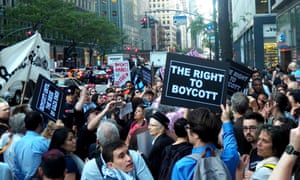
Protesters in New York City call for a boycott of Israel in 2016. (photo: Pacific Press / LightRocket via Getty Images)
All over the world, it is an alarming time to be Jewish – but conflating anti-Zionism with Jew-hatred is a tragic mistake.

By Peter Beinart | The Guardian | Mar 7, 2019

I don’t consider Israel an apartheid state. But its ethnic nationalism excludes many of the people under its control.

It is a bewildering and alarming time to be a Jew, both because antisemitism is rising and because so many politicians are responding to it not by protecting Jews but by victimizing Palestinians.

On 16 February, members of France’s yellow vest protest movement hurled antisemitic insults at the distinguished French Jewish philosopher Alain Finkielkraut. On 19 February, swastikas were found on 80 gravestones in Alsace. Two days later, the French president, Emmanuel Macron, after announcing that Europe was “facing a resurgence of antisemitism unseen since World War II”, unveiled new measures to fight it.

Among them was a new official definition of antisemitism. That definition, produced by the International Holocaust Remembrance Alliance in 2016, includes among its “contemporary examples” of antisemitism “denying the Jewish people their right to self-determination”. In other words, anti-Zionism is Jew hatred. In so doing, Macron joined Germany, Britain, the United States and roughly 30 other governments. And like them, he made a tragic mistake.

Continue reading “Debunking the myth that anti-Zionism is antisemitic”

Event: Palestinian Rights Advocacy Day (Mar 15)

Please join our brothers and sisters at the Rachel Corrie Foundation for a day of advocacy for Palestinian Rights.
Date: Friday, Mar 15, 2019
Time: 9:00 am – 4:30 pm
Location: United Churches of Olympia Social Hall
110 11th Ave SE
Olympia, WA  98501
Information & Registration: Event information here →
Tickets: $10 suggested donation
Event Details

Our goals during this fun, action-packed day are:

  • to strengthen statewide organizing for advocacy on Palestine
  • to continue to inform and educate state legislators about issues related to Palestinian rights.
Schedule
  • Gathering and Socializing: 9:00–10:00 am
  • Welcome and Introductions 10:00–10:05 am
  • Presentations & Training: 10:05 am
  • Lunch with Legislative District Groups: 11:30 am
  • Walk and Transport to State Capitol: 12:15–12:30 pm
  • Group Photo in Front of Capitol: 12:30–12:45 pm
  • Visits and Deliveries of Materials to Legislative Offices 1:00–3:00 pm
  • Return to United Churches Location: 3:00–3:15 pm
  • Debriefs: 3:15–4:00 pm
  • Closing and Collecting Ideas, Contacts, Evaluations, and Plans for Follow-up and Ongoing Work: 4:00 pm
  • Homeward or on to dinner in Olympia! 4:30 pm

More information here →

Attacks by Israeli settlers surge as West Bank tensions boil

Awad Naasam looks through the broken window of his tractor, which he said Jewish settlers tried to steal, in al-Mughayyir, West Bank. (photo: Kobi Wolf / The Washington Post)
A more sympathetic US policy toward settlements may have emboldened the extremist youths who carry out reprisal attacks.

By Loveday Morris and Ruth Eglash | The Washington Post | Mar 6, 2019

‘Among that settler ideology, there are people that look and say there is no reason why anyone should stop us. . . . There is a right-wing government in Israel and a friend in the White House.’
— Lior Amihai, executive director of Yesh Din, an Israeli human rights group

Palestinians in this town woke one morning last month to find their mosque vandalized, with a Star of David painted on the exterior alongside Hebrew graffiti accusing it of preaching “incitement.”

“We are at an alarming point,” said Barakat Mahmoud, the mosque’s imam. “We’ve never had direct confrontation with the settlers in this town.”

The incident was one in a recent spate of attacks blamed on Israeli settlers that officials on both sides of the conflict say are spiking. Israel’s security agency, Shin Bet, documented 295 of what it calls “Jewish terror” incidents last year, a 40 percent increase.

Although no Israeli government figures were available for January, the United Nations had recorded at least 30 incidents this year in which Israeli settlers were accused of causing casualties or damaging property, with a total of 14 Palestinians injured and one killed.

Continue reading “Attacks by Israeli settlers surge as West Bank tensions boil”

Analysis: There’s a different kind of escalation brewing in the West Bank

A graffiti reading 'enough with the administrative edicts, price tag, revenge' spray-painted on a wall in Palestinian village in the West Bank, 2018
A graffiti reading ‘enough with the administrative edicts, price tag, revenge’ spray-painted on a wall in Palestinian village in the West Bank, 2018. (photo: Israel Police)
The rise of settler violence against Palestinians is likely to continue as the army, the police and Israeli society stand by passively — or even encourage attacks.

By Amira Hass | Haaretz | Mar 6, 2019

Israeli security officials have noted the rise in nationalist crime by Jews against Palestinians.

The noticeable escalation in the West Bank is firstly due to settler violence toward Palestinians. And the assumption among Palestinians must be that this escalation will only continue, as the army and police, as well as Israeli society as a whole, stand by without trying to or succeeding in halting it, in the best case, and supporting and encouraging it, in the other case.

This anxiety can be felt in everyday Palestinian conversations about what the near future might bring, in the choice of travel routes that stay as far from certain settlements as possible and in deciding not to go out to work in the field or to take animals to graze because of the proximity of violent settlements. The expected entry of avowed Kahanists into the Knesset, and with the prime minister’s encouragement yet, shows the breakdown of more barriers in Israeli society against the wish-fulfillment of those who dream of mass expulsion.

Continue reading “Analysis: There’s a different kind of escalation brewing in the West Bank”

Two weeks in Palestine: A land as oppressed as it is beautiful

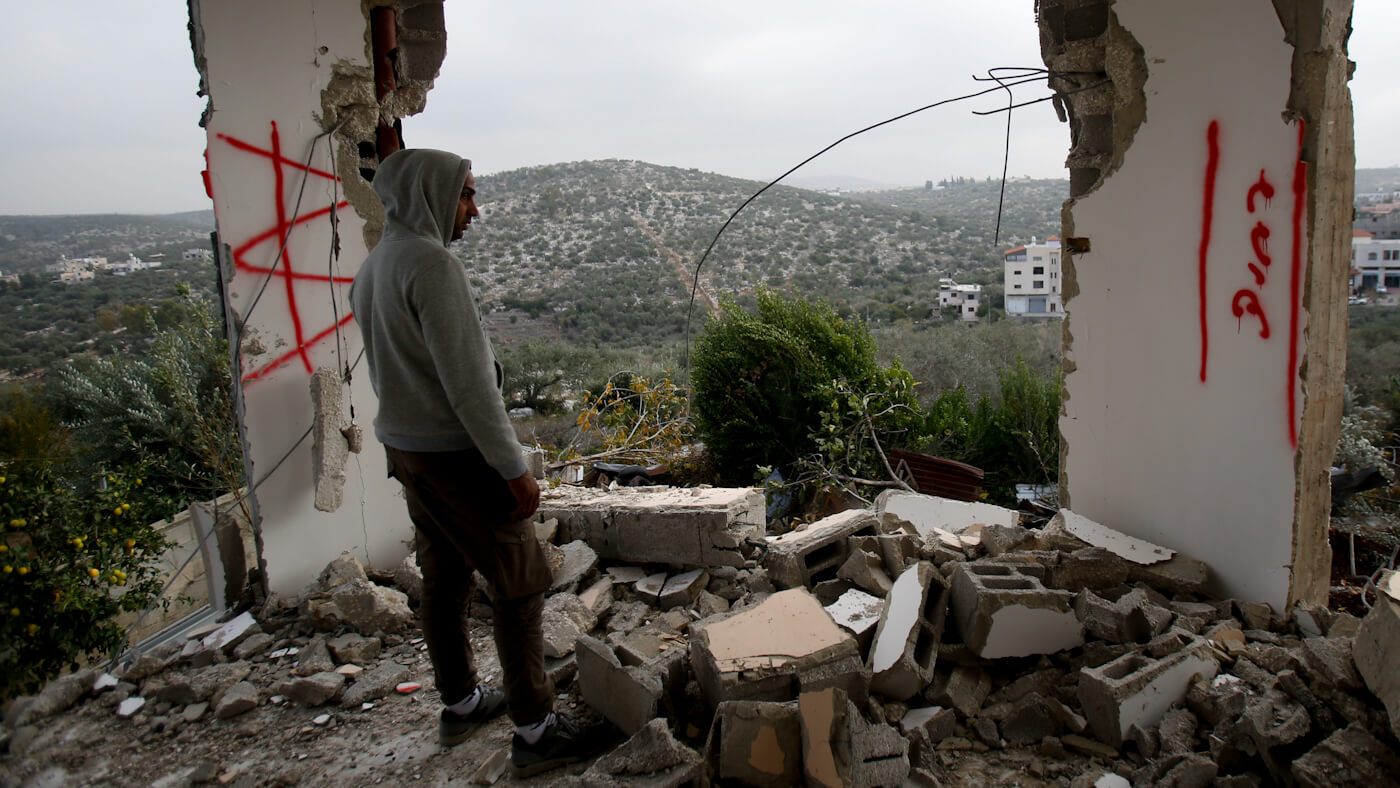
A Palestinian man examines a house after it was demolished by the Israeli army in the village of Shweikeh, near the West Bank city of Tulkarem, Dec 17, 2018. (photo: Majdi Mohammed / AP)
The author recounts his travels through occupied Palestine highlighting the stark juxtaposition between the beauty of the land, and the ugliness of its occupation.

By Miko Peled | Mint Press News | Mar 1, 2019

‘We drink camel’s milk, we love it and we always had camels that we used to milk. Now, as part of the ethnic cleansing process, the Israeli authorities confiscated our camels, they give them to nearby Israeli Jewish settlements and we have to buy the milk from them.’
— Aziz from the village of Al-Araqib

The beauty of Palestine in late February and particularly after a few spots of rain is unmatched. Lush green and almond blossoms everywhere, but from Tarshiha near the Lebanese border in the north to Lakia in the Naqab desert in the south, the horrors of a relentless, oppressive regime that shows every sign of becoming more oppressive are everywhere.

Tarshiha

A jewel in the northern Galilee is lush green and beautiful with signs of prosperity all around. In 1948, Tarshiha, which had a minority Christian population, was subjected to a brutal ethnic cleansing campaign but the Christian families were permitted to return. Today, the full name of the town is Ma’alot-Tarshiha because the neighboring Israeli settlement of Ma’alot, which sits on Tarshiha lands, has taken over and the two now comprise a single — yet segregated — town sharing a single municipality. Still, with all the signs of prosperity, families remember the horrors and many are still living in far off refugee camps, unable to return to their homes and their land.

Continue reading “Two weeks in Palestine: A land as oppressed as it is beautiful”

Under Israeli occupation, water is a luxury

Eliyahu Hershkovitz / Haaretz)
Of all the methods Israel uses to expel Palestinians from their land, the deprivation of water is the most cruel.

By Amira Hass | Haaretz | Feb 24, 2019

I have every right as a citizen and a journalist to ask those who hand down the orders [to destroy Palestinian water pipes], and those who carry them out: ‘Tell me, can you look at yourself in the mirror?’

When I wrote my questions and asked the spokesperson’s office of the Coordinator of Government Activities in the Territories to explain the destruction of the water pipelines in the Palestinian villages southeast of Yatta, on February 13, my fingers started itching wanting to type the following question: “Tell me, aren’t you ashamed?” You may interpret it as a didactic urge, you can see it as a vestige of faith in the possibility of exerting an influence, or a crumb of hope that there’s somebody there who doesn’t automatically carry out orders and will feel a niggling doubt. But the itching in my fingers disappeared quickly.

This is not the first time that I’m repressing my didactic urge to ask the representatives of the destroyers, and the deprivers of water, if they aren’t ashamed. After all, every day our forces carry out some brutal act of demolition or prevent construction or assist the settlers who are permeated with a sense of racial superiority, to expel shepherds and farmers from their land. The vast majority of these acts of destruction and expulsion are not reported in the Israeli media. After all, writing about them would require the hiring of another two full-time reporters.

Continue reading “Under Israeli occupation, water is a luxury”

Breaking the silence: Inside the Israeli right’s campaign to silence an anti-occupation group

In this photo taken Tuesday, Nov. 21, 2017. Yehuda Shaul, co-founder of
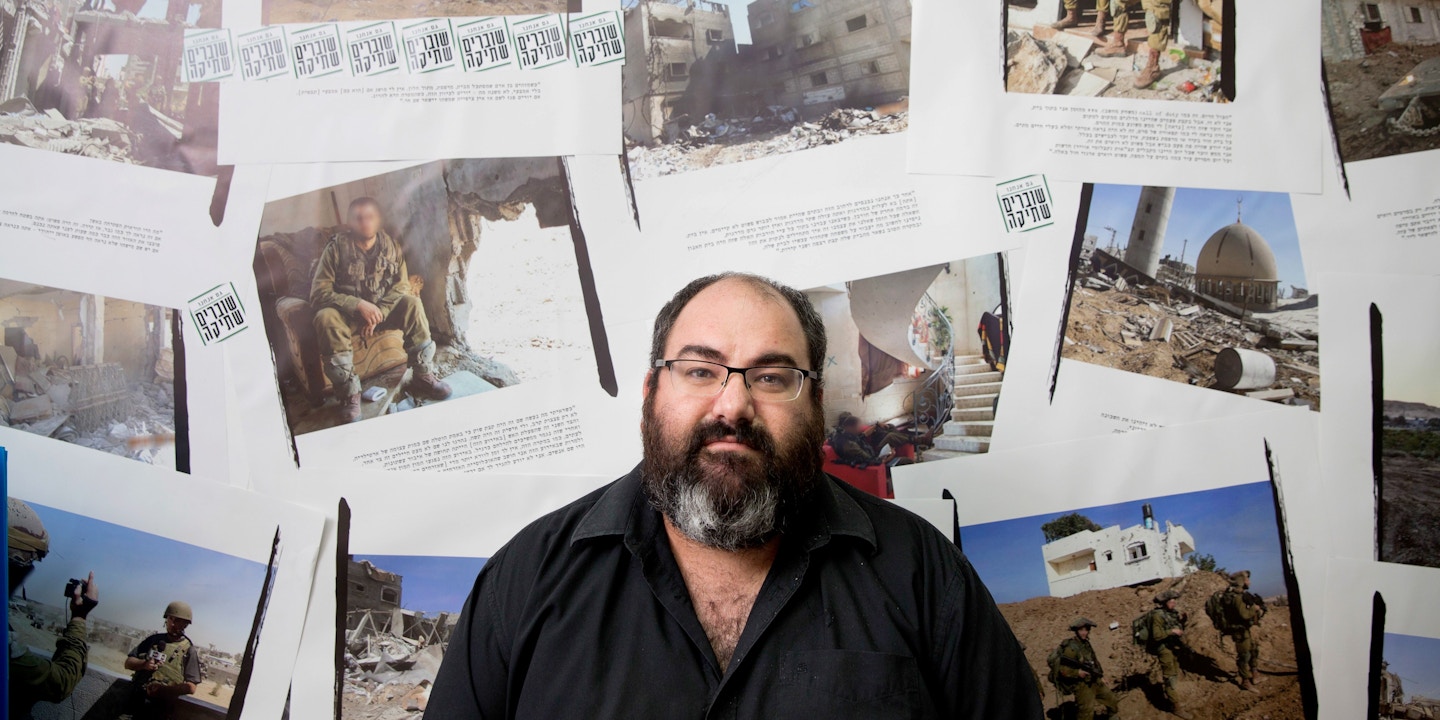
Yehuda Shaul, a co-founder of Breaking the Silence, after a media briefing in Tel Aviv, Israel, on Nov. 21, 2017. (photo: Oded Balilty / AP)
This small organization of Israeli veteran combatants has found themselves at the center of an orchestrated campaign to discredit their anti-occupation and human rights work.

By Mairav Zonszein | The Intercept | Mar 3, 2019

For Breaking the Silence, the discovery of a network of spies was just the tip of the iceberg.

On Jan 12, 2016, Yuli Novak called her staff of a dozen people together in their Tel Aviv offices to reveal the identity of a spy who had infiltrated the organization. At the time, Novak was the executive director of Breaking the Silence, an Israeli anti–occupation group that collects testimonies of Israeli soldiers operating in Palestinian territories. She informed the staff that a man calling himself “Chai” had been secretly videotaping them. Chai had been active with the group for a year and a half, visiting their office on a weekly basis, and had grown close to several staff members.

“The moment I said it, everyone’s first reaction was to look left and right,” Novak told me over iced tea in Jaffa, near Tel Aviv, in July. “The initial feeling was paranoia — everyone thinking to themselves, Who else? People were automatically suspicious. In that moment, you don’t know who is for you and who is against you.” Frima Bubis, who joined Breaking the Silence just before Chai was exposed, remembers the feeling. “Your mind just runs — I even suspected Yuli. It was awful. Everyone scared of the other, but everyone looking to others for support,” Bubis said. “I remember it as a moment of serious trauma of trust. It was a relief that it wasn’t anyone from the staff.”

Continue reading “Breaking the silence: Inside the Israeli right’s campaign to silence an anti-occupation group”

Progressives must stop weaponizing charges of anti-Semitism against critics of Israel

Rep. Ilhan Omar, an outspoken and successful American Muslim Black woman, embodies the very threat to patriarchal white supremacy and colonialism that many in power find so disturbing. (photo: Lorie Shaull / Flickr / cc)
It is shocking that the main targets of outrage over anti-Semitism are members of marginalized communities on the progressive left who are critical of Israeli policies.

By Jordan Goldwarg and Aneelah Afzali | Common Dreams | Feb 27, 2019

It is important to ask why marginalized community members are the main targets of outrage, and who benefits when marginalized groups are pitted against each other.

As an American Jew and an American Muslim, we find the cycle of attacks on Congresswoman Ilhan Omar, Congresswoman Rashida Tlaib, Dr. Marc Lamont Hill, Tamika Mallory, Linda Sarsour, Angela Davis, and others deeply troubling. These attacks reflect a weaponization of the “anti-Semitism” charge against certain individuals (especially Muslim and/or Black leaders supporting Palestinian human rights), which turns progressive allies against each other and ignores the real source of physical threat to our Jewish (and Muslim and Black) siblings.

There is no doubt that anti-Semitism is alive and well. The FBI reported a 37% increase in anti-Semitic crimes from 2016 to 2017 (the most recent year for which data is available). Islamophobia has also increased sharply in recent years, as we face some of the highest levels of anti-Muslim hate crimes in our nation’s history along with hateful rhetoric and policies from the highest levels of our government (such as the Muslim Ban). And Black Americans are still victims of hate crimes more than any other group in our country, with a 16% increase from 2016 to 2017.

Continue reading “Progressives must stop weaponizing charges of anti-Semitism against critics of Israel”