The Democratic Inquisition has come after Ilhan Omar

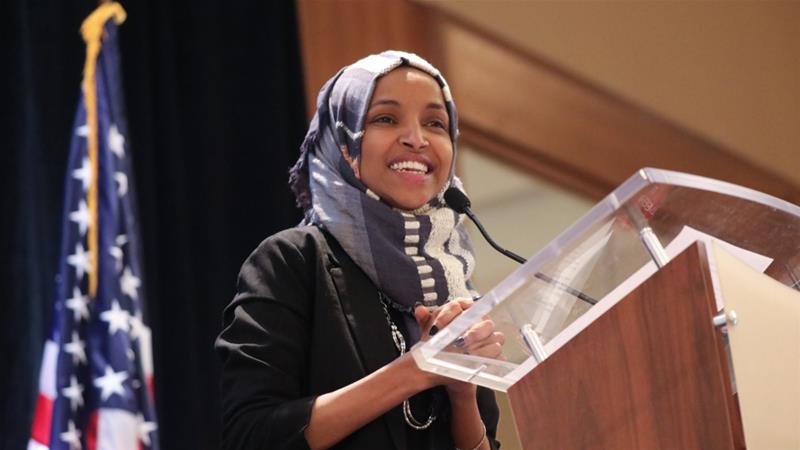
Ilhan Omar is the first Somali American to win a seat in the US Congress. (photo: Anadolu)
But strong popular resistance is foiling attempts to burn her at the political stake.

By Richard Silverstein | Al Jazeera | Mar 7, 2019

For those who need a primer in anti-Semitism, let’s talk about what it is and isn’t. It is the hatred of Jews for being Jews. It should not be confused with Israel. There is nothing wrong with criticizing Israel or advocating for an Israel that is a democracy offering equal rights to all citizens, Jewish and non-Jewish.

In the late 15th century, as Catholic monarchs Ferdinand II and Isabella I pushed to conquer territories in the Iberian Peninsula under Muslim rule, they launched a religious tribunal which came to be known as the Spanish Inquisition.

One of its main tasks was to discover “false converts” to Christianity among the Jews and Muslims of Andalusia. The Inquisition used torture generously to extract forced confessions of “sin” from people suspected of observing Jewish and Muslim rituals or traditions in the privacy of their homes and subsequently punished them in public in what was known as auto-da-fe.

In this modern age, it would be nice (but naive) to think that we have put behind these times. Apparently, these medieval practices are still in use in the US Congress.

Continue reading “The Democratic Inquisition has come after Ilhan Omar”

Palestine solidarity work is most effective when done within an anti-racist framework

Rep. Ilhan Omar (D-MN). (Photo: Ilhan Omar for Congress/Facebook)
Rep. Ilhan Omar (D-MN). (photo: Ilhan Omar for Congress / Facebook)
Palestine solidarity work will be most effective when done within an anti-racist, anti-white supremacist framework.

By Alice Rothchild | Mondoweiss | Mar 12, 2019

This struggle is not about Israel as a Jewish state, but about how Israel behaves as a state in the community of nations.

The recent fury and attacks on Ilhan Omar and her forthright statements exposing and criticizing the role of the Israel lobby and the Congressional requirement of allegiance to the policies of the state of Israel come at time when issues of political framing are roiling Jewish and progressive communities. It is becoming increasingly clear at this political moment that there are major generational divisions within the Democratic Party and within the general population. More people are also willing to say out loud that antisemitism is very different from critical thinking about the continued rightward plunge of Israeli politics.  For me this further clarifies my understanding that working on Israel/Palestine and doing Palestine solidarity work is most effectively accomplished within an anti-racist, anti-white supremacist framework.

So how did that strategic awareness happen for me? I came from a traditional Jewish family where our love of Israel was as uncomplicated as lighting candles on Shabbat or our pride in our roots in the tenements and sweat shops of the Lower East Side of New York. It wasn’t until the 1990s that I began to face the contradictions between my adult political self, working on issues of women’s rights, civil rights, health care justice, and my growing discomfort with Israel. At first I understood that this debate was really only of interest to Jews and Palestinians, although I quickly expanded that to some of the progressive Christian community. For us, the problem started in 1967 and our work was ending the occupation and supporting the radical notion of a two-state solution.

Continue reading “Palestine solidarity work is most effective when done within an anti-racist framework”

Ilhan Omar and the weaponization of antisemitism

5883
‘That this is the second round of such condemnation of Omar in the span of a month is sadly not surprising.’ (photo: Joshua Roberts / Getty Images)
It should not be difficult to recognize the meaningful distinction between Ilhan Omar’s recent comments and the kind of antisemitism surging on the right.

By Joshua Leifer | The Guardian | Mar 6, 2019

Omar did not say anything that other critics have not said before: that the pro-Israel lobby enforces rigid support for the increasingly rightwing Israeli government’s policies. . . . If she were not a black, hijab-wearing Muslim woman, the reaction to her words surely would have been different.

Ilhan Omar’s most recent comments have been stripped entirely of their context, their intentions twisted and reversed. During an event in Washington DC last week, she spoke sensitively about her commitment to human rights advocacy, her experiences of Islamophobia, and her compassion for her Jewish constituents. Then Omar said: “I want to talk about the political influence in this country that says it is OK for people to push for allegiance to a foreign country . . . I want to ask, why is it OK for me to talk about the influence of the NRA, of fossil-fuel industries, or big pharma, and not talk about a powerful lobby that is influencing policy?”

It wasn’t long before Republicans and centrist Democrats pounced. The backlash has reached such a degree of absurdity that Omar’s own party plans to censure her for her remarks. This is something the Democrats did not do in response to baldly antisemitic statements by Republicans, nor even, as Jeffrey Isaac wisely points out, in the wake of the massacre in Pittsburgh last October — the deadliest antisemitic attack in US history, incited by Donald Trump and his supporters’ xenophobic rhetoric.

Continue reading “Ilhan Omar and the weaponization of antisemitism”

Think the Netanyahu corruption allegations will change Israel? Think again.

Israeli Prime Minister Benjamin Netanyahu delivers a speech in Ramat Gan, Israel, Mar 4. (photo: Amir Cohen / Reuters)
If the corruption allegations push just enough voters to the opposition bloc, Israel is most likely to get another right-leaning government — without Netanyahu.

By Gershom Gorenberg | The Washington Post | Mar 8, 2019

When political division are wide, when parties become tribes, corruption has less effect. Psychologist and Nobel laureate Daniel Kahneman has written about the flaw in human minds that makes people devalue a proposal coming from the other side in a conflict. The same applies to allegations: If you think they come from your political adversaries, you devalue them.

“You conveyed demands to post positive news items about yourself, your wife, Sara Netanyahu, and members of your family, and photographs of you . . . [and] to publish items with political messages that you desired to disseminate to the public.”

This is one snippet of Israeli Attorney General Avichai Mandelblit’s warning to Prime Minister Benjamin Netanyahu that he’s likely to be indicted on bribery and other corruption charges. The full document, released publicly, is 57 pages long, all written in stinging second person: “You . . . you . . . you.” Netanyahu’s demands, as listed by the attorney general, were directed to telecom tycoon Shaul Elovitch, whose holdings included Walla, one of Israel’s top two news websites.

The demands seem to have been fulfilled. In return for getting a remote control over the news — so Mandelblit alleges — Netanyahu made regulatory decisions that put hundreds of millions of dollars in Elovitch’s pocket. The paeans to Netanyahu reached their crescendo on each of the past two election days in Israel. The payoffs to Elovitch were apparently meant to tip the elections.

Continue reading “Think the Netanyahu corruption allegations will change Israel? Think again.”

Republicans and Democrats say their criticism of Ilhan Omar is about anti-Semitism — they’re gaslighting you

Rep. Ilhan Omar and Sen. Bernie Sanders speaking at a news conference in Washington, DC, Jan 10, 2019. (photo: Tom Williams / CQ Roll Call / AP)
Omar’s fellow congressional Democrats have said little or nothing about the shameful Republican record of anti-Semitism, but many have joined the pile-on against Omar.

By Medhi Hasan | The Intercept | Mar 5, 2019

Whether or not you agree with Omar’s remarks, whether or not you were personally offended, anyone who tells you that these nonstop, bipartisan political attacks on her are about fighting anti-Semitism is gaslighting you.

So let me get this straight: The president of the United States has called neo-Nazis “very fine people”; retweeted neo-Nazis; told an audience of Jewish-Americans that Israel is “your country”; and indulged in viciously anti-Semitic conspiracy theories. While running for office, he tweeted an image of Hillary Clinton inside a Star of David, next to a pile of cash; told an audience of Jewish donors, “You want to control your politicians, that’s fine”; and put out a campaign ad that attacked three rich and powerful Jewish figures. While a private citizen, he insisted only “short guys that wear yarmulkes” should count his money and kept a book of Adolf Hitler’s speeches on his bedside table.

He has never apologized for any of this. Nor has he been censured by Congress.

Continue reading “Republicans and Democrats say their criticism of Ilhan Omar is about anti-Semitism — they’re gaslighting you”

Anti-Semitism versus legitimate criticism of the state of Israel

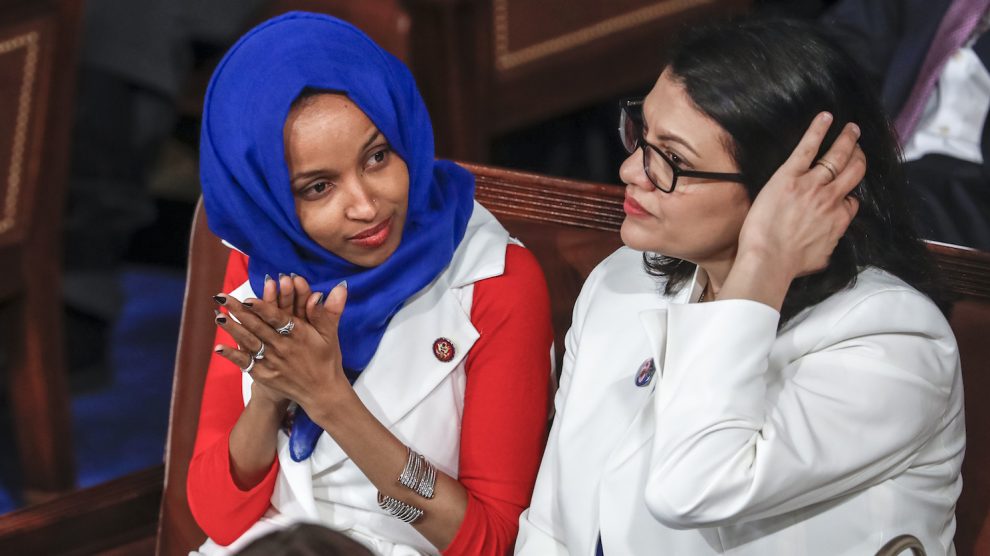
Rep. Ilhan Omar, D-Minn., left, joined at right by Rep. Rashida Tlaib, D-Mich., listens to President Trump’s State of the Union speech at the Capitol in Washington Feb 5, 2019 (photo: AP / J. Scott Applewhite)

Calling for fair treatment of Palestinians does not constitute anti-Semitism.

By  Mae Elise Cannon | Religion News Service | Mar 7, 2019

While we seek and advocate for justice for Palestinians, we must also acknowledge the rootedness of anti-Semitism in Christian history, and its remnants in some of today’s Christian rhetoric.

The question of what constitutes legitimate critique of Israel as opposed to anti-Semitism is front and center in the conversation about Israel in the U.S. following the outcry regarding Rep. Ilhan Omar’s tweets about the American Israel Public Affairs Committee and the impending anti-Semitism resolution in the House.

In light of debates on Capitol Hill about what defines anti-Semitism and recent increased incidents of hatred toward Jews, it is particularly paramount to weed out and eradicate anti-Semitism, while also distinguishing it from legitimate criticism of Israel.

How does one criticize Israel’s policies without being anti-Semitic?

We need to listen to what the Jewish community says about anti-Semitism. While there are differences of opinion and multiple perspectives, particularly across conservative and liberal divides, commonalities also exist.

Continue reading “Anti-Semitism versus legitimate criticism of the state of Israel”

Event: Palestinian Rights Advocacy Day (Friday)

Please join our brothers and sisters at the Rachel Corrie Foundation for a day of advocacy for Palestinian Rights.
Date: Friday, Mar 15, 2019
Time: 9:00 am – 4:30 pm
Location: United Churches of Olympia Social Hall
110 11th Ave SE
Olympia, WA  98501
Information & Registration: Event information here →
Tickets: $10 suggested donation
Event Details

Our goals during this fun, action-packed day are:

  • to strengthen statewide organizing for advocacy on Palestine
  • to continue to inform and educate state legislators about issues related to Palestinian rights.
Schedule
  • Gathering and Socializing: 9:00–10:00 am
  • Welcome and Introductions 10:00–10:05 am
  • Presentations & Training: 10:05 am
  • Lunch with Legislative District Groups: 11:30 am
  • Walk and Transport to State Capitol: 12:15–12:30 pm
  • Group Photo in Front of Capitol: 12:30–12:45 pm
  • Visits and Deliveries of Materials to Legislative Offices 1:00–3:00 pm
  • Return to United Churches Location: 3:00–3:15 pm
  • Debriefs: 3:15–4:00 pm
  • Closing and Collecting Ideas, Contacts, Evaluations, and Plans for Follow-up and Ongoing Work: 4:00 pm
  • Homeward or on to dinner in Olympia! 4:30 pm

More information here →

In defense of Ilhan Omar — again

Rep. Ilhan Omar in Minneapolis, MN, Oct 26, 2018. (photo: Brian Snyder / Reuters)
Did the House pass such a full-throated Resolution about anti-Semitism after Charlottesville, or after the recent Pittsburgh synagogue massacre?

By Jeffrey Isaac | Public Seminar | Mar 5, 2019

I encourage everyone to watch the nine-minute video in its entirety. Far from a fire-breathing or hateful speech, Omar can be seen very carefully trying to parse her words in order to express her frustration, to defend herself, and to clarify her position on the rights of Palestinians.

Ilhan Omar is again at the center of controversy, this time for remarks she made last week at a panel discussion at Busboys and Poets, a Washington, DC, bookstore and restaurant. Omar’s “offending” comment was a reference to “the political influence in this country that says that it’s okay for people to push for allegiance to a foreign country.”

She was immediately accused of feeding centuries-old anti-Semitic tropes about the nefarious influence of a Jewish cabal. A chorus of denunciations have ensued, a number of prominent House Democrats, most of them Jewish, have taken particular offense, and apparently the House Democratic leadership has decided to pass a four-page Resolution denouncing anti-Semitism and especially references to “dual loyalty,” implicitly rebuking Omar (the Washington Post headline declares that “Rep. Omar’s comments force Democrats to act on anti-Semitism measure.” Indeed, House leadership was forced to do nothing; they are choosing to do this).

Meanwhile, Republicans call for more drastic action against her, shedding crocodile tears about bigotry, seeking to inoculate their party by absurdly comparing Omar to the viciously racist Steve King, and gleefully sowing division among Democrats.

Continue reading “In defense of Ilhan Omar — again”

Growing criticism of Israeli policies

A student holds up their fist in support of a pro-BDS speaker during a University of Michigan Student Government meeting in Ann Arbor, MI, Nov 14, 2017. (photo: Hunter Dyke / The Ann Arbor News / AP)
On college campuses, in state legislatures and in many other venues nationwide, the polarized debate about Israel is a familiar conflict and likely to intensify.

By David Crary | Associated Press via The Seattle Times | Mar 9, 2019

‘These laws are meant to silence and repress. But they can’t change people’s hearts and minds.’
— Rabbi Alissa Wise, deputy director of Jewish Voice for Peace

For Congress, the allegations of anti-Semitism directed toward Rep. Ilhan Omar have no precedent. Yet on college campuses, in state legislatures and in many other venues nationwide, the polarized debate about Israel is a familiar conflict and likely to intensify in the months and years ahead.

Fueled by a wave of youthful activists, including many Jews aligning with Muslims, criticism of Israel’s policies toward the Palestinians has grown in volume and scope, with persistent calls for boycotts and disinvestment. Pro-Israel organizations and politicians have countered with tough responses, and efforts to reconcile the differences have gained little traction.

Continue reading “Growing criticism of Israeli policies”

Did AIPAC funding influence Democrats’ responses to Ilhan Omar?

3805
The responses to Ilhan Omar about the influence of money from the pro-Israel lobby may back up her point. (photo: Chip Somodevilla / Getty Images)
Some accused the freshman congresswoman of antisemitism while others denounced “ugly attacks” on her.

By Tom Perkins | The Guardian | Mar 9, 2019

‘Money works both ways — donors give to those candidates they view as champions of their issues, but at the same time politicians know where their funding comes from and will likely take into account wishes of their donors when faced with a tough decision.’
— Brendan Fischer, a campaign finance expert at the Campaign Legal Center

When the Democratic congresswoman Ilhan Omar claimed pro-Israel lobby money influenced American politics, in the way other powerful lobbying groups do, she ignited allegations of antisemitism and sparked a furious debate in her own party. But a look at House Democrats and 2020 presidential candidates’ responses to the resulting row seems to validate her claim.

House Democratic leaders who drafted a resolution initially aimed at condemning Omar’s remarks received millions from the pro-Israel lobby throughout their congressional careers. Congressman Eliot Engel, who accused Omar of using “a vile antisemitic slur,” has taken about $1.07m throughout his career, or about $107,000 per election.

Meanwhile, some of her staunchest defenders took little or no money from the lobby. Congresswoman Rashida Tlaib received no pro-Israel lobby donations during her 2018 campaign, and tweeted that she was “honored” to serve with Omar, who was enduring “ugly attacks.”

Continue reading “Did AIPAC funding influence Democrats’ responses to Ilhan Omar?”