This article could be illegal in Arkansas

The Arkansas state capitol building. (photo: Wikimedia Commons)
It should go without saying that no editorial, op-ed or news article should be “illegal,” particularly one talking about core constitutional protections for free speech and our free press.

By Gabe Rottman | Reporters Committee for Freedom of the Press | Jul 2, 2019

Not only does [the Arkansas law] put a thumb on the scale of public debate — a newspaper that signs the certification is free to publish editorials or any other content opposing an Israel boycott — but it also forces newspapers that might otherwise remain silent on a public controversy to take a side.

In August 2017, the Arkansas legislature passed a law requiring any state contractor to sign a form pledging it will not participate in a boycott of Israel. The only options for a contractor that does not want to sign are to give up contracting with the state or to discount prices by 20 percent. The law is so broad it could outlaw the publication of this article in the state. Here’s why.

The Arkansas Times, an alternative newsweekly in Little Rock, has for years contracted to run advertisements for Pulaski Technical College, a state school. The Times has never commented on an Israeli boycott, but it refused to sign the certification for fear it would interfere with its perceived editorial independence. Pulaski Technical College withdrew its advertising.

The Arkansas Times sued, arguing the law violates the First Amendment, particularly because the Arkansas legislature passed the law not because of any rash of Israeli boycotts in the state, but to target one particular global boycott movement, the “Boycott, Divestment, Sanctions” campaign, or “BDS.”

Continue reading “This article could be illegal in Arkansas”

Kairos Puget Sound Coalition’s Summer Potluck and Play

IMG_7944.JPG
KPSC Summer Potluck 2018.  (photo:  Ann Marchand)
Please join our brothers and sisters with the Kairos Puget Sound Coalition for their summer event.
Date: Saturday, July 13, 2019
Time: 5:00 – 8:00 pm
Location: Huda Giddens home, 4338 N.E. 44th St., Seattle
Information: Event information here →
Tickets: Free
Event Details

The annual potluck event takes place at the lovely home of Huda Giddens.  A play reading “Where I Grew Up” with Yusef Mahmoud and Ed Mast, followed by an active discussion, will occur in the park adjacent to Huda’s home.

Everyone welcome and bring a potluck dish to share to Huda Giddens.

Evening Schedule:

5:00 – Welcome, remarks, and social
5:30-6:30 – Potluck
6:30-8:00 – Play – with Yusef Mahmoud and Ed Mast, followed by a guided discussion
with Ed Mast.

More information here →


J Street launches birthright alternative, featuring ‘Occupation 101’

jstreet.org
An alternative ‘birthright’ tour that will include the Palestinian narrative.

By Judy Maltz (Haaretz) |   Forward  | Jul 1, 2019

By omitting Palestinian perspectives, Birthright trips create ‘a political environment that allows home demolitions, settlement expansion, and other destructive policies of occupation to continue unchallenged.’
— J Street

A first-of-its-kind “alternative Birthright” tour aimed at progressive-minded young American Jews kicks off in Israel on Tuesday.

Forty participants are set to take part in the 10-day inaugural trip, titled “Let Our People Know,” which is sponsored and financed by J Street.

The tour includes visits to the West Bank cities of Hebron and Ramallah, as well as meetings with Jewish settlers from the Binyamin Regional Council.

Continue reading “J Street launches birthright alternative, featuring ‘Occupation 101’”

Jared Kushner’s plan for Palestine is even crazier than you thought

Kevin Lamarque /Reuters)
Kushner’s “economic peace” plan repeatedly claims that occupied Palestine can model itself after Singapore, South Korea, Japan, and Taiwan. That’s certainly ambitious — but also ignorant, absurd and even dangerous.

By Teresita Cruz-del Rosario and Victor Kattan | Haaretz | Jul 4, 2019

The lessons of these Asian economic success stories is fairly straightforward: sovereignty was key to transforming these states into Asian economic power houses embedded in strong states that could drive development policies.

Jared Kushner’s glossy “economic peace” plan has been widely, although not universally, panned.

Critics have attacked the plan from innumerable angles: from the photographs used to promote it, culled from USAID programs whose funding had been ended by the Trump administration, to the recycling of old, largely discredited ideas, associated with previous Israeli and US plans that promoted economic development before a political plan.

None of these peace plans, including those that prioritized economic development ahead of a political program, have worked.

One key claim of the plan, largely overlooked by critics, are Kushner’s case studies, which are repeatedly referenced throughout the document: Singapore, South Korea, Japan, and Taiwan.

Continue reading “Jared Kushner’s plan for Palestine is even crazier than you thought”

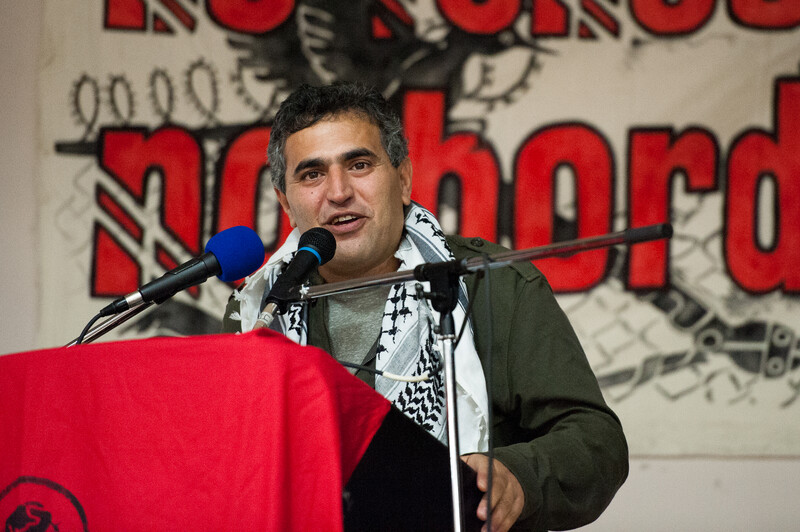
Germany threatens journalist with prison for speaking about Palestine

A man wearing a Palestinian scarf speaks at a podium
Khaled Barakat (photo: No One Is Illegal Vancouver)
Germany fearful of open discourse critical of Israel.

By  Riri Hylton  |  The Electronic Intifada  |  Jul 1, 2019

‘The same forces advocating for and issuing this political ban against me are involved in repressing Jewish voices that criticize Zionism, Israeli policy and German policy on Israel.’
—Khaled Barakat

German authorities barred Palestinian-Canadian journalist Khaled Barakat from speaking at a Palestine solidarity event in Berlin, claiming his “anti-Semitic” speeches posed a threat to public order and could undermine relations between the country and Israel.

The activist has been prohibited from attending future political events and threatened with up to one year in prison, marking another success in the Israel lobby’s bid to clamp down on criticism abroad.

Barakat had been invited to speak at an Arab community event in Berlin on 22 June to discuss Palestinian liberation and its implications for other Arab communities, as well as US President Donald Trump’s so-called Deal of the Century.

Continue reading “Germany threatens journalist with prison for speaking about Palestine”

The ‘deal of the century’ as a deliberate deception

White House adviser Jared Kushner presented his economic plan
White House adviser Jared Kushner presented his economic plan ‘Peace to Prosperity’ at a workshop in Manama, Bahrain on June 25. (photo: Bahrain News Agency via AP)
Kushner’s plan recycles failed past proposals and will clearly not succeed. But was it meant to in the first place?

By Ibrahim Fraihat  | Aljazeera |  June 29, 2019

Kushner’s ‘deal of the century’ has by far surpassed all others in this regard by completely decoupling politics from economic solutions.

Proposing an economic approach to resolve the Palestinian-Israeli conflict is nothing new and it was definitely not pioneered by President Donald Trump and his adviser and son-in-law Jared Kushner. It was put forward many times in the past by both the Israeli side, most prominently represented by Israeli leader Shimon Peres and his New Middle East vision, and by various international mediators, including the Quartet on the Middle East, which was created by the UN, US, EU and Russia after the Second Intifada.

Needless to say, all past proposals have failed for one simple reason: They all suffered from an imbalance between economics and politics. Kushner’s “deal of the century” has by far surpassed all others in this regard by completely decoupling politics from economic solutions.

Continue reading “The ‘deal of the century’ as a deliberate deception”

What “Holy Land” tours miss

(photo: SJ Travel Photo and Video / Shutterstock)
Congratulations, I want to say. You have managed to visit the Holy Land without meeting an Arab.

By Jessica Moore | Sojourners | Jun 27, 2019

This tourist avoids seeing a checkpoint in action, with lines of Palestinian men, women, and children standing on the side, legs spread, waiting for a soldier to check them. Avoids facing the miles of thick concrete security wall, snaking in between crumbling Arab villages and gleaming Jewish settlements. Avoids seeing the barb-wired watch towers, with teenagers — who have lived their whole lives behind the wall — kick a soccer ball below.

As a Palestinian Christian who grew up in Jerusalem, I have a hard time knowing where, if anywhere, my narrative fits among the pictures evangelical Christians paint of Israel. I was reminded of this recently when an acquaintance of mine did a “holy land tour,” and posted travel updates that showed up on my social media stream.

Seeing others post pictures in the same spots where I walked home from school, went on a field trip, or stopped for bread on the way back from church, is like watching someone’s first-date encounter with your old friend. But as the pictures roll by, something else begins to gather in my chest. Rage.

One more person visiting my homeland and also not visiting my homeland.

Continue reading “What “Holy Land” tours miss”

Trump should scrap his Israeli-Palestinian peace plan and focus on Gaza

Palestinians in Gaza City protest against the US-sponsored Middle East economic conference in Bahrain on Jun 26. (photo: Mohammed Abed / AFP / Getty Images)
The White House’s fantasy proposal is bound to fail.

By Hady Amr, Ilan Goldenberg and Natan Sachs | Foreign Policy | Jun 28, 2019

If the Trump administration wants to help Palestinians and Israelis, it should shelve its fantasy plan, which the Palestinian leadership has already rejected, and instead focus on something much more tangible — addressing the ongoing Gaza-Israel conflict.

Over the weekend, the White House released its multibillion-dollar plan for the Palestinian economy as part of President Donald Trump’s “deal of the century,” which his administration has billed as a broader program for Middle East peace. Jared Kushner — Trump’s son-in-law, senior advisor, and point person on Israeli-Palestinian issues — spent two days in Bahrain this week at a White House-led conference trying to generate international support for this approach.

The conference faced tremendous challenges: With the United States and Iran on the brink of a potential conflict, convening in Bahrain, which hosts a major US naval base, cast the event in the shadow of US-Iran tensions. No Palestinian government officials attended, and nearly all Palestinian businesspeople skipped the event as well because the Trump administration has alienated them. And the Israeli government was largely absorbed with a new round of elections set for September. The event did not seem to generate much interest in Trump’s plan or bring the sides even an inch closer to anything resembling a deal.

Continue reading “Trump should scrap his Israeli-Palestinian peace plan and focus on Gaza”

“Some suburb of hell” — America’s new concentration camps

Children’s shoes and a cuddly toy left at the Tornillo Port of Entry after a protest by several US mayors against the Trump adminstration’s family separation policy, near El Paso, Texas, Jun 21, 2018. (photo: Brendan Smialowski / AFP / Getty Images)
Every country thinks it can do detention better when it starts these projects. But no good way to conduct mass indefinite detention has yet been devised; the system always degrades.

By Andrew Pitzer | The New York Review of Books | Jun 21, 2019

Concentration camps . . . don’t typically result from the theft of land, as happened with Native Americans, or owning human beings in a system of forced labor, as in the slave trade. Exile, theft, and forced labor can come later, but in the beginning, detention itself is usually the point of concentration camps. By the end of the Nineteenth Century, the mass production of barbed wire and machines guns made this kind of detention possible and practical in ways it never had been before.

On Monday, New York Congresswoman Alexandria Ocasio-Cortez referred to US border detention facilities as “concentration camps,” spurring a backlash in which critics accused her of demeaning the memory of those who died in the Holocaust. Debates raged over a label for what is happening along the southern border and grew louder as the week rolled on. But even this back-and-forth over naming the camps has been a recurrent feature in the mass detention of civilians ever since its inception, a history that long predates the Holocaust.

At the heart of such policy is a question: What does a country owe desperate people whom it does not consider to be its citizens? The twentieth century posed this question to the world just as the shadow of global conflict threatened for the second time in less than three decades. The dominant response was silence, and the doctrine of absolute national sovereignty meant that what a state did to people under its control, within its borders, was nobody else’s business. After the harrowing toll of the Holocaust with the murder of millions, the world revisited its answer, deciding that perhaps something was owed to those in mortal danger. From the Fourth Geneva Convention protecting civilians in 1949 to the 1989 Convention on the Rights of the Child, the international community established humanitarian obligations toward the most vulnerable that apply, at least in theory, to all nations.

Continue reading ““Some suburb of hell” — America’s new concentration camps”

In Bahrain, Gaza Is pitched as a “hot IPO” — Palestinians aren’t buying it

Bahrain News Agency, via Associated Press)
The economic plan itself was conspicuous in its omission of any mention of Israel’s military occupation of the West Bank and its blockade of the Gaza Strip.

By David Halbfinger | The New York Times | Jun 26, 2019

The point is not talking about pie-in-the-sky projects. These projects, if you take the word ‘Palestinian’ out of them, any developing country can do well. Some of them have been talked about for 25 years now. Why haven’t they materialized? What’s stopping them? The Israeli military occupation. It’s the elephant they left out of the circus when they went to Bahrain.
— Palestinian-American business consultant Sam Bahour

Judged on its own terms, the White House-led conference on improving the lives of Palestinians, staged this week in Bahrain as the first step toward a long-promised American peace plan, was a smashing success.

It proved that the Israel-Palestinian conflict “actually is a solvable problem, economically,” Jared Kushner, the president’s son-in-law and senior adviser, declared proudly — though that proposition was never actually in doubt.

It put the conflict back near the top of the international agenda, at least for a day and a half. And it may have also created a powerful new constituency for a resolution, by bringing together billionaire fund managers and the heads of banks and multinational corporations like AT&T, who seemed to be grappling with the subject for the first time.

Continue reading “In Bahrain, Gaza Is pitched as a “hot IPO” — Palestinians aren’t buying it”