How to solve the Israeli-Palestinian conflict, according to psychology research

Palestinians and Israelis clash during demonstrations on Jerusalem Day, 2018. (photo: Olivier Fitoussi)
Both Israelis and Palestinians are in competition over the victim role. A new study may have the key to breaking the impasse.

By Netta Ahituv | Haaretz |  Dec 14, 2019

‘The suffering we have undergone remains with us longer than the suffering we caused.’
— Prof. Nurit Shnabel, Tel Aviv University psychology department

To be the victim in a conflict is no less significant in terms of impact than being the victor, according to a recent study conducted at Tel Aviv University. Indeed, for many people it is the main goal – whether the conflict is an argument between two private individuals or a national dispute.

“It’s a human trait,” explains Prof. Nurit Shnabel of the university’s psychology department, who led the study. “The suffering we have undergone remains with us longer than the suffering we caused. Even if I understand at the rational level that my side can be perceived as victim and aggressor at the same time – emotionally it’s different. I can’t feel them both simultaneously. And it’s easier to be the victim.”

Continue reading “How to solve the Israeli-Palestinian conflict, according to psychology research”

Trump’s new executive order promotes white supremacy

US President Donald Trump after he signed an executive order on anti-Semitism during a Hanukkah reception at the White House in Washington on December 11, 2019 [Reuters/Tom Brenne]
US President Donald Trump after he signed an executive order on anti-Semitism during a Hanukkah reception at the White House in Washington on December 11, 2019. (photo: Reuters / Tom Brenne)
Trump seeks to divide the liberal opposition to his presidency by leading an ‘anti-Semitism crusade’.

By Yoav Litvin  |  Al Jazeera  |  Dec 12, 2019

This construction of Jews as a nationality or race with an inherent right to eliminate an indigenous population serves to model an American revisionist formulation of a victimized ‘white race’ with ‘Christian values’ and inherent, exclusive rights to land and resources.

On Wednesday, US President Donald Trump signed an executive order which he says is meant to fight anti-Semitism on college campuses. The document extends Title VI of the Civil Rights Act of 1964, which prohibits discrimination based on race, color and national origin in programs and organizations receiving federal funding, to include anti-Semitism.

The executive order uses the definition of anti-Semitism put forward by the International Holocaust Remembrance Alliance (IHRA), which is opposed by its own author and includes in its examples:

“Denying the Jewish people their right to self-determination, e.g., by claiming that the existence of a State of Israel is a racist endeavor.”

Continue reading “Trump’s new executive order promotes white supremacy”

Gaza 2020: How easy it is for the world to delete Palestinian pain

A man holds the hand of Maria al-Gazali, a 14-month old Palestinian baby, as her body lies on a stretcher at a hospital in Beit Lahia, northern Gaza on 5 May 2019. She died during an Israeli air strike. (photo: AFP)
The UN said in 2012 that Gaza would be unlivable by 2020. Israel has contributed to this deliberately.

By David Hearst | Middle East Eye | Dec 13, 2019

This is Gaza now: a brutal siege of a forgotten people subsisting in conditions predicted to be unlivable by the UN in 2020, a year that is just a few weeks away.

I would like you to try an exercise. Google the words “family of eight killed” and you will be given several options – one in Sonora, Mexico, another in Pike, Ohio, yet another in Mendocino County, California.

But Google’s massive memory seems to have suffered amnesia over what took place just one month ago in Deir al-Baba, Gaza.

To recap, because you, too, may have forgotten: on 14 November, an Israeli pilot dropped a one-tonne JDAM bomb on a building where eight members of one family were sleeping. Five of them were children. Two of them were infants.

Continue reading “Gaza 2020: How easy it is for the world to delete Palestinian pain”

Trump executive order marks culmination of deliberate strategy to stifle campus organizing for Palestinian rights

UNC-Chapel Hill Students for Justice in Palestine, December 24, 2012. (Photo: Facebook)
UNC-Chapel Hill Students for Justice in Palestine, December 24, 2012. (photo: Facebook)
This executive order continues to provide cover for governmental crack down on students organizing for Palestinian rights.

By Josh Ruebner |  Mondoweiss  |  Dec 12, 2019

It is worth noting that the president resorted to this Executive Order only because a similar legislative effort has stalled in Congress due to First Amendment concerns.

President Trump signed yesterday an Executive Order empowering the federal government to crack down on campus organizing for Palestinian rights under the guise of combating antisemitism.

“This is our message to universities: If you want to accept the tremendous amount of federal dollars that you get every year, you must reject antisemitism,” Trump stated during a White House Hanukkah reception which doubled as a signing ceremony.

But Trump’s Executive Order has nothing to do with combating the scourge of antisemitism, the revival of which he is greatly responsible for by stoking white supremacy. Instead, it is primarily designed to pressure universities to disallow students to boycott for Palestinian rights.

Continue reading “Trump executive order marks culmination of deliberate strategy to stifle campus organizing for Palestinian rights”

Trump plunges into campus conflicts about Israel and Palestinian rights

A guest at the White House Hanukkah reception on Wednesday wears a “Make America Great Again” yarmulke. (Tom Brenner/Reuters)
A guest at the White House Hanukkah reception wears a “Make America Great Again” yarmulke, Wed, Dec 11, 2019. (photo: Tom Brenner / Reuters)
The executive order, like many of Trump’s policy moves related to Israel, drew approval from parts of his evangelical Christian base, while Jewish leaders were divided in their responses.

By Julie Zauzmer and Susan Svrluga | The Washington Post | Dec 11, 2019

The executive order ‘has been crafted carefully in a way to paper over the inherent flaw in directing federal agencies to use a definition of anti-Semitism that reaches speech plainly protected by the First Amendment.’
— Will Creeley, a senior vice president of the Foundation for Individual Rights in Education

President Trump added new fuel Wednesday to a long-simmering fight about how colleges should handle activism around the Israeli–Palestinian conflict, signing a controversial executive order directing the federal government to penalize universities that allow anti-Semitism on campus.

Jewish Americans, from rabbis to college students, were deeply divided in their opinion of an order ostensibly meant to protect Jews. Advocates for Palestinian rights and for free speech on college campuses feared that the order might be used to punish students for criticism of Israel that they contend is political, not anti-Semitic.

On campuses across the country, including at George Washington University in the District, students and faculty are fighting over what constitutes bias against Jews and what is legitimate criticism of a foreign government. Continue reading “Trump plunges into campus conflicts about Israel and Palestinian rights”

House vote on two-state solution shows Congress more divided than ever over Israel

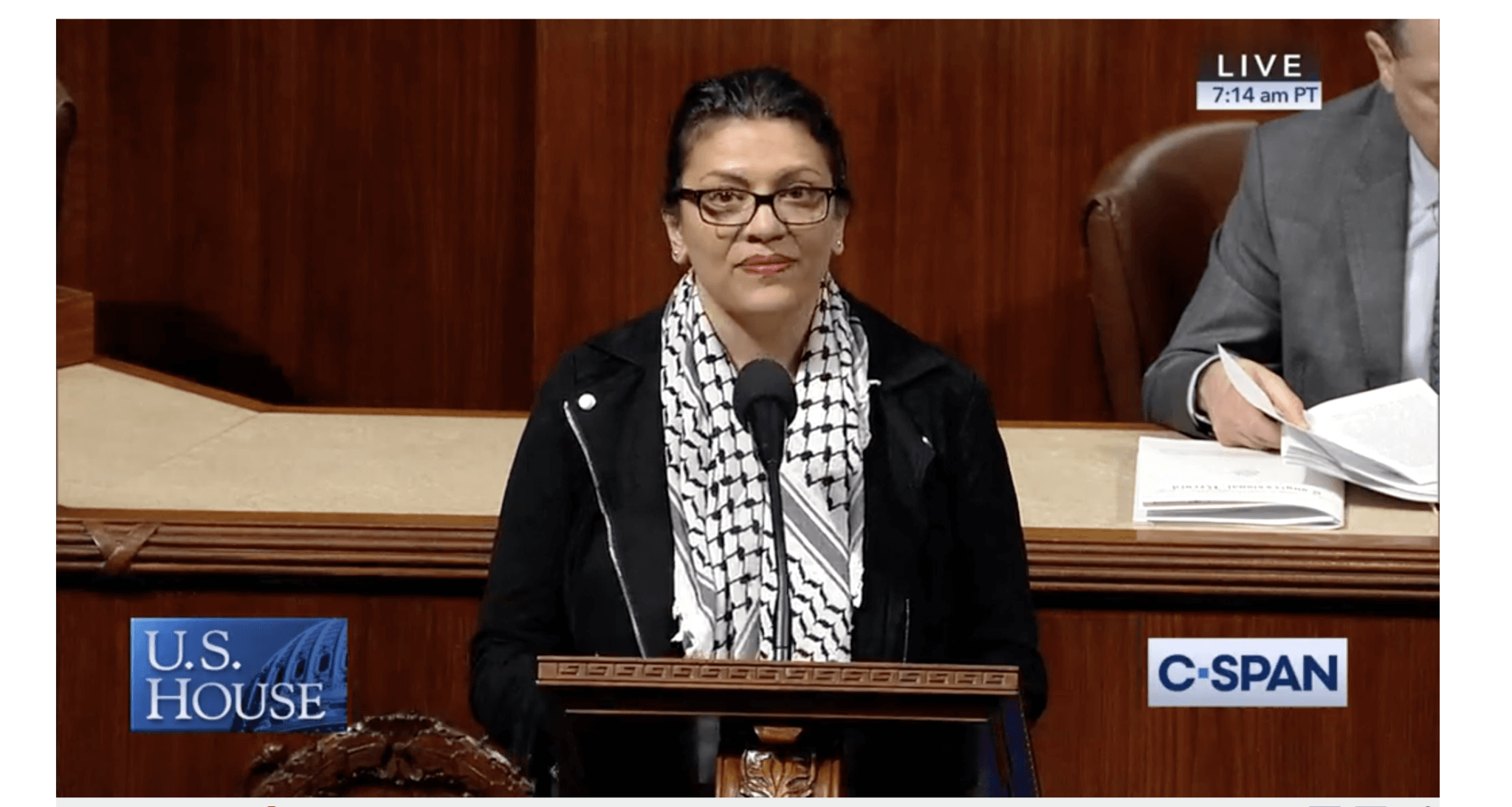
Rep. Rashida Tlaib addressing the House of Representatives on H.Res.326.
Rep. Rashida Tlaib addressing the House of Representatives on H.Res.326. (photo: Mondoweiss)
H.Res. 326 passed but it was a significantly watered down version of previous resolution text.

By Josh Ruebner |  Mondoweiss |  Dec 9, 2019

Democrats primarily rehashed the supposed benefits of a negotiated two-state resolution while refusing to offer any meaningful ideas on how to get there in light of both major Israeli political parties’ opposition to the idea.

The House of Representatives narrowly passed along mostly partisan lines on Friday its most significant piece of legislation on the Israeli-Palestinian impasse this congressional session.

H.Res.326, a non-binding resolution, affirms that “only” a negotiated two-state resolution to the issue “can both ensure the state of Israel’s survival as a Jewish and democratic state and fulfill the legitimate aspirations of the Palestinian people for a state of their own”.

The resolution was adopted 226-188 with two Representatives abstaining.

Continue reading “House vote on two-state solution shows Congress more divided than ever over Israel”

‘Incitement’ and ‘indecency’: How Palestinian dissent is repressed online

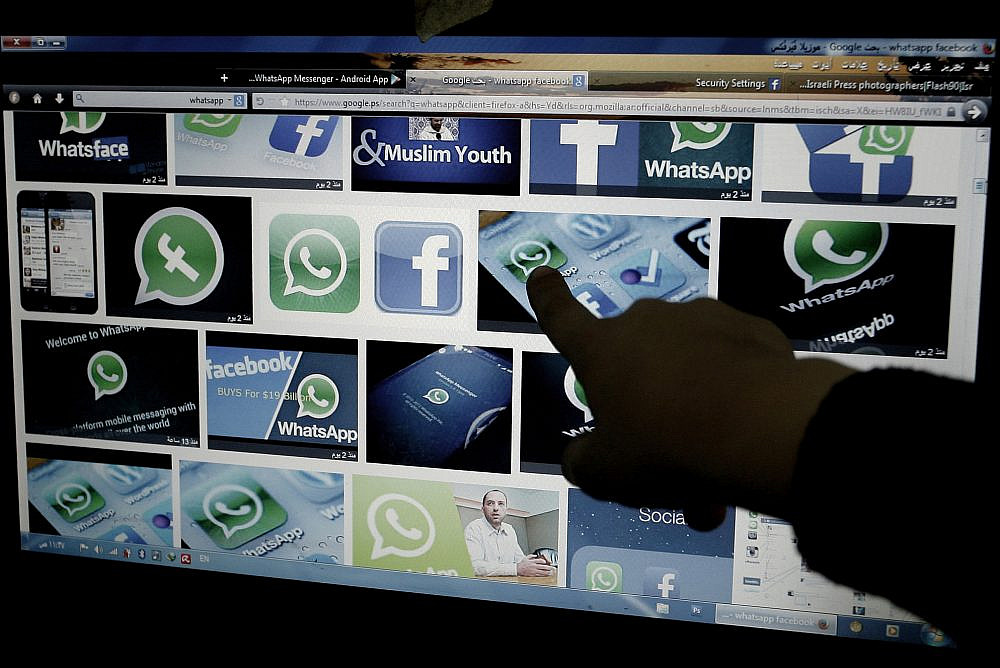
A Palestinian youth points to logos of Facebook and WhatsApp on his computer in Rafah, southern Gaza Strip February 22, 2014. (Photo Abed Rahim Khatib / Flash90)
A Palestinian youth points to logos of Facebook and WhatsApp on his computer in Rafah, southern Gaza Strip February 22, 2014. (photo: Abed Rahim Khatib / Flash90)
Censorship of Palestinian content by Israel, the PA, and Hamas is escalating at an unprecedented and dangerous speed.

By Marwa Fatafta |  +972 Magazine  |  Dec 4, 2019

To express your political views as a Palestinian, you must now tiptoe around three different authorities: Israel, the Fatah-led PA in the West Bank, and the de facto Hamas government in the Gaza Strip…

On Oct. 11, 2019, Facebook shut down the Palestinian Information Center, a news page with five million followers, without prior notice. Six days later, at the request of the attorney general of the Palestinian Authority (PA), the Ramallah Magistrates Court ordered the blocking of 59 websites under the pretext that they were threatening “national security, public order, and public manners.”

Shortly afterward — ironically, on the morning of the International Day to End Impunity for Crimes against Journalists — Twitter blocked three accounts of the Quds News Network, an independent Palestinian media outlet with a large online following. Metras, another Palestinian website on the PA’s blacklist, reported that a number of their Facebook posts were flagged and deleted, and that they received a warning that their page might be taken down.

Continue reading “‘Incitement’ and ‘indecency’: How Palestinian dissent is repressed online”

Seattle Times Op-Ed Response: ‘Extreme Liberals’ may not be the real problem

Gaza Anniversary Demonstration, Seattle, Dec 27, 2009. (photo: Palestine Solidarity Committee)
The following letter has been submitted to the Seattle Times in response to an op-ed by Rabbi Weiner on Dec 3, 2019.

By Rev. Richard Gibson | Presbyterian Church USA | Dec 5, 2019

Please do not allow the term ‘anti-Semitism’ to become a distraction for appropriate criticism of immoral government and military policies which violate International Law and United Nations resolutions.

Dear Editor:

“Extreme Liberals” may not be the real problem. Thanks to Rabbi Weiner (Seattle’s extreme liberals also pose a threat to the Jewish community) for raising the difficult question of “anti-Semitism”: defined as the hatred of Jewish people and their religion.

Liberals in Seattle, across the nation and in Congress, are very concerned about the immoral government and military policies of the State of Israel: denying Palestinian rights, bulldozing homes and orchards, arresting and imprisoning children in the middle of the night, sniper fire killing civilian journalists, medical persons and children at the border protests in GAZA — all of which violate International Law, and do not give Israel good publicity!
Continue reading “Seattle Times Op-Ed Response: ‘Extreme Liberals’ may not be the real problem”

Op-Ed: Seattle’s extreme liberals also pose a threat to the Jewish community

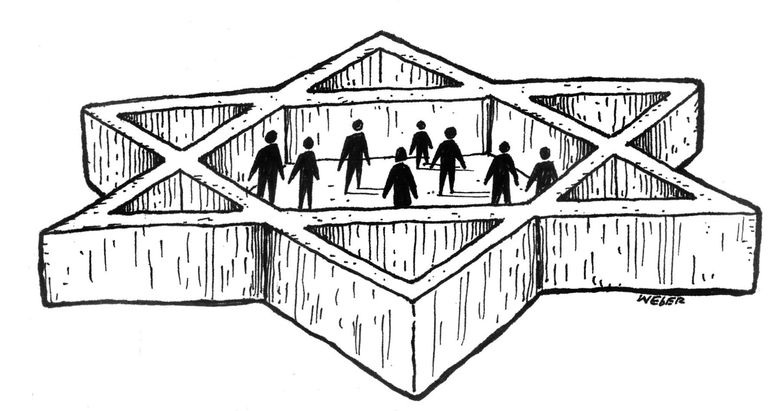
Mark Weber / Op-Art
Mark Weber / Op-Art
Rabbi Weiner responds to the  the need for supportive allies and city leaders in this time of increasing anti-Semitism.

By Daniel A. Weiner |  The Seattle Times  |  Dec 2, 2019

The unqualified support of countless voices from around the world bore out the loving affirmation of the majority over the cowardly cravenness of the marginal.

Anti-Semitism is significantly and unquestionably on the rise. Even among the many vicious acts and inciting words characteristic of these tumultuous, Trumpian times, the marked increase in what many assert as the “oldest of hatreds” is a return to a troubling trope in our history. The statistics, media coverage and lived experience of American Jews reinforce this perception as reality.

And yet, there are many within our society, supportive allies and principled civic leaders, who have spoken out and acted against the resurgence of this dark specter. While I have worked closely with Regina Friedland, director of the American Jewish Committee, Seattle region, and respect her efforts, I take issue with her overgeneralized indictment of Mayor Jenny Durkan’s responsiveness to recent anti-Jewish bigotry [“Why are Seattle’s leaders silent about anti-Semitism?” Nov. 23, Opinion].

Continue reading “Op-Ed: Seattle’s extreme liberals also pose a threat to the Jewish community”

Conversation: Turning possibility into power

Image courtesy of Dov Khenin
Interview with Dov Khenin, Israeli political scientist, lawyer, and one of the most prolific and progressive of Israel’s lawmakers.

By Libby Lenkinski  |  Jewish Currents  |  Dec 3, 2019

Fighting against the occupation is very central to our political activity in Israel—it has been and still is the main issue for my movement, and for me personally.
— Dov Khenin

Israel is stuck in parliamentary muck. After two elections in the span of six months, it’s now staring down the barrel of a third. This month marks a full year since the country has had a functioning government, while its prime minister-in-name-only—who was indicted on charges of bribery, fraud, and breach of trust—is hanging on by a thread. In the midst of this political turmoil, I reached out to former parliamentarian and social activist Dov Khenin to discuss the past and future of the progressive movement in Israel.

After serving in the now-deeply-dysfunctional Knesset for a dozen years as a member of Hadash (Israel’s joint Arab-Jewish Communist Party), Dov chose not to seek re-election last January. In his time there, he made his legislative mark, passing over 100 pieces of legislation, including sweeping environmental protection legislation and increases in the minimum wage. He was also the sole Jewish member of the Joint List, the alliance of the four Arab-majority political parties.

Continue reading “Conversation: Turning possibility into power”