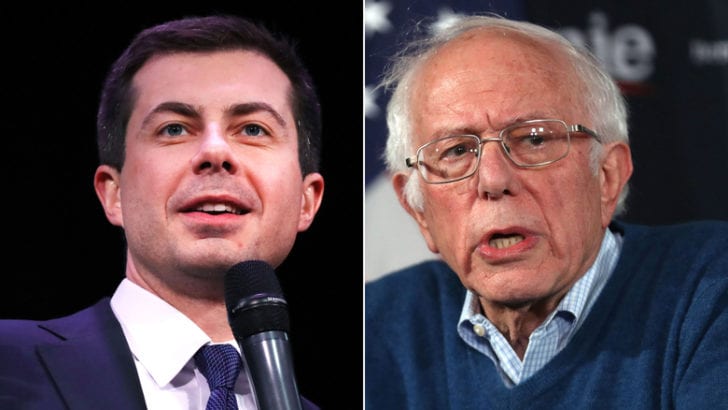
How do Bernie & Buttigieg stand on Israel-Palestine?

How do Bernie & Buttigieg stand on Israel-Palestine?
Pete Buttigieg / Bernie Sanders
One supports Palestinian human rights. One says he’d keep the $10 million per day flowing to Israel no matter what it does. Which is which?

By Kathryn Shihadah and Alison Weir  |  If Americans Knew Blog  | Feb 11, 2020

While it may be an exaggeration to suggest that “billionaires in wine caves” are choosing the next president of the United States, it may be that some wealthy donors have an agenda that they can advance in a wine cave event, while a teacher or pipefitter has little more to wield than a vote.

For over 70 years, the Israeli-Palestinian conflict has been the core issue of the Middle East, central to tragic wars – some involving American troops – and escalating violence. In the past ten days Israeli forces have shot dead nine unarmed Palestinians, seven of them teenagers. In 2019, 149 Palestinians were killed in the conflict along with 10 Israelis.

US Middle East policies, under both Democratic and Republican administrations, have been largely driven by the pro-Israel lobby in the US for many decades. Campaign donors like Sheldon Adelson have influenced Trump policies, while other billionaires such as Haim Saban have influenced Democratic ones.

The US blockade against Iran (which, under international law, constitutes an act of war), was begun by Bush and continued under Obama. The Trump “Muslim Ban” focused on countries that had been selected by the Obama administration and that had long been targeted by Israel

Continue reading “How do Bernie & Buttigieg stand on Israel-Palestine?”

Water as a Weapon Against Palestinians


From: Water Justice in Palestine <waterjusticeinpalestine@gmail.com>

Subject: Fact #151: Water as a weapon against Palestinians


Fact

This week, the Israeli military once again destroyed pipelines that supplied irrigation water to the West Bank village of Bardala. The village depends on agriculture for its main source of income.

Bardala was already suffering water shortage, due to Israel’s refusal to provide it with more than 100 cubic meters of water/hr. (The necessary minimum is 240.) 

Before Israel’s occupation of Palestine, Bardala’s wells provided more than sufficient water.

In 1974, Israel and its water company, Mekorot, closed Bardala’s wells, demanded the village’s residents pay to receive water from their own springs, and built several deep wells on Bardala’s lands for use by Israelis only.

In 2006, Mekorot further reduced Bardala’s water supply by 75%. 

In 2017, Israel bulldozed Bardala’s rebuilt water outlets and destroyed 168 meters of pipelines to farms.

A month later, Israeli soldiers shot at the village’s peaceful Right to Water march of 500


Sources


See our blog  for the article Trump to Palestinians: surrender and we’ll give you a pretend ‘state’ and water too.

Alliance for Water Justice in Palestine

Facebook | Website waterjusticeinpalestine.org | Twitter @WaterPalestine


Sources


See our blog  for the article Trump to Palestinians: surrender and we’ll give you a pretend ‘state’ and water too.

Alliance for Water Justice in Palestine

Facebook | Website waterjusticeinpalestine.org | Twitter @WaterPalestine

Journalist Abby Martin sues State of Georgia over law requiring pledge of allegiance to Israel

Journalist Abby Martin announces a federal free speech lawsuit to overturn Georgia’s unconstitutional Israel boycott in partnership with CAIR and the Partnership for Justice Fund. (photo: Facebook Screenshot)
Martin, the journalist and documentarian of ‘Gaza Fights for Freedom’, is challenging free speech restrictions because of her support for a boycott of Israel.

By Alan Macleod | Activist Post | Feb 10, 2020

‘The hyperbolic notion that conservatives are the ones being persecuted on college campuses has made blatant censorship campaigns against people for criticism of Israel, or other progressive protests, go completely ignored.’
— Abby Martin, film documentarian

After refusing to sign a pledge of allegiance to the state of Israel, the state of Georgia shut down a media literacy conference featuring journalist and filmmaker Abby Martin at Georgia Southern University. Martin had recently released a documentary critical of the Israeli government called Gaza Fights for Freedom. Now she is suing the state, claiming the decision is a violation of the First Amendment. Along with the Council on American-Islamic Relations (CAIR) and the Partnership for Civil Justice Fund (PCJF), today she filed a federal free speech lawsuit against the university system of Georgia.

Martin was dismayed by the university’s decision: “This censorship of my talk based on forced compliance to anti-BDS laws in Georgia is just one level of a nationwide campaign to protect Israel from grassroots pressure. We must stand firmly opposed to these efforts and not cower in fear to these blatant violations of free speech,” she said.
Continue reading “Journalist Abby Martin sues State of Georgia over law requiring pledge of allegiance to Israel”

Jared Kushner does not see the brutal occupation I helped carry out

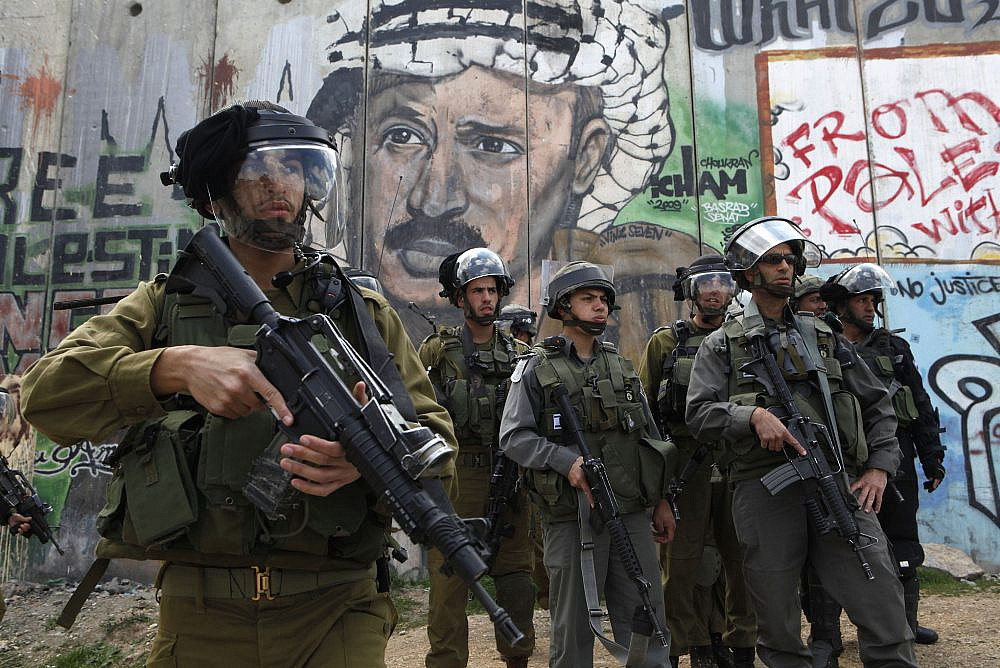
Israeli security officers take position near a burning tire during clashes with Palestinian protesters at a demonstration marking Land Day at Qalandiya checkpoint, near Ramallah, March 30, 2012. (Uri Lenz/FLASH90)
Israeli security officers take position near a burning tire during clashes with Palestinian protesters at a demonstration marking Land Day at Qalandiya checkpoint, near Ramallah, March 30, 2012. (photo: Uri Lenz / FLASH90)
A former soldier speaks out about the two separate legal systems for Israelis and Palestinians. The Trump plan wants to make this reality permanent.

By Yehuda Shaul | +972 Magazine | Feb 3, 2020

And although I do not know what it is like to live under occupation, I do know what it is like to carry out that occupation, having served as an IDF soldier in Palestinian communities that Israel has subjected to military rule for over half a century.

In an interview on CNN last week, Jared Kushner, one of the architects of President Donald Trump’s newly-released “Deal of the Century,” stated: “The reality is that Israel’s there [in the West Bank], and they’re not leaving… I’m not looking at the world as it existed in 1967. I’m looking at the world as it exists in 2020.”

These remarks echoed Kushner’s repeated calls for Palestinians to abandon their history and accept today’s facts on the ground. Only this, he says, would make it possible for Palestinians to move forward to a prosperous future.

I would urge Kushner to follow his own guidance and take a closer look at the “reality” he claims to see.

Continue reading “Jared Kushner does not see the brutal occupation I helped carry out”

Why did Palestinians reject Trump’s peace plan? Here are three reasons

President Trump speaks during an event with Israeli Prime Minister Benjamin Netanyahu in the East Room of the White House in Washington on Jan. 28. (Susan Walsh/AP)
President Trump speaks during an event with Israeli Prime Minister Benjamin Netanyahu in the White House, Jan 28. (photo: Susan Walsh / AP)
This situation has a name, regardless of whom one blames for it: apartheid.

By Ezzedine Fishere | The Washington Post | Feb 6, 2020

Condemning Trump’s plan and calling for resuscitating the two-state solution is no longer useful; that ‘solution’ has been dead for more than a decade. . . . Trump’s plan opened a gate for a powerful stream that will carry us toward the dreadful challenges of an apartheid state. The question before us now is what we all — Palestinians, Arabs, Israelis and the world — will do about that.

One didn’t need to read 25 books to predict that the Palestinians would reject President Trump’s Middle East “peace plan.” Palestinians have a reputation for rejecting offers, knowing quite well the next could be worse. They rejected the 1947 United Nations partition plan that gave them less than 45 percent of Mandatory Palestine, Ehud Barak’s “generous offer” at Camp David in 2000, and Ehud Olmert’s even “more generous” offer in 2008 after the Annapolis process. The world has grown weary of this perceived lack of pragmatism; many feel that, given their weak position, Palestinians should accept what they can get or “shut up,” as Saudi Crown Prince Mohammed bin Salman so eloquently put it in 2018.

Yet, without truly understanding the behavior and motivations of Palestinians, it is impossible to find a solution or even begin to manage the Arab-Israeli conflict.

The Palestinians have accepted other offers, such as the Security Council resolution 242 in 1967 and the Oslo Accords, which promised them a meager 22 percent of Palestine — at best. All the proposed solutions involved a loss, so why do they accept some plans and reject others? The answer lies in three things Palestinians care about most: a sense of fairness, the hope of living freely in a sovereign state of their own, and the facts on the ground.
Continue reading “Why did Palestinians reject Trump’s peace plan? Here are three reasons”

A diktat on behalf of Israel: Faith leaders and organizations stand up to the U.S. Plan for “Peace to Prosperity”

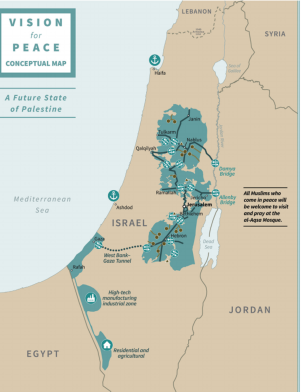
US Peace Plan Peace to Prosperity map. (photo: White House)
Statements from faith leaders across the world speak out about Trumps peace plan.

By Palestine Portal | Feb 5, 2020

‘It constitutes an ultimatum, rather than a real, sustainable or just solution. No just peace can be established for either Palestinians or Israelis with such a plan.’
— Olav Fykse Tveit, General Secretary, World Council of Churches

Last week the United States issued its much-vaunted “Deal of the Century,” titled “Peace to Prosperity.” Faith leaders and organizations in Palestine, the U.S. and across the world responded immediately with outrage and protest. “An insult to history, humanity, the Palestinian people, and the American dignity itself” reads the statement from Kairos Palestine. The Palestine Israel Network of the Episcopal Peace Fellowship puts it well: “This plan is not a peace agreement or even a reasonably framed blueprint for a peace agreement: Palestinians themselves have had no say in its design, and there has been no negotiation between sides. The plan is rather a diktat imposed unilaterally by the United States on behalf of Israel to further Israel’s illegal consolidation of permanent control over all the territory of Palestine, from the Mediterranean Sea to the Jordan River.”

Continue reading “A diktat on behalf of Israel: Faith leaders and organizations stand up to the U.S. Plan for “Peace to Prosperity””

Kairos Statement on the American declaration on peace in the Middle East


4065319613
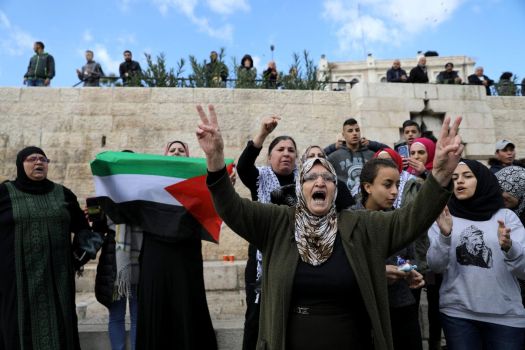
Palestinians protesting after U.S. President Donald Trump’s announcement recognizing Jerusalem as Israel’s capital, near Damascus Gate in the Old City of Jerusalem, Dec 7, 2017. (photo: Ammar Awad / Reuters)
A plea from Palestinian Christians to other Christians to stand up in the face of injustice against the Palestinian people and demand their countries to reject categorically the so-called ‘deal of the century’.

By Kairos Palestine | Jan 28, 2020

…President Trump did not offer anything towards this equality but rather consolidated further Israeli hegemony and Palestinians subjugation to it.

The position announced by the U.S. administration regarding what they termed as the ‘deal of the century’ was in fact an insult to history, humanity, the Palestinian people, and the American dignity itself.

The American-Israeli proposal is premised on consolidating Israeli control over all of Palestine’s land, making sure that the Palestinian people are subjected to this control, in return for economic promises that are closer to a deal for buying the people and their spirit with money.

This proposal seeks to legitimize the Israeli occupation and revoke the history of the Palestinian people and their legitimate inalienable rights, particularly the right of return for the Palestinian refugees and the right to self-determination in an attempt to eliminate the Palestinian question completely and definitively.

Continue reading “Kairos Statement on the American declaration on peace in the Middle East”

What the Arab League should tell the US

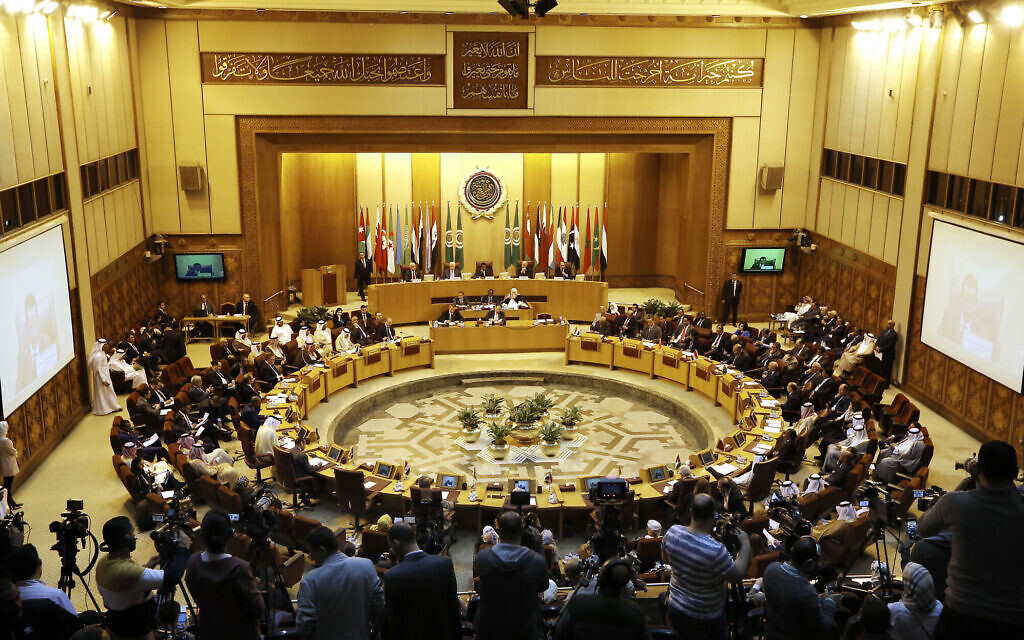
An extraordinary session of the Arab League foreign ministers meets to discuss the situation in the Palestinian territories at the Arab League headquarters in Cairo, Egypt, last year. (photo: AP)
A call to remember the Arab response needs to be focused on Palestinian and Arab rights rather than dealing directly with some of the outlandish comments made in the US plan.

By Daoud Kuttab|  Arab News | January 31, 2020

The Arab response needs to be focused on Palestinian and Arab rights rather than dealing directly with some of the outlandish comments made in the US plan.

An emergency session of the Arab League on Saturday will discuss the Trump Mideast peace plan — a proposal unveiled at the White House in the presence of Israeli Prime Minister Benjamin Netanyahu but without any Palestinian or Arab leader present. The Arab position on this issue must be clear without being bombastic.

US Secretary of State Mike Pompeo has said that if Palestinians reject the US plan, “they should make a counter offer.”

Arabs, including Palestinians, have made an offer and are still awaiting a reply.

Continue reading “What the Arab League should tell the US”

A hierarchy of vulnerability

Erez Cross (photo: Alice Rothchild)
Having freedom of movement is a privilege that is fraught with modern dangers in the context of ever expanding state and global surveillance.

By Alice Rothchild | Mondoweiss  | Feb 1, 2020

 …the most relevant book I read on the issue of borders was Francisco Cantu’s The Line Becomes a River, Dispatches from the Border. Cantu wrote eloquently of his experiences as a US border patrol agent, his realization that there are no “good” border guards (or soldiers at checkpoints for that matter), when the institutions themselves are corrupted.

I was recently passing through customs where I popped my US passport face down on a little machine which then opened a gate that led to two yellow footprints in the next compartment. I placed my feet on the footprints, faced the camera, tried to look like my friendly passport photo, and bam, the next gate opened and I was in. It occurred to me that this is both reassuring and creepy. The fact that I have “papers” means that I officially exist, that I am recognized on this planet as a human with some value and protections. Someone in officialdom (not to mention my husband and daughters) will notice if I disappear.

The fact that surveillance systems (at least in the First World), all recognize my passport and my face, can check the criminal history/no fly/terrorist watch list in two seconds flat, and come back “All good,” is actually frightening. As you are probably increasingly aware, between our i-phones, social media, public surveillance cameras, credit card history, and every airport we breeze through or wait for hours, our existence, buying habits, and locations are being closely watched and recorded.

Continue reading “A hierarchy of vulnerability”

Trump’s deal of the century won’t bring peace…that was the plan

Donald Trump and Benjamin Netanyahu at the White House. (photo: The White House – Public Domain)
A peace plan with no outcome that will lead to peace.

By Jonathan Cook |  CounterPunch  | Jan 30, 2020

This was a deal designed in Tel Aviv more than in Washington – and its point was to ensure there would be no Palestinian partner.

Much of Donald Trump’s long-trailed “deal of the century” came as no surprise. Over the past 18 months, Israeli officials had leaked many of its details.

The so-called “Vision for Peace” unveiled on Tuesday simply confirmed that the US government has publicly adopted the long-running consensus in Israel: that it is entitled to keep permanently the swaths of territory it seized illegally over the past half-century that deny the Palestinians any hope of a state.

The White House has discarded the traditional US pose as an “honest broker” between Israel and the Palestinians. Palestinian leaders were not invited to the ceremony, and would not have come had they been. This was a deal designed in Tel Aviv more than in Washington – and its point was to ensure there would be no Palestinian partner.

Continue reading “Trump’s deal of the century won’t bring peace…that was the plan”