Why did Palestinians reject Trump’s peace plan? Here are three reasons

President Trump speaks during an event with Israeli Prime Minister Benjamin Netanyahu in the East Room of the White House in Washington on Jan. 28. (Susan Walsh/AP)
President Trump speaks during an event with Israeli Prime Minister Benjamin Netanyahu in the White House, Jan 28. (photo: Susan Walsh / AP)
This situation has a name, regardless of whom one blames for it: apartheid.

By Ezzedine Fishere | The Washington Post | Feb 6, 2020

Condemning Trump’s plan and calling for resuscitating the two-state solution is no longer useful; that ‘solution’ has been dead for more than a decade. . . . Trump’s plan opened a gate for a powerful stream that will carry us toward the dreadful challenges of an apartheid state. The question before us now is what we all — Palestinians, Arabs, Israelis and the world — will do about that.

One didn’t need to read 25 books to predict that the Palestinians would reject President Trump’s Middle East “peace plan.” Palestinians have a reputation for rejecting offers, knowing quite well the next could be worse. They rejected the 1947 United Nations partition plan that gave them less than 45 percent of Mandatory Palestine, Ehud Barak’s “generous offer” at Camp David in 2000, and Ehud Olmert’s even “more generous” offer in 2008 after the Annapolis process. The world has grown weary of this perceived lack of pragmatism; many feel that, given their weak position, Palestinians should accept what they can get or “shut up,” as Saudi Crown Prince Mohammed bin Salman so eloquently put it in 2018.

Yet, without truly understanding the behavior and motivations of Palestinians, it is impossible to find a solution or even begin to manage the Arab-Israeli conflict.

The Palestinians have accepted other offers, such as the Security Council resolution 242 in 1967 and the Oslo Accords, which promised them a meager 22 percent of Palestine — at best. All the proposed solutions involved a loss, so why do they accept some plans and reject others? The answer lies in three things Palestinians care about most: a sense of fairness, the hope of living freely in a sovereign state of their own, and the facts on the ground.
Continue reading “Why did Palestinians reject Trump’s peace plan? Here are three reasons”

A diktat on behalf of Israel: Faith leaders and organizations stand up to the U.S. Plan for “Peace to Prosperity”

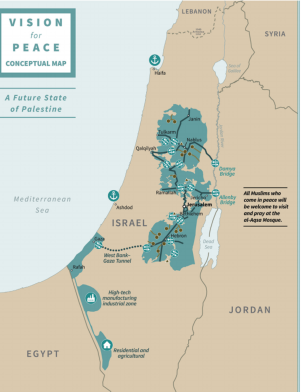
US Peace Plan Peace to Prosperity map. (photo: White House)
Statements from faith leaders across the world speak out about Trumps peace plan.

By Palestine Portal | Feb 5, 2020

‘It constitutes an ultimatum, rather than a real, sustainable or just solution. No just peace can be established for either Palestinians or Israelis with such a plan.’
— Olav Fykse Tveit, General Secretary, World Council of Churches

Last week the United States issued its much-vaunted “Deal of the Century,” titled “Peace to Prosperity.” Faith leaders and organizations in Palestine, the U.S. and across the world responded immediately with outrage and protest. “An insult to history, humanity, the Palestinian people, and the American dignity itself” reads the statement from Kairos Palestine. The Palestine Israel Network of the Episcopal Peace Fellowship puts it well: “This plan is not a peace agreement or even a reasonably framed blueprint for a peace agreement: Palestinians themselves have had no say in its design, and there has been no negotiation between sides. The plan is rather a diktat imposed unilaterally by the United States on behalf of Israel to further Israel’s illegal consolidation of permanent control over all the territory of Palestine, from the Mediterranean Sea to the Jordan River.”

Continue reading “A diktat on behalf of Israel: Faith leaders and organizations stand up to the U.S. Plan for “Peace to Prosperity””

Kairos Statement on the American declaration on peace in the Middle East


4065319613
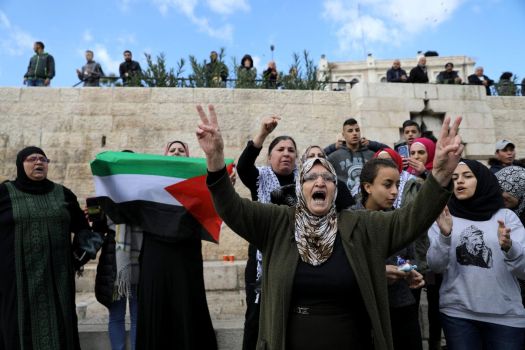
Palestinians protesting after U.S. President Donald Trump’s announcement recognizing Jerusalem as Israel’s capital, near Damascus Gate in the Old City of Jerusalem, Dec 7, 2017. (photo: Ammar Awad / Reuters)
A plea from Palestinian Christians to other Christians to stand up in the face of injustice against the Palestinian people and demand their countries to reject categorically the so-called ‘deal of the century’.

By Kairos Palestine | Jan 28, 2020

…President Trump did not offer anything towards this equality but rather consolidated further Israeli hegemony and Palestinians subjugation to it.

The position announced by the U.S. administration regarding what they termed as the ‘deal of the century’ was in fact an insult to history, humanity, the Palestinian people, and the American dignity itself.

The American-Israeli proposal is premised on consolidating Israeli control over all of Palestine’s land, making sure that the Palestinian people are subjected to this control, in return for economic promises that are closer to a deal for buying the people and their spirit with money.

This proposal seeks to legitimize the Israeli occupation and revoke the history of the Palestinian people and their legitimate inalienable rights, particularly the right of return for the Palestinian refugees and the right to self-determination in an attempt to eliminate the Palestinian question completely and definitively.

Continue reading “Kairos Statement on the American declaration on peace in the Middle East”

What the Arab League should tell the US

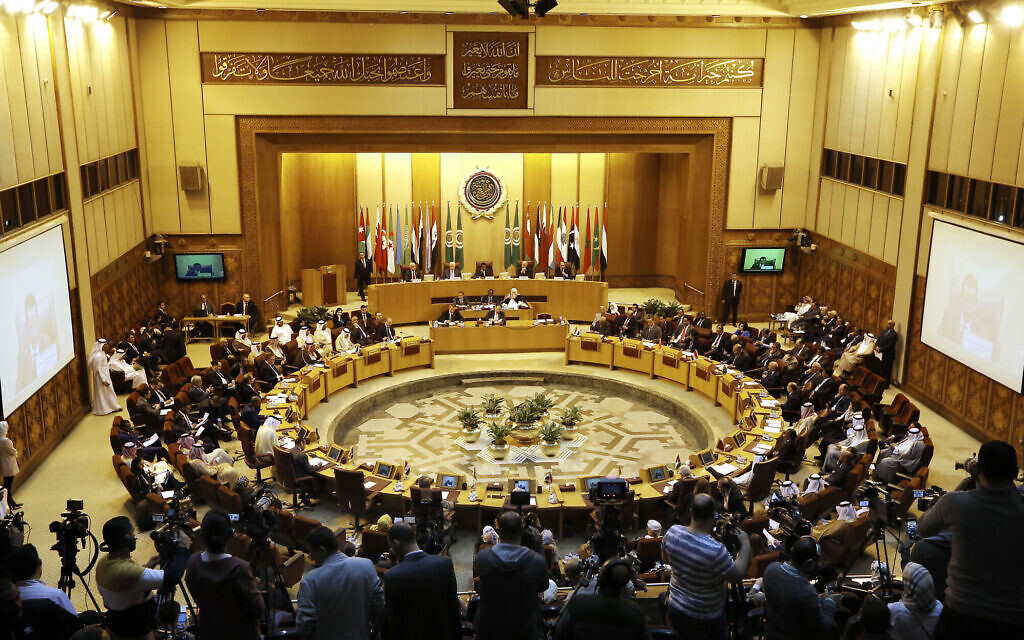
An extraordinary session of the Arab League foreign ministers meets to discuss the situation in the Palestinian territories at the Arab League headquarters in Cairo, Egypt, last year. (photo: AP)
A call to remember the Arab response needs to be focused on Palestinian and Arab rights rather than dealing directly with some of the outlandish comments made in the US plan.

By Daoud Kuttab|  Arab News | January 31, 2020

The Arab response needs to be focused on Palestinian and Arab rights rather than dealing directly with some of the outlandish comments made in the US plan.

An emergency session of the Arab League on Saturday will discuss the Trump Mideast peace plan — a proposal unveiled at the White House in the presence of Israeli Prime Minister Benjamin Netanyahu but without any Palestinian or Arab leader present. The Arab position on this issue must be clear without being bombastic.

US Secretary of State Mike Pompeo has said that if Palestinians reject the US plan, “they should make a counter offer.”

Arabs, including Palestinians, have made an offer and are still awaiting a reply.

Continue reading “What the Arab League should tell the US”

A hierarchy of vulnerability

Erez Cross (photo: Alice Rothchild)
Having freedom of movement is a privilege that is fraught with modern dangers in the context of ever expanding state and global surveillance.

By Alice Rothchild | Mondoweiss  | Feb 1, 2020

 …the most relevant book I read on the issue of borders was Francisco Cantu’s The Line Becomes a River, Dispatches from the Border. Cantu wrote eloquently of his experiences as a US border patrol agent, his realization that there are no “good” border guards (or soldiers at checkpoints for that matter), when the institutions themselves are corrupted.

I was recently passing through customs where I popped my US passport face down on a little machine which then opened a gate that led to two yellow footprints in the next compartment. I placed my feet on the footprints, faced the camera, tried to look like my friendly passport photo, and bam, the next gate opened and I was in. It occurred to me that this is both reassuring and creepy. The fact that I have “papers” means that I officially exist, that I am recognized on this planet as a human with some value and protections. Someone in officialdom (not to mention my husband and daughters) will notice if I disappear.

The fact that surveillance systems (at least in the First World), all recognize my passport and my face, can check the criminal history/no fly/terrorist watch list in two seconds flat, and come back “All good,” is actually frightening. As you are probably increasingly aware, between our i-phones, social media, public surveillance cameras, credit card history, and every airport we breeze through or wait for hours, our existence, buying habits, and locations are being closely watched and recorded.

Continue reading “A hierarchy of vulnerability”

Trump’s deal of the century won’t bring peace…that was the plan

Donald Trump and Benjamin Netanyahu at the White House. (photo: The White House – Public Domain)
A peace plan with no outcome that will lead to peace.

By Jonathan Cook |  CounterPunch  | Jan 30, 2020

This was a deal designed in Tel Aviv more than in Washington – and its point was to ensure there would be no Palestinian partner.

Much of Donald Trump’s long-trailed “deal of the century” came as no surprise. Over the past 18 months, Israeli officials had leaked many of its details.

The so-called “Vision for Peace” unveiled on Tuesday simply confirmed that the US government has publicly adopted the long-running consensus in Israel: that it is entitled to keep permanently the swaths of territory it seized illegally over the past half-century that deny the Palestinians any hope of a state.

The White House has discarded the traditional US pose as an “honest broker” between Israel and the Palestinians. Palestinian leaders were not invited to the ceremony, and would not have come had they been. This was a deal designed in Tel Aviv more than in Washington – and its point was to ensure there would be no Palestinian partner.

Continue reading “Trump’s deal of the century won’t bring peace…that was the plan”

The Trump peace sham

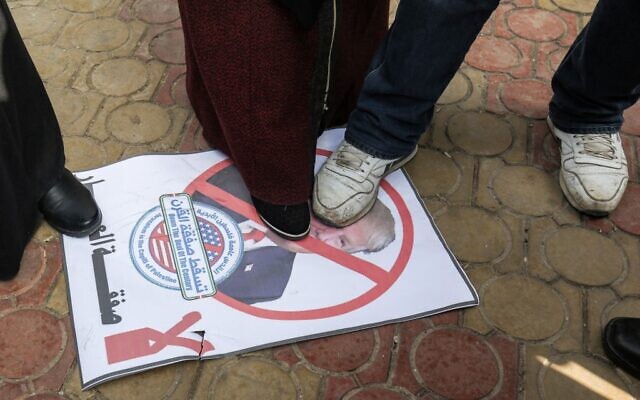
Palestinian demonstrators step with their feet on a poster showing the face of US President Donald Trump during a protest against his expected announcement of a peace plan, in Rafah in the southern Gaza Strip on January 28, 2020. (Photo by SAID KHATIB / AFP)
Palestinian demonstrators step with their feet on a poster showing the face of US President Donald Trump during a protest against his expected announcement of a peace plan, in Rafah in the southern Gaza Strip on January 28, 2020. (photo: Said Khatib by / AFP)
J Street has pulled together a compilation of analysis and statements from a variety of sources in response to Trump’s peace plan proposal.

By J Street | Jan 29, 2020

The Palestinians will be left with a proto-state that is physically divided, economically challenged, and possibly not viable as a modern country.
—  Robin Wright, foreign affairs analyst

If there was ever any doubt that the Trump-Netanyahu “peace plan” was anything other than a smokescreen for annexation, it was disabused just moments after the plan’s glitzy White House announcement.

Immediately following President Trump’s announcement of a plan he claimed would chart a course to a “two-state solution,” Prime Minister Netanyahu took to the very same podium to announce his government would immediately move to impose sovereignty over the Jordan Valley and all West Bank settlements — a flagrant violation of international law.

Continue reading “The Trump peace sham”

Trump releases Mideast Peace Plan that strongly favors Israel

Note: Boundaries are approximate and based on available data provided by the White House, some of which was obscured. (photo:Source: White House by The New York Times)
The plan would discard the longtime goal of granting the Palestinians a full-fledged state.

By Michael Crowley / David M. Halbfinger | The New York Times | Jan 28, 2020

‘We say a thousand times over: no, no, no,’
— President Mahmoud Abbas of the Palestinian Authority

President Trump on Tuesday unveiled his long-awaited Middle East peace plan with a flourish, releasing a proposal that would give Israel most of what it has sought over decades of conflict while offering the Palestinians the possibility of a state with limited sovereignty.

Mr. Trump’s plan would guarantee that Israel would control a unified Jerusalem as its capital and not require it to uproot any of the settlements in the West Bank that have provoked Palestinian outrage and alienated much of the world. Mr. Trump promised to provide $50 billion in international investment to build the new Palestinian entity and open an embassy in its new state.

“My vision presents a win-win opportunity for both sides, a realistic two-state solution that resolves the risk of Palestinian statehood to Israel’s security,” the president said at a White House ceremony that demonstrated the one-sided state of affairs: He was flanked by Prime Minister Benjamin Netanyahu of Israel but no counterpart from the Palestinian leadership, which is not on speaking terms with the Trump administration.

Continue reading “Trump releases Mideast Peace Plan that strongly favors Israel”

Orla Guerin’s report shows what’s wrong with Holocaust remembrance

International correspondent Orla Geruin appearing on BBC News at Ten on Wednesday (Credit: BBC iPlayer)
International correspondent Orla Geruin appearing on BBC News. (photo: BBC iPlayer)
A short TV news report attracted fierce criticism, with some suggesting Guerin’s comments sought to draw parallels between the Israeli-Palestinian conflict and the Holocaust.

By Robert A. H. Cohen | Writing from the Edge  | Jan 26, 2020

The undeniable truth is that Palestinians are part of the post Holocaust story too.

As I become older I realize that the Holocaust is not over. The gas chambers and incinerators are gone but the consequences of the horror will continue to play out in the decades and even centuries to come. Our understanding of who we are as Jews, our place in the world, our politics, how others view us, even our theology, continues to be shaped, indeed defined, by the Holocaust.

Why would it be otherwise?

Just as with earlier major turning points of Jewish history – the destruction of the Second Temple in AD 70 or the expulsion from Spain in 1492 – the Holocaust changed everything. A third of our people were destroyed along with their culture and heritage. But none of us were left untouched whether we were alive then or born since. Or are yet to be born.

Continue reading “Orla Guerin’s report shows what’s wrong with Holocaust remembrance”

Aftermath: The Iran war after the Soleimani assassination


No War with Iran protest Jan 4, 2020 in Durham NC. (photo: Anthony Crider – CC BY 2.0)
Trump’s Iran policy, as with Jerusalem and the Golan Heights, is taking to its logical and deadly conclusion the entire imperialist-zionist conception of the Middle East.

By Jim Kavanagh | CounterPunch |  Jan 24, 2020

The one big war makes perfect sense when one understands that the United States has thoroughly internalized Israel’s interests as its own.

“Praise be to God, who made our enemies fools.”
— Ayatollah Khamenei

I’ve been writing and speaking for months about the looming danger of war with Iran, often to considerable skepticism.

In June, in an essay entitled “Eve of Destruction: Iran Strikes Back,” after the U.S. initiated its “maximum pressure” blockade of Iranian oil exports, I pointed out that “Iran considers that it is already at war,” and that the downing of the U.S. drone was a sign that “Iran is calling the U.S. bluff on escalation dominance.”

Continue reading “Aftermath: The Iran war after the Soleimani assassination”