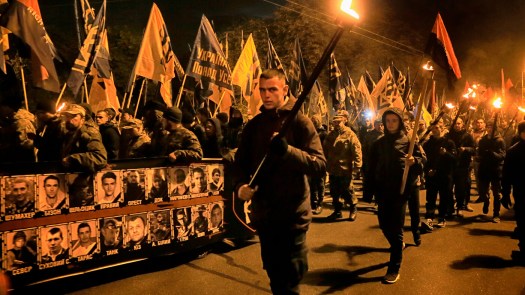
Volunteers of the ultra far-right Azov Battalion at a rally marking Fatherland Defender Day in Kiev, Ukraine, Oct. 14, 2016. (photo: Efrem Lukatsky | AP)
The US has voted against similar resolutions every year since 2014, dismissing them as Russian attempts to delegitimize the Ukrainian government.
By Alex McLeod | MintPress News | Dec 18, 2020
While this could be seen as another example of Donald Trump refusing to condemn the far-right, it is highly doubtful that the incoming Biden administration would have voted any differently.
The United States and Ukraine were the only two nations to vote against a United Nations resolution Wednesday on, “Combating glorification of Nazism, neo-Nazism and other practices that contribute to fuelling contemporary forms of racism, racial discrimination, xenophobia and related intolerance.” The resolution passed 130-2.
The resolution featured 70 fairly bland statements condemning the crimes of Adolf Hitler, while also expressing concern at the rise of contemporary Neo-Nazi groups.
Suhad Saidam adjusts one of her face masks on a youth at her sewing workshop in Gaza City, Monday, Dec. 14, 2020. (photo: Adel Hana / AP)
Both the Israeli-Palestinian conflict and a growing gap between rich and poor countries could keep vaccines from the West Bank and Gaza as the virus surges.
By Steve Hendrix and Shira Rubin | The Washington Post | Dec 18, 2020
‘Israel bears moral and humanitarian responsibility for vaccinating the Palestinian population under its control,’ — Physicians for Human Rights appeal
JERUSALEM — Israel, like many high-income countries, is moving quickly to roll out newly approved coronavirus vaccines, with Prime Minister Benjamin Netanyahu scheduled to get the symbolic first shot Saturday. But next door in the West Bank and Gaza Strip, the prospects for vaccinating almost 5 million Palestinians are far less certain, as financial, political and logistical hurdles could delay inoculations against the raging pandemic for months.
The split highlights not only the tense disparities between Israel and the Palestinian populations it effectively controls, but the growing divergence between vaccine haves and have-nots as the world enters the pandemic endgame.
The United States, Britain, Russia and other developed countries have already begun administering vaccines to health-care workers, the elderly and other priority groups. Other nations are receiving shipments now.
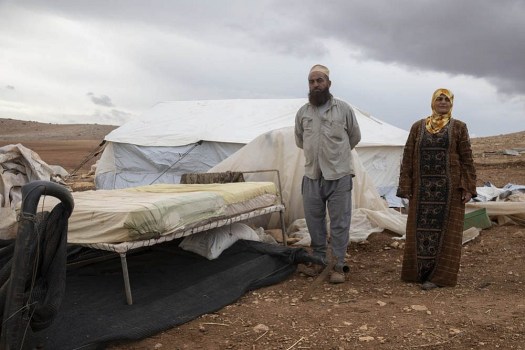
Abdul-Ghani and Fadwa Awawdeh are seen among the debris of an Israeli demolition in the Palestinian community of Humsa al-Fuqa, in the occupied West Bank, November 4, 2020. (photo: Ahmad al-Bazz / Activestills)
Blaming Palestinians for their own displacement, Democratic Majority for Israel is pushing back against its party’s criticism of the largest West Bank demolition in a decade, memo reveals.
By Alex Kane | +972 Magazine | Dec 16, 2020
‘It’s completely unjustifiable to be rationalizing kicking people out of their homes in the middle of a global pandemic,’ — Emily Mayer, political director of the anti-occupation Jewish group IfNotNow
When Israeli bulldozers stormed the West Bank community of Humsa al-Fuqa (Khirbet Humsa) and demolished its structures on Nov. 3, leaving 11 Palestinian families homeless, some Democrats in Washington, D.C. took notice.
Two weeks after the Israeli demolition, which took place under the cover of U.S. election day, Rep. Mark Pocan (D-Wisc.) and 39 of his Congressional colleagues sent a letter to Secretary of State Mike Pompeo criticizing Israel’s actions as “a serious violation of international law” and an example of “creeping annexation.” Pocan’s letter also demanded that Pompeo examine whether Israel had utilized U.S.-made equipment during the demolition operation.
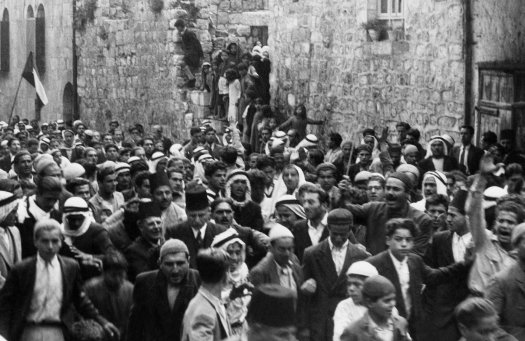
A picture dated before 1937 during the British Mandate in Palestine shows Arabs demonstrating in the Old City of Jerusalem against the Jewish immigration to Palestine. (photo: AFP)
Israel’s outrageous fabrications about the immigration of Arab Jews to Israel in the 1940s and ’50s are an attempt to mask the injustices meted out to Palestinians.
By Joseph Massad | Middle East Eye | Dec 15, 2020
Despite Israeli culpability in bringing about the exodus of Arab Jews from their countries, the Israeli government continues to blame it on Arab governments.
Israeli propaganda about the “expulsion” of Arab Jews from Arab countries in the late 1940s and early 1950s continues without respite. Earlier this month, Israel’s UN ambassador, Gilad Erdan, informed UN Secretary-General Antonio Guterres that he “intends to submit a draft resolution requiring the international body to hold an annual commemoration for the hundreds of thousands of Jews exiled from Arab countries due to the creation of the State of Israel”, according to a report in Ynet.
Israel’s fabrications about the immigration of Arab Jews to Israel are so outrageous that the country holds a commemoration on 30 November each year. This date just happens to coincide with the ethnic cleansing by Zionist gangs of Palestine, which began on 30 November 1947, a day after the UN General Assembly adopted the Partition Plan. The choice of date seeks to implicate Arab Jews in the conquest of Palestine, when most had no role in it.
Campaign Against Antisemitism rally against antisemitism. (photo: Jewish News)
A look into how Israel and the Jewish establishment in Europe are politicizing antisemitism to protect Israel from criticism.
By Jonathan Cook | Jonathan Cook Blog | Dec 11, 2020
If those who support human rights and demand an end to the oppression of Palestinians find themselves labelled antisemitic, it will become ever harder to distinguish between bogus (weaponised) “antisemitism” on the left and real Jew hatred from the right.
The Israeli newspaper Haaretz has run a fascinating long report this week offering a disturbing snapshot of the political climate rapidly emerging across Europe on the issue of antisemitism. The article documents a kind of cultural, political and intellectual reign of terror in Germany since the parliament passed a resolution last year equating support for non-violent boycotts of Israel – in solidarity with Palestinians oppressed by Israel – with antisemitism.
The article concerns Germany but anyone reading it will see very strong parallels with what is happening in other European countries, especially the UK and France.
Book “Beyond the Two-State Solution” by Jonathan Kuttab
Please join Nonviolence International with the roll out of Jonathan Kuttab’s short book, Beyond The Two-State Solution which has had an overwhelmingly positive response. Kuttab is co-founder of Nonviolence International, a well-known international human rights attorney who has practiced in the US, Palestine, and Israel. He was the head of the Legal Committee negotiating the Cairo Agreement of 1994 between Israel and the PLO.
Jonathan Kuttab is co-founder of Nonviolence International and a co-founder of the Palestinian human rights group Al-Haq. A well-known international human rights attorney, he has practiced in the US, Palestine, and Israel. He serves on the Board of Bethlehem Bible College and is President of the Board of Holy Land Trust. He is co-founder and board member of the Just Peace Advocates. He was the head of the Legal Committee negotiating the Cairo Agreement of 1994 between Israel and the PLO.
Azmera Hammouri-Davis is a writer, poet, producer, and artist-educator from Keaáu, Hawaii. She has a Masters of Theological Studies from Harvard Divinity School.
Robert Herbst is a human rights lawyer in New York City and a member of the Westchester, New York chapter of Jewish Voice for Peace. He has been speaking and writing on Israel-Palestine since Operation Protective Edge in Gaza in 2014. Before moving to Westchester, Bob served on the Board and Executive Committee of Congregation Bnai Jeshurun on Manhattan’s Upper West Side, and as Chair of its Social Action Committee.
Rabbi Lynn Gottlieb, one of the first women to become a rabbi in Jewish history, is a “visionary” Jewish educator, feminist, community organizer, peace activist, writer, klezmer dancer, percussionist, visual and ceremonial artist, and master storyteller. She writes on the cover of Jonathan’s book, “some are trapped by the past. This book opens the gate to the future.
HOST:
David Hart is Nonviolence International’s Co-Director. David is an experienced progressive movement leader, conflict resolution practitioner, and nonprofit manager. He was the Chief Executive Officer of the Association for Conflict Resolution and Director of the Americans with Disabilities Act (ADA) Mediation Program at the Key Bridge Foundation. David has served as Executive Director of local, state, and national nonprofit organizations, including Veterans for Peace.
Cancel culture has been around for decades, but the effort to silence pro-Palestinian voices is escalating.
By James Zogby | Responsible Statecraft | Dec 7, 2020
…when we rightly welcome a discussion of the injustices done to the indigenous peoples of America or the crimes of slavery and Jim Crow, how can we deny Palestinians the right to protest their expulsion and dispossession?
In the very month in which I read articles condemning the “cancel culture” – which some apply exclusively to the “left’s efforts to silence or shame views with which they disagree” – several disturbing incidents caught my attention.
A Palestinian American Congresswoman was called an anti-Semite because she greeted the announcement of President-elect Biden’s pick for Secretary of State with the hope that her right to support the movement to Boycott, Divest, or Sanction Israel (BDS) would be recognized. An accomplished Arab American woman, of Palestinian descent, appointed to a position in Biden’s White House was condemned for an observation she made as a student, two decades ago, in which she pointed out how it must have been despair that drove young Palestinians to become suicide bombers. The California Board of Education removed Arab American studies from a model ethnic studies curriculum and eliminated any mention of Palestine. Secretary of State Mike Pompeo announced that the State Department will adopt a definition of anti-Semitism that conflates criticism of Israel with anti-Semitism. As a result, he will designate the BDS movement as an anti-Semitic “cancer” and may also sanction respected human rights organizations because of their criticism of Israeli policies.
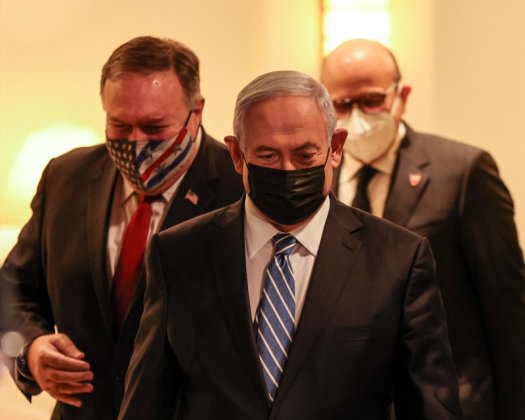
From left, Pompeo, Israeli Prime Minister Benjamin Netanyahu, and Bahrain’s Foreign Minister Abdullatif bin Rashid Al Zayani arrive for a press conference after their trilateral meeting in Jerusalem, Nov. 18. (photo: Menahem Kahana—Pool / EPA-EFE / Shutterstock)
When Pompeo conflates Boycott Divestment and Sanctions (BDS) with anti-Semitism, Palestinians, as well as national and international civil rights advocates object.
By Sanya Mansoor | Time | Dec 4, 2020
‘Every other form of Palestinian resistance has been criminalized and made unavailable…It’s not that BDS is integral. What do we have besides it?’ — Noura Erakat, a human rights attorney and assistant professor at Rutgers University
On the same day that Secretary of State Mike Pompeo became the first high-ranking American diplomat to visit an Israeli settlement in the occupied West Bank, he also doubled down on the Trump administration’s opposition to a global pro-Palestinian movement to boycott Israel.
The Boycott, Divestment and Sanctions (BDS) movement relies on putting political and economic pressure on Israel. The goal is to push Israel to recognize the rights of Palestinian citizens currently living in Israel; allow Palestinian refugees, who were driven out of the country as early as 1948 when Israel was created, to return to their homes; and withdraw from all land that it seized after the 1967 Arab-Israeli war, including the the occupied West Bank—which is claimed by the Palestinians.
Relatives mourn during the funeral of Palestinian teenager Ali Abu Alia in al-Mughayyir village in the Israeli-occupied West Bank. (photo: Mohamad Torokman / Reuters)
Ali Abu Alia is the fifth Palestinian minor from occupied West Bank killed by Israeli forces with live ammunition this year, rights group says.
By Anas Jnena, Mersiha Gadzo | Al Jazeera | Dec 6, 2020
‘Like nearly every other case involving Israeli forces’ unlawful killing of Palestinian children, systemic impunity as the norm ensures that the perpetrator responsible will never be held accountable by Israeli authorities,’ — Ayed Abu Eqtaish, director at the Defense for Children International Palestine (DCIP)
Ali Abu Alia had just turned 15 on Friday when Israeli forces shot and killed him using live ammunition at a protest in al-Mughayyir village in the occupied West Bank.
He was excited to have a birthday party later in the evening, especially since the Abu Alia family is religious and did not usually celebrate.
But Ali’s father, Ayman, had let his wife know that this time they were going to throw him a party.
“Ali got excited and asked his mother to prepare the cake for the evening. But it’s his fate to eat the cake somewhere else [in heaven],” Ayman, 40, told Al Jazeera from al-Mughayyir, northeast of Ramallah.
According to information obtained by the Defense for Children International Palestine (DCIP), Israeli occupying forces shot Ali in the abdomen while he was observing clashes between Palestinian youth and Israeli forces at the entrance to the village.
Palestinian citizens of Israel protest outside the Prime Minister’s Office in Jerusalem against gun violence and organized crime in their communities, October 10, 2019. (photo: Yonatan Sindel / Flash90)
Rather than addressing the roots of crime and violence among Palestinian citizens, Israel is advancing plans to depoliticize the community.
By Shahrazad Odeh | +972 Magazine | Dec 4, 2020
Rather than investing in social services and offering original solutions that center rehabilitation in Palestinian society, it lists outdated recommendations that are merely tools by which the state can tighten its grip on Palestinian citizens under its colonial rule.
Four years ago, in early September, I woke up in the middle of the night in Umm al-Fahem to the sound of machine guns. Afraid and baffled, not knowing where the shots were coming from or who they were being fired at, I called the police to report a crime. It took the officers two hours to make their way from the police station, which is a 15-minute drive away. When they finally arrived, they collected the ammunition in a clear plastic bag, and waved it in front of children looking on at the scene.
These kinds of incidents have persisted despite the Israeli government introducing several programs over the years to help eradicate crime across the country. In many Palestinian cities and towns in Israel, citizens still go to sleep to the sound of gun shots.






 HolyLandJustice.org
You must be logged in to post a comment.