‘We will not be silenced, siloed, or stopped’: federal judge tosses lawsuit targeting Palestinian rights group

CoUoSpSWgAAYAmS-580x387
(photo: US Campaign for Palestinian Rights)
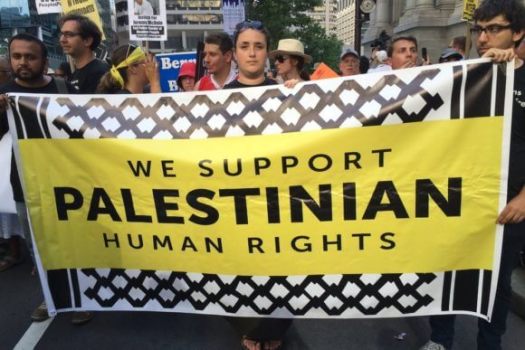
A federal judge has dismissed a Jewish National Fund lawsuit that targeted the US Campaign for Palestinian Rights for alleged terror connections over its support for BDS.

By Michael Arria | Mondoweiss] | Mar 30, 2021

Lawsuits like this one are frequently implemented by pro-Israel groups in an attempt to bog down Palestinian organizations and stifle support for movements like BDS.

A federal judge has dismissed a lawsuit that targeted a Palestinian rights organization for alleged terror connections.

In 2019 the Jewish National Fund (JNF), and 12 American citizens living in Israel, sued the US Campaign for Palestinian Rights (USCPR) for $90 million. The lawsuit alleged that USCPR had funneled money to Boycott National Committee (BNC), which was then used for terrorist activities. The USCPR was represented by attorneys at the Center for Constitutional Rights (CCR).

Continue reading “‘We will not be silenced, siloed, or stopped’: federal judge tosses lawsuit targeting Palestinian rights group”

The Jerusalem Declaration on Antisemitism

Screen Shot 2021-04-02 at 12.26.26 PM
Strasbourg Chief Rabbi Harold Abraham Weill views the vandalized tombs in the Jewish cemetery of Westhoffen, west of the city of Strasbourg, eastern France, in December 2019. (photo: Jean-Francois Badias / AP)
Why the oldest hatred needs a new definition.

By Brian Klug | The Nation | Apr 1, 2021

People of goodwill look to the IHRA definition for guidance concerning a key question: When should political speech about Israel or Zionism be protected—and when does it cross the line into anti-Semitism? What they need is clarity. What they get is a matzah pudding.

Confronted with the Jerusalem Declaration on Antisemitism (JDA), published on March 25, 2021, it is tempting—especially for Jews at this time of year—to ask: Why is this definition of anti-Semitism different from all other definitions?

Continue reading “The Jerusalem Declaration on Antisemitism”
How we speak about the failure of the PLO

oslo
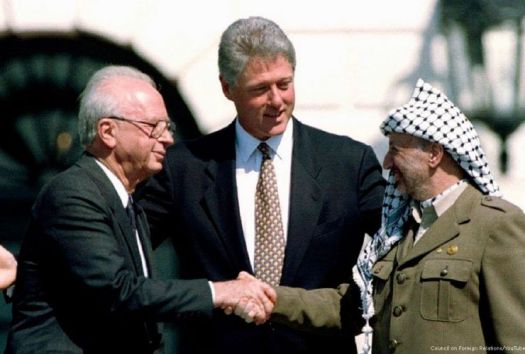
Yitzhak Rabin, Bill Clinton, and Yasser Arafat at the White House, signing the Oslo Accords. I(photo: Wikimedia)
A recent Foreign Affairs article gets history wrong and obscures a robust Palestinian discourse.

By Helena Cobban | Boston Review | Mar 31, 2021

One strong concern about the Oslo Accords was that they said nothing about what would happen if, after the five-year interim period prescribed therein, the two sides failed to arrive at a final peace agreement.

It is hard to believe that it has been fifty years since I used to sit on the floor of drafty college residences in Oxford with Hussein Agha, Ahmad Samih Khalidi, Ahmad’s cousin Rashid Khalidi, and other luminaries of the Oxford University Arab Society, listening to their discussions of the then-parlous state of the Palestinian freedom movement (and voicing an occasional interjection). During the previous year, Palestinian guerrillas earlier chased out of the West Bank by Israel had proceeded to challenge King Hussein’s rule in Jordan; and during “Black” September 1970, Hussein hit back at them hard. In Spring 1971 the guerrillas were still reeling from Black September and were struggling to regroup in the extensive Palestinian refugee camps in Lebanon. In Oxford we eagerly read any scrap of news we could get about their achievements there.

Continue reading “How we speak about the failure of the PLO”

St Marks Mideast Focus Ministry Film Series: ‘TIL KINGDOM COME

Screen Shot 2021-02-15 at 6.49.12 PMPlease join our brothers and sisters at St. Marks Episcopal Church (Seattle) Mideast Focus Ministry group for a series of films in spring 2021.  The next film:

‘Til Kingdom Come

TilKingdomCome-Film-Poster

In this provocative look at strange political bedfellows, Israeli filmmaker Maya Zinshtein (Forever Pure, DOC NYC 2016) investigates the political alliance between American evangelicals and Israel’s right wing, and their influence on the Trump administration’s foreign policy. Why do American church leaders encourage parishioners to make donations to Israel, even from poor communities? Because they believe Israel’s expansion will play a key role in end-times prophecy, when Christians will be saved and others—including Jews—will perish.

The discussion will include special guests: Rochelle Watson and Jonathan Brenneman, of Friends of Sabeel North America

Date: Friday, April 9, 2021
Time: To get a link to watch the film at your convenience, send a message to seattlemideastfocus@gmail.com

You will get the link around 4 p.m. on Wednesday, April 7 and have until 8 p.m. on Friday, April 9, to watch the film. Watch the film on your own and join the discussion on April 9 at 8 p.m. using this Zoom link.

Information: Additional information and list of all films here →
Tickets: Free, must register
Event Details

Summary:

  1. Send an email to seattlemideastfocus@gmail.com to get a link to the film
  2. Watch the film between Apr 7 –  April 9th at 8pm
  3. Join the discussion on 4/9 at 8:00pm via this Zoom link.

More information here →

On Land Day in Palestine: Our home is our land

A group of Palestinians hold Palestinian flags and shout slogans during a demonstration within the Palestine’s ‘Land Day’ commemorations on March 30, 2018 in Nablus, West Bank. (photo: Nedal Eshtayah / Anadolu Agency)
Palestinians mark Land Day on March 30th and it is personal.

By Yousef Aljamal | Politics Today | Mar 30, 2021

The relationship a peasant has with the land is like the relationship between a mother and her children. It is deep and interconnected in a way that a settler-colonial society can never understand.

When in 1948 Zionist militias invaded the village of Aqer, where my family is originally from, my great-grandfather was one of a few poorly equipped fighters who tried to stop the invading forces. The fighters took up posts at the village school, located nearly a kilometer from the village.

Soon after, and after some resistance, the invading militia took over the school, killing the fighters who remained inside, including my great-grandfather, who was found dead inside the building. My grandfather buried his father in the village graveyard only to become a refugee for the rest of his life in Gaza days later.

Continue reading “On Land Day in Palestine: Our home is our land”

Gaza enters second coronavirus wave, with 25% of tests coming back positive

.
A medical worker of UNRWA gives a shot of the Sputnik V Covid-19 vaccine at UNRWA’s clinic in the Rafah, in the southern Gaza, on March 3, 2021. (photo: Abed Rahim Khatib / Flash90)
For weeks, the coastal enclave enjoyed a lull, even as as a surge in infections shook the West Bank. But with thousands of new cases, a new wave is officially here

By Aaron Boxerman | The Times of Israel | Mar 29, 2021

“We’re in a new wave. The virus curve is rising by the day. We expect the rate of positive tests to also continue to rise,”
— Dr. Aed Yaghi, Gaza branch of the Palestinian Medical Relief Society

With cases spiking, the Gaza Strip has entered a second wave of the coronavirus pandemic, health officials in the coastal enclave told The Times of Israel on Monday.

Gaza saw 891 new coronavirus cases in 24 hours, the Gaza Health Ministry reported on Monday. The total number of active infections nearly tripled over the past two weeks, from 2,291 to 6,619.

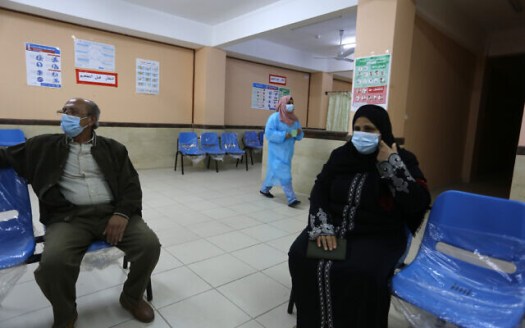
The daily rate of positive tests in Gaza has skyrocketed to 25 percent over the past 24 hours, according to Hamas health officials. The high positivity rate indicates that the virus is likely spreading widely undetected.

Continue reading “Gaza enters second coronavirus wave, with 25% of tests coming back positive”

We need a better definition of anti-Semitism

b5d11286-d5b6-49d3-bf7a-1b0f273afcd8
People visit the Yad Vashem museum on Jan. 27, 2019, in Jerusalem. (photo: Ilia Yefimovich / Getty Images)
A popular working definition adopted by the U.S. government is overly broad and politicized.

By Joshua Shanes and Dov Waxman | Slate | Mar 26, 2021

Scholars, students, activists, and even artists have been branded anti-Semites (even when they are Jewish) for opposing Zionism, advocating for a Palestinian right of return, or promoting the Boycott, Divestment, and Sanctions campaign against Israel.

During a period when far-right, white nationalist, and anti-Semitic extremists have been parading and brawling on the streets of American cities, storming and looting the U.S. Capitol, and even murdering Jews in their places of worship, debating the definition of anti-Semitism might seem to be a trivial and pedantic academic exercise. Yet it has become a hotly contested, politically controversial issue, not only in the United States, but also in other Western democracies, including Germany and the United Kingdom.

Continue reading “We need a better definition of anti-Semitism”

Challenging Israel’s exceptionalism in American politics

An Israeli soldier keeps guard near a Palestinian woman standing by a Star of David graffiti sprayed by Israeli settlers near an army checkpoint in the centre of the occupied West Bank city of Hebron on May 18, 2009 AFP
Hebron has a notoriously heavy military presence to guard the Israeli settler population, which is set to increase (photo: AFP)
A new book explores why many on the left in the US exempt Palestinians from their value set.

By Khaled Elgindy | Responsible Statecraft | Mar 22, 2021

…not only are self-styled progressives silent on Palestinian rights, but many also actively support policies that perpetuate Palestinian suffering and dehumanization.

While support for Israel across the political spectrum remains strong in Washington, the traditional bipartisan consensus in favor of unconditional support for Israel has begun to fray in recent years. More than a half century of Israeli occupation, the rightward drift in Israeli politics, and shifts in the American political landscape, have led growing numbers of Americans, particularly left-leaning Democrats, to become more vocal in their support for Palestinian rights and in their opposition to unconditional support for Israel. This trend has been anything but uniform, however, as the bulk of American liberal and progressive politicians continue to adhere to the traditional pro-Israel orthodoxy.

It is this group that is the focus of the new book, “Except for Palestine: The Limits of Progressive Politics,” by Marc Lamont Hill and Mitchell Plitnick. “Except for Palestine” is a timely and compelling treatise on the moral failings of U.S. policy and American politics in relation to Israel/Palestine.

Continue reading “Challenging Israel’s exceptionalism in American politics”

Israel’s election ended in another mess. Could an Arab party break the deadlock?

merlin_183972060_4ea87b36-c3b8-417c-9f56-779763ef8b34-jumbo
Mansour Abbas, in a mosque last month in the village of Daburiyya, Israel, could play the role of kingmaker in Israel’s election. (photo: Dan Balilty for The New York Times)
In the fourth attempt, neither Prime Minister Benjamin Netanyahu nor his opponents have a clear path to power. An Islamist party has emerged as a possible kingmaker.

By Patrick Kingsley and Adam Rasgon | The New York Times |  Mar 24, 2020

An independent Arab party has never been part of an Israeli government before, although some Arab lawmakers supported Yitzhak Rabin’s government from the outside in the 1990s.

JERUSALEM — After a fourth Israeli election in two years appears to have ended in another stalemate, leaving many Israelis feeling trapped in an endless loop, there was at least one surprising result on Wednesday: An Arab political party has emerged as a potential kingmaker.

Even more surprising, the party was Raam, an Islamist group with roots in the same religious movement as Hamas, the militant group that runs the Gaza Strip. For years, Raam was rarely interested in working with the Israeli leadership and, like most Arab parties, was ostracized by its Jewish counterparts.

Continue reading “Israel’s election ended in another mess. Could an Arab party break the deadlock?”

Palestinian advocacy is not ‘terrorism’

Samidoun-1024x768
Activists with Samidoun Deutschland protest in Germany on March 18, 2021. (photo: Samidoun/Twitter) 
This statement was issued on March 22, 2021 by the Canada Palestine Association and BDS Vancouver-Coast Salish.  It highlights the efforts to silence Palestinian advocacy groups.

By BDS Vancouver-Coast Salish | Mondoweiss | Mar 23, 2021

There are no concrete charges against Samidoun, simply that it helps Palestinian prisoners and is involved in “anti-Israel propaganda efforts.”

On February 28, 2021, Israel’s Defense Minister Benny Gantz declared that he was adding the Samidoun Palestinian Prisoner Solidarity Network to Israel’s “terror list.” The designation was based on accusations that are both spurious and false. There has been a recent upsurge in the campaign by the Israeli government to thwart effective Palestinian civil society groups that refuse to be silenced or sanitized.

There are no concrete charges against Samidoun, simply that it helps Palestinian prisoners and is involved in “anti-Israel propaganda efforts.” Samidoun operates as a public and transparent prisoner advocacy group; it is independent and has no organizational connection or affiliation with any Palestinian party.

Continue reading “Palestinian advocacy is not ‘terrorism’”