In less than one week, we hope you’ll join Kairos USA, Kairos West Michigan, and the Indiana Center for Middle East Peace for a conversation with Rev. Dr. Munther Isaac. Rev. Isaac is Pastor of Christmas Lutheran Church in Bethlehem, Academic Dean of Bethlehem Bible College, and Co-Director of the Global Kairos for Justice Coalition.
A Conversation with Rev. Dr. Munther Isaac & Dr. Michael Spath Tuesday, January 30 2:00 to 3:00 p.m. ET / 11:00 a.m. to 12:00 p.m. PT Register Here
More Upcoming Events
The Bible & Settler Colonialism in Palestine & Beyond Webinar presented by the Center & Library for the Bible and Social Justice, featuring Rev. Prof. Mitri Raheb with Atalia Omer and Revelation Velunta. Saturday, January 27 9:30 a.m. ET / 6:30 p.m. PT Register Here
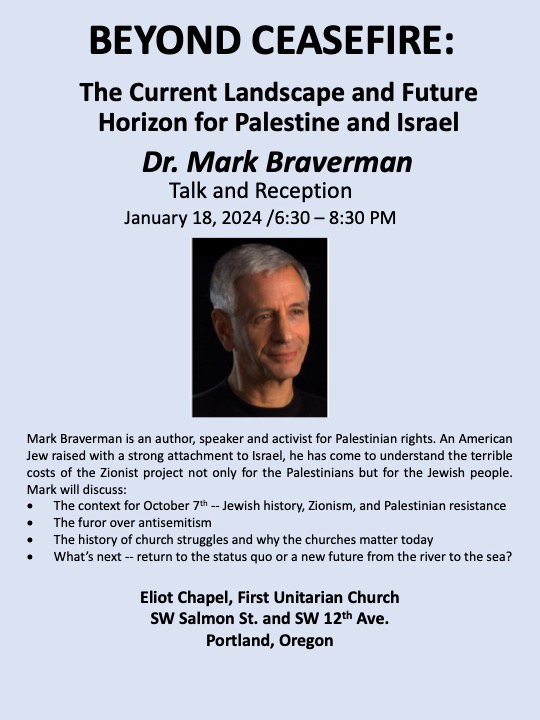
We’re excited to share that Dr. Mark Braverman, Executive Director of Kairos USA, will be speaking in Portland, Oregon on January 18 & 19. Mark’s talks and follow-up Q&A sessions will cover:
Jewish history, Zionism, and Palestinian resistance leading up to October 7th.
Antisemitism — what it is and why it’s important.
The history of church complicity in colonialism, its struggles with equality and human rights, and why the church matters today.
The U.S. political landscape — coming to terms with our settler-colonial DNA.
What’s next — a return to the status quo, or a new future from the river to the sea?
Thursday, January 18th First Unitarian Church — Eliot Chapel SW Salmon St. & SW 12th Ave., Portland, OR 6:30 to 8:30 p.m. Mark’s talk will be followed by a reception.
Friday, January 19th Grace Memorial Episcopal Church 1535 NE 17th St., Portland, OR 10 to 11:30 a.m. Coffee, tea, and snacks provided!
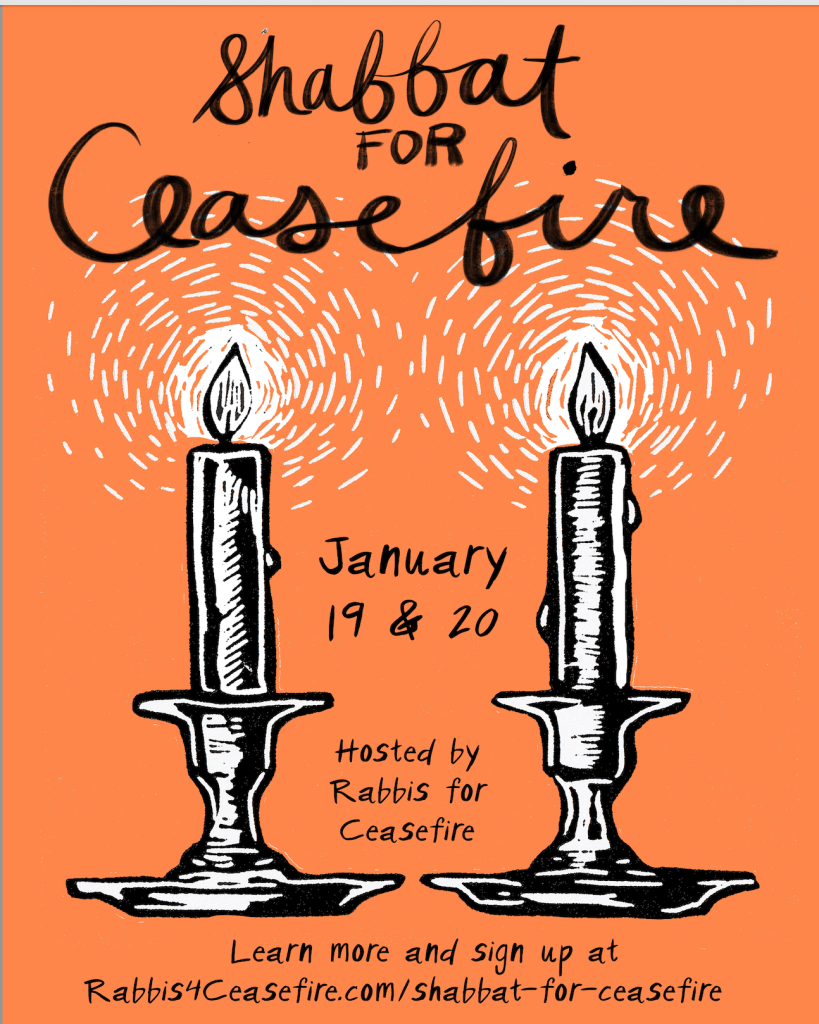
Please share using the fliers below, and invite your friends and family to attend!
All are invited to this webinar, presented by the Center & Library for the Bible and Social Justice, featuring Rev. Prof. Mitri Raheb with Atalia Omer and Revelation Velunta: “The Bible and Settler Colonialism in Palestine and Beyond.”
The event will take place on Saturday, January 27, 2024, at 9:30 a.m. ET / 6:30 a.m. PT.
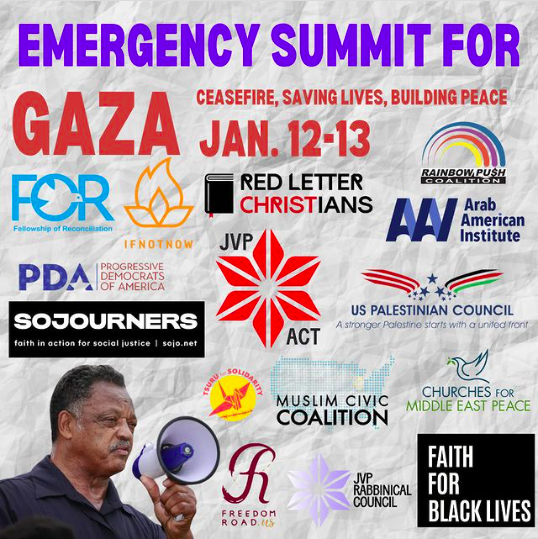
In-person in Chicago or on Zoom, join communities of faith on January 12 & 13 for an Emergency Summit for Gaza, a two-day event that includes speakers, discussions, prayer, and collective action. The summit is sponsored by the Rainbow Push Coalition, Churches for Middle East Peace (CMEP), Red Letter Christians, Jewish Voice for Peace, If Not Now, the Arab American Institute, Faith for Black Lives, the Muslim Civic Coalition, the U.S. Palestinian Council, Sojourners, and others. Tickets are free, but registration is required!
Christians calling for a ceasefire in Gaza will meet in Washington, D.C. ahead of the national March on Washington for Gaza on January 13. Gather with CMEP, FOSNA, and other Christian voices for Palestine at 12:30 p.m. at the National Museum of American Historyon Madison Drive NW between 12th Street and 14th Street NW. The march begins at 1 p.m.
January 13 | Candlelight Prayer Vigil for a Ceasefire
Join Christian leaders in prayer for a ceasefire and demilitarization in Israel and Palestine. The vigil will take place at 4 p.m. ET at The Ellipse (south of the White House), 15th St & Constitution Ave NW, south of the chainlink fence. You can also livestream the event with Churches for Middle East Peace (CMEP). Learn more, register, & find the link to the YouTube channel where the event will be livestreamed at CMEP.org.
January 14 | Ceasefire Prayer Service
Live from Jerusalem, join Churches for Middle East Peace (CMEP) and Bethlehem Bible College for this streaming of a live prayer gathering in Jerusalem on Sunday morning. The event will take place at 12:30 a.m. PT.
On January 26, several organizations including Jewish Voice for Peace and U.S. Campaign for Palestinian Rights (USCPR) are holding a National Day of Action and encouraging communities across the country to plan local activities.
On December 28, Reverend Dr. Canon Naim Stifan Ateek published an open letter to U.S. President Joe Biden outlining what he calls “a prophetic vision for justice.” His vision is “rooted in the spirit of United Nations Security Council resolution 242” and “based on the formula of land for peace for the two peoples that must live together on the land.”
“Mr. President, let us imagine together the future and let us take bold steps and concrete actions that will actually transform our words into a just peace for all.”
Rev. Dr. Ateek outlines his vision in the letter, in chronological detail. It begins with a permanent ceasefire, recognition of Palestine as a United Nations member state, and a “conclusive end” to Israel’s occupation. He places responsibility for the rebuilding of Gaza with the U.K., U.S., and Israel: “Justice requires that they be found liable and held accountable.” He invites collaboration with the governments and peoples of Ireland and South Africa, and emphasizes the means to establish a sovereign and viable Palestinian state.
“The Palestinians bear no responsibility for the horrors of the Holocaust,” he writes. “But the Palestinian people must now be prepared to live in peace with their Israeli Jewish neighbors. Both peoples may help one another heal from the wounds of the Holocaust, the pain and suffering of the Nakba, and the horrors of the current catastrophe.”
“It was our beloved Archbishop Desmond Tutu, the International Patron of Sabeel, who said, ‘We are prisoners of Hope.’ And so, it is with much hope and anticipation that you will join me in seeing this vision become a reality, one that requires bold actions and a passion for justice, and only justice!”
On Sunday, December 10, Dean Thomason at St. Mark’s Cathedral in Seattle was joined virtually by Father Fadi Diab, rector of St. Andrew’s Anglican Church in Ramallah. Father Diab provided updates from the Christian community in Ramallah.
“We’re very much, psychologically, devastated,” he said. “The community we serve [is] also overwhelmed with the pain that mainly comes from Gaza, but also from places that the Israeli army invades in the West Bank.”
St. Andrews is providing stress-relief and trauma-response training and programs for teachers and community members, and shelter and sustenance for community members who’ve been displaced from homes and jobs. Demolition of Palestinian homes, he said, is happening quickly.
Fr. Diab also discussed the harms of propaganda in the West, far-right political power in Israel, and increased settler violence in the West Bank, armed and encouraged by Israel’s government.
“I don’t dare to drive on these roads, because you don’t know when the settlers will attack,” said Fr. Diab. And from the side of Israel’s police: “Any call for a ceasefire puts you in danger of being arrested.”
Take Action
Read more updates and donate at afedj.org — the American Friends of Episcopal Diocese of Jerusalem.
Write to friends and Christian siblings in Palestine, who feel isolated and alone.
“We are called to save lives,” said Fr. Diab. “It is your role as Americans to reach out to your leaders, and convince them that this is not acceptable, this is morally indefensible, and we need a ceasefire and end to this conflict forever.”
Listen to a recording of the full conversation between Dean Thomason and Father Diab here.
On November 30, Dr. Doug Thorpe of the Bishop’s Committee facilitated a conversation between Jonathan Kuttab, executive director of the Friends of Sabeel North America (FOSNA), and Dr. Alice Rothchild, physician, author, activist, and filmmaker. Watch a full recording of the event below!
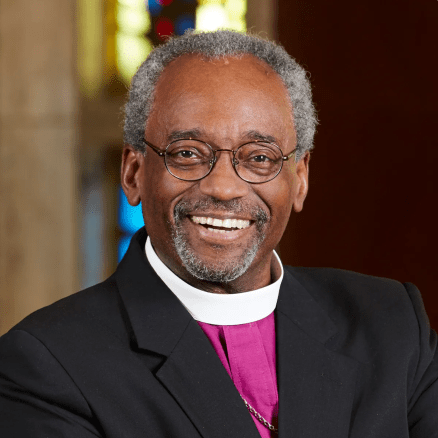
The following message was released by Presiding Bishop of the Episcopal Church, The Most Rev. Michael Curry, on November 7, 2023
The violence is horrific, and the geopolitics are complex, but my call to love is simple: Stop the killing. Stop all of it. Stop it today.
—The Most Reverend Michael Curry
You may know me as the pastor who is always talking about love, and I am. But today I am mindful that the urgency of love—true, sacrificial love that respects all of humanity—is not just a good feeling, and it is not easy.
We are called to a love that demands much from us. We are called to a love that tells the truth.
The violence is horrific, and the geopolitics are complex, but my call to love is simple: Stop the killing. Stop all of it. Stop it today.
We will not be silent while an entire population is denied food, water, electricity, and fuel needed to run hospitals. We cannot stand by while thousands of civilians die. Our partners in the region tell us they live in terror—that they feel they have died even while alive. They feel that the international community is tacitly sanctioning the killing of civilians and the bombing of schools, hospitals, and refugee camps.
Staying quiet in this moment would be a stain upon our souls and would deepen our complicity.
U.S. leadership must tell Israel to stop bombing civilian areas and allow access for full humanitarian aid to flow freely into Gaza.
Every human child of God—Palestinian and Israeli—deserves safety and security. We need to stop the killing. Today.
Vengeance will not bring back the dead. Retaliation will not repair the harms and the hurt. We are called to love, even and especially when it seems impossible.
We must stop the next 10,000 from being killed. As Episcopalians, we must call upon our leaders—President Biden, members of Congress, and others—to be unequivocal that we need to stop the killing. Today. This is clearly what love demands of us.
—The Most Rev. Michael Curry, presiding Bishop of the Episcopal Church
This week’s events do break an unsustainable status quo, challenging everyone to think beyond the current paradigms.
By Jonathan Kuttab | Friends of Sabeel North America| October 12, 2023
The truth is that there is no military solution, and once that becomes clear to one and all, perhaps we can finally decide to give peace a chance.
The events of the last few days in Israel and Gaza have shattered the long-held assumptions of many observers, working to shift many popular paradigms. Amidst the devastation, there does remain reason to hope that these events will shake up the status quo and lead to major changes. Even the taking of captives could serve as a catalyst for the opening of negotiations and contacts between Hamas and Israel. The astonishing and unexpected military success of Hamas in breaching the separation wall and in shifting the battle over the weekend to the enemy’s population could potentially even help reduce the power imbalance and lead to genuine talks.
For one thing, the fighting mostly took place inside sovereign Israeli territory and amongst its civilian population. This has never happened since the creation of the state in 1948, whereby the Israeli army successfully ensured that for all the wars with the Arab World the fighting (and the vast majority of destruction, civilian casualties, and human suffering) occurred within Arab territories and amongst the Arab population. It was Israeli soldiers who entered Arab houses, ordered kids out of their beds, kidnapped them and took them in their jeeps, controlled their lives, and triumphantly returned to their own homes at the end of hostilities.
My heart goes out to the families who lost their dear ones and particularly to those who still do not know the fate of their loved ones, who may be dead, injured, or held captive under the power and mercy of their enemies.
While watching Israeli TV in Hebrew (simultaneously with Palestinian sources in Arabic) I heard the stories of Israeli families who lived in fear under lockdown, without electricity, and who attempted to call for help but no responsible agency would answer or come to their rescue. It seems, those Israelis living a few kilometers from Gaza were given, for a few days, a taste of what Gazans experience all year round.






 HolyLandJustice.org
You must be logged in to post a comment.