Israel backs off housing project at Jerusalem’s Atarot airport site amid US pressure

.
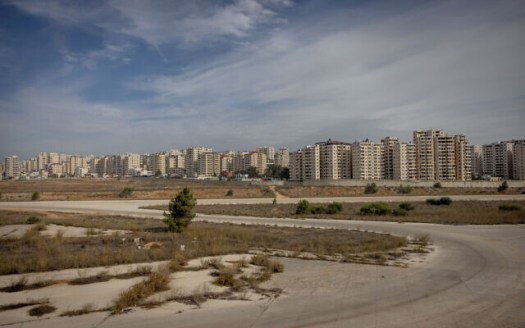
The abandoned Atarot Airport, north of Jerusalem, on November 25, 2021. (credit: Yonatan Sindel / Flash90)
Officials notify White House they won’t move forward with plan to build 9,000 units on abandoned plot at northern tip of the capital, across the pre-1967 Green Line.

By Jacob Magid | The Times of Israel | Nov 25, 2021

Opponents of the project argue that it would hamper dwindling efforts to advance a two-state solution, by bisecting a large part of East Jerusalem, which Palestinians view as the capital of their future state.

Israel informed Biden administration officials on Thursday that it has shelved a controversial plan to advance a massive housing project in the East Jerusalem neighborhood of Atarot following pushback from Washington, a senior Israeli official confirmed to The Times of Israel.

The project, which received preliminary approval from Jerusalem’s local municipal planning committee earlier this week, would see 9,000 housing units for ultra-Orthodox Jews built on the abandoned site of the former Atarot Airport. The area was annexed by Israel as part of the post-1967 expanded Jerusalem, but lies beyond the Green Line.

Continue reading “Israel backs off housing project at Jerusalem’s Atarot airport site amid US pressure”

We’re a small Arkansas newspaper. Why is the state making us sign a pledge about Israel?

190228-alan-leveritt-ew-1230p
Alan Leveritt, publisher of the Arkansas Times. (credit: Brian Chilson / Arkansas Times)
A new documentary film “Boycott” follows three plaintiffs challenging their states’ anti-boycott laws.

By Alan Leveritt | The New York Times | Nov 22, 2021

Let’s be clear, states are trading their citizens’ First Amendment rights for what looks like unconditional support for a foreign government.

At The Arkansas Times, a publication I founded 47 years ago, our pages focus on small-scale local issues, like protecting Medicaid expansion from the predations of our state legislature and other elements of Arkansas politics, history and culture. So I was surprised when in 2018 I received an ultimatum from the University of Arkansas’s Pulaski Technical College, a longtime advertiser: To continue receiving its ad dollars, we would have to certify in writing that our company was not engaged in a boycott of Israel. It was puzzling. Our paper focuses on the virtues of Sims Bar-B-Que down on Broadway — why would we be required to sign a pledge regarding a country in the Middle East?

Continue reading “We’re a small Arkansas newspaper. Why is the state making us sign a pledge about Israel?”

It is impossible to “Shrink the Conflict”

AP_21298287707923_7f79c9961bc25cd6c87b496101c37916
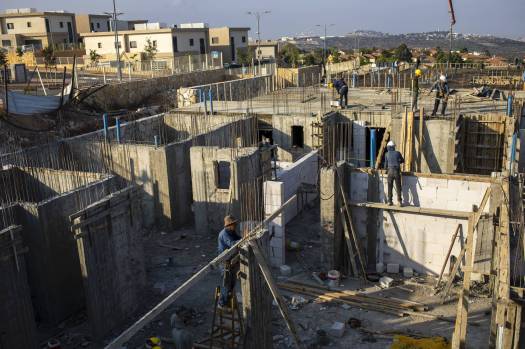
Palestinian laborers built new houses in the West Bank Jewish settlement of Bruchin near the Palestinian town of Nablus, Oct. 25th, 2021. (credit: Ariel Schalit / AP Photo)
The Israeli government cannot significantly improve Palestinian lives without granting them basic rights.

By Peter Beinart | Jewish Currents | Nov 11, 2021

Again and again over the past five decades, Israeli leaders have promised an enlightened, hands-off occupation that fosters prosperity among the Palestinians under their control. And, again and again, Palestinians have experienced despotism, land theft, and violence.

ON OCTOBER 22ND, Israel’s defense ministry outlawed six prominent Palestinian human rights groups. Two days later, Israel’s housing and construction ministry announced plans to build more than 1,300 new homes for Jewish settlers in the West Bank. The day after that, Israeli troops reportedly stood by as settlers attacked a member of Rabbis for Human Rights who was helping Palestinians gather olives—one of more than 58 attacks on Palestinians and their supporters during the October olive harvest. On October 26th, Israel’s public security minister banned a festival in an East Jerusalem church, thus signaling his intention to prohibit “almost all Palestinian cultural events in East Jerusalem,” according to Haaretz. Peace Now reports that since taking office in June, Israeli Prime Minister Naftali Bennett’s “government has actively worked to promote settlements and deepen the Israeli occupation of the [occupied] territories.”

Continue reading “It is impossible to “Shrink the Conflict””

Biden’s balancing act in the Middle East has a problem: Israel

download
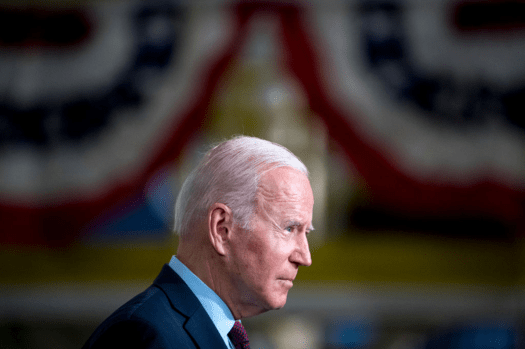
Palestinian advocates say President Joe Biden is not doing enough to increase the pressure on Israel. (credit: Nic Antaya / Getty Images)
In an interview, Israel’s interior minister dismisses U.S. plans to reopen a consulate in Jerusalem and downplays reports of Israeli settler violence against Palestinians.

By Nahal Toosi  | Politico | Nov 19, 2021

Palestinian advocates say Biden is not doing enough to increase the pressure on Israel, especially if he is serious about seeking a two-state solution to the decades-old conflict — something Trump said he could live without.

Soon after taking office, President Joe Biden and his aides began using a new talking point when discussing the Israeli-Palestinian conflict — part of an effort to rebalance a U.S. policy the previous U.S. administration had skewed heavily to favor Israel.

“Israelis and Palestinians,” the phrase usually goes, “deserve equal measures of freedom, dignity, security, and prosperity.”

In recent weeks, however, a series of Israeli actions against Palestinians have exacerbated tensions with the Biden administration while testing how serious the U.S. president is about respecting the rights of everyone in the conflict.

Continue reading “Biden’s balancing act in the Middle East has a problem: Israel”

Israel’s brazen attack on Al-Haq – Troubled from apartheid charges, armed with terrorism designations and blessed by U.S. silence

US-Israel-Palestine-s-1300x731
Anti-Israel Protest, Washington, DC March 26, 2017.  (credit: Ted Eytan, Wikimedia Commons)
A Palestinian perspective on the discussion and efforts needed to compel Israel to reverse its decision.

By Ahmed Abofoul | Opinio Juris | Nov 15, 2021

…the current reality is that the fate of these organizations and their staff depends profoundly on the international community’s unequivocal condemnations and the concrete actions taken thereafter.

On 19 October 2021, the Israeli Defense Ministry, Benny Gantz, designated six Palestinian human rights and civil society organizations (CSOs) as “terrorist organizations,” under Israel’s domestic Counter-Terrorism Law of 2016. On 7 November 2021, it was reported that the Israeli army had issued a military order extending the application of Gantz’s designation to the occupied West Bank. One of these organizations is Al-Haq, with which the author is proudly associated. Established in 1979, not only was Al-Haq the first Palestinian independent non-governmental human rights organization, but also one of the earliest in the region and the world. Al-Haq has a specific mandate to “protect and promote human rights and the rule of law” in the occupied Palestinian territory (oPt). To that end, Al-Haq “documents violations of the individual and collective rights of Palestinians in the [oPt], irrespective of the identity of the perpetrator, and seeks to end such breaches by way of advocacy before national and international mechanisms and by holding the violators accountable.”

Continue reading “Israel’s brazen attack on Al-Haq – Troubled from apartheid charges, armed with terrorism designations and blessed by U.S. silence”

Welcome to the Panopticon: Israel’s Systematic Surveillance of Palestinians and the Implications for the World

israel-palestine-surveillance-drones-getty
An Israeli soldier uses an unmanned surveillance drone to monitor Palestinian citizens in the occupied West Bank city of Hebron, 30 September 2015. (credit: Hazem Bader / AFP via Getty Images)
Please join our brothers and sisters at Foundation for Middle East Peace for a conversation about Israel’s cyber-surveillance of Palestinians, from hacking the phones of human rights defenders and officials, to increased monitoring of Jerusalemites, to the mass deployment of facial recognition software against Palestinians in the West Bank.
Date: Thursday November 18, 2021
Time: 9:00am – 10:30pm (PST) / 12:00pm – 1:30pm (EST)
Location: On-line Webinar
Information: Event information here →
Tickets: Free, must register
Event Details

Three major stories broke over the past week about Israel’s cyber-surveillance of Palestinians, from hacking the phones of human rights defenders and officials, to increased monitoring of Jerusalemites, to the mass deployment of facial recognition software against Palestinians in the West Bank. To discuss these issues and their broader implications, FMEP is proud to host a conversation with four experts – Andrew Anderson (Front Line Defenders), Marwa Fatafta (Access Now), Avner Gvaryahu (Breaking the Silence), and Sophia Goodfriend (7amleh), in conversation with FMEP President Lara Friedman.

More information here →

The Tipping Point

Screen Shot 2021-11-11 at 11.31.44 AM

Things are moving — and it is happening on a global scale.  This issue of Palestine Portal brings a startling and hopeful report from England, information about a new resource from a U.S. denomination, and news of an international conference on Christian Zionism sponsored by Kyoto University.

By Palestine Portal | Oct 18, 2021

“It is some kind of miracle…a positive step in breaching the Church of England’s silence and inaction on Palestinian issues.”
— Karen Fairfax-Cholmeley of Sabeel-Kairos UK and Global Kairos for Justice

The struggle for the liberation of Palestine has reached a tipping point. A debate is underway In the public square on whether it is accurate to speak of Zionism as settler colonialism. In the U.S. House of Representatives, the words “apartheid” and “State of Israel” were spoken in the same breath in a debate on military funding for Israel.

A parallel tipping point has been reached in the church struggle over Israel and Palestine. Protestant denominations in the U.S. have embraced the call of Palestinian civil society for Boycott, Divestment and Sanctions. Churches at denominational levels in Norway, South Africa and the United States have renounced Zionism, declaring, in the words of the 2020 “Cry for Hope” of Global Kairos for Justice that “support for the oppression of the Palestinian people, whether passive or active, through silence, word or deed, is a sin, incompatible with the Christian faith and a grave misuse of the Bible.”

Continue reading “The Tipping Point”

Inside the Unraveling of American Zionism

Screen Shot 2021-11-09 at 5.04.18 PM
Leah Nussbaum and Evan Traylor, students at Hebrew Union College in New York. (credit: Damon Casarez for The New York Times)
How a new generation of Jewish leaders began to rethink their support for Israel.

By Marc Tracy | The New York Times Magazine | Nov 2, 2021

“For those of us for whom Israel has represented hope and justice, we need to give ourselves permission to watch, to acknowledge what we see, to mourn and to cry. And then, to change our behavior and demand better.”
— an open letter to American Jews

It began, as so much these days does, with a group chat. Early this year, around 20 rabbinical and cantorial students started a WhatsApp thread they eventually named “Rad Future Clergy.” Among them, they attended rabbinical schools in five different U.S. cities. Several of them first became friends while studying and working in a sixth city, Jerusalem, the capital of the land that both the Torah and Israel’s declaration of independence deem the place for “the ingathering of the exiles.”

In April, the texting heated up. A longstanding effort by a right-wing Jewish group to assume ownership of Palestinian homes in Sheikh Jarrah, an East Jerusalem neighborhood, was coming to a head. Israel’s government characterized the issue as a mere “real estate dispute,” which was true in a narrow sense but elided the winding history of the homes’ ownership — which changed hands as the land beneath them did over the course of two wars — as well as the Jewish group’s frank goal of altering East Jerusalem’s demographics to secure it permanently for Israel. Protests in the neighborhood spread to the nearby Temple Mount, a holy site for both Jews and Muslims, where riot police fired rubber bullets and Arab protesters threw stones following Friday prayers.

Continue reading “Inside the Unraveling of American Zionism”

Vermont Episcopalians condemn Israeli apartheid, setting up a national showdown

ISS_00-2-1-770x515
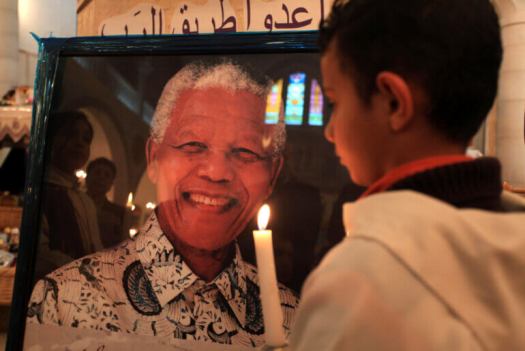
An altar boy stands with a candle in front of an image of the late South African leaker President Nelson Mandela on display during a special Sunday service in his honor at the Holy Family Church in the West Bank city of Ramallah on Dec 8 2013. (credit: Issam Rimawi / APA Images)
The Episcopal Church of Vermont stood up loudly against Israel’s U.S.-backed oppression of the Palestinians, Nov. 4, as its annual convention, condemning by an 89-25 majority what it said are the Jewish State’s apartheid policies.

By Steve France | Mondoweiss | Nov 5, 2021

The openness of the other delegates seemed also to show that general awareness of public protests against Israel is rapidly growing…

The Episcopal Church of Vermont stood up loudly against Israel’s U.S.-backed oppression of the Palestinians, Nov. 4, as its annual convention, condemning by an 89-25 majority what it said are the Jewish State’s apartheid policies.

The action added to a barrage of condemnations of Israel’s apartheid regime since January by human rights groups and leaders and is of special significance to other Episcopal dioceses – and beyond that to other mainline church denominations — that are under rising pressure from members pressing for similar condemnations. The first major denomination to conclude that it was compelled to call out Israel and its U.S. sponsors on apartheid and a host of related injustices – the United Church of Christ — acted only last July but its resolution was seen then as a harbinger of actions to come from sister denominations.

Continue reading “Vermont Episcopalians condemn Israeli apartheid, setting up a national showdown”

What Apartheid means for Israel

1227951190
Israeli security forces intervene Palestinian demonstrators as Palestinians gather to demonstrate against the new construction of Jewish settlements and separation wall in Turmus Ayya village of Ramallah, West Bank on August 07, 2020. (credit: Issam Rimawi / Anadolu Agency via Getty Images)
A growing consensus has formed around the term—not as a rhetorical comparison to South Africa, but describing a system of domination built on the partition of Palestine.

By Tareq Baconi | The New York Review | Nov 5, 2021

“What happens in the Occupied Territories can no longer be treated as separate from the reality in the entire area under Israel’s control.”
— Report from B’Tselem, Israel’s leading human rights organization

Future historians may single out 2021 as the year the tide turned for the Palestinian struggle—though it was hard to see coming. The final months of 2020 were among the bleakest in decades, as a US administration bent on furthering Israel’s right-wing expansionist vision sought to dismantle, bit by bit, the central concerns that make up the Palestinian cause: the right of refugees to return to homes from which they were expelled in 1948, the status of Jerusalem as the capital of Palestine, and the right to self-determination on lands currently occupied by Israel. At the year’s end, the coup de grâce came when several Arab states turned their backs on Palestine, normalizing diplomatic and economic relations with Israel despite its continuing subjugation of Palestinians. The Palestinian people seemed to have been vanquished, while Israel pursued its annexation of occupied territory.

But breakthroughs came unexpectedly. In January 2021, B’Tselem, Israel’s leading human rights organization, released a report unambiguously titled A Regime of Jewish Supremacy from the Jordan River to the Mediterranean Sea: This Is Apartheid. In it, the authors argued that their organization’s mandate from its founding in 1989—to bring to light Israeli human rights violations in the Occupied Territories—was no longer adequate. “The situation has changed,” the report explained. “What happens in the Occupied Territories can no longer be treated as separate from the reality in the entire area under Israel’s control.”

The power of this report was not in the accusation, delivered by an Israeli organization, that Israel was practicing apartheid; Yesh Din, an Israeli human rights organization committed to protecting Palestinians living under Israel’s military regime in the West Bank, had leveled that charge six months earlier, as had several leading Israeli public figures. Indeed, numerous Israeli and international voices have warned for years that Israeli practices, left unchecked, would amount to a system of apartheid. What was different about B’Tselem’s analysis was its challenge to a pervasive myth, one to which much of the international community subscribes, that Israel’s military rule in the occupied Palestinian territory can be treated as somehow separate from the state of Israel. Instead, the organization characterized Israel as a single “regime that governs the entire area.”

Read the full article here →
Note:   To read the whole article you will have to register with The New York Review.