Israel’s Systematic Surveillance of Palestinians

WP2x840
A man points at surveillance cameras in the Palestinian West Bank city of Hebron, on Nov. 9, 2021. Recent reports have exposed the magnitude of Israel’s surveillance program targeting Palestinians. (credit: Hazem Bader / AFT via Getty Images)
Reaction to the threat of new surveillance technologies being used on Palestinians and the potential for use in a global context.

By Janna Aladdin | Washington Report on Middle East Affairs | Dec 17, 2021

The Palestinian Policy Network, both emphasized that such surveillance not only entails political and security threats for Palestinians, but also works to hinder their free expression.

Waging Peace

HOW DOES the Israeli government’s reliance on cyber spyware and surveillance technologies pose a risk not only to Palestinians and their supporters, but also the global community? This question underscored much of the discussion surrounding the webinar, “Welcome to the Panopticon: Israel’s Systematic Surveillance of Palestinians and the Implications for the World,” hosted by the Foundation for Middle East Peace (FMEP) on Nov. 18.

A recent Washington Post investigation, which demonstrated that Israel has been systematically increasing surveillance on Palestinians in the West Bank by building a database that integrates facial recognition, set the stage for much of the talk.

Continue reading “Israel’s Systematic Surveillance of Palestinians”

This was the deadliest year for Palestinian children since 2014

F210526ARK11-1000x668
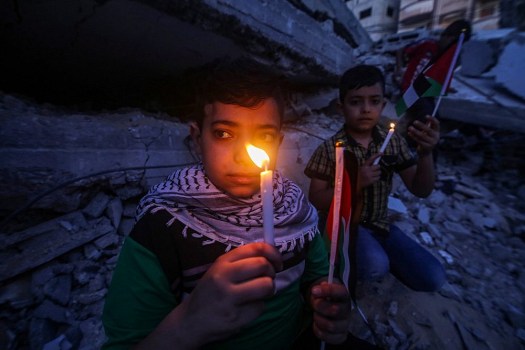
Palestinian children light candles during a protest near destroyed buildings in the southern Gaza Strip city of Rafah, May 25, 2021. (credit: Abed Rahim Khatib/  Flash90)
Instead of holding perpetrators accountable, Israel is criminalizing the work that organizations like mine are doing to protect Palestinian children’s rights.

By Khaled Quzmar | +972 Magazine | Dec 14, 2021

Based on our findings, a total of 67 Palestinian children were killed during the 11-day military escalation between Israeli forces and Palestinian armed groups in May.

This year was unlike any other I can remember from my decades of defending Palestinian children’s rights. Israel’s bombardment of the Gaza Strip in May, amidst a mass youth-led uprising across historic Palestine, sparked an outcry around the world, with more people than ever demanding Israel be held accountable for its violence toward Palestinians and calling for an end to its apartheid regime. It felt like our movement for justice, accountability, and liberation was finally in the world’s spotlight.

And yet, that attention has not resulted in any meaningful change for Palestinian children living under Israeli military occupation. In fact, 2021 has been the deadliest year for Palestinian children since 2014, a year which included Israel’s devastating military assault in the Gaza Strip codenamed “Operation Protective Edge.”

Continue reading “This was the deadliest year for Palestinian children since 2014”

‘Haaretz’ publisher says Israel is ‘an apartheid state’ — as his paper continues to warn against an Israel-Iran war

1018316866-770x515
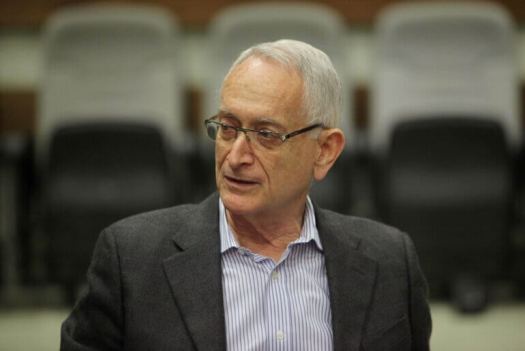
Amos Schocken (credit: Haaretz)
Haaretz publisher acknowledged for significant role in Israel news coverage and commentary.

By James North |  Mondoweiss  | Dec 12, 2021

“The product of Zionism, the State of Israel, is not a Jewish and democratic state, but has instead become an apartheid state, plain and simple.”
— Amos Schocken, Haaretz publisher

Amos Schocken is Israel’s equivalent of the latest Sulzberger to inherit control of the New York Times. Schocken, in his mid-70s, is the third generation of his family to run Haaretz, the most respected newspaper in Israel, and he speaks out regularly in columns and on social media.

Just the other day, Schocken called Israel “an apartheid state.” He was indignantly responding to a right-wing member of the Knesset, Israel’s Parliament. Here’s the full quotation:

The product of Zionism, the State of Israel, is not a Jewish and democratic state, but has instead become an apartheid state, plain and simple.

Continue reading “‘Haaretz’ publisher says Israel is ‘an apartheid state’ — as his paper continues to warn against an Israel-Iran war”

From Birchbark Books to Palestine: Takeaways from Louise Erdrich’s The Sentence

Rasha-678x455
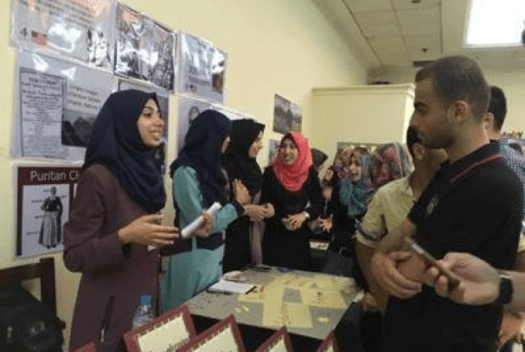
Rasha Ghabayen explains to a group of students the history of Native American Literature. (credit: Yousef Aljamal, Palestine Chronicle)
A look at the ways literature crosses borders and unites people in a common anti-colonial struggle.

By Benay Blend | Palestine Chronicle | Dec 5, 2021

…what both Palestinians and Native Americans have in common are “white saviors,”

In the past few years, several articles and books have focused on the ties between Native American and Palestinian activists/scholars. See, for example, Steven Salaita’s ‘Internationalism:  Decolonizing Native America and Palestine’ (2016), ‘Holy Land in Transit: Colonialism and the Quest for Canaan’ (2006), and Marion Kawas, “Solidarity Between Palestinians and Indigenous Activists Has Keep Roots” (2020).

Louise Erdrich does not draw these links in her most recent novel ‘The Sentence’ (2021), but it nevertheless brings to mind several commonalities as well as differences between the Palestinian solidarity movement and various forms of Native activism. Moreover, Erdrich highlights those moments in 2021 that called for alliances between various movements for social justice, including climate change and the murder of unarmed black men by local police, in particular George Floyd, so it makes sense to look for lessons regarding the Palestine solidarity movement that could be taken from the book.

Continue reading “From Birchbark Books to Palestine: Takeaways from Louise Erdrich’s The Sentence”

Voices from the Holy Land Online Film Salon: “Christians in Palestine”

Screen Shot 2021-12-07 at 5.48.19 PM

Please join our brothers and sisters from Voices from the Holy Land for an Online Film Salon discussion this month focusing on Christians in Palestine today, as we approach the Christmas story.  The 2 films are: “Bethlehem – The Living Stones” and “Christians of Palestine, Life Behind the Wall”.
Date: Sunday, December 12, 2021
Time: 3:00 pm EDT / 12:00 noon PDT
Location: On-line
Information: Event information here →
Tickets: Free with registration
Event Details

“Bethlehem – The Living Stones”: So often, Christian pilgrims travel to the Holy Land to experience where Jesus lived, walked and performed miracles. Churches now stand over ancient stones on the places where Bible events occurred. The tours come; the tours go. But most of the pilgrims/tourists don’t encounter the Palestinian people in Bethlehem. This film opens the aperture to experience the land where Jesus walked, through the eyes of “the living stones,” Palestinian Christians who descend from the disciples.

“Christians of Palestine, Life Behind the Wall”: This short documentary focuses on how the Israeli occupation impacts the Palestinian population of today. The story, told by Christian-Palestinians, sheds light on different perspectives of the conflict that we don’t hear about in the United States. Watch the film. Witness the Christmas celebration and hopeful spirit of those living in the walled city of Bethlehem. This film conveys a message of peace, along with a deeper understanding of what the Bethlehemites face.

View these films in advance (links provided upon registration) and join our salon discussion on Dec. 12 with Yousef AlKhouri , lecturer at Bethlehem Bible College & member, Christ at the Checkpoint and Elizabeth, a community builder and former teacher at Jerusalem School in Bethlehem. The discussion will be led by Rev. Susan Wilder, Co-Moderator of the Israel/Palestine Mission Network of The Presbyterian Church (USA).

More information here →

Reflections on Palestine Day by a former Israeli Refusenik

Israel_refusniks
Demonstration of israeli refusniks in front Dan Haluz the head of IDF. “refuse to be war criminal”, July 2006. (credit: Public domain, via Wikimedia Commons)
What brought an Israeli Jew to that point of refusal?

By Charles Lenchner | CounterPunch |  Dec 2, 2021

Imagine looking at the moon, without realizing you only ever see half of it. Then one day you learn, it rotates in such a way as to keep the dark side hidden from human eyes, for eternity. Such was the logic of Israeli education, at least for Jews. Suddenly I got to see the other side.

About 34 years ago I willingly walked into the processing center for draftees in Israel. This was after an intense 18-month period of organizing, wherein I helped create a group of Israeli Jews willing to publicly commit to refusing to support the Occupation.

As it happened, I was the first one to be called up from those that signed our official letter. It had 16 names. This was before the first Intifada, a time when Israelis thought the Occupation was cost free and would last forever.

Continue reading “Reflections on Palestine Day by a former Israeli Refusenik”

Ben, Jerry and Hochul’s boycott hypocrisy

2ZWCR3O3ZND4XCDLRVVDTH3FQA
Ben & Jerry’s (credit: Joe Raedle / Getty Images)
The differing interpretations of boycott legitimacy.

By Katherine Franke | New York Daily News|  Nov 28, 2021

Yet in the same week that the Biden administration signaled that it was inclined to boycott China over its human rights violations, the governor of New York announced that she plans for state government to divest from the company that owns Ben & Jerry’s over the ice cream manufacturer’s decision to restrict sales in the Israeli-occupied West Bank.

Last week, Republican members of Congress issued adamant calls on the U.S. government to boycott the Winter Olympics in Beijing to protest the Chinese government’s abuses of the human rights of Uyghurs and the crackdown on protesters and journalists in Hong Kong. The Biden administration has signaled an inclination to do so. Meanwhile, the Women’s Tennis Association threatened to pull all of its tournaments in China after the disappearance of Peng Shuai, a top female tennis player was who has claimed to have been sexually assaulted by a Chinese government official.

Continue reading “Ben, Jerry and Hochul’s boycott hypocrisy”

Webinar: Palestine-Israel – where to look for hope?

ehimetalor-akhere-unuabona-1e-8AT7W1aM-unsplash (1)
May 15th 2021, around 150,000 people attend the March for Palestine protest; they converged at the Israeli Embassy but were blocked and eventually met with resistance by the met Police. (credit:  Ehimetalor Akhere Unuabona on Unsplash)
Please join in a discussion with Peter Beinart, Editor-at-large of Jewish Currents; Diana Buttu, Palestinian lawyer, analyst and former legal advisor to the PLO negotiation team; and Daniel Levy, President of the U.S./Middle East Project. The session will be moderated by Rebecca Abou-Chedid, USMEP non-resident Fellow.  Following short interventions by the panelists, there will be a discussion and Q&A.
Date: Thursday,  December 2, 2021
Time: 12:00pm EST / 9:00am PST
Location: On-line zoom webinar
Information: Event information here →
Tickets: Free, but must register
Event Details

The three-week long May crisis in Palestine-Israel was in part a repetition of well-rehearsed scenes of devastation, but it also witnessed something unusual – a broad Palestinian mobilization transcending a Palestinian landscape normally characterized by fragmentation and atomization, alongside a shift in the public discourse and debate, most notably in the US.

As familiar patterns of behavior reassert themselves, and with business-as-usual approaches coming from the new governments in Israel, the US, and the Muqata bubble (or worse in the case of Israel applying a ‘terror designation’ to six leading Palestinian NGOs), we pose the question: where should one look for hopeful signs of change and fluidity, for a path to get beyond permanent impasse, occupation and inequality?

More information here →

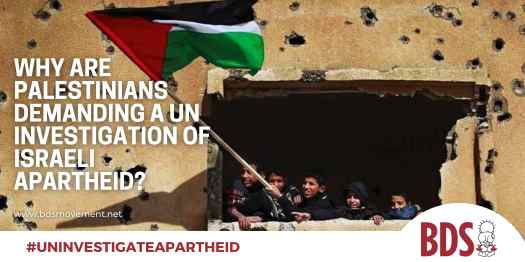
Pushing for #UNInvestigateApartheid – The best solidarity action with Palestinian People on November 29th

International Day of Solidarity with Palestinian People (Banner (Landscape))-min

Monday November 29, 2021 marks the 43rd UN International Day of Solidarity with the Palestinian People. The best way to show real solidarity with Palestinians is to push for #UNinvestigateApartheid.

By Palestinian BDS National Committee (BNC) | BDS | Nov 26, 2021

Apartheid is… the severe deprivation of the oppressed group of fundamental human rights and freedoms, calculated to prevent its development.

Apartheid is a crime against humanity. States and international organizations, foremost the United Nations, have a legal obligation to give no recognition or assistance to an apartheid regime, and to act to bring it to an end. Individuals responsible for the crime are to face prosecution and punishment by domestic courts or the International Criminal Court.

Under international law, apartheid consists of inhuman acts committed by an institutionalized regime of racial domination and systematic oppression for the purpose of maintaining that regime. For decades, Israel has practiced apartheid against the Palestinian people.

Continue reading “Pushing for #UNInvestigateApartheid – The best solidarity action with Palestinian People on November 29th”

‘We violated people’s privacy for a living’: How Israel’s cyber army went corporate

F121015MS51-1000x668
Israeli soldiers of the operational unit 8200 training in the field, Sep 11, 2012. (credit: Moshe Shai / Flash90)
The blurred line between the military and private sector in Israel has allowed dangerous cyber weapons like NSO’s spyware to flourish worldwide.

By Sophia Goodfriend | +972 Magazine | Nov 23, 2021

…these are not simply private companies conducting business abroad: they are deeply connected to the Israeli military establishment, and their products are central to Israel’s own surveillance arsenal.

At a security conference and exposition called “iHLS Innotech” held in Tel Aviv last week, five Israeli cyber experts spoke at a roundtable titled “Ethics of the Sale of Cyber and Intelligence Tools at the Offensive Realm.” The panelists, all men hailing from lengthy careers in the military and private sector, joked that the conversation would be so difficult that it warranted a bottle of scotch whiskey at 10:45 a.m.

As the scotch made a number of rounds on the stage, some of the panelists spoke about promoting stricter initiatives to regulate the sale of cyber weapons and technologies, such as barring veterans of army intelligence units who have used these technologies from working for offensive cyberespionage firms. But the consensus among the panelists was that companies would most likely continue selling their services with the blessing of Israeli export law.

Continue reading “‘We violated people’s privacy for a living’: How Israel’s cyber army went corporate”