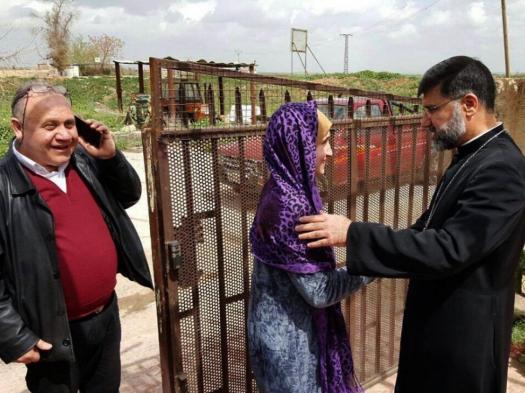
“Honestly, this man should go down as a saint, the things that he’s done, the sacrifices he’s made to help these people. He’s refusing to leave Syria until all his flock is secured.” — Aneki Nissan
Deep inside Syria, a bishop worked secretly to save the lives of 226 members of his flock from the Islamic State group — by amassing millions of dollars from his community around the world to buy their freedom.
They were seized from the Khabur River valley in northern Syria, among the last holdouts of a minority that had been chased across the Mideast for generations. On February 23, 2015, ISIS fighters attacked 35 Christian towns simultaneously, sweeping up scores of people.
It took more than a year, and videotaped killings of three captives, before all the rest were freed.
Palestinian children waiting inside the Shuafat Refugee Camp for buses to take them to school. (photo: Luca Locatelli/Institute, for The New York Times)
Life and death in East Jerusalem’s Palestinian refugee camp.
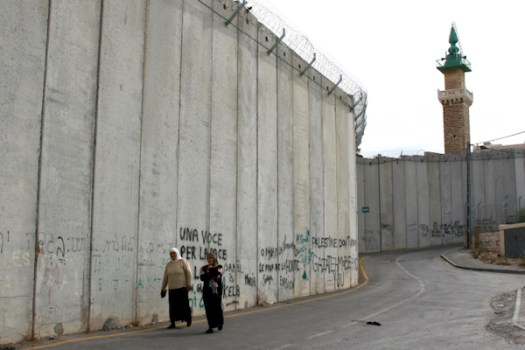
The camp is, according to Israeli law, inside Israel, and the people who live there are Jerusalem residents, but they are refugees in their own city. Residents pay taxes to Israel, but the camp is barely serviced. There is very little legally supplied water, a scarcely functioning sewage system, essentially no garbage pickup, no road building, no mail service (the streets don’t even have names, much less addresses), virtually no infrastructure of any kind. There is no adequate school system. Israeli emergency fire and medical services do not enter the camp. The Israeli police enter only to make arrests; they provide no security for camp residents. There is chaotic land registration. While no one knows how many people really live in the Shuafat camp and its three surrounding neighborhoods, which is roughly one square kilometer, it’s estimated that the population is around 80,000. They live surrounded by a 25-foot concrete wall, a wall interspersed by guard towers and trapdoors that swing open when Israeli forces raid the camp, with reinforcements in the hundreds, or even, as in December 2015, over a thousand troops.
Standing at an intersection in Shuafat Refugee Camp, in East Jerusalem, I watched as a boy, sunk down behind the steering wheel of a beat-up sedan, zoomed through an intersection with his arm out the driver’s-side window, signaling like a Nascar driver pulling in for a pit stop. I was amazed. He looked about 12.
“No one cares here,” my host, Baha Nababta, said, laughing at my astonishment. “Anyone can do anything they want.”
As Baha and I walked around Shuafat this spring, teenagers fell in behind us, forming a kind of retinue. Among them were cool kids who looked like cool kids the world over, tuned in to that teenage frequency, a dog whistle with global reach. I noticed that white was a popular color. White slouchy, pegged jeans, white polo shirts, white high-tops. Maybe white has extra status in a place where many roads are unpaved and turn to mud, where garbage is everywhere, literally, and where water shortages make it exceedingly difficult to keep people and clothing clean.
We need to understand what we all are facing. This is against foreigners and Jews. Anti-Semitism is raising its ugly head in different parts of the world. All together we should fight terrorism, fight anti-Semitism, fight xenophobia and fight for our values. This is what makes Israel part of the free world. Instead of saying workers of the world unite, moderates of the world should unite.
The government of Prime Minister Benjamin Netanyahu is fretting over what President Obama may or may not do in the waning days of his administration.
Will Obama endorse a U.N. resolution enshrining a rough outline for what a two-state solution to the long-running Israel-Palestinian conflict should look like — regarding future borders, the fate of the Jewish settlements and Palestinian refugees, the sharing of Jerusalem?
Or maybe Obama will give a speech.
Or send Secretary of State John F. Kerry to Paris to mull the “French initiative” to push for an end to Israel’s 50-year military occupation, a conference that appears to be stalled.
“I imagine this will be the end of State Department statements for 50 years calling settlements illegal to illegitimate, unhelpful or obstacles to peace. American foreign policy is about to be dramatically shifted. . . . It’s not about one check from Jared Kushner, but a broad threat to 50 years of bipartisan support for the proposition that settlements are an obstacle to peace. Now, that could be declared dead. I’m very alarmed.” — Jeremy Ben-Ami, President of J Street
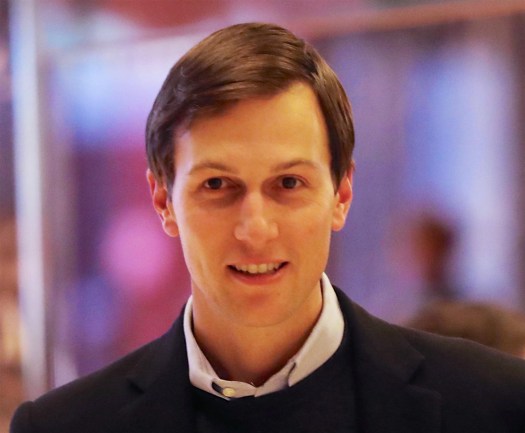
Jared Kushner, who may become a Middle East peace envoy in his father-in-law’s administration, is a director of a family foundation that has made charitable donations to West Bank settlements.
The gifts totaled $58,500 between 2011 and 2013, a small portion of the almost $8.5 million the Seryl and Charles Kushner Family Foundation gave away in that period, according to IRS records first reported by the Israeli newspaper Haaretz and reviewed independently by The Washington Post. Kushner and his three siblings are directors, along with their parents, of the foundation.
President-elect Donald Trump has said he may make his son-in-law, who is married to Ivanka Trump, a broker for talks between Israelis and Palestinians, saying Kushner would be “very good” at working with both sides.
Said Al-Abbasi, Silwan Neighborhood, East Jerusalem. [photo: MA’AN News]By Middle East Memo
December 5, 2016
Demolitions of Palestinian structures and homes in the occupied West Bank and East Jerusalem have seen an unprecedented surge this year, with the number of structures demolished in the first half of 2016 well exceeding the total number of demolitions carried out in all of 2015. At least 1,569 Palestinians have been displaced since the beginning of 2016 as a result of demolitions in the occupied territory, compared to 688 Palestinians displaced over the entirety of 2015, according to U.N. documentation.
Two Palestinian brothers in the neighborhood of Silwan in occupied East Jerusalem were forced to demolish their own homes on Saturday in compliance with an Israeli court order.
One of the owners, Said Al-Abbasi, told Ma’an that he and his brother Nasser had built their homes in the Karm Al-Sheikh area of Silwan two-and-a-half years ago. However, before construction could be completed, the Jerusalem municipality delivered demolition orders for their homes.
During the court hearings, the Al-Abbasi brothers, who have 12 children between them, were forced to close the construction site with concrete until all legal proceedings had concluded. Said told Ma’an that the Jerusalem municipality threatened to imprison the pair if they tried to resume construction at the site.
“Today, the Israeli Knesset shifted from a path to establish a Palestinian state to a path of extending sovereignty to Judea and Samaria [as Israel calls the occupied Palestinian territories]. Let there be no doubt: the regulation bill is what will spearhead the extension of [Israeli] sovereignty.” — Naftali Bennett, Israeli Minister of Education and Minister of Diaspora Affairs
“[The legislation] has the objective of protecting illegal settlements built on private Palestinian property in the West Bank. It is a very worrying initiative. I encourage Israeli legislators to reconsider such a move, which would have far-reaching legal consequences across the occupied West Bank.” — Nickolay Mladenov, U.N. Special Coordinator for the Middle East Peace Process
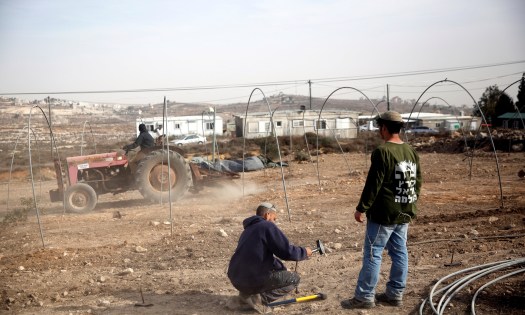
Israel’s parliament has voted to retroactively legalize thousands of illegitimate settler homes in outposts built on private Palestinian land, in a highly controversial move described by critics as a “land grab.” The measure, which passed in a stormy Knesset session late on Monday, has been met with international condemnation, and has already strained relations within Prime Minister Benjamin Netanyahu’s governing rightwing coalition.
It comes in sharp defiance of a call on Sunday by the U.S. Secretary of State, John Kerry, who urged Israel again to rein in the construction of settlements on West Bank land.
Israeli critics and Palestinians have described the legislation as a land grab that would further distance prospects for a two-state solution to end the long Israeli-Palestinian conflict. Some high-profile political supporters, echoing that view, celebrated the vote by saying it opened the way to annexation of the West Bank and the end of any prospect of a Palestinian state.
According to estimates by opponents — including the prominent anti-occupation group Peace Now — the new law, if finally approved, would effectively annex 55 illegal outposts and approximately 4,000 housing units in settlements and illegal outposts.
Perhaps demonstrating how out of touch decision makers are with the electorate on the matter of Palestine and Palestinian rights, momentum in American government — local and national — seems to be toward limiting the tools Americans have to leverage their own economic and political power to end the occupation. At least 22 U.S. states have legislation that punishes companies for answering the Palestinian call for boycott, divestment and sanctions against Israel.
The number of Americans who support imposing sanctions on Israel over its defiant settlement policies has shot up to 46 percent, the same percentage of Americans who voted for Donald Trump in the presidential election.
That number has shot up nearly 10 percentage points over the past year, according to a national poll published by the Brookings Institute on Friday, on the sidelines of this week’s Saban Forum, “an annual dialogue between American and Israeli leaders.”
Among Democrats, a 60-percent majority “supported imposing some economic sanctions or taking more serious action” in response to Israeli settlements, the poll found. A much smaller number of Republican respondents (31 percent) support sanctions.
The United States, like most countries in the world, opposes the existence and expansion of Israeli settlements — both in the occupied West Bank (including East Jerusalem) and Golan Heights. Despite that opposition, however, Washington has rarely set any consequences for Israel’s settlement policies or actions.
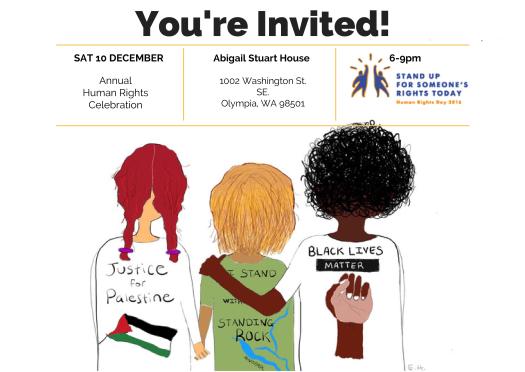
Join the Rachel Corrie Foundation for the 2016 Annual Human Rights Day Celebration for an evening of food and knowledge. Gather together for an evening with friends and enjoy delicious food prepared by local Olympia chefs, wine and locally-brewed beer donated by Three Magnets Brewing Co., a musical performance by Benjamin SittingBull, a Plains Indian singer, flutist and drummer, and a discussion on environmental and political activism.
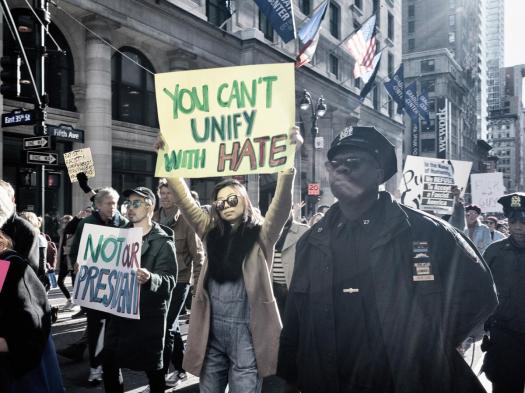
Now is the time to resist the slightest extension in the boundaries of what is right and just. Now is the time to speak up and to wear as a badge of honor the opprobrium of bigots.
America has always been aspirational to me. Even when I chafed at its hypocrisies, it somehow always seemed sure, a nation that knew what it was doing, refreshingly free of that anything-can-happen existential uncertainty so familiar to developing nations. But no longer. The election of Donald Trump has flattened the poetry in America’s founding philosophy: the country born from an idea of freedom is to be governed by an unstable, stubbornly uninformed, authoritarian demagogue. And in response to this there are people living in visceral fear, people anxiously trying to discern policy from bluster, and people kowtowing as though to a new king. Things that were recently pushed to the corners of America’s political space — overt racism, glaring misogyny, anti-intellectualism — are once again creeping to the center.
Now is the time to resist the slightest extension in the boundaries of what is right and just. Now is the time to speak up and to wear as a badge of honor the opprobrium of bigots. Now is the time to confront the weak core at the heart of America’s addiction to optimism; it allows too little room for resilience, and too much for fragility. Hazy visions of “healing” and “not becoming the hate we hate” sound dangerously like appeasement. The responsibility to forge unity belongs not to the denigrated but to the denigrators. The premise for empathy has to be equal humanity; it is an injustice to demand that the maligned identify with those who question their humanity.
[Jordan Goldwarg is the Northwest regional director for Kids4Peace International, a global movement of youth and families, dedicated to ending conflict and inspiring hope in divided societies around the world.]
In my work as the director of an interfaith-youth movement, I have had the privilege of visiting numerous mosques in Seattle and forming close friendships and professional relationships with many Muslims. Through these contacts, I have come to see Islam as a religion that espouses peace, compassion and tolerance.
On a recent night, I received a disturbing email informing me of vandalism that had damaged the main sign at the Muslim Association of Puget Sound (MAPS), the largest mosque in the region.
The following day, I received a phone call from a Muslim friend telling me that if a national Muslim registry is created, she will fear for her children and move her family back to East Africa.
These two incidents dramatically illustrate the anxiety that American Muslims are feeling, driven in no small part by a 67 percent increase in hate crimes last year over 2014, according to the FBI.
The vandalized sign underscores the critical importance of non-Muslim allies to stand against Islamophobia and support our Muslim friends and neighbors.
We need to defend Muslims for two reasons. First, as friends, we can speak out against bigotry and lend our voices in opposition to those who say that Muslims who speak in their own defense are simply trying to protect their own interests.
Second, we have the ability to make members of a targeted group feel valued and accepted as members of our community. So many of my Muslim colleagues have told me that community support is what makes this time of fear and anxiety more bearable. Continue reading “Stand with your Muslim neighbors”





 HolyLandJustice.org
You must be logged in to post a comment.