How Natalie Portman became the latest Israel-Palestine flashpoint

Natalie Portman. (photo: Emma McIntyre / Getty Images)

She turned down Israel’s Nobel Prize — and kicked off a major firestorm.

By Zach Beauchamp | Vox | Apr 23, 2018


This is not a marginal controversy, some kind of celebrity sideshow. It is a leading indicator of the rising tensions between liberal American Jewry and the increasingly right-wing Israeli government. Portman is the canary in the coal mine, warning Israel that its policies on the Palestinians and African migrants are putting it increasingly at odds with its most natural friends abroad.


Natalie Portman, one of the most famous Jewish celebrities on the planet, just announced she was boycotting a major Israeli event.

Portman was scheduled to travel to Jerusalem to receive the Genesis Prize, a prominent award sometimes referred to as the “Jewish Nobel.” On Friday [Apr 20], she abruptly canceled her visit, writing that she “did not want to appear as endorsing [Israeli Prime Minister] Benjamin Netanyahu” in an Instagram post explaining her decision. It’s not yet clear what’s happening to the $2 million in prize money that comes with the award.

Celebrities deciding to avoid Israel on political grounds is not all that uncommon. Hollywood is left-leaning, and many celebrities are outspokenly pro-Palestinian. Netanyahu’s government is one of the furthest right in Israeli history, particularly when it comes to the conflict with the Palestinians. Tensions are to be expected.

But Portman is an altogether different case. Continue reading “How Natalie Portman became the latest Israel-Palestine flashpoint”
America’s “most Jewish” secular college votes to divest from Israel

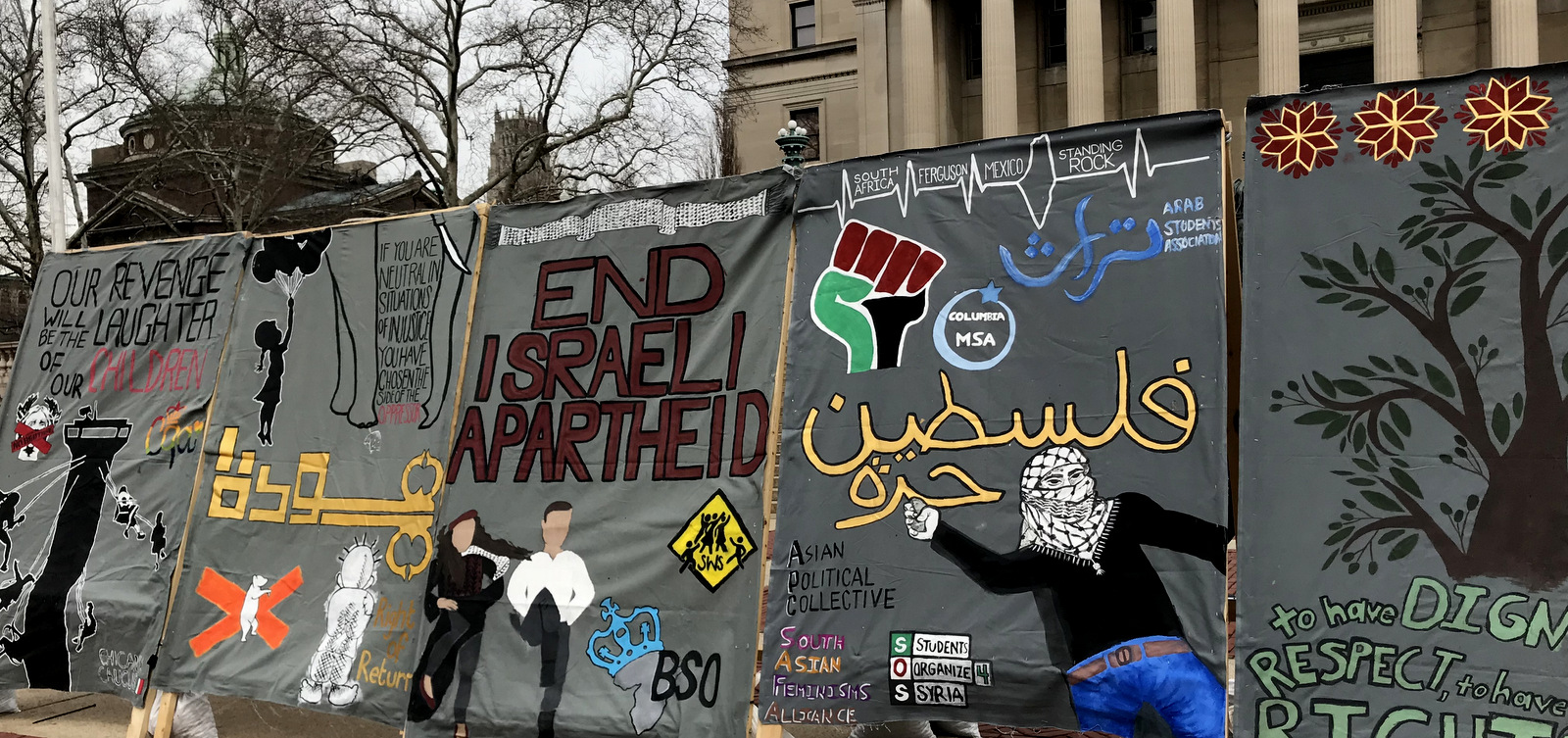
A display erected by students at Barnard College and Columbia University in protest of Israeli apartheid. (photo: Godland / Mint Press News)

One-third of Barnard College’s students are Jewish, the highest proportion among secular colleges in the United States.

By Whitney Webb | Mint Press News | Apr 24, 2018


While the school administration will not move forward with the call to divest, it has nonetheless caused concern among pro-Israel activists that the results will embolden BDS activists, as the vote has been hailed as a major victory for the movement.


Students at Barnard College just voted overwhelmingly to ask the school’s administration to divest from and boycott eight companies that do business with Israel and profit from the Israeli government’s treatment of Palestinians. Barnard, a women’s college that is part of Columbia University, passed the referendum by a 64 to 36 percent margin, with about half of the school’s students participating in the vote — a turnout much higher than in previous votes on the subject, perhaps reflecting Israel’s recent shooting of more than 2,000 unarmed Gazan protesters.

The result of the vote is being hailed as a major victory for Palestinian-rights movement BDS, the campaign to boycott, divest and sanction Israel for its violations of international law in Palestine.

Continue reading “America’s “most Jewish” secular college votes to divest from Israel”

Second Palestinian journalist dies from sniper fire

Palestinian journalist Ahmed Abu Hussein is seen receiving medical treatment after being shot by an Israeli sniper during a protest on the Gaza border, Apr 13, 2018.

Ahmed Abu Hussein was shot by Israeli snipers during a protest near the Gaza-Israel border two weeks ago. He was standing at a distance from the fence and was wearing a PRESS jacket.

By Haggai Matar | +972 Magazine | Apr 25, 2018


“Ahmed had always expected this could happen to him. The situation in Gaza is difficult. There is no work. But Ahmed always had ambition and he wanted to progress. His friends offered him this job, and he would write and photograph for the agency and send materials for publication.”
— Abu Hussein’s mother


Ahmed Abu Hussein, a Palestinian journalist based in Gaza who was shot by Israeli soldiers two weeks ago, died of his wounds on Wednesday at Tel Hashomer Hospital in central Israel. Abu Hussein is the second Gazan journalist to be killed by IDF snipers over the past month, and one of 40 Palestinians killed during the Great Return March protests.

On Friday April 13, Abu Hussein, a 24-year-old from Jabaliya refugee camp, went to take photographs of the protest next to the Gaza-Israel border fence. His mother told +972 that he had been working with a small photo agency named Bisan, and according to the Committee to Protect Journalists, Abu Hussein had worked for a radio station linked to the Popular Front for the Liberation of Palestine (it is yet unclear whether he worked for both places at the same or separately).

Abu Hussein was wearing a PRESS jacket — and was standing with a group of photographers near a press tent at the Great Return March encampment — when an Israeli sniper’s bullet pierced his abdomen, disrupting the blood flow to his brain . . . . His mother says he was struck by a hollow-point bullet, which expands as it hits its target in order to cause maximum damage. This is the same kind of bullet that has been used against dozens of those who have been killed and maimed during demonstrations in Gaza over the past month.

Continue reading “Second Palestinian journalist dies from sniper fire”

Blasted limbs, broken dreams

gazalegs
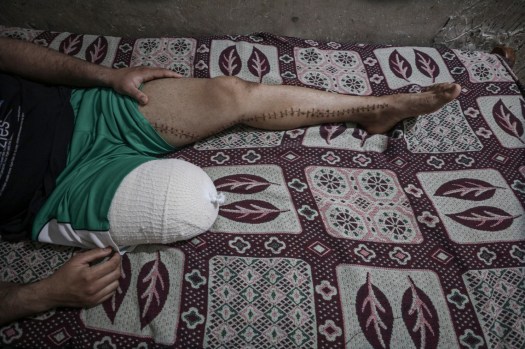
Palestinian cyclist Alaa al-Daly, 21, rests at his home in Rafah in the southern Gaza Strip on April 19. Daly’s dream of competing in the Asian Games was shattered after he lost his leg, struck by a bullet fired by an Israeli soldier during a protest along the Gaza border. (photo: Wissam Nassar / The Washington Post)

Israel appears to be targeting the legs of protesters, then denying them access to medical care in Israel.

By Eric Cunningham and Hazem Balousha | The Washington Post | Apr 28, 2018


“The deployment of snipers, careful planning and significant number of injuries to the lower limbs does reflect an apparent policy to target [those] limbs. [Targeting protesters’ legs] does not make the policy any less illegal. The use of live ammunition to any part of the body invariably causes serious injury and even death.”
— Omar Shakir, Israel-Palestine director at Human Rights Watch


Mohammad al-Ajouri is a lanky teenager who loves to run, a medal-winning track star with ambitions to compete abroad.

But last month, while participating in a protest along Gaza’s border, he was struck by a bullet fired by an Israeli soldier. It penetrated his calf, shattering his leg before exiting the shin. Doctors tried to save the limb, but an infection soon spread. The leg had to be amputated.

During the past month of demonstrations along the border between Gaza and Israel, at least 17 Palestinians have suffered gunshot wounds that ultimately cost them their legs, according to the Palestinian Health Ministry in Gaza.

In at least three of the cases, Israeli authorities rejected the transfer of wounded Gazans to the West Bank, where they could receive medical care that might have saved their limbs, according to lawyers and one of the patients’ families.

Continue reading “Blasted limbs, broken dreams”

Paraguay pledges to move embassy to Jerusalem

Paraguayan President Horacio Cartes. (photo: notihispanic.com)

Paraguay would become the third country to commit to moving its embassy to Jerusalem.

By Tovah Lazaroff | The Jerusalem Post | Apr 30, 2018


  • Guatemala is the only country besides the US that plans to move its embassy to Jerusalem.
  • Romania and Honduras are also considering the move.
  • The Czech Republic plans to open a consulate in Jerusalem, but not an embassy.
  • Currently 87 countries have embassies in Israel, none of them in Jerusalem

Paraguayan president Horacio Cartes pledged to relocate his country’s embassy from Tel Aviv to Jerusalem at a special celebratory event in Asunción to mark Israel’s 70th anniversary.

Cartes said that he would like the move to take place before he leaves office in mid-August. Foreign Ministry spokesman Emmanuel Nahshon tweeted about the statement under the heading “good news.” But he later said that it was still unclear if plans to relocate the embassy were in the works.

Continue reading “Paraguay pledges to move embassy to Jerusalem”

Pompeo and Palestinians have “nothing to discuss” amid Gaza crisis

Secretary of State Mike Pompeo, left, met with Prime Minister Benjamin Netanyahu on Sunday. (photo: Thomas Coex / The New York Times)

No one at the State Department called Palestinian leaders to ask for a get-together with Mr. Pompeo, according to Palestinian officials.

By Gardiner Harris and Isabel Kershner | The New York Times | Apr 29, 2018


“No meeting in Ramallah on his first visit sets an ominous tone about prospects for any progress, or even dialogue, with the Palestinians.”
— Daniel Shapiro, former US ambassador to Israel


Secretary of State Mike Pompeo came to Israel Sunday in the midst of the worst crisis in relations between Israelis and Palestinians in years, but he did not meet a single Palestinian representative and mentioned them publicly once.

For decades, American diplomats saw themselves as brokers between the two sides, and secretaries of state typically met Palestinian representatives on regional tours like this one. When relations between the two sides deteriorated, the United States sought to bridge the divide.

No more.

Continue reading “Pompeo and Palestinians have “nothing to discuss” amid Gaza crisis”

American Jews have abandoned Gaza — and the truth

gettyimages-950746464-1524683810
(photo: Getty Images)

Israel controls Gaza in the way a prison guard might control a prison courtyard in which he never actually sets foot.

By Peter Beinart | Forward | Apr 26, 2018


The struggle for human decency, Orwell argued, is also a struggle for honest language. Our community’s complicity in the human nightmare in Gaza should fill every American Jew with shame. The first step toward ending that complicity is to stop lying to ourselves.


“In our time,” wrote George Orwell in 1946, “political speech and writing are largely the defense of the indefensible.” British colonialism, the Soviet gulag and America’s dropping of an atomic bomb, he argued, “can indeed be defended, but only by arguments which are too brutal for most people to face.” So how do people defend the indefensible? Through “euphemism, question-begging and sheer cloudy vagueness.” By obscuring the truth.

So it is, more than 70 years later, with Israeli policy toward the Gaza Strip. The truth is too brutal to honestly defend. Why are thousands of Palestinians risking their lives by running toward the Israeli snipers who guard the fence that encloses Gaza? Because Gaza is becoming uninhabitable. That’s not hyperbole. The United Nations says that Gaza will be “unlivable” by 2020, maybe sooner.

Hamas bears some of the blame for that: Its refusal to recognize Israel, its decades of terrorist attacks and its authoritarianism have all worsened Gaza’s plight. Mahmoud Abbas’s Palestinian Authority bears some of the blame too. So does Egypt.

But the actor with the greatest power over Gaza is Israel. Israeli policies are instrumental in denying Gaza’s people the water, electricity, education and food they need to live decent lives.

Continue reading “American Jews have abandoned Gaza — and the truth”

For Gaza protester, living or dying is the “same thing”

Palestinians gathered for a protest at the Gaza Strip’s border with Israel on Friday. (photo: Wissam Nassar / The New York Times)

Hope is a scarce commodity in Gaza, which is little more than an open-air prison.

By Iyad Abuheweila and David Halbfinger | The New York Times | Apr 29, 2018


“It doesn’t matter to me if they shoot me or not. Death or life — it’s the same thing.”
— Saber al-Gerim


No one would ever pick out Saber al-Gerim from the crowds of Palestinians demonstrating against Israel along the heavily guarded fence that has helped turn the Gaza Strip into an open-air prison.

Not for his youthful appearance. At 22, he wears ripped jeans and white sneakers, has a modish haircut and carries a few extra pounds from too many months without work.

Not for his anger. Screaming “Allahu akbar!” and hurling stones with a sling, or straining to pull a cable hooked onto Israel’s barbed-wire barrier in hopes of tearing it apart, he is just one in a fevered multitude, a protagonist in nobody’s drama but his own.

Not even for his willingness to risk death, or his dream of going home to a patch of land he has never seen and cannot really visualize.

Continue reading “For Gaza protester, living or dying is the “same thing””

Feminism, Gaza, and life in Israel’s Knesset

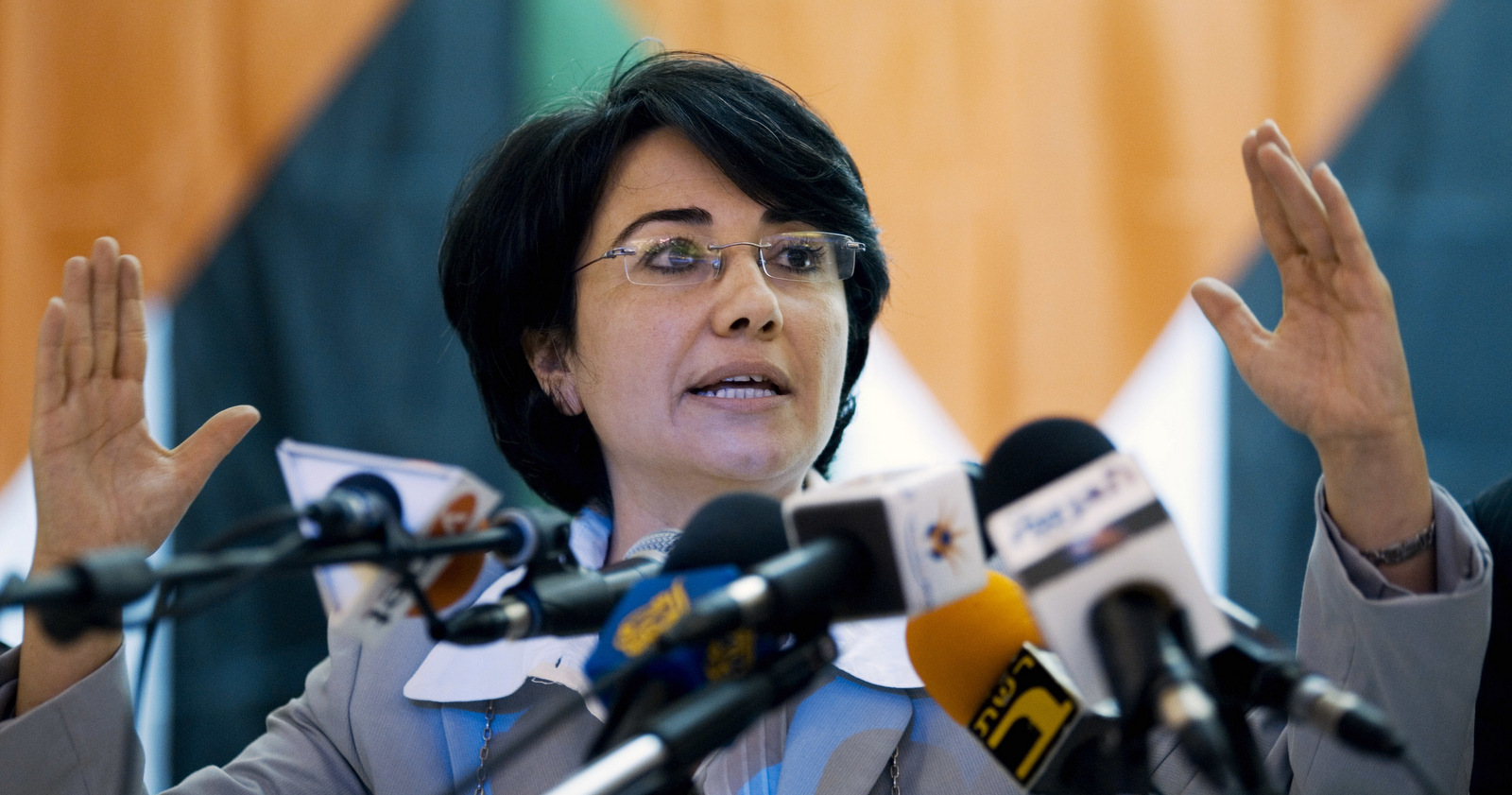
Haeneen Zoabi speaks to the press in Nazareth, Jun 1, 2010. (photo: Ariel Schalit / AP)

Palestinian Israeli Knesset member Haneen Zoabi discusses her experience as a member of the Israeli Knesset.

By Dennis Bernstein | Mint Press News | Apr 23, 2018


“Equality and justice are strategic threats. As a member of the Knesset, I am asked to be loyal to racism, loyal to apartheid laws, loyal to my oppressor. In Arab schools, we cannot study our own history, our own literature. We cannot control our own textbooks. We learn that we don’t have any special relation to our homeland. We pay taxes so that our children can learn how inferior we are in our homeland. We must thank Israel every day for not expelling us in 1948.”
— Haneen Zoabi, Israeli member of the Knesset


Haneen Zoabi is a member of the Israeli Knesset and the first woman elected to the Israeli Knesset on an Arab party list. She’s an unrelenting advocate for equal citizenship rights for the Palestinian citizens of Israel, and despite repeated attacks of all kinds, she remains unrelenting in her call for an end to Israel’s occupation of Palestinian Lands.

Zoabi considers herself a straight up feminist. She says “real feminism must acknowledge the discrimination against Arab women in Israel, and real feminism must know to identify with and struggle alongside them, at the national, civil and social levels.”

Zoabi joined forces with the Balad Party a year after it was founded in 1997. A key guiding principle of the Party is to maintain a one-third quota for women candidates. The party advocates for the rights of Palestinians, legally designated as ‘Arab Israelis’. Zoabi has been banned from the Knesset five times for taking strong stands in support of Palestinian rights.

Continue reading “Feminism, Gaza, and life in Israel’s Knesset”

Film: Disturbing the Peace (Tomorrow)

disturbing-the-peace-2

Pushing for Change: Mideast Focus Ministry Film Series V

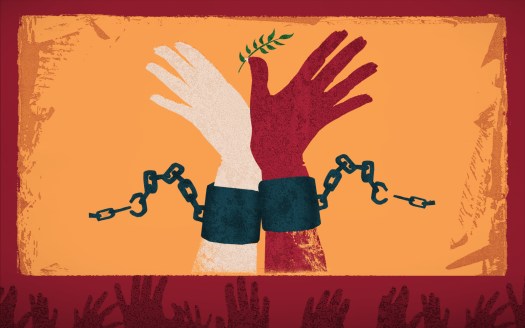
“Disturbing the Peace” is a story of the human potential unleashed when we stop participating in a story that no longer serves us, and with the power of our convictions, risk and push to actions that create new possibilities. This film follows former enemy combatants who have joined together to challenge the status quo and say “Enough.”

Date: Friday, Apr 27, 2018
Time: 7:00 – 9:00 pm
Location: Bloedel Hall
St. Mark’s Cathedral
1245 10th Ave E
Seattle, WA  98102
Information: Event website
Admission: Free

Event Details

Our concern is to help balance the limited and confusing media coverage of the Holy Land. We use compelling films as an entry point for reflection and discussion. As Christians, we respond to Christ’s call to seek justice and love the oppressed. As Americans, we ask: Can we reconcile this calling with our government’s massive financial support of Israeli military operations? We hope the time will come when Jews, Muslims and Christians will again come together in harmony in the Holy Land.

In this series, we see how people pushed to bring about a safe country for the Jewish people, and how today others are still push- ing for safety and change. Do our efforts for change lead to peace and justice . . . or not?

More information here →