Israelis, too, could face consequences from contaminated water.
By Fred de Sam Lazaro | PBS News Hour | Jan 1, 2019
In the Gaza Strip, 97 percent of freshwater is unsuitable for human consumption, and raw sewage pours into the Mediterranean Sea. Facilities for desalinating and treating water function on only a limited basis, as Israel controls the flow of fuel and supplies into the region.
A hospital in Gaza, where the health system has been worn down by years of blockade. (photo: Mohammed Saber / EPA)
Doctors say antibiotics shortages stop them following protocols to fight drug-resistant bacteria, which are likely to spread to Israel and the West Bank.
By Madlen Davies and Emma Graham-Harrison | The Guardian | Dec 31, 2018
‘This is a global health security issue because multi-drug-resistant organisms don’t know any boundaries. That’s why the global community, even if it’s not interested in the politics of Gaza, should be interested in this.’ — Dina Nasser, lead infection control nurse at Augusta Victoria hospital in East Jerusalem
Doctors in Gaza and the West Bank have said they are battling an epidemic of antibiotic-resistant superbugs, a growing problem in the world’s conflict zones, which could also spill over the Palestinian borders.
The rise and spread of such virulent infections adds to the devastation of war, increasing medical costs, blocking hospital beds because patients need care for longer, and often leaving people whose injuries might once have been healed with life-changing disabilities.
Gaza is a particularly fertile breeding ground for superbugs because its health system has been worn down by years of blockade, and antibiotics are in short supply, the Bureau of Investigative Journalism has found.
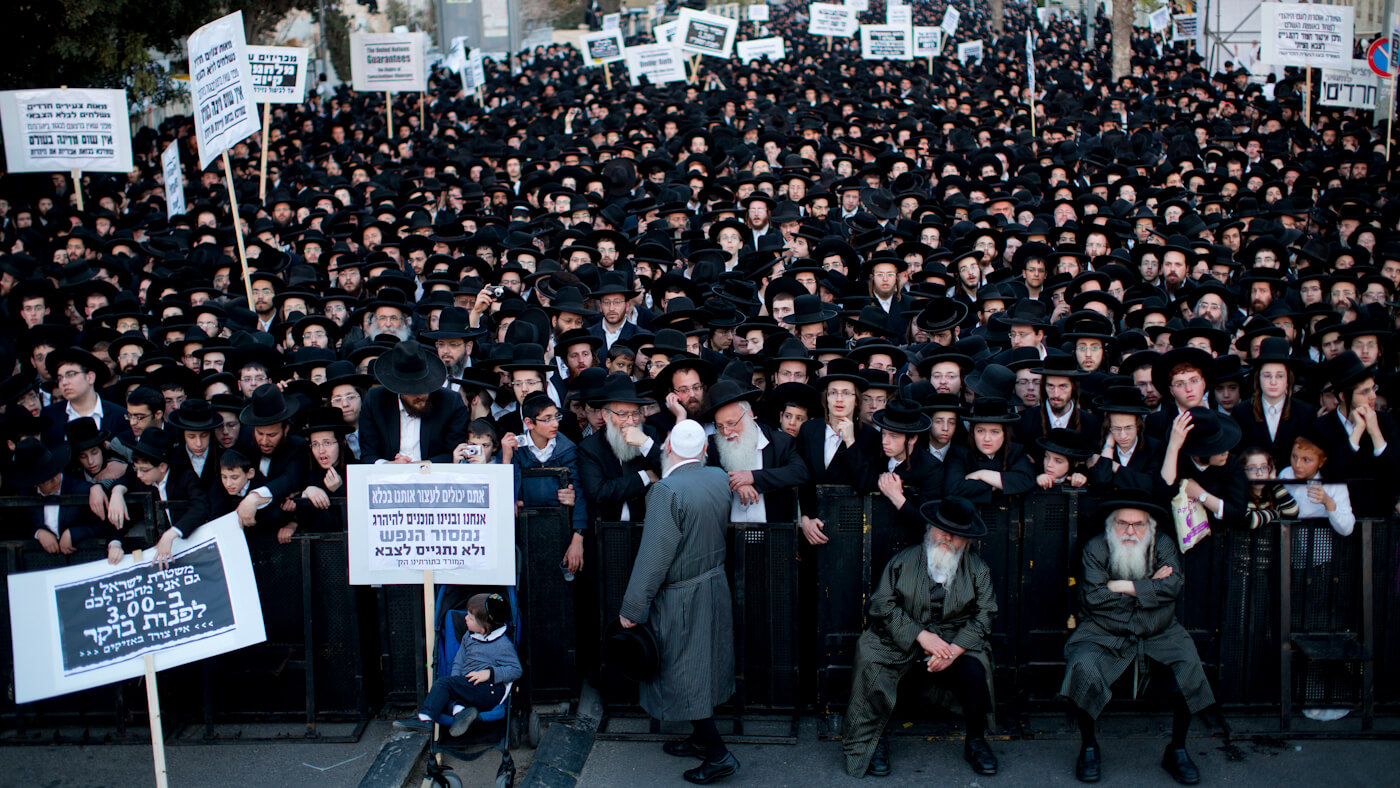
Ultra-Orthodox Jews take part in a protest against Israeli army conscription in Jerusalem, Mar 28, 2017. (photo: Oded Balilty / AP)
The Haredi community’s stance against military conscription is anchored in faith and principle that no power has been able to defeat.
By Miko Peled | Mint Press News | Dec 28, 2018
As much as the Zionist state and its various agencies want to believe that Israel is the state of the Jewish people, there is one Jewish community that will never accept this — it is the one community that is the most devout, the Haredi community.
“Nazis, Nazis,” that’s what I thought I heard. I was driving down the main road near Jerusalem’s Ultra-orthodox Me’a Sha’arim neighborhood where hundreds of young Haredi Jews were blocking the road. Dumpsters were burning and the traffic came to a halt. I jumped out of the car and ran to see what was happening. I asked a young Yeshiva student what was going on and if they were really shouting “Nazis.” He confirmed to me that they were calling the Israeli riot police Nazis and that this protest was because the police had just arrested several Haredi girls for refusal to serve in the Israeli army.
Nazis? I asked him, really? He then went on to describe the abuse and violence with which the police treat the young men and women in this community, particularly since Israel’s draft law had changed, making them all potential deserters.
It may be impossible to imagine a deeper divide than the one separating the two sides of this issue. Like a tiger that was allowed to remain in quiet slumber for some sixty-five years and has been abruptly awakened, Israel now has another angry, uncompromising community on its hands. And for no other reason than opportunistic politicians who saw in this divide a way to make a name for themselves.
An Israeli settler fixes an Israeli flag on the roof of a building in Hebron, Jan 21, 2016. (photo: AFP)
Netanyahu was the one-state visionary. The struggle for its character lies with those who will follow him.
By Gideon Levy | Haaretz | Dec 26, 2018
In retrospect, we should be grateful to Netanyahu for taking this solution off the agenda, because it was a mirage. The events of 1948, the refugees, the return and equality would not have been resolved by the two-state solution; it would have been an interim arrangement. Netanyahu posed the truth; now the only question is what type of regime will prevail in the one state that has been here for decades and will probably be here between the river and the sea forever.
Benjamin Netanyahu must be excoriated. One can understand those who are dying for him to just go away. It’s clear his time is almost up. But one cannot say he hasn’t done anything.
In his dozen years as prime minister he has changed the face of Israel in ways that he considers wildly successful. Some of the changes he’s made could be rolled back if only some worthy liberal leader was given the chance — a hope that for now seems far-fetched.
But there is one big, fateful change, the fruit of Netanyahu’s calculated policy, that is irreversible. Against the stance of the entire world, the United States, the Palestinian Authority and even against the declared position of most Israelis, Israel’s ninth prime minister has managed to remove the possibility of a viable Palestinian state from the agenda. He has irrevocably destroyed the two-state solution. Whether reelected or not, Netanyahu will be remembered as a revolutionary statesman; the man who shaped the country in his image. . . .
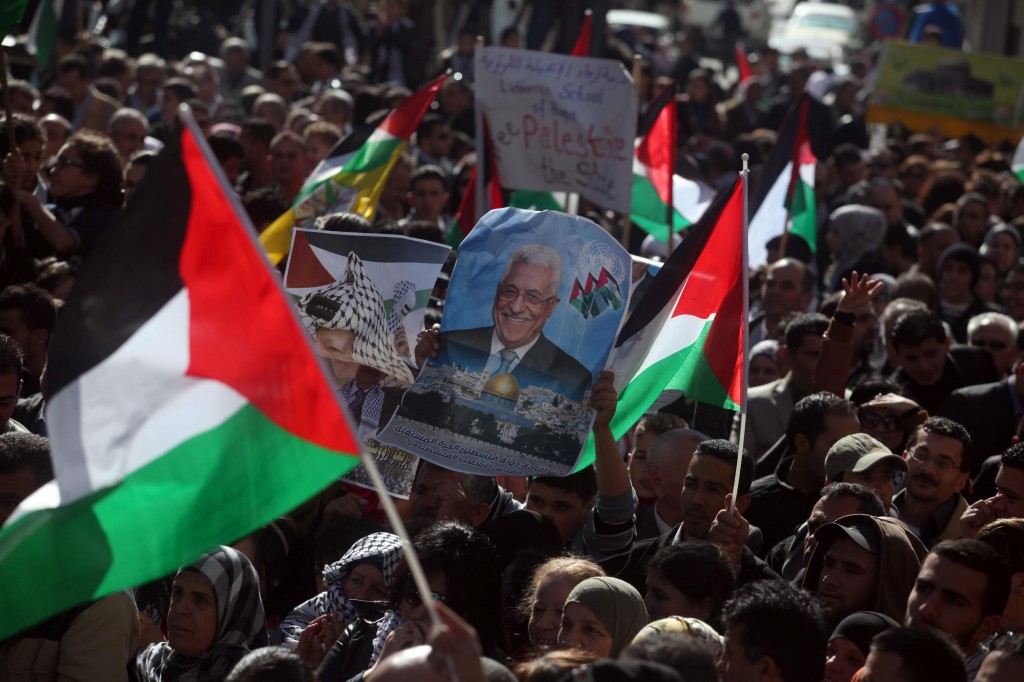
Palestinians wave their national flag during a rally in Ramallah on Nov 29, 2012, to support Palestinian leader Mahmoud Abbas’s bid for UN recognition of statehood. (Issam Rimawi / Flash90)
Though Palestinian bid is doomed to fail due to expected US veto, Israeli envoy attacks Ramallah for ‘destructive policies that have encouraged recent terror attacks’
By Raphael Ahren | The Times of Israel | Dec 27, 2018
“We are preparing to stop the initiative,” Israel’s Ambassador to the UN Danny Danon declared, saying that his delegation will work together with the US administration on the matter.
The Palestinian Authority plans to apply for full membership at the United Nations, a move that is highly unlikely to succeed due to the opposition of the United States and other countries.
PA Foreign Minister Riyad al-Malki on Wednesday announced in an interview his intention to ask the UN Security Council to hold a vote on the matter next month.
At least nine countries would have to vote in favor of granting Palestine full membership, and even then one of the council’s five permanent members could veto the resolution.
The vote is expected to take place on January 15 in the framework of the Security Council’s quarterly discussion on the Situation in the Middle East.
A view shows the dome of the Assyrian church facing a mosque minaret in Bethlehem in the Israeli-occupied West Bank, Dec 24, 2018. (photo: Mustafa Ganeyeh / Reuters)
Remember Christ was a Palestinian refugee — a Jewish Palestinian refugee — who is the founding figure of Christianity, and a beloved prophet for Muslims. The rest is commentary.
By Hamid Dabashi | Al Jazeera | Dec 25, 2018
And when the angels said, ‘O Mary, indeed Allah gives you good tidings of a word from Him, whose name will be the Messiah, Jesus, the son of Mary — distinguished in this world and the hereafter and among those brought near [to Allah].’ (The Quran 3:45)
There is something beautifully sacred about the moment in the Quran when the angels inform Mary she is about to give birth to Jesus. Angels bring her the good news. They tell her of how “He will speak to the people in the cradle and in maturity and will be of the righteous.”
The sublime innocence of Mary at hearing this news can hardly be better captured in any scripture: “She said, ‘My Lord, how will I have a child when no man has touched me?’ [The angel] said, ‘Such is Allah; He creates what He wills. When He decrees a matter, He only says to it, “Be,” and it is.’” (The Quran 3:47).
A portrait of Ms. Najjar in her family’s home. (photo: Hosam Salem / The New York Times)
The bullet that killed her was fired by an Israeli sniper into a crowd that included white-coated medics in plain view. Neither the medics nor anyone around them posed any apparent threat of violence to Israeli personnel.
By David Halbfinger | The New York Times | Dec 30, 2018
Though Israel later admitted her killing was unintentional, the shooting appears to have been reckless at best, and possibly a war crime, for which no one has yet been punished.
A young medic in a head scarf runs into danger, her only protection a white lab coat. Through a haze of tear gas and black smoke, she tries to reach a man sprawled on the ground along the Gaza border. Israeli soldiers, their weapons leveled, watch warily from the other side.
Minutes later, a rifle shot rips through the din, and the Israeli-Palestinian drama has its newest tragic figure.
For a few days in June, the world took notice of the death of 20-year-old Rouzan al-Najjar, killed while treating the wounded at protests against Israel’s blockade of the Gaza Strip. Even as she was buried, she became a symbol of the conflict, with both sides staking out competing and mutually exclusive narratives.
To the Palestinians, she was an innocent martyr killed in cold blood, an example of Israel’s disregard for Palestinian life. To the Israelis, she was part of a violent protest aimed at destroying their country, to which lethal force is a legitimate response as a last resort.
[If the link above does not display a video in your browser, you can view it directly here →. The NY Times created a detailed reconstruction of the events leading up to Rouzan al-Najjar’s killing. — Eds.]
Alice Walker stands in front of a picture of herself from 1974 as she tours her archives at Emory University, in Atlanta, in 2009. (photo: John Amis / AP)
What’s lacking from the Times is appropriate shock at Alice Walker’s bigotry and its own refusal to admit a mistake.
By Richard Cohen | The Washington Post | Dec 24, 2018
[NY Times Book Review Editor Pamela Paul] surely does not mean to, but she manages to treat anti-Semitism as just another point of view — not a hatred with a unique and appalling pedigree that has led to unending slaughter
Over the centuries, anti-Semitism has been many things — a religious conviction, an ideology, a national ethic, an unadorned expression of hate and, in more recent times, evidence of sturdy insanity. Now thanks to a New York Times interview with Alice Walker, it’s been reduced to merely a point of view. To cite the Times’s own motto, this interview was definitely not “news that’s fit to print.”
Walker, of course, is a highly praised novelist best known for “The Color Purple,” for which she won a Pulitzer Prize. Her renown is great, and it was no doubt on this basis that the Times interviewed her for its “By the Book” feature that runs in the Sunday Book Review. The trouble started with the first question.
“What books are on your nightstand?” the Times asked. The second book Walker named was “And the Truth Shall Set You Free” by the British conspiracy theorist David Icke. The book is so repellently anti-Semitic that Icke’s usual publisher wouldn’t touch it. Among other things, it endorses that hoary anti-Semitic forgery “The Protocols of the Elders of Zion,” which blames evil Jews for much of the world’s ills. The book also suggests that schools ought to balance lessons on the Holocaust with some questioning whether it ever even happened, and it reveals that the world is run by a cabal of giant, shape-shifting lizards, many of whom just happen to be Jewish.
Members of the National Socialist Movement, one of the largest neo-Nazi groups in the US, hold a swastika burning after a rally on Apr 21, 2018 in Draketown, Georgia. (photo: Spencer Platt / Getty Images)
Ultimately defeating anti-Jewish and anti-Black prejudice in our communities depends on principled solidarity and rejection of the tropes created by white supremacy.
By Rebecca Pierce | Forward | Dec 19, 2018
The anti-Jewish tropes found in Icke’s writings are steeped in the ideology of white supremacy and white power, which casts Jews as simultaneously a perennial social other, a communist scourge and somehow in control of world banking, politics and media.
Every generation that struggles against oppression stands on the shoulders of those who came before us. But even as we honor those who taught us, we must also challenge them when they stray from the path of fighting for justice, and fall into the trap of stigmatizing one community to uplift another.
For Black feminists, The Color Purple author and activist Alice Walker has long been a luminary and leader, guiding us on a path towards personal and collective liberation through her work. Unfortunately, this week many of us find ourselves in the painful but necessary position of having to push back on anti-Jewish words and endorsements that are especially harmful coming from someone so influential in the fight against patriarchy and white supremacy.
In an interview with The New York Times Book Review this week, Walker recommended “And the Truth Shall Set You Free” by British conspiracy theorist David Icke, a book that alleges the existence of a Jewish-influenced cabal set on world domination and positively cites notorious anti-Jewish forgery The Protocols of the Elders of Zion.
Author Alice Walker attends “The Color Purple” TimesTalks, at the New School in New York City, Oct 29, 2015. (photo: Jamie McCarthy / Getty Images)
The book, recommended by author Alice Walker, repeatedly cites the “Protocols of the Elders of Zion,” dubs the Talmud “among the most appallingly racist documents on the planet,” and says Jews funded the Holocaust and control the KKK.
By Yair Rosenberg | Tablet | Dec 17, 2018
That a celebrated cultural figure like Walker would promote such a self-evidently unhinged bigot might seem surprising at first glance. But this is only because the cultural establishment has spent years studiously looking away from Walker’s praise of Icke and his work, and her repeated expressions of anti-Semitism.
Over the weekend, the New York Times Book Review published a full-length interview with Alice Walker, the Pulitzer Prize-winning author of The Color Purple. The very first question: “What books are on your nightstand?”
Walker replied with four, the second of which was And the Truth Shall Set You Free by David Icke. “In Icke’s books there is the whole of existence, on this planet and several others, to think about. A curious person’s dream come true.”
This passed without comment from the New York Times interviewer, and the publication passed it on to readers without qualification. This is rather remarkable because the book is an unhinged anti-Semitic conspiracy tract written by one of Britain’s most notorious anti-Semites.
You must be logged in to post a comment.