The 2019 Women’s March: privileging victimhood and the power of class

The first Women’s March in Washington DC, January 21, 2017. (Photo: Getty Images)
While the Women’s March of 2017 was an expression of unity across many issues, the 2019 Women’s March has struggled with accusations of anti-Semitism.

By Alice Rothchild | Mondoweiss |  Jan 22, 2019

 It has become clearer and clearer to many Jewish activists and their allies that if we are working for equal rights for all, if we are condemning racism, anti-semitism and Islamophobia, if we are working to create safe societies for women, if we are working against gun violence, then Zionism becomes increasingly problematic.

Over the weekend I rallied and marched in one of Seattle’s two women’s marches, with speeches from indigenous and immigrant communities, the Washington Poor People’s Campaign, Dreamers, and religious figures. We chanted to end the school to prison pipeline and the building of an expensive youth jail, to fund education, healthcare, housing, gun control, and to end the government shutdown. We gave our support to transpeople and Native Peoples especially Missing and Murdered Indigenous women, to saving our environment, to welcoming immigrants, and fighting racism, anti-Semitism, sexism, homophobia, and “toxic masculinity.” The day celebrated inclusivity and cross-sectional political organizing led by “womxn” and marginalized communities. “Women are the Wall and Trump will Pay!”

The Women’s March in 2017, following the inauguration of the most sexist, racist, and dangerous president in the U.S., was the largest single day demonstration in our history. Despite all the expressions of unity, two years and many marches and outrages later, much has been written about this 2019 Women’s March and the angry schisms around accusations of anti-Semitism. This has resulted in the loss of endorsements, the organizing of competing marches, and an enormous amount of public handwringing, along with calls for the resignations of the leadership and the weakening of the movement. At the same time, Jewish women have been exhorted to march in unity with the original Women’s March and the organizers talk about establishing a “platform on which truly progressive candidates can run and win in 2020.”

Continue reading “The 2019 Women’s March: privileging victimhood and the power of class”

Israel unearths a Roman-era road in East Jerusalem, unsettling a Palestinian neighborhood

https://www.washingtonpost.com/video/c/embed/6ca0c6b3-8066-445d-afde-8c41fa6a1a96

Palestinians say it is an attempt to literally pull their hopes for a future capital in East Jerusalem from under their feet.

By Ruth Eglash and Loveday Morris | The Washington Post | Jan 25, 2019

If you are Israeli or Jewish then you feel very excited by what is shown here. But the history of Jerusalem does not only belong to the Israelis.
— Yonathan Mizrachi, an Israeli archaeologist and executive director of Emek Shaveh, an Israeli cultural heritage group

The main road winding through the densely built Arab neighborhood of Wadi Hilweh is like many others in Jerusalem, lined with convenience stores and often crammed with traffic. There’s little clue to what is happening just yards below the pavement and under the floors of surrounding houses and apartment blocks.

For five years, Israeli archaeologists, supported by a nationalist Jewish organization, have been digging a tunnel here. Their aim is to uncover what they say was once an important thoroughfare used by worshipers some 2,000 years ago to reach the Jewish holy temple.

Developers envisage an archaeological attraction that would lure millions of visitors keen to walk the same stones as ancient pilgrims, or perhaps even Jesus. Private donors have contributed $75 million for the Pilgrim’s Road project, and the government has put up $13 million more.

Continue reading “Israel unearths a Roman-era road in East Jerusalem, unsettling a Palestinian neighborhood”

Film: Soufra (Friday)

Please join our brothers and sisters at the Mideast Focus Ministry for their First Friday Film series. There will be a light reception prepared by local Syrian refugees beginning at 6:15 pm.
Date: Friday, Feb 1, 2019
Time: 7:00 – 8:30 pm
Location: St. Mark’s Cathedral
Bloedel Hall
1245 10th Ave E
Seattle, WA 98102
Information: Event information here →
Tickets: Free Admission
Event Details

Soufra follows the unlikely and wildly inspirational story of intrepid social entrepreneur, Mariam Shaar — a generational refugee who has spent her entire life in the Burj El Barajneh refugee camp just south of Beirut, Lebanon. The film follows Mariam as she sets out against all odds to change her fate by launching a successful catering company, “Soufra,” and then expand it into a food truck business with a diverse team of fellow refugee woman who now share this camp as their home.

Together, they heal the wounds of war through the unifying power of food while taking their future into their own hands through an unrelenting belief in Mariam, and in each other. In the process, Mariam is breaking barriers, pulling together Syrian, Iraqi, Palestinian and Lebanese women to work side by side and form beautiful friendships while running this thriving business. Continue reading “Film: Soufra (Friday)”

For Michelle Alexander’s critics, Palestinians don’t deserve civil rights

Michelle Alexander speaks at the Miller Center Forum, Dec 3, 2010. (Miller Center / CC BY 2.0)
The uproar by over Alexander’s NY Times essay in support of Palestinian rights echoes the reactions of white Americans to the Civil Rights Movement decades ago.

By Amjad Iraqi | +972 Magazine | Jan 23, 2019

Most Americans thought it [the Civil Rights movement] was going too far and movement activists were being too extreme. Some thought its goals were wrong; others that activists were going about it the wrong way — and most white Americans were happy with the status quo as it was. And so, they criticized, monitored, demonized and at times criminalized those who challenged the way things were, making dissent very costly.

Michelle Alexander’s powerful New York Times essay on Saturday (“Time to Break the Silence on Palestine”), ahead of the commemoration of Martin Luther King Jr. Day, was arguably a milestone for the Palestine movement in the US.

First, for who wrote it: Alexander, the author of the seminal book The New Jim Crow, is a renowned lawyer and public intellectual respected for her activism and scholarship on racism in the U.S., who cannot easily be dismissed as “fringe.”

Second, for where it was written: in a leading mainstream newspaper, which more frequently features op-eds by Israel advocates like Bari Weiss, Matti Friedman, Bret Stephens, Shmuel Rosner, and even officials like Naftali Bennett.

Third, for when it was written: Alexander is the latest prominent Black American in recent months to vocally express — and be targeted for — her solidarity with the Palestinian people, after others like Tamika Mallory, Marc Lamont Hill, and Angela Davis faced similar public outrages and disavowals.

And fourth, for why it was written: to challenge the widespread fear of backlash, held by many progressive Americans, for publicly criticizing Israel and speaking up for Palestinian rights.

Continue reading “For Michelle Alexander’s critics, Palestinians don’t deserve civil rights”

Children’s lives in danger amid Gaza fuel shortage

Children's lives 'in danger' amid Gaza fuel shortage
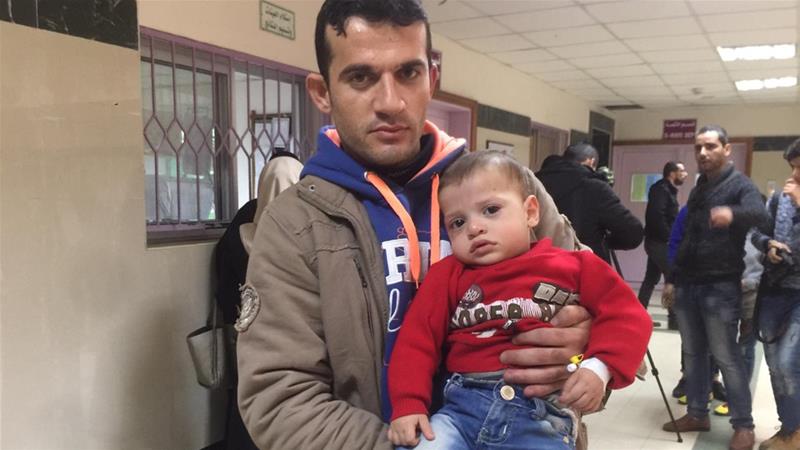
Sufian Salem is at al-Rantisi Hospital with his one-year old child, Mohammed, who is suffering from breathing problems. (photo: Maram Humaid / Al Jazeera)
Hospitals in the Palestinian territory are facing fuel shortages amidst cold weather that could be deadly for many patients.

Maram Humaid | Al Jazeera | Jan 20, 2019

We feel very concerned due to the news of fuel crisis in hospitals. It’s a disaster. If the hospital stopped, where we would go? All patient children would die, not only my child.
—Suffian Salem

Gaza’s health ministry has made an urgent appeal for help amid an ongoing fuel crisis in the coastal territory, warning of a “catastrophic situation” in its hospitals, including a children’s facility.

Ashraf al-Qidra, spokesman of Gaza’s health ministry, said five hospitals in the Palestinian territory would stop operating within hours, because generators were unable to operate due to the fuel shortage.

Last week, Beit Hanoun hospital in northern Gaza stopped operating.

“The lives of hundreds of patients in Gaza hospitals are under a threat of dire consequences,” al-Qidra said.

Continue reading “Children’s lives in danger amid Gaza fuel shortage”

Israel’s ‘Apartheid Road’ brings renewed home demolitions, land confiscations for Palestinian town

The Palestinian side of Israel’s new ‘Apartheid Road.’ (Photo: Yumna Patel)
Israeli authorities consider the new highway a “gift” to Palestinians.

By Yumna Patel | Mondoweiss | Jan 22, 2019

People around the world were shocked by this apartheid road, but in Anata, and all across the occupied lands of Palestine, we have already been living in a reality of apartheid for so long.
— Mohammed Salameh

It was only a matter of time, 66-year-old Mohammed Salameh said, before his hometown of Anata suffered another blow dealt by the Israeli occupation.

Located in the central occupied West Bank district of Jerusalem, less than 10 km north of Jerusalem City, the Palestinian town of Anata has seen it all: vast land confiscations, clusters of Israeli settlements built on its land, the Israeli separation wall, home demolitions, and residents killed and arrested by Israeli soldiers.

So when more of Anata’s lands were cut off last week when Israeli authorities opened Route 4370 highway, deemed by locals as the “Apartheid Road,” Salameh and his fellow community members were forced to continue on with their lives as usual.

“We were not surprised by the opening,” Salameh told Mondoweiss in the office of Anata’s municipality, where he works as the Coordinator of Land Protection in the town. “They have been working on this road for years, so we knew it would open eventually.”

When it was opened, stark images of the eight meter wall running through the middle of Route 4730 made international headlines.
Continue reading “Israel’s ‘Apartheid Road’ brings renewed home demolitions, land confiscations for Palestinian town”

Time to break the silence on Palestine

Relatives of a Palestinian nurse, Razan al-Najjar, 21, mourning in June after she was shot dead in Gaza by Israeli soldiers. (photo: Hosam Salem / The New York Times)
Martin Luther King Jr. courageously spoke out about the Vietnam War — we must do the same when it comes to this grave injustice of our time.

By Michelle Alexander | The New York Times | Jan 19, 2019

I want to say, as clearly as I know how, that the humanity and the dignity of any person or people cannot in any way diminish the humanity and dignity of another person or another people. To hold fast to the image of God in every person is to insist that the Palestinian child is as precious as the Jewish child.
— Rev. Dr. William J. Barber II

On April 4, 1967, exactly one year before his assassination, the Rev. Dr. Martin Luther King Jr. stepped up to the lectern at the Riverside Church in Manhattan. The United States had been in active combat in Vietnam for two years and tens of thousands of people had been killed, including some 10,000 American troops. The political establishment — from left to right — backed the war, and more than 400,000 American service members were in Vietnam, their lives on the line.

Many of King’s strongest allies urged him to remain silent about the war or at least to soft-pedal any criticism. They knew that if he told the whole truth about the unjust and disastrous war he would be falsely labeled a Communist, suffer retaliation and severe backlash, alienate supporters and threaten the fragile progress of the civil rights movement.

King rejected all the well-meaning advice and said, “I come to this magnificent house of worship tonight because my conscience leaves me no other choice.” Quoting a statement by the Clergy and Laymen Concerned About Vietnam, he said, “A time comes when silence is betrayal” and added, “that time has come for us in relation to Vietnam.”

Continue reading “Time to break the silence on Palestine”

GOP lawmaker really doesn’t want Rep. Rashida Tlaib to let lawmakers know what life Is like in occupied West Bank


Rep. Rashida Tlaib (D-Mich.). (Photo: Rashida Tlaib)
Rep. Brian Babin (R-Texas) thinks the “mere prospect” of Tlaib’s proposed congressional delegation is dangerous to the status quo

By Andrea Germanos | Common Dreams |  Jan 18, 2019

I don’t think AIPAC provides a real, fair lens into this issue as it glosses over the side that I know is real, which is what’s happening to my grandmother and what’s happening to my family there.
— Rep. Rashida Tlaib (D-Mich.)

Newly-elected Rep. Rashida Tlaib (D-Mich.) wants to offer members of Congress an alternative to the “sugar-coated” junket to Israel the American Israel Public Affairs Committee-affiliated group offers members of Congress by leading a delegation to the West Bank. For a Republican lawmaker, however, giving lawmakers a view of life in the occupied territory is an “exceedingly dangerous” plan that must be stopped.

In letters he sent Thursday to House Speaker Nancy Pelosi (D-Calif.) and Democratic House committee heads, Rep. Brian Babin (R-Texas) laid out his “extreme concern” with Tlaib’s proposal, first reported by The Intercept in December.

Unlike the rite of passage for new Republican and Democratic congress members that some dub the “Jewish Disneyland trip”—sponsored by American Israel Education Foundation (AIEF)—the proposed congressional delegation by the first Palestinian-American woman to serve in Congress would focus on “Israel’s detention of Palestinian children, education, access to clean water, and poverty,” the news outlet reported at the time.

Continue reading “GOP lawmaker really doesn’t want Rep. Rashida Tlaib to let lawmakers know what life Is like in occupied West Bank”

Justice & Equality in Israel-Palestine

halper
Please join for a presentation and dialogue on the issue of demolition of Palestinian homes and Israel’s Nation-State law.
Date: Wednesday, Jan 23, 2019
Time: 7:00 – 9:00 pm
Location: University Congregational UCC
4515 16th Ave NE Seattle, WA  98105
(Turner Lounge)
Information: Event information here →
Tickets: Free
Event Details

Jeff Halper is an American-born anthropologist, author, lecturer, and political activist, living in Israel since 1973.  He is a frequent speaker about Israeli politics, focusing mainly on non-violent strategies to solve the Israeli-Palestinian conflict. Halper co-founded Israeli Committee Against House Demolitions (ICAHD) to challenge and resist the Israeli policy of demolishing Palestinian homes in the Occupied Territories and to organize Israelis, Palestinians and international volunteers to jointly rebuild demolished Palestinian homes as political acts of resistance.

Visit ICAHD  for more information about the work they are doing.

He will also be speaking on Thur, Jan 24th, 7:00- 9:00 pm at Trinity Lutheran Church, 6215 196th St SW, Lynnwood, WA 98036

More information here →

Beyond free speech

People marched to New York Gov. Cuomo house to tell him they demand the Right to Boycott for Palestinian human rights. (photo: Jake Ratner / Jul 6, 2016 )
Concerns about restricting free speech may have shut down current anti-BDS legislation, but important not to lose sight of BDS goals: the human rights of the Palestinian people.

By Nadia Elia | Mondoweiss | Jan 14, 2019

We must now use the national platform we have, as the Senate debates anti-BDS legislation, to make the case that solidarity with Palestine, and heeding the call for a global campaign to boycott, divest from, and impose sanctions on Israel, are the moral thing to do, regardless of whether they are a form of free speech or not.

When a delegation of pro-justice activists and community leaders met with Washington state governor Jay Inslee in 2017, to urge him not to endorse the “Governors United against BDS” letter (which, sadly, he signed onto, like every single US state governor, as well as the mayor of Washington, DC), he spoke of it as a foreign policy matter. I strategically “corrected” him, pointing out that the right to boycott was not a foreign policy issue, but one of American free speech. As a member of Washington Freedom to Boycott (which we have since renamed Washington Advocates for Palestinian Rights), I helped circulate the following call to action to thousands, asking them to tell Inslee that “whatever your views on Israel, Palestine, or the BDS movement, anti-BDS legislation is anti-freedom of speech…”

Continue reading “Beyond free speech”