There is ‘unity of purpose’ among Palestinians, says scholar Ilan Pappe
By Riyaz ul Khaliq | Anadolu Agency | Nov 6 2022
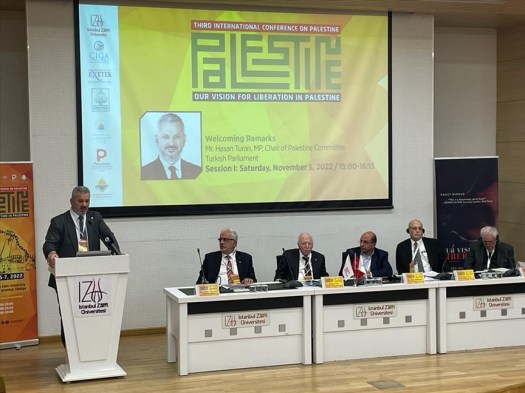
“The occupier, Israel, is every day occupying more and more lands of Palestinians but powerful (nations) who could deliver justice to Palestinians, are not paying attention,” — Hasan Turan, a lawmaker and chairman of the Palestine Committee at the Grand National Assembly of Türkiye
A three-day conference discussing “Our vision for liberation in Palestine” began Saturday in the Turkish metropolis of Istanbul.
Palestine is a “fundamental problem in the world,” said Hasan Turan, a lawmaker and chairman of the Palestine Committee at the Grand National Assembly of Türkiye.
“The occupier, Israel, is every day occupying more and more lands of Palestinians but powerful (nations) who could deliver justice to Palestinians, are not paying attention,” he said, addressing the conference that is hosted by the Center for Islam and Global Affairs (CIGA) at Istanbul Sabahattin Zaim University (IZU).
A campaign poster in Tel Aviv shows, from left, Itamar Ben-Gvir, Benjamin Netanyahu and Bezalel Smotrich. (credit: Jamal Awad / Flash90)
Israel’s boosters across the political spectrum are panicking over the far-right’s victory in Israel’s election, and the reactions are telling.
By Mitchell Plitnick | Mondoweiss | Nov 3, 2022
“Ben-Gvir & fellow ultranationalist Bezalel Smotrich raise the specter of a gov’t willing to strip Israel’s Palestinian-Arab citizens of rights, weaken the judiciary, short-circuit Netanyahu’s legal charges & ratchet up intercommunal tensions and violations of Palestinian rights…” — Jeremy Ben-Ami, leader of the liberal Zionist J Street
As the results of the election in Israel are being finalized – an election wherein millions of Palestinians living under Israeli dominance have no say—consternation outside of Israel among its supporters is ballooning. The reactions from Israel’s boosters are telling.
U.S. Ambassador to Israel Tom Nides, a man almost as slavishly devoted to Israel as his predecessor, David Friedman, said, “It’s too early to predict the precise makeup of the coalition until all votes are counted.” But he “intends to keep working with Israel’s government on the two countries’ shared interests and values.”
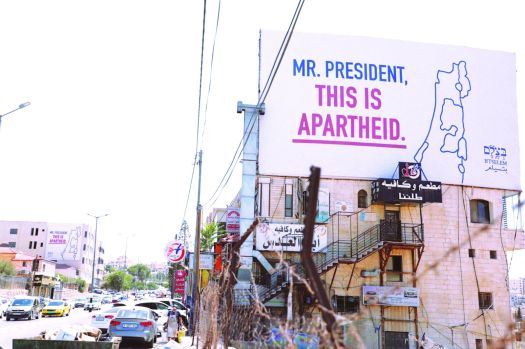
A billboard put up by the Israeli human rights group B’Tselem ahead of Biden’s visit to Israel and the West Bank. (credit: Haidi Motola/B’Tselem)
Embracing a radical critique of Israeli apartheid is a precondition for bringing it to a just end.
By Noura Erakat and John Reynolds | Jewish Currents | Nov 1, 2022
In January 2021, the leading Israeli watchdog group, B’Tselem, deemed Israel a “regime of Jewish supremacy from the Jordan River to the Mediterranean Sea.”
AT THE HEIGHT of the Unity Intifada in May 2021, as Palestinians demonstrated from Gaza City to Haifa to Ramallah, Rep. Rashida Tlaib, the only Palestinian American member of Congress, demanded an end to Israel’s “apartheid government.” Two days later, Reps. Alexandria Ocasio-Cortez and Cori Bush joined her in tweeting, in reference to Israel: “Apartheid states aren’t democracies.” The use of the “apartheid” label—and the rejection, from even a small minority of legislators, of the claim that Israel is “the only democracy in the Middle East”—signaled a break with US political orthodoxy.
These interventions were not only buoyed by the landmark Palestinian uprising but enabled by a series of recent, high-profile reports from major human rights organizations. In January 2021, the leading Israeli watchdog group, B’Tselem, deemed Israel a “regime of Jewish supremacy from the Jordan River to the Mediterranean Sea.” A few months later, in April, the global advocacy organization Human Rights Watch (HRW) described a reality of “apartheid and persecution” maintained for the purpose of “privileging Jews over Palestinians” and involving “an institutionalized regime of systematic oppression and domination.” These organizations aimed to consolidate an anti-apartheid analysis as common sense; their work seemed to give many people permission to speak. Throughout the spring and summer of 2021, solidarity statements and open letters referencing the reports flowed from scholarly and cultural organizations around the world. (Tlaib, too, cited both B’Tselem and HRW.) The momentum continued into 2022: In February, Amnesty International published its own extensive study of Israel’s apartheid against Palestinians, calling it a “cruel system of domination.”
Right-wing Israeli politician Itamar Ben Gvir interacts with supporters in a Jerusalem market ahead of the general election on October 28, 2022. (credit: Ilia Yefimovich / DPA via Zuma Press / APA Images)
The fascistic messianic right declared its grip over the Israeli Jewish psyche in this week’s elections. Now, a political crisis awaits liberal Zionists and the United States
By Philip Weiss | Mondoweiss | Nov 2, 2022
“There will be a third intifada,” — shopkeeper in East Jerusalem
It was hard not to witness the death of hope in Jerusalem on Tuesday night. Those who held out hope that the Israeli system would somehow resist the right, and exhibit tolerance — that hope was dashed by the Israeli election, in which the fascistic messianic right declared its grip over the Israeli Jewish psyche.
Exit polls show the explicitly-anti-Palestinian party Religious Zionism at 13 or 14 seats in the parliament, making it the third largest party. When official votes are released, the party will likely be in position to put the largest vote-getter, Benjamin Netanyahu, whose right-wing Likud Party polls at about 31 seats, back in the prime minister’s job after 18 months absence.
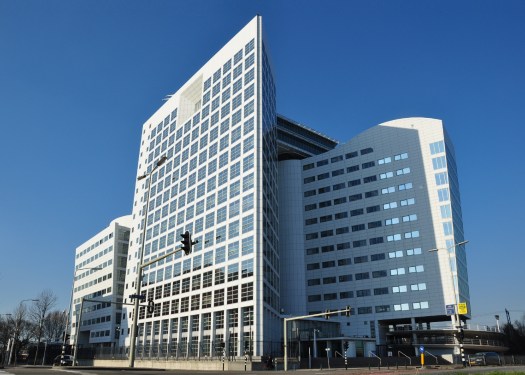
Eurojust in The Hague, Netherlands. (credit: Vincent van Zeijst, CC BY-SA 3.0 , via Wikimedia Commons)
It is extremely rare for a complaint to focus on an individual culprit.
By Democracy for the Arab World Now (DAWN) | Oct 31, 2022
“What makes the Toledano case so appropriate for the ICC is not just the crimes involved, but the opportunity for the court to show that international crimes cannot be ‘legalized’ through domestic legislation” — Michael Schaeffer Omer-Man, Director of Research for Israel-Palestine at DAWN
(Washington, D.C., October 31, 2022) — The Office of the Prosecutor of the International Criminal Court (ICC) should investigate senior Israeli military lawyer Eyal Toledano in the commission of war crimes and crimes against humanity, including the crime of apartheid, said Democracy for the Arab World Now (DAWN), in a submission filed with the Prosecutor today.
The war crimes and crimes against humanity documented in DAWN’s ICC submission, the result of a months-long investigation, took place between 2016 and 2020 in the occupied West Bank, placing them temporally and geographically within the scope of the existing ICC investigation into the Situation in Palestine.
UNIVERSITY OF WASHINGTON (PHOTO: WIKIMEDIA COMMONS)
A controversy at the University of Washington over donor efforts to stifle scholarly work critical of Israel raises serious questions about the role of money and academia.
By Alice Rothchild | Mondoweiss | Oct 27, 2022
It became clear…that the holder of the Benaroya chair was expected to refrain from making ‘certain political statements’ and to ‘accept the proposition that study of ‘modern Israel’ is incompatible with the concurrent study of ‘Israel/Palestine.’”
In today’s society there is awareness that the interests and demands of funders influence what topics are studied, the definitions of acceptable norms, hidden meanings of language, and sources of knowledge, and that ultimately funding may easily taint research findings. In February 2022 at the University of Washington, a controversy became public that serves as an example of just this issue as well as the wide divisions within the Jewish community when it comes to Israel/Palestine, and the disastrous but predictable consequences when these different worldviews collide.y harvested.
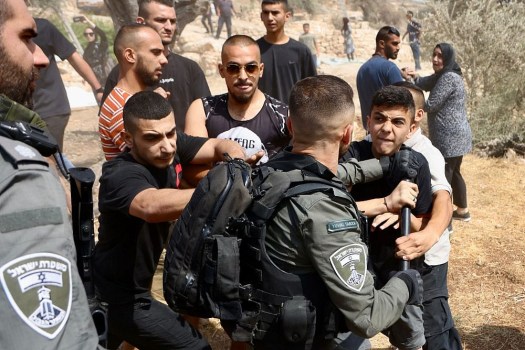
Israeli police officers deny Palestinians access to olive trees in Wadi Rababa, East Jerusalem, October 7, 2022. (credit: Oren Ziv)
Soldiers were seen picking the trees after receiving permission from a settler group. When Palestinians went to harvest the next day, police prevented them.
By Oren Ziv and Meron Rapoport | +972 Magazine | Oct 19, 2022
“We have a land registration document proving that this is our land. Then suddenly they came and took it,” — Ibrahim Sumarin, a resident of Silwan
An olive grove in the East Jerusalem neighborhood of Silwan has become the latest site of struggle between Palestinian residents, who have cultivated the flora for generations, and Israeli authorities and organizations, which have been coveting land and property in the area for years as part of their agenda of “Judaizing” East Jerusalem.
On Oct. 6, uniformed female soldiers were observed collecting olives from the trees in Silwan’s Wadi Rababa, a section of the Hinnom Valley which is part of a national park around the walls of Jerusalem’s Old City. Although it falls under the purview of Israel’s Nature and Parks Authority, the area has been designated as an “agricultural farm” and has been managed for the past two years by Elad, a settler organization that has been centrally involved in Israeli encroachments in Silwan.
A woman poses for photos in front of the large poster form of a postage stamp depicting the Crimean Kerch Bridge on fire in Kyiv, Ukraine on 8 October 2022. (credit: Reuters)
Stark contradictions in West’s treatment of the Ukraine war and the occupation and siege of Palestine should serve as a wake-up call.
By Jonathan Cook | Middle East Eye | Oct 14, 2022
Had the Palestinians openly celebrated blowing up a bridge in East Jerusalem, a territory illegally annexed by Israel in the 1960s, and killed Israeli civilians as collateral damage in the process, who can really imagine western media reports being similarly supportive?
No one took responsibility for the explosion over the weekend that ripped through a section of the Kerch Bridge that links Russia to Crimea and was built by Moscow after it annexed the peninsula back in 2014.
But it was not just Kyiv’s gleeful celebrations that indicated the main suspect. Within hours, the Ukrainian authorities had released a set of commemorative stamps depicting the destruction.
Samia Khoury with kindergarteners at her East Jerusalem school singing a birthday greeting to Alison Weir for her 70th birthday. (credit: Alison Weir)
Shadi Khoury, 16-year-old student at the Ramallah Friends School and grandson of Sabeel co-founder Samia Khoury, was kidnapped from his home in Beit Hanina in East Jerusalem by Israeli Occupation forces.
By Alison Weir | Israel-Palestine News | Oct 18, 2022
Shadi should not be sleeping in a prison cell. He is a child and should be home with his family. — Samia Khoury, Sabeel co-founder
Dear Friends
In the early hours of this morning the Israeli occupation forces, consisting of a troop of around 12 persons consisting of army and secret service, stormed my son’s house after breaking the gate at the entrance of the compound in which we all live, so as to arrest his younger son Shadi Khoury, a sixteen-year-old child, a student at the Quakers Friends School in Ramallah. They beat him until he was bleeding all over the room and along the path on the way out of the house dragging him barefoot and blindfolded not allowing the parents to see where the blood was coming from. Shadi was taken to the interrogation section in the police compound called “the Russian compound”
Palestinian militants raise their weapons during a memorial service of Mohammed Al-Azizi and Abdul Rahman Sobh, who were killed by Israeli forces on July 24, 2022, in Nablus, September 2, 2022. (credit: Shadi Jarar’ah / APA Images)
The current moment of resistance across the West Bank is unprecedented. Palestinians are returning to a state of refusal of the settler-colonial reality some would have them ignore.
By Faris Giacaman | Mondoweiss | Oct 14, 2022
The fate of this moment might end up being decided by whether Palestinian society rallies around the armed resistance groups.
Shu’fat refugee camp is under siege. The Israeli army unleashes its fury in a fervent manhunt for the fighter responsible for killing a soldier at the Shu’fat military checkpoint. In Nablus, an armed resistance group going by the name of Areen al-Usud (“the Lion’s Den”) puts out a call for a mass strike across Palestine. What’s more surprising is that several cities heed the call, despite the fact that it did not originate from any official political party, yet putting a halt to normal life in many cities all the same.
None of this would have been fathomable less than a year ago. In the past few days, Areen al-Usud has declared responsibility for six different shooting operations against Israeli military targets. In Jenin refugee camp, another armed group, the Jenin Brigades, continues to make a stand against the Israeli army during its incursions into the camp. Just this morning, as the Shu’fat siege entered another day, the army launched a parallel invasion of Jenin, killing one and injuring six others in the months-long effort to stamp out the burgeoning resistance movement there.







 HolyLandJustice.org
You must be logged in to post a comment.