Peace process was never intended to give Palestinians a state — true confessions from Council on Foreign Relations

008-e1524493896558
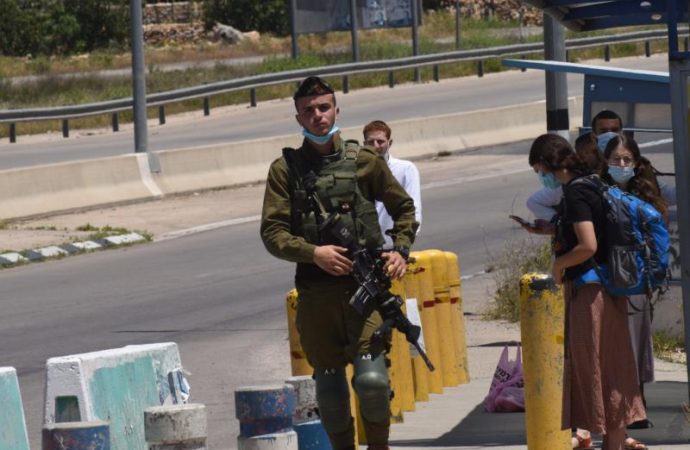
Israeli soldier holding a mobile phone in front of the photographer, trying to prevent the documentation of the events taking place in the West Bank village of Nabi Saleh, April 20, 2018. (photo: Anne Paq)
Truth telling about the objective of the peace process.

By Philip Weiss | Mondoweiss | May 22, 2020

We should be grateful to Cook for saying that the point of the peace process was to fail; and that failure was all for Israel’s interest.

Steven Cook of the Council on Foreign Relations has an article at Foreign Policy saying that the U.S. should phase out aid to Israel and “end the special relationship” because the peace process has attained its real objective: Israel is established as a secure country with a standard of living rivaling the UK and France, and no real military threat.

The piece is shocking because it strips the mask from the peace process, saying just what Edward Said, Rashid Khalidi and Ali Abunimah said decades ago, it was intended to fail, never producing Palestinian sovereignty.


Continue reading “Peace process was never intended to give Palestinians a state — true confessions from Council on Foreign Relations”

Abbas, cornered by Israeli annexation, opts for ‘Judgment Day’ scenario

Mahmoud Abbas, president of the Palestinian Authority, said he is ending security cooperation with Israel, a move that could lead to violence.
Mahmoud Abbas, president of the Palestinian Authority, said he is ending security cooperation with Israel, a move that could lead to violence. (photo: Alaa Badarneh)
The Palestinian leader has promoted security cooperation with Israel in his quest for a Palestinian state. That strategy may have hit a dead end.

By David M. Halbfinger, Adam Rasgon and Mohammed Najib | The New York Times | May 20, 2020

By declaring his intent to break off the close security cooperation with Israel that has protected his government from more radical Palestinian elements, and Israeli citizens from acts of terrorism, Mr. Abbas’s decision could remove impediments to more militant responses.

Tuesday night, for most Palestinian Muslims, was the Night of Destiny, commemorating the revelation of the first verses of the Quran to the Prophet Muhammad.

For Mahmoud Abbas, president of the Palestinian Authority, it was a night of reckoning.

As long as he has led the Palestinian national movement, Mr. Abbas has opposed violence and espoused negotiations with Israel.

But Israel’s push, with the Trump administration’s support, to annex occupied territory that the Palestinians have counted on for a future state may be steering Mr. Abbas’s strategy to a dead end.

Continue reading “Abbas, cornered by Israeli annexation, opts for ‘Judgment Day’ scenario”

A possible spike in Gaza

A Palestinian child wears a mask as he runs between alleys in Al-Shate' refugee camp, in the Gaza Strip on May 18, 2020. Photo by Mahmoud Al-Hindi/APA Images
A Palestinian child wears a mask as he runs between alleys in Al-Shate’ refugee camp, in the Gaza Strip on May 18, 2020. (photo: Mahmoud Al-Hindi / APA Images)
A news roundup on COVID-19 and other events in Palestine this week.

By Editors | Mondoweiss |  May 22, 2020

After a lull in cases over the previous period this week saw a slight spike in cases of COVID-19, especially in Gaza where the coronavirus had been kept in check until now.

The Latest:

  • 602 total COVID-19 cases; 368 in the West Bank, 55 in the Gaza Strip and 179 in Jerusalem
  • 16,683 Israelis have tested positive for COVID-19; 279 people have died
  • According to a study published by Tel Aviv University, more than 70% of COVID-19 cases in Israel were infected by a strain that originated in the United States
  • According to the Palestinian Ministry of Health: since the onset of the pandemic, 45,343 laboratory samples have been tested. At least 30,581 Palestinians are currently in quarantine at home

Continue reading “A possible spike in Gaza”

No Bark, No Bite

Vice President Joe Biden in Des Moines, Iowa, May 3rd, 2019. (photo: Michael F. Hiatt via Shutterstock)
It appears the old rules governing the Israel debate in Washington—set by AIPAC and its allies—still apply.

By Peter Beinart | Jewish Currents | May 21, 2020

How could a letter asking Democrats to oppose annexation, which almost all of them ostensibly do, and pledging consequences no more severe than a decline in American public support for Israel—which AIPAC’s own Democratic front group has warned of publicly—still win so little support?

With each passing week, it becomes clearer that Joe Biden’s victory over Bernie Sanders is making it easier for Israel to annex the West Bank.

The latest evidence comes from the United States Senate. On May 1st, with the support of the pro-Israel, anti-occupation lobbying group J Street, three Democratic senators—Chris Murphy from Connecticut, Chris Van Hollen from Maryland, and Tim Kaine from Virginia—drafted a letter opposing annexation, which they asked their colleagues to sign. Murphy, Van Hollen, and Kaine are not Israeli Prime Minister Benjamin Netanyahu’s toughest critics in the Senate—in 2017, Kaine backed the Taylor Force Act, which cut aid to the Palestinian Authority—but this is precisely what made the three senators appealing messengers. “The letter,” one Senate staffer explained, “was designed to attract more moderate Democrats that don’t typically stick their neck out on these things.”

Continue reading “No Bark, No Bite”

3rd Thursday Action Alert: Tell Congress: No to annexation, and no to continued occupation

Action request to tell Congress that now is the time for the US to oppose Israeli annexation.

By Global Ministries | May 18, 2020

Palestinians therefore refer to the ‘ongoing nakba,’ which has meant a de facto appropriation of Palestinian land and property, and denial of their basic human and civil rights.

Last Friday, May 15, Palestinians commemorated Nakba Day. “Nakba,” an Arabic word that means “catastrophe,” is how Palestinians describe what happened to them following Israel’s declaration of independence in May 1948 and the corresponding war. During the period, more than 500 Palestinian towns and villages were destroyed by the nascent Israeli state’s military, resulting in the forcible displacement and dispossession of more than 750,000 Palestinians from their homes and villages. Today, those still living and their descendants, comprise more than 5 million Palestinian refugees, whose rights of return and/or compensation for their losses as articulated in UN resolution 194 (1948) remain unfulfilled.

Continue reading “3rd Thursday Action Alert: Tell Congress: No to annexation, and no to continued occupation”

Abbas declares end to agreements with Israel, US

Palestinian President Mahmoud Abbas, attends the meeting of the Palestinian leadership, in the West Bank city of Ramallah, on May 19, 2020. (Photo: Thaer Ganaim/APA Images)
Palestinian President Mahmoud Abbas, attends the meeting of the Palestinian Leadership, in the West Bank city of Ramallah, on May 19, 2020. (photo: Thaer Ganaim / APA Images)
Analysts are doubtful Abbas statement will amount to much change on the ground.

By Yumna Patel | Mondoweiss | May 20, 2020

While Abbas’ statements have made the front page of Israeli, Palestinian, and international news websites, one major question remains: will this time be any different?

Palestinian President Mahmoud Abbas declared late Tuesday night an end to “all agreements and understandings” with Israel and the United States, and that his government would be “handing over responsibility of the occupied territories back to Israel.”

In an emergency meeting with Palestinian leadership, Abbas said: “the Palestine Liberation Organization and the State of Palestine are absolved, as of today of all the agreements and understandings with the American and Israeli governments and of all the obligations based on these understandings and agreements, including the security ones.”

Continue reading “Abbas declares end to agreements with Israel, US”

Webinar: Tied in a Single Garment of Destiny: Black Christian Reflections on Palestine

Please join our brothers and sisters for a panel of leaders and activists who will reflect on how triple evils tie together Black and Palestinian stories, our past and present struggles for justice, and the role of the Church and liberation theologies in the march toward freedom.
Date: Thursday, May 21 2020
Time: 3:00 – 4:30 pm PT
Location: Webinar
Information: Event information here →
Tickets: Free, must register
Event Details

As people of African descent, our struggle against the racism, economic exploitation, and militarism of the United States, what Rev. Dr. King dubbed the “giant triplets,” ties us to the Palestinian people, as they face these giants as well, under Israeli occupation. And today those most harmed by the triple evils are disproportionately impacted by the giant of the COVID-19 public health crisis. It is more apparent than ever that Palestinians and Black Americans are tied in “a single garment of destiny,” what affects one directly affects the other indirectly.

The panel of dynamic thought leaders and activists will reflect on how the triple evils tie together Black and Palestinian stories, our past and present struggles for justice, and the role of the Church and liberation theologies in the march toward freedom. Our panelists include:

  • Ash-Lee Woodard Henderson is an Affrilachian (Black Appalachian), working class woman. She is the Co-Executive Director of the Highlander Research & Education Center in New Market, TN.
  • Erica N. Williams is an ordained minister, activist and organizer for the Poor People’s Campaign: A National Call for Moral Revival.
  • Khury Petersen-Smith is the Michael Ratner Middle East Fellow at Institute for Policy Studies.
  • Nyle Fort is a minister, activist, and Ph.D. candidate in religion and African American studies at Princeton University.
  • Sarah Nahar is a border-walking scholar-activist working on a PhD in Religion and Environmental Studies in Syracuse, NY (traditional Haudenosaunee land).

More information here →


Israel’s new government: scandalous by any definition

HQ_TA_Banner_slot_logo
Americans for Peace Now
Yossi Alpher is an independent security analyst. He is the former director of the Jaffee Center for Strategic Studies at Tel Aviv University, a former senior official with the Mossad, and a former IDF intelligence officer.

By Americans for Peace Now | May 18, 2020

After nearly 18 months of transition government and three deadlocked elections, what has emerged, at a time of acute economic hardship brought on by the corona pandemic, is Israel’s largest and most financially wasteful government in history, a record 36 ministers-strong.

Q. What are the primary tasks that confront the new government of Israel that was sworn in on May 17?

A. Before discussing some very urgent tasks, the scandal involved in the emergence of this government requires that we start with its ugly aspect. Followed by the funny part. Then and only then can we get down to what’s urgent and important.

After nearly 18 months of transition government and three deadlocked elections, what has emerged, at a time of acute economic hardship brought on by the corona pandemic, is Israel’s largest and most financially wasteful government in history, a record 36 ministers-strong. It features the remarkable innovation of a prime minister and an alternate prime minister. Its leader, Binyamin Netanyahu, claims that the hundreds of millions of taxpayer shekels needed to pay for salaries, offices, drivers and all the other perks of useless ministries will come to less than the cost of a fourth round of elections.

Continue reading “Israel’s new government: scandalous by any definition”

Webinar: Peace in the Holy Land, A Palestinian Christian Perspective

Webinar logo

Please join our brothers and sisters on the Israel Palestine Impact Team at Bellevue Presbyterian Church to hear Palestinian Christian Alex Awad delve into questions American evangelical Christians often have about the Israeli-Palestinian conflict.
Date: Friday, May 29, 2020
Time: 1:00 – 2:30 pm
PST
Location: Webinar
Information: Event information here →
Tickets: Free with registration
Event Details

After registering, you’ll receive a confirmation email with a link to join the webinar.

Born and raised in Jerusalem, Alex Awad spent much of his life in ministry in the Holy Land. He pastored an international church in East Jerusalem and also served many years at Bethlehem Bible College. During the webinar — titled “Peace in the Holy Land, A Palestinian Christian Perspective” — Alex will address questions evangelical Christians commonly raise about the longstanding Israeli-Palestinian conflict. These include:

  • What prevents peace between Israel and Palestine?
  • What does the Bible say about the situation in the Holy Land today?
  • Who are the Palestinian Christians?
  • What are the challenges and opportunities for interfaith dialogue

An online question-and-answer session will follow the presentation. Kyle Cristofalo, CMEP’s Director of Advocacy and Government Relations, will moderate the session and also address audience questions.

More information here →

Church leaders oppose Israeli plans to annex unilaterally West Bank land

An Israeli soldier guards at the Gush Etzon Settlements junction near Bethlehem, West Bank, May 10, 2020.  (photo: CNS / Debbie Hill)
Church leaders call on the United States, the Russian Federation, the European Union and the United Nations to respond with a peace initiative of their own based on international law and U.N resolutions.

By Judith Sudilovsky | Holy Land Christian Ecumenical Foundation | May 14, 2020

‘An array of plans for Israel to unilaterally annex West Bank land, backed mainly by right-wing factions, raises serious and catastrophic questions about the feasibility of any peaceful agreement to end the decades-long conflict, one that continues to cost many innocent lives as part of a vicious cycle of human tragedy and injustice,’
— Church Leaders in the Holy Lands statement

JERUSALEM – Moving forward with an Israeli plan to unilaterally annex West Bank land could mean the end to the already languishing Palestinian-Israeli peace talks, said the heads of the Holy Land churches.

“An array of plans for Israel to unilaterally annex West Bank land, backed mainly by right-wing factions, raises serious and catastrophic questions about the feasibility of any peaceful agreement to end the decades-long conflict, one that continues to cost many innocent lives as part of a vicious cycle of human tragedy and injustice,” the church leaders said in their statement.

Among those who signed the May 7 statement were Archbishop Pierbattista Pizzaballa, apostolic administrator of the Latin Patriarchate of Jerusalem, and Franciscan Father Francesco Patton, custos of the Holy Land.

Continue reading “Church leaders oppose Israeli plans to annex unilaterally West Bank land”