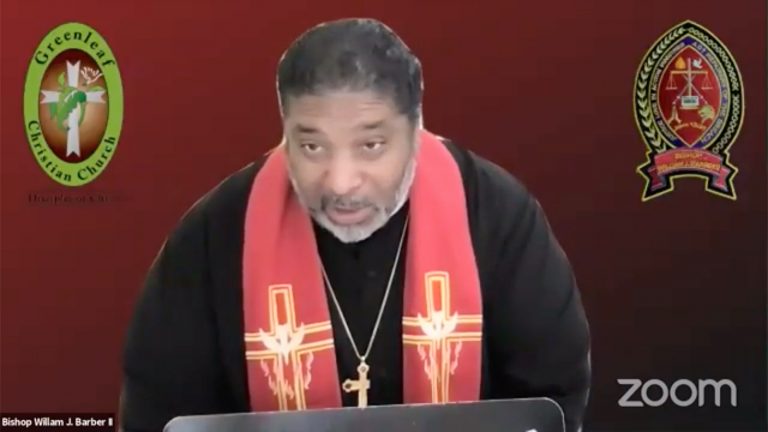
William Barber preaches at Easter vigil service spotlighting Christian Palestinians

The Rev. William Barber II speaks during a virtual Easter vigil service April 3, 2021, titled “Easter in Jerusalem: The Sabeel Community Celebrates Holy Saturday 2021,” led by a Christian activist group in Jerusalem. (photo: Video screengrab)
Barber’s appearance served to recognize Christians in the Palestinian liberation movement, which some American evangelicals paint as an apocalyptic conflict between Christians and Muslims.

By Daoud Kuttab | Religion News Service | Apr 6, 2021

“Jesus, a brown-skinned Palestinian Jew, called us to preach good news to the poor, the broken and the bruised and all those who are made to feel unaccepted,”
— Rev William Barber, co-chair of the Poor People’s Campaign

(RNS) — In a display of solidarity with the Palestinian cause, the Rev. William Barber II participated in a virtual Easter vigil service Saturday (April 3) led by a Christian activist group in Jerusalem.

Though never mentioning Israel, he called on his listeners in Israeli-occupied Palestinian territories, “Get up, my Palestinian brothers and sisters, my Christian and Muslim brothers, we have work to do in his name.”

The webinar, attended by more than 700 people, was broadcast by Friends of Sabeel North America and Sabeel Ecumenical Liberation Theology Center in Jerusalem, allied organizations that call attention to the plight of Palestinians.

Continue reading “William Barber preaches at Easter vigil service spotlighting Christian Palestinians”

Blinken tells Israel: Palestinians should enjoy same rights, freedoms as you do

US-DIPLOMACY-RIGHTS-BLINKEN
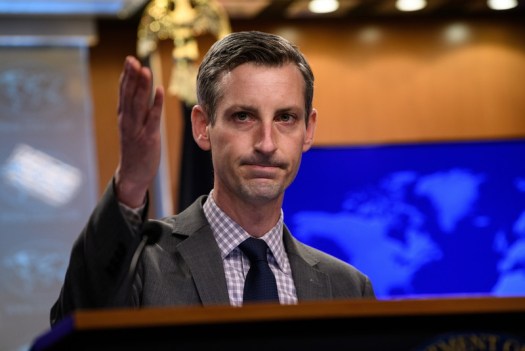
US Secretary of State Antony Blinken speaks during the release of the “2020 Country Reports on Human Rights Practices,” at the State Department in Washington, DC on March 30, 2021. (photo: Mandel Ngan / Pool / AFP)
US secretary of state to Foreign Minister Ashkenazi: ‘Israelis and Palestinians should enjoy equal measures of freedom, security, prosperity and democracy’

By AFP and TOI Staff | The Times of Israel |  Apr 3, 2021

“We believe when it comes to settlement activity that Israel should refrain from unilateral steps that exacerbate tensions and that undercut efforts to advance a negotiated two-state solution,”
— Ned Price, State Department spokesman 

US Secretary of State Antony Blinken called Friday on Israel to ensure “equal” treatment of the Palestinians as the new US administration cautiously steps up efforts for a two-state solution.

In a telephone call with Foreign Minister Gabi Ashkenazi, Blinken “emphasized the administration’s belief that Israelis and Palestinians should enjoy equal measures of freedom, security, prosperity and democracy,” State Department spokesman Ned Price said.

Continue reading “Blinken tells Israel: Palestinians should enjoy same rights, freedoms as you do”

State Department buries Israeli occupation in word salad

020421-ned-price
Spokesperson Ned Price attempted this week to clarify the State Department’s muddled language on the Israeli occupation. (photo: Reuters)
Biden continues to stay disturbingly close to Trump.

By Michael Brown |  The Electronic Intifada | Apr 2, 2021

Recognizing the reality of occupation, moreover, means recognizing that Israel has no sovereignty over these territories and that the Palestinians living in them enjoy essential international protections, including the Fourth Geneva Convention.

Last year, presidential candidate Joe Biden personally intervened to keep the word “occupation” out of the Democratic Party’s platform regarding Israel.

In doing so, he infuriated a portion of the party’s base – a group Biden and his advisers presumably figured would dislike President Donald Trump and his anti-Palestinian policies even more than they might have disliked Biden.

Now the Biden administration is trying to thread the needle on the Israeli occupation of Palestinian land and Syria’s Golan Heights with the State Department’s latest annual human rights report.

It is titled: “2020 Country Reports on Human Rights Practices: Israel, West Bank and Gaza.”

Continue reading “State Department buries Israeli occupation in word salad”

Why I signed the Jerusalem Declaration on Antisemitism

IHRA-1536x1066
(photo: Mark Kerrison / Alamy Live News
The damage done by the IHRA definition of antisemitism is profound.

By Barry Trachtenberg | Jewish Currents | Mar 26, 2021

Although I remain apprehensive about inadvertently reinforcing beliefs in Jewish exceptionalism, the widespread adoption and abuse of the flawed IHRA definition has convinced me that it needs outright replacement

In the fall of 2017, in my capacity as a scholar of Jewish history, I advised the US House Judiciary Committee to reject codifying into law definitions of antisemitism such as those that were contained in the “Anti-Semitism Awareness Act,” which was then under consideration by Congress. I objected to the language of the bill, which was based on the definition of antisemitism adopted by the International Holocaust Remembrance Alliance (IHRA)—a definition that equates valid criticism of Israel and Zionism with antisemitism and has thus become a tool for the suppression of protected speech. But I was also concerned with the possibility that the legislation would inadvertently reinforce perceptions of Jewish exceptionalism: By claiming that there was a need for a set of standards that was distinct from existing civil rights legislation and which defined what could and couldn’t be said about Jews, I argued, Congress not only risked putting unconstitutional limits on free speech, but also risked reinforcing the idea that Jews are a people for whom special rules need to be made. I testified that at the core of anti-Jewish hatred rests the belief that Jews are exceptionally unique in the world, and that by making legislation that was focused exclusively on antisemitism rather than religious, racial, and ethnic hatred more broadly, Congress would be singling out Jews in a way that would run contrary to the stated goals of the legislation.

Continue reading “Why I signed the Jerusalem Declaration on Antisemitism”

‘We will not be silenced, siloed, or stopped’: federal judge tosses lawsuit targeting Palestinian rights group

CoUoSpSWgAAYAmS-580x387
(photo: US Campaign for Palestinian Rights)
A federal judge has dismissed a Jewish National Fund lawsuit that targeted the US Campaign for Palestinian Rights for alleged terror connections over its support for BDS.

By Michael Arria | Mondoweiss] | Mar 30, 2021

Lawsuits like this one are frequently implemented by pro-Israel groups in an attempt to bog down Palestinian organizations and stifle support for movements like BDS.

A federal judge has dismissed a lawsuit that targeted a Palestinian rights organization for alleged terror connections.

In 2019 the Jewish National Fund (JNF), and 12 American citizens living in Israel, sued the US Campaign for Palestinian Rights (USCPR) for $90 million. The lawsuit alleged that USCPR had funneled money to Boycott National Committee (BNC), which was then used for terrorist activities. The USCPR was represented by attorneys at the Center for Constitutional Rights (CCR).

Continue reading “‘We will not be silenced, siloed, or stopped’: federal judge tosses lawsuit targeting Palestinian rights group”

The Jerusalem Declaration on Antisemitism

Screen Shot 2021-04-02 at 12.26.26 PM
Strasbourg Chief Rabbi Harold Abraham Weill views the vandalized tombs in the Jewish cemetery of Westhoffen, west of the city of Strasbourg, eastern France, in December 2019. (photo: Jean-Francois Badias / AP)
Why the oldest hatred needs a new definition.

By Brian Klug | The Nation | Apr 1, 2021

People of goodwill look to the IHRA definition for guidance concerning a key question: When should political speech about Israel or Zionism be protected—and when does it cross the line into anti-Semitism? What they need is clarity. What they get is a matzah pudding.

Confronted with the Jerusalem Declaration on Antisemitism (JDA), published on March 25, 2021, it is tempting—especially for Jews at this time of year—to ask: Why is this definition of anti-Semitism different from all other definitions?

Continue reading “The Jerusalem Declaration on Antisemitism”

How we speak about the failure of the PLO

oslo
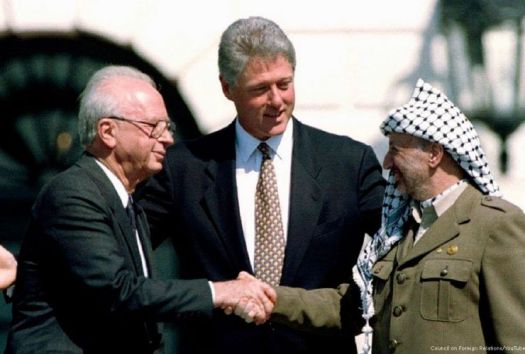
Yitzhak Rabin, Bill Clinton, and Yasser Arafat at the White House, signing the Oslo Accords. I(photo: Wikimedia)
A recent Foreign Affairs article gets history wrong and obscures a robust Palestinian discourse.

By Helena Cobban | Boston Review | Mar 31, 2021

One strong concern about the Oslo Accords was that they said nothing about what would happen if, after the five-year interim period prescribed therein, the two sides failed to arrive at a final peace agreement.

It is hard to believe that it has been fifty years since I used to sit on the floor of drafty college residences in Oxford with Hussein Agha, Ahmad Samih Khalidi, Ahmad’s cousin Rashid Khalidi, and other luminaries of the Oxford University Arab Society, listening to their discussions of the then-parlous state of the Palestinian freedom movement (and voicing an occasional interjection). During the previous year, Palestinian guerrillas earlier chased out of the West Bank by Israel had proceeded to challenge King Hussein’s rule in Jordan; and during “Black” September 1970, Hussein hit back at them hard. In Spring 1971 the guerrillas were still reeling from Black September and were struggling to regroup in the extensive Palestinian refugee camps in Lebanon. In Oxford we eagerly read any scrap of news we could get about their achievements there.

Continue reading “How we speak about the failure of the PLO”

St Marks Mideast Focus Ministry Film Series: ‘TIL KINGDOM COME

Screen Shot 2021-02-15 at 6.49.12 PMPlease join our brothers and sisters at St. Marks Episcopal Church (Seattle) Mideast Focus Ministry group for a series of films in spring 2021.  The next film:

‘Til Kingdom Come

TilKingdomCome-Film-Poster

In this provocative look at strange political bedfellows, Israeli filmmaker Maya Zinshtein (Forever Pure, DOC NYC 2016) investigates the political alliance between American evangelicals and Israel’s right wing, and their influence on the Trump administration’s foreign policy. Why do American church leaders encourage parishioners to make donations to Israel, even from poor communities? Because they believe Israel’s expansion will play a key role in end-times prophecy, when Christians will be saved and others—including Jews—will perish.

The discussion will include special guests: Rochelle Watson and Jonathan Brenneman, of Friends of Sabeel North America

Date: Friday, April 9, 2021
Time: To get a link to watch the film at your convenience, send a message to seattlemideastfocus@gmail.com

You will get the link around 4 p.m. on Wednesday, April 7 and have until 8 p.m. on Friday, April 9, to watch the film. Watch the film on your own and join the discussion on April 9 at 8 p.m. using this Zoom link.

Information: Additional information and list of all films here →
Tickets: Free, must register
Event Details

Summary:

  1. Send an email to seattlemideastfocus@gmail.com to get a link to the film
  2. Watch the film between Apr 7 –  April 9th at 8pm
  3. Join the discussion on 4/9 at 8:00pm via this Zoom link.

More information here →

On Land Day in Palestine: Our home is our land

A group of Palestinians hold Palestinian flags and shout slogans during a demonstration within the Palestine’s ‘Land Day’ commemorations on March 30, 2018 in Nablus, West Bank. (photo: Nedal Eshtayah / Anadolu Agency)
Palestinians mark Land Day on March 30th and it is personal.

By Yousef Aljamal | Politics Today | Mar 30, 2021

The relationship a peasant has with the land is like the relationship between a mother and her children. It is deep and interconnected in a way that a settler-colonial society can never understand.

When in 1948 Zionist militias invaded the village of Aqer, where my family is originally from, my great-grandfather was one of a few poorly equipped fighters who tried to stop the invading forces. The fighters took up posts at the village school, located nearly a kilometer from the village.

Soon after, and after some resistance, the invading militia took over the school, killing the fighters who remained inside, including my great-grandfather, who was found dead inside the building. My grandfather buried his father in the village graveyard only to become a refugee for the rest of his life in Gaza days later.

Continue reading “On Land Day in Palestine: Our home is our land”

Gaza enters second coronavirus wave, with 25% of tests coming back positive

.
A medical worker of UNRWA gives a shot of the Sputnik V Covid-19 vaccine at UNRWA’s clinic in the Rafah, in the southern Gaza, on March 3, 2021. (photo: Abed Rahim Khatib / Flash90)
For weeks, the coastal enclave enjoyed a lull, even as as a surge in infections shook the West Bank. But with thousands of new cases, a new wave is officially here

By Aaron Boxerman | The Times of Israel | Mar 29, 2021

“We’re in a new wave. The virus curve is rising by the day. We expect the rate of positive tests to also continue to rise,”
— Dr. Aed Yaghi, Gaza branch of the Palestinian Medical Relief Society

With cases spiking, the Gaza Strip has entered a second wave of the coronavirus pandemic, health officials in the coastal enclave told The Times of Israel on Monday.

Gaza saw 891 new coronavirus cases in 24 hours, the Gaza Health Ministry reported on Monday. The total number of active infections nearly tripled over the past two weeks, from 2,291 to 6,619.

The daily rate of positive tests in Gaza has skyrocketed to 25 percent over the past 24 hours, according to Hamas health officials. The high positivity rate indicates that the virus is likely spreading widely undetected.

Continue reading “Gaza enters second coronavirus wave, with 25% of tests coming back positive”