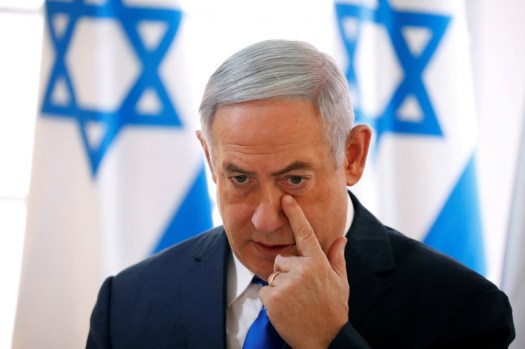
Israeli PM Benjamin Netanyahu has tried to shut down social media posts critical of Israel. (photo: Amir Cohen / Reuters)
There are concerns that Israel’s politicized approach to crushing online dissent could become normalized worldwide.
By Jonathan Cook | The Electronic Intifada | June 5, 2021
The revelations follow widespread reports last month that social media corporations regularly removed posts that referred to the Jerusalem neighborhood of Sheikh Jarrah…
Israel’s caretaker prime minister, Benjamin Netanyahu, sought to shut down all use of the popular video-sharing app TikTok in Israel last month.
The attempt to censor TikTok, details of which emerged last weekend, is one of a number of reported attempts by Israel to control social media content during last month’s military assault on the Gaza Strip.
Netanyahu tried to impose the blackout as Israel faced an international social media outcry over its 11-day attack on Gaza, which killed more than 250 Palestinians, and the violent repression by Israeli police of Palestinian protests in occupied East Jerusalem and inside Israel.
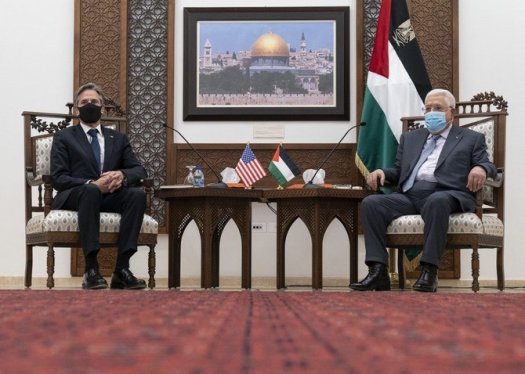
Secretary of State Antony Blinken speaks with Palestinian president Mahmud Abbas in Ramallah. (photo: File/AFP)
A call for recognition of Palestine by the global community must happen before other issues can be negotiated.
By Daoud Kuttab | Arab News | May 30, 2031
Issues such as settlements, Jerusalem, refugees and settlers need to be agreed, not whether the state of Palestine should even exist.
At a time when support for the two-state solution is almost at its lowest level, we are now repeatedly hearing this term. What makes such statements by Western leaders so hypocritical is that it is little more than lip service.
The term “two-state solution” applies to the final status of peace talks that must lead to the state of Palestine being recognized alongside the state of Israel. The world community has long recognized the state of Israel but has balked when it comes to Palestine. In 2012, the UN General Assembly officially voted to recognize Palestine as a non-member observer state. Since that vote, 140 countries have recognized the state of Palestine within the borders that obtained on June 4, 1967. However, among the leading Western countries, only Sweden has recognized Palestine, even though the parliaments of several European countries have passed resolutions calling on their own governments to do so. Many countries have said they will make such a move en masse and use recognition as part of a political deal.
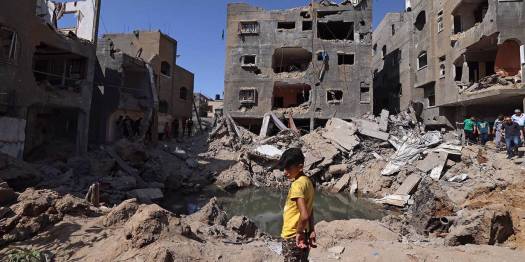
A Palestinian child stands amidst the rubble of buildings, destroyed by Israeli strikes, in Beit Hanun in the northern Gaza Strip on May 21, 2021. (photo: Emmanuel Dunand / AFP / Getty Images)
Human rights are human rights, and they are part of international law under the UN Charter. Whether the case is Xinjiang and the Uighurs, Myanmar and the Rohingya, or Israel and the Palestinian Arabs, the correct way to defend international law is through the United Nations, starting with an independent investigation under the auspices of the UN Human Rights Council.
By Jeffrey D. Sachs | Project Syndicate | May 25, 2021
The truth is that the US government’s uncritical support for Israel has come to depend more on evangelical Christians, such as former US Secretary of State Michael Pompeo, than on American Jews, who are deeply divided by Netanyahu’s actions.
NEW YORK – Israel’s attempt to justify its latest brutal assault on Gaza rings hollow to anybody familiar with events in Israel, where the government of Prime Minister Binyamin Netanyahu, backed by anti-Arab racists, has systematically, cruelly, and persistently violated the basic human rights of the Arab population. Human Rights Watch, a global NGO with many Jewish leaders, has recently condemned Israel for crimes against humanity.
Israel’s behavior puts US President Joe Biden’s administration, which professes a foreign policy based on human rights, under the spotlight. If that commitment is genuine, the administration should support an independent UN investigation of Israeli human rights violations against the Arab population and suspend military aid to Israel until the inquiry is completed and the human rights of the Palestinians are secured.
Dabke represents a form of solidarity and cultural resistance. (photo: via ActiveStills.org)
Palestinians have employed non-violence for decades.
By Benay Blend | Palestine Chronicle | May 24, 2021
“The problem with the non-violence bandwagon…is that it is grossly misrepresentative of the reality on the ground.” — Ramzy Baroud, author
In “The Violence Debate: Teaching the Oppressed how to Fight Oppression” (2010), Ramzy Baroud explains that for “progressive and Leftist media and audiences, stories praising non-violence” are preferred, for they invoke a strategy acceptable to liberals in the West. At no other time, perhaps, than the present has there been so much condemnation of the victims for their resistance.
“Whether in subtle or overt ways,” Baroud continues, “armed resistance in Palestine is always condemned.” It is analogous to informing Africans (Blacks) that if they would just do what the police are asking in a polite manner, then they won’t get shot.
“The problem with the non-violence bandwagon,” Baroud concludes, “is that it is grossly misrepresentative of the reality on the ground.” As he points out, Palestinians have employed non-violence for decades going back to the prolonged strike of 1936.
Palestine march DC. (photo: Nuha Maharoof / IG (Sri.Lankan)
Organized in less than one week, the event unfurled the potential for Muslim American and Palestinian activists to lead antiwar mobilizations.
By Nadia B. Ahmad and Faisal R. Khan | Mondoweiss | May 31, 2021
This unprecedented gathering on Saturday at the Lincoln Memorial was a clear sign to President Joe Biden, his administration, and to Israel that public opinion in the United States is shifting, and people of conscience demand a tangible solution for Palestinians who have endured decades of dehumanization, marginalization, and subjugation.
Standing atop the steps of the Lincoln Memorial, Nuha Maharoof peered over the crowd at the National March for Palestine on Saturday. To her left, she saw a man on the ledge set off red and green smoke grenades, signifying the colors of the Palestinian flag. She described the cinematic moment “like a scene from a movie, every head in the crowd turned to the sky to watch the colors dissipate.” She pulled out her phone and captured the iconic moment, saying her heart filled with hope for Palestine. The image has since gone viral. She had learned of the protest the day before from social media posts and decided to go with her friends. We tracked her down through a Google image search.
A Palestinian man waves a the Palestinian flag at the Al-Aqsa Compound in Jerusalem on 13 May 2021 . (ohoto: Mostafa Alkharouf / Anadolu Agency)
It is a moment that demands fresh analyses and new forms of solidarity organized not simply around Palestinian suffering, but also around resistance.
By Rana Baker | ROAR Magazine | May 29, 2021
In Palestinian mosques, Muslims do not remember God only. They remember colonial injustice, renew their commitment to fighting the powers which inflict it, and behoove God to strengthen the resolve of those who risk their lives fighting it.
The Islamic month of Ramadan is not itself the time of revolution. Yet, Ramadan holds within itself disruptions and intensifications that are always immanent — always capable of turning into an insurrection if summoned into action. These disruptions and intensifications are constitutive of the month and it is from them that the uprising that engulfed Palestine for two weeks in May drew its first spark. Ramadan’s disruptive temporality did not condition the uprising, but it did provide the immediate historical accident which ignited it and entangled all of Palestine.
Accidents, however, are materially conditioned. They are circumscribed by spatial arrangements and specific material practices which themselves are not accidents. Accidents are only accidents to the extent that their occurrence is neither pre-determined nor possible to predict. One can predict that the colonized will rise up against their colonizers, but the specific “accident” which sets an uprising in motion is not historically pre-determined.
A fire at Tent of Nations (TON) is a setback, but Nassar family still focuses on pursuing its mission of building understanding and hope for a better future.
May 25, 2021 Update from Daoud Nassar:
On Friday, May 20, the Tent of Nations farm was struck by a horrendous fire fed by strong winds. Our family, along with the support of many young people from the village, our neighbors and the fire department, were able to control the fire after some hours. Thank God, no one from the family was hurt, but the damage is huge and painful to see. The fire completely destroyed over one thousand new and mature olive, grape, almond, fig and pine trees. Another 700 trees were affected by the heat and the smoke and caused some damage; we are trying to rescue these trees by watering them on a daily basis, using our limited rain-water sources stored in the cisterns you all helped us to build; we are grateful for that. To this moment, we do not know the cause of the fire or who was behind it.
We know that you will want to know what is being planned to restore the loss of so many trees, what is the plan and the timing, and what you can do to help. Tree planting cannot begin until the fall, but there is much to be done to prepare the soil and repair the damage, and we will keep you informed and let you know about the ways you can help. This loss will not deter us and the Tent of Nations from pursuing its mission of building understanding and hope for a better future for our grandchildren.
With gratitude – Daoud
NOTE: Please continue to pray for the Tent of Nations. After June 1, groups and individuals will be allowed to enter the country. Volunteers will be needed to help prepare the land for planting new trees and repairing the damages to the farm (please see the Tent of Nations website in order to sign up for volunteer work or to schedule a visit).
There will be financial support needed in order to restore the land and infrastructure. Contributions (checks made out to FOTONNA) can be sent to the new FOTONNA Finance Director at: Beth Moore – FOTONNA Finance Director – 3436 East Avenue, South – La Crosse, WI 54601. A PayPal option will be made available soon; check the FOTONNA website for more information. You can also access a new Contribution Form on the Website at this time.
Please note that Tent of Nations (TON) is not an NGO. They are a small family-owned farm that welcomes individuals and groups to visit, volunteer, and hear their story. They are not affiliated with any other organization, and are privately funded through Friends of Tent of Nations.
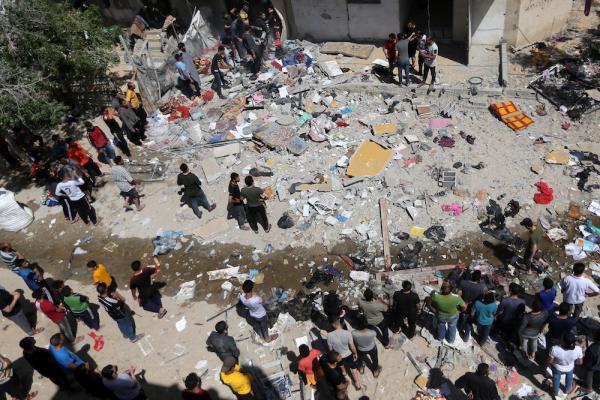
Palestinians gather at the scene where a house was hit by an Israeli air strike in the southern Gaza Strip on May 12, 2021. (photo: Reuters / Ibraheem Abu Mustafa)
It is time to change the theological narrative that renders the state of Israel invincible to errors and beyond any judgment.
By Munther Isaac | Sojourners | May 19, 2021
Calling things by their names is a necessary step toward resolving any conflict. Using the words racism and apartheid may cause pause — but these are the descriptors that define our daily lives.
“Pray for the peace of Jerusalem!”
Palestine and Israel are back in the news. So again, we Palestinians hear this common refrain. But such calls for prayer are no longer enough. I say this as a Palestinian pastor who believes in prayer, leads prayer services for peace, and genuinely values your good intentions.
But good intentions are not enough.
In his Sermon on the Mount, Jesus didn’t say, “Blessed are the peace prayers.” He said, “Blessed are the peacemakers.” (Matthew 5:9, emphasis added).
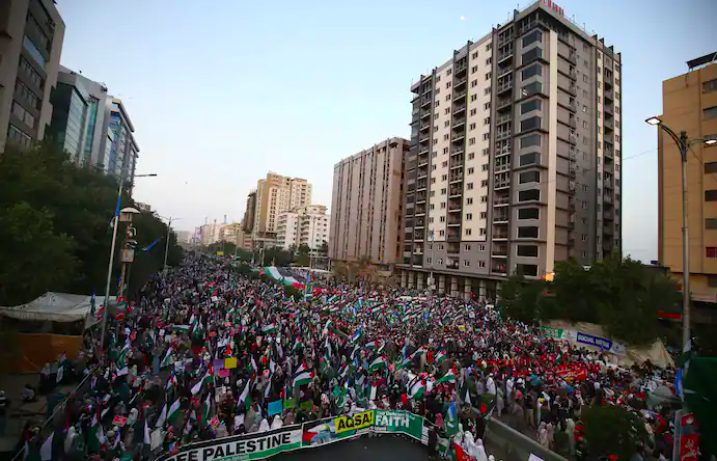
Pro-Palestinian demonstrators rally Sunday in Karachi, Pakistan. (photo: Shahzaib Akber / EPA-EFE / REX / Shutterstock)
Palestinian activists are fighting back against a history of takedowns with one-star reviews and ancient Arabic.
By Elizabeth Dwoskin and Gerrit De Vynck | The Washington Post | May 28, 2021
“Ultimately, what we’re seeing here is existing offline repression and inequality being replicated online, and Palestinians are left out of the policy conversation,” — Jillian York, a director at the Electronic Frontier Foundation
Just days after violent conflict erupted in Israel and the Palestinian territories, both Facebook and Twitter copped to major faux pas: The companies had wrongly blocked or restricted millions of mostly pro-Palestinian posts and accounts related to the crisis.
Activists around the world charged the companies with failing a critical test: whether their services would enable the world to watch an important global event unfold unfettered through the eyes of those affected.
The companies blamed the errors on glitches in artificial intelligence software.
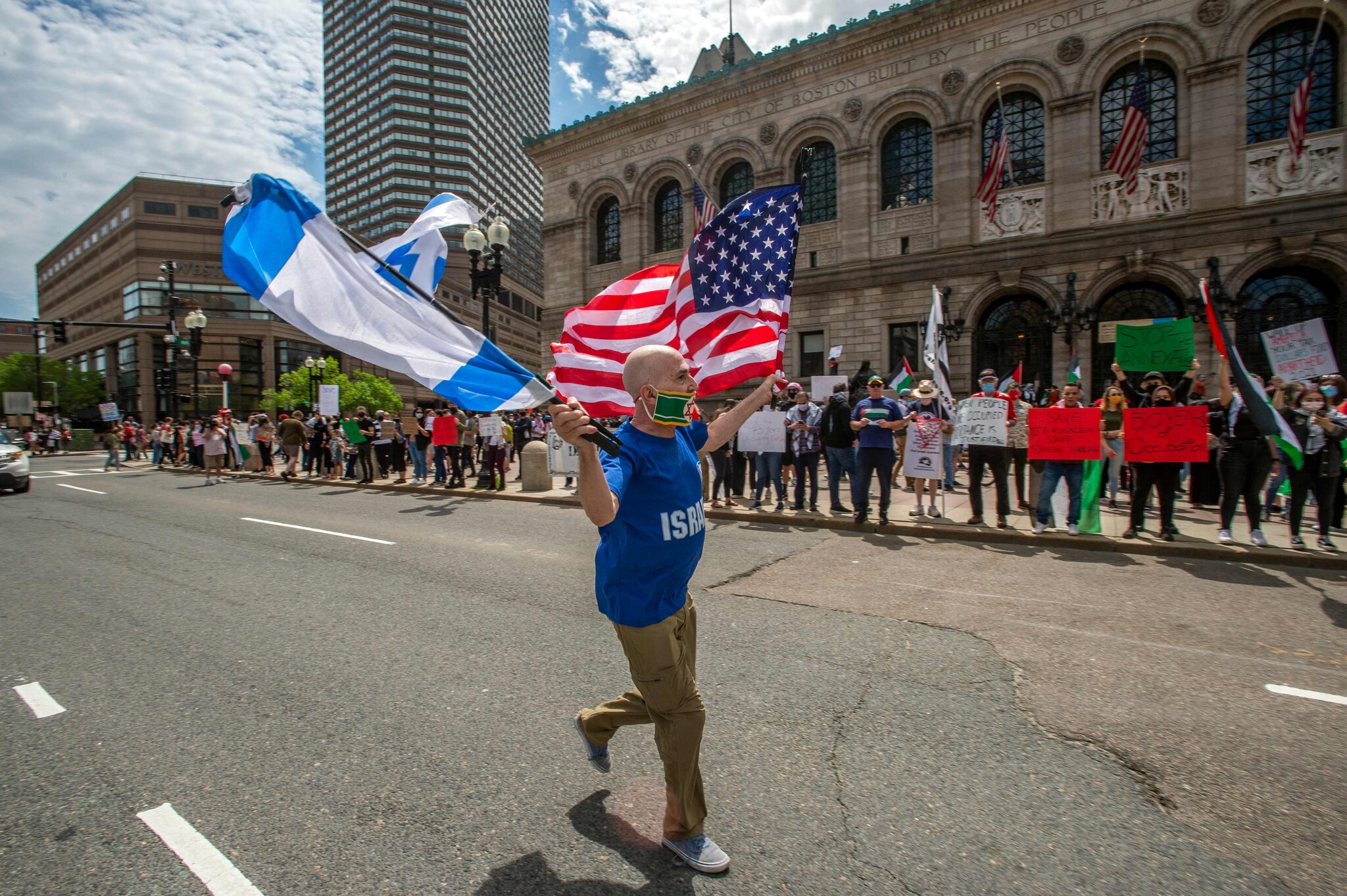
A man waving the flags of Israel and the United States in front of a rally in support of Palestine last week in Copley Square in Boston. (photo: Joseph Prezioso / Agence France-Presse — Getty Images)
Israel has quietly sought, and perhaps achieved, a large measure of autonomy from its half-century of reliance on the United States.
By Max Fisher | The New York Times | May 24, 2021
Once reliant on American arms transfers, Israel now produces many of its most essential weapons domestically.
Israel, a small country surrounded by adversaries and locked in conflict with the Palestinians, depends absolutely on American diplomatic and military support. By giving it, the United States safeguards Israel and wields significant leverage over its actions.
That’s the conventional wisdom, anyway. For decades, it was true: Israeli leaders and voters alike treated Washington as essential to their country’s survival.
But that dependence may be ending. While Israel still benefits greatly from American assistance, security experts and political analysts say that the country has quietly cultivated, and may have achieved, effective autonomy from the United States.



 HolyLandJustice.org
You must be logged in to post a comment.