A Palestinian farmer fills water tanks in the West Bank village of Khirbet al-Makhoul, Jordan Valley, October 9, 2013. (credit: Activestills.org)
For the past 15 years, I have witnessed how the Israeli army cuts Palestinian communities from accessing water in order to expel them and take their land.
By Daphne Banai | +972 Magazine | Sept 24, 2021
Denying water to the Palestinians in the South Hebron Hills is one of many brutal methods for expelling the local population in order to take its land and hand it over to Jewish settlers.
Abu Hani and his family live only two kilometers from the Israeli settlement outpost of Avigayil in the occupied South Hebron Hills. But unlike Avigayil’s residents, who are connected to Israel’s national water grid, Abu Hani and his children are barred from doing so. Not only do they not receive a drop from Mekorot, Israel’s national water company, the Israeli authorities also prohibit them from maintaining cisterns for storing rainwater, as they had been doing until Israel took over the area.
The broken window of a synagogue in Cottbus, Germany, that was vandalized in November, 2015. (credit: Patrick Pleul / dpa via AP)
As American Jewry’s Zionist consensus crumbles, we must learn to address one another across communal divides.
By Peter Beinart | Jewish Currents | Sept 20, 2021
American Jews of all ideological stripes need shared spaces, based on mutual respect, which encourage the kinds of conversations that aren’t possible on Twitter.
This spring and summer, as violence engulfed Israel-Palestine and antisemitic attacks in the US made media headlines, some hawkish Jewish commentators began using an arresting phrase to describe Jews who oppose the Jewish state. In a tweet in May, UCLA professor Judea Pearl proposed that just as Jewish leaders in the 17th century excommunicated the followers of the false messiah, Shabtai Tzvi, it was now time “to proclaim Jewish-born Zionophobes: ‘Ex-Jews.’” That same month, in an article in the Orthodox publication Cross-Currents, Yitzchok Adlerstein, director of Interfaith Affairs for the Simon Wiesenthal Center, scrolled through his own roster of historic turncoats—“the Pablo Christianis and Johannes Pfefferkorns who reinvented themselves as Christians to find fame and money”—before declaring that Bernie Sanders, who “devotes his energies to undermining the largest Jewish community in the world,” is an “ex-Jew.” In June in Tablet, historian Gil Troy and former Soviet dissident and Israeli cabinet minister Natan Sharansky improvised on the theme: They labeled Jewish anti-Zionists “Un-Jews.”
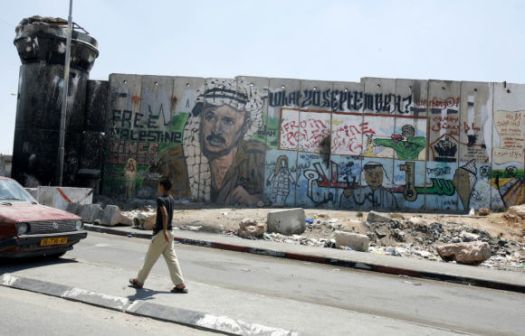
A Palestinian boy walks past a mural of late Palestinian leader Yasser Arafat on a section of Israel’s separation barrier at Oalandia checkpoint, between Jerusalem and Ramallah on July 6, 2012. (credit: Mahfouz Abu Turk / APA Images)
To say the current Palestinian political crisis is simply a Hamas-Fatah split is to ignore a history of division that cannot be solely blamed on Palestinians.
By Ramzy Baroud | Mondoweiss | Sept 29, 2021
Even Palestinian division has rarely been a Palestinian decision, although the Palestinian leadership deserves much blame for failing to develop a pluralistic political system that is not dependent in its survival on a single group or individual.
The political division in Palestinian society is deep-rooted, and must not be conveniently reduced to the Hamas-Fatah split, or disagreements around elections—and the lack thereof—and the Oslo Accords. The divisions are linked to events that preceded all of this and are tied to the issue of who is the representative of the Palestinian people. Today’s disunity is the outcome of one political party’s decades-long sortie becoming dominant.
This dates back to Palestinian politics prior to the establishment of Israel in 1948 on the ruins of historic Palestine, when various Palestinian clans fought for control over the entire Palestinian body politic. Disagreements led to conflict, often violent, though, at times, it also resulted in relative harmony, for example, the establishment of the Arab Higher Committee (AHC) in 1936. Continue reading “Why Palestinians are divided”
An aerial view of the University of North Carolina campus in Chapel Hill, N.C., on April 21, 2013. (Photo credit: Lance King / Getty Images)
An Israeli consul general baselessly accused a graduate student of antisemitism and said she shouldn’t teach a course on the Israeli-Palestinian conflict.
By Murtaza Hussain | The Intercept| Sept 28,2021
“It is not a new phenomenon where outside parties have tried to stifle academic freedom on this subject…But these people have never seen me teach, never seen my past evaluations which have said that I treat students fairly, and thus have no right to dictate what I say inside the classroom.” — Kylie Broderick, UNC Ph.D. student
This August, Israeli consular officials in the southeast U.S. arranged meetings with a dean at the University of North Carolina at Chapel Hill to discuss a graduate student teaching a course on the Israeli-Palestinian conflict. According to two UNC professors with knowledge of the meetings, who asked for anonymity for fear of retribution, the Israeli official accused the Ph.D. student of antisemitism and said she was unfit to teach the course.
The intervention by an Israeli government official, Consul General to the Southeastern United States Anat Sultan-Dadon, followed a pressure campaign by right-wing pro-Israel websites and an advocacy group to remove the graduate student, Kylie Broderick, from teaching the history department course called “The Conflict over Israel/Palestine.” The websites and pro-Israel advocacy group pointed to postings Broderick had made on Twitter that criticized Israel and Zionism and, without evidence, cited the postings as evidence of antisemitism.
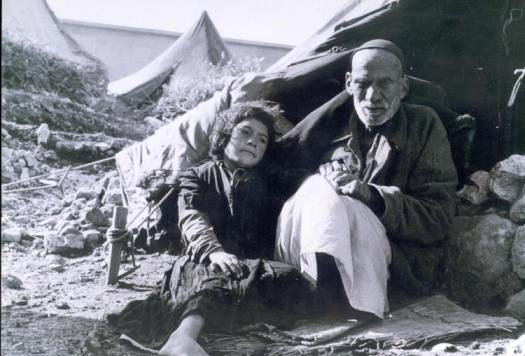
Sudden refugees forever, Palestine Nakba 1948. (credit: Hanini, CC BY 3.0, Wikimedia Commons)
As long as Britain and other states continue to superficially endorse a two-state solution, Israel will become entrenched as a full-blown apartheid state with international blessing.
By Ilan Pappé | Consortium News | Sept 27, 2021
There is a pattern to British policy that can be identified today as it could in 1948: staff on the ground watch and report the destruction of Palestinian life and the apartheid aspects of Israel while U.K. policy-makers remain loyal to the description of Israel as the only democracy in the Middle East
Britain today is a secondary actor in the international arena and its ability to influence the so-called peace process in Israel and Palestine is limited. It cannot be considered a significant contributor to efforts to find a solution to Israel’s continued colonization and occupation of Palestine.
Yet Britain bears massive historical responsibility for the situation of the Palestinian people and shares the overall Western blame for the present reality in the occupied territories.
In 1917, after the so-called Balfour Declaration, Britain enabled the settler colonial movement of Zionism to begin a project of state building in Palestine. During its subsequent rule as a ‘mandatory’ power, the U.K. provided assistance to the small community of Jewish settlers to build the infrastructure of their future state, while being aware that the indigenous people of Palestine, who were 90 percent of the population in 1917, rejected this prospect.
A missile from the Israeli Iron Dome, launched during the Operation Pillar of Defense to intercept a missile coming from the Gaza strip. (credit: Israel Defense Forces and Nehemiya Gershuni-Aylho נחמיה גרשוני-איילהו, licensed under Creative Commons)
A writer from Gaza reflects on Israel’s “defensive weapon,” Iron Dome.
By Muhammad Shehada | Newsweek | Sept 24, 2021
… the progressive push to defund the Iron Dome was quite simply a recognition of our pain.
Progressive House Democrats sparked a charged debate after they got their party to remove $1 billion of additional funding to Israel to replenish its Iron Dome from a congressional bill earlier this week. The Iron Dome is a defense missile technology that shoots down rockets, which Israel uses to defend itself from attack.
Some praised the progressives for an act of resistance to the near unquestioned support Israel receives from Congress. Others criticized the push to remove funding for the Iron Dome as wrong, given that it is meant to save Israeli lives. Still others pointed out that Israel, with a GDP of nearly $400 billion, doesn’t need and shouldn’t be receiving such generous amounts of U.S. aid that other countries need more desperately—an argument made last year by Yossi Beilin, former Israeli Minister of Justice, and Daniel Kurtzer, former Ambassador to Israel under President Bush.
Israeli border guards block a street to Palestinians in the city of Hebron in the Israeli-occupied West Bank, 18 June 2021. (credit: Mosab Shawer / AFP / Getty Images)
The UN played a crucial role in defeating South African apartheid – it is time to investigate Israel’s unequal regime.
By Hanan Ashrawi & Lakhdar Brahimi | The Guardian | Sept 25, 2021
The Palestinian people – whether under occupation in Gaza and the West Bank, including Jerusalem, inside Israel or living as refugees and forced exiles – has waited for decades for the UN to implement the tens of resolutions it has adopted in support of Palestinian rights.
This week, world leaders have gathered in New York for the 76th session of the United Nations general assembly, struggling to prove its continued relevance in a bruised world. The major themes so far have been the climate crisis, vaccinating the world against Covid-19 and the new regime in Afghanistan – and rightly so. But there is another issue that also demands our attention, where progress could restore faith in the general assembly’s ability to act: the deepening regime of Israeli Jewish supremacy over millions of Palestinians, which has been recognised by more and more observers as a regime of apartheid. We join many global leaders in calling for the general assembly to investigate this regime, and consequently take the necessary measures of accountability to dismantle it.
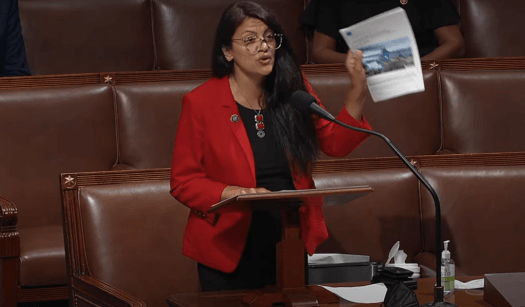
Rashida Tlaib calls Israel an apartheid state during deliberations on spending $1 billion for Israeli Military Program, Iron Dome, Sept 23, 2021. (credit: screenshot)
Eight Democrats and one Republican voted against spending $1 billion on Israel’s Iron Dome missile system.
By Michael Arria and Philip Weiss | Mondoweiss | Sept 23, 2021
“We cannot only be talking about Israelis’ need for safety at a time when Palestinians are living under a violent apartheid system and our dying from what Human Rights Watch have said are war crimes,” — US Rep. Rashida Tlaib
This week House progressives were able to temporarily hold up an additional $1 billion to Israel that had been tacked onto the short-term government spending bill to replenish the country’s Iron Dome system.
The victory ended up being short-lived, as Iron Dome spending was split into a separate vote by pro-Israel Dems and passed easily in the House. The final vote was 420-9 with 2 present.
The funding’s removal had sparked widespread congressional backlash on both sides of the aisle. The vote seemed to catch progressive House members in disarray, as some of lawmakers associated with the funding’s initial removal ended up voting for the legislation.
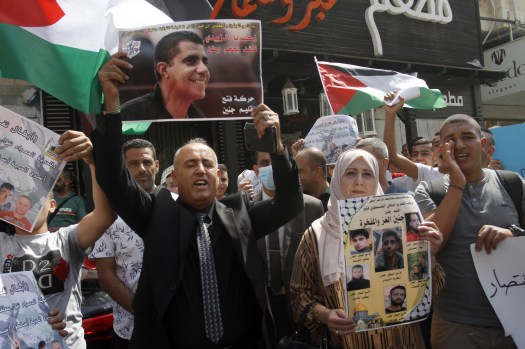
JENIN, WEST BANK, PALESTINE – 2021/09/14: Palestinians seen holding portraits showing prisoners, Zakaria al-Zubaidi and the four prisoners who escaped from Jalameh prison during the demonstration in solidarity with Palestinian prisoners held in Israeli prisons, outside the offices of the International Committee of the Red Cross in the city of Jenbin. (credit: Photo by Nasser Ishtayeh / SOPA Images / LightRocket via Getty Images)
The dramatic escape of six Palestinian prisoners from a high-security prison in Israel earlier this month has cast a bright light on the long-neglected and intensely polarizing issue of Palestinian political prisoners, their status in Palestinian society, and their treatment at the hands of Israel. What are the conditions of Palestinians being held in Israeli jails? Why does the issue generate such intense emotion among both Palestinians and Israelis as well as in Washington?
Jawad Boulus
Jawad Boulus is a renowned Palestinian human rights lawyer, political commentator, and author. Boulus was born into a Christian family in the small Arab Galilee village of Kafr Yaseef in 1956, and graduated from the Hebrew University of Jerusalem in 1980. As a Palestinian with Israeli citizenship, Boulus has been deeply involved in the Israeli-Palestinian conflict and the fight for Palestinian human rights for over 40 years. He currently publishes a notable weekly opinion column in Arabic which is circulated in numerous local and international printed newspapers and online magazines. He is the Director of the Legal Unit of the Palestinian Prisoners’ Club in Ramallah. He serves as Co-Chair on the Board of Directors to ‘Hand in Hand,’ a network of integrated bilingual schools for Jewish and Arab children in Israel. Boulus also serves as Secretary to the Mahmoud Darwish Association for Innovation. His own law firm is based in Jerusalem, where he resides with his wife Jumana.
Sahar Francis
Sahar Francis is the General Director of Addameer Prisoner Support and Human Rights Association, a Ramallah-based Palestinian NGO that provides legal and advocacy support to Palestinian political prisoners in Israeli and Palestinian prisons. An attorney by training, she joined Addameer in 1998, first as a human rights lawyer, then as head of the Legal Unit. With over sixteen years of human rights experience including legal counseling and representation, Francis is a leader of prisoners rights advocacy. She has also represented Addameer at the UN Human Rights Council, sits on the Board of Defense for Children International-Palestine Section, and was recently appointed to be on the technical committee for the Palestinian National Committee for the follow-up of the International Criminal Court (ICC). Francis earned her law degree from the University of Haifa in 1994, entered the Israeli Bar Association in February 1996, and earned her master’s degree in International Studies from Birzeit University in 2006.
Lara Friedman
Lara Friedman is the president of the Foundation for Middle East Peace. With more than 25 years working in the Middle East foreign policy arena, Lara is a leading authority on U.S. foreign policy in the Middle East, with particular expertise on the Israeli-Arab conflict, Israeli settlements, Jerusalem, and the role of the U.S. Congress. Prior to joining FMEP, Lara was the Director of Policy and Government Relations at Americans for Peace Now, and before that she was a U.S. Foreign Service Officer, serving in Jerusalem, Washington, Tunis and Beirut. She tweets @LaraFriedmanDC
Khaled Elgindy, moderator
Khaled Elgindy is senior fellow and director of the Program on Palestine and Israeli-Palestinian Affairs at the Middle East Institute. He is the author of Blind Spot: America and the Palestinians, from Balfour to Trump, published by Brookings Institution Press in April 2019. Elgindy previously served as a fellow in the Foreign Policy program at the Brookings Institution from 2010 through 2018. Prior to arriving at Brookings, he served as an adviser to the Palestinian leadership in Ramallah on permanent status negotiations with Israel from 2004 to 2009, and was a key participant in the Annapolis negotiations of 2007-08. Elgindy is also an adjunct instructor in Arab Studies at Georgetown University. He tweets @elgindy_
The raised hand of a demonstrator at a protest in Sheikh Jarrah, East Jerusalem, on July 30th, 2021. (credit: Eddie Gerald / Alamy Stock Photo)
In Israel, incitement has become an increasingly common charge since 2016.
By Sophia Goodfriend | Jewish Currents | Sept 15, 2021
Israeli police have wielded the law against users who retweet or like posts that security forces define as incendiary…
ON JUNE 11th, Mohammad Kana’neh joined a few hundred protesters at a weekly demonstration against settlement expansion in Sheikh Jarrah, a neighborhood in East Jerusalem that has become a flashpoint for protests against Palestinian displacement. Kana’neh, a Palestinian citizen of Israel and prominent leader of the secular Arab nationalist Abnaa el-Balad movement, stood under the hot sun and addressed the crowd in Hebrew, calling for an end to Israel’s occupation “from Silwan to Sheikh Jarrah, from Acco to Gaza.” He then turned to the line of border police that faced the crowd, shouting at them to “get out of the army.” Shortly after the protest dispersed, Kana’neh shared a video of his speech that another attendee had uploaded to Facebook; within hours, his post had been reshared by hundreds of users.







 HolyLandJustice.org
You must be logged in to post a comment.