Father Fadi Diab, rector of St. Andrew’s Parish in Ramallah, Palestine
On Friday, October 25th, the Bishops Committee for Justice & Peace in the Holy Land hosted a Zoom call with Father Fadi for a workshop at the Annual Convention for the Episcopal Diocese of Olympia in Tacoma, WA. The following video is a recording of that Zoom call.
Bishop’s Committee for Justice and Peace in the Holy Land Urges Awareness of Threats to Christian Minority in Israel/Palestine
By Stacy Andersen, BCJPHL, July 24, 2024
Last month, the 81st General Convention of The Episcopal Church passed Resolution D075 calling for the Immediate Release of Ms. Layan Nasir, 24, from Administrative Detention in Israel. The Episcopal Office of Government Relations was asked to advocate to the US government to pressure Israel to end the practice of administrative detention. Episcopalians are asked to pray daily for Layan and to advocate for the immediate release of Layan and all other Palestinians held under administrative detention, an unjust practice embedded in the apartheid system that Israel imposes on the occupied West Bank. On July 19, the International Court of Justice ruled that the Israeli occupation of Palestine is illegal.
Many will remember Fr. Fadi Diab from his parish visits in the Diocese of Olympia one year ago. Layan Nasir is a member of Fr. Diab’s congregation at St. Peter’s Anglican Church in Birzeit, a small community near Ramallah in the occupied West Bank. In the early morning hours of April 7, a military patrol appeared at the family home, and while holding her parents at gunpoint, arrested, blindfolded, handcuffed, and arrested Layan without warrant or charge. At a July 11 hearing, a military judge denied her release from Israel’s notorious Damon prison, where severe deprivation and threatening conditions are reported. No evidence or explanation for Layan’s imprisonment has ever been given, and she has been denied contact with her family or her priest. Both Archbishop of Canterbury Welby and our own Presiding Bishop Curry have called for her release.
Administrative detention is a quasi-legal practice of military law that enables Israel to hold a Palestinian suspect indefinitely without formal charge or trial. Military law has been applied to Palestinian residents since 1967, when the West Bank was occupied by Israel. According to Israel’s B’tselem and other human rights NGOs, this two-tiered justice system discriminates against all Palestinians, both adult and children, while Israeli settlers living in the West Bank are entitled to trial by jury in civilian courts.
Administrative detention allows Palestinian children as young as 12 years to be removed from their homes (typically during night-time hours), taken to prison in Israel, and detained indefinitely without due process. Reliable reports indicate that more than 500 children are arrested each year. While some prisoners are able to obtain legal representation, many are not. When a trial does occur, a 95% conviction rate is the rule. Currently, nearly 4000 Palestinians are reported imprisoned under administrative detention. Layan is the only Christian woman now being held.
Layan’s detention is only one example of the continuing harassment of Christian laity and clergy in the West Bank and Gaza that threatens the future existence of Christians and the Christian church in the Occupied Palestinian Territories. As the occupying power, the State of Israel is obliged by International Law to protect those at risk.
Along with many other Palestinian Christian leaders, Fr. Diab is urging that we, as fellow Episcopalians, pray and advocate for the release or Layan Nasir and actively press the U.S. government to facilitate the end of the injustice and human rights violations of the illegal Israeli Occupation.
By CNN’s International Investigations and Visuals teams | Updated May 11, 2024
We were told they were not allowed to move. They should sit upright. They’re not allowed to talk. Not allowed to peek under their blindfold. — An Israeli whistleblower recounting his experience at Sde Teiman
Sde Teiman, IsraelCNN —
At a military base that now doubles as a detention center in Israel’s Negev desert, an Israeli working at the facility snapped two photographs of a scene that he says continues to haunt him.
Rows of men in gray tracksuits are seen sitting on paper-thin mattresses, ringfenced by barbed wire. All appear blindfolded, their heads hanging heavy under the glare of floodlights.
A putrid stench filled the air and the room hummed with the men’s murmurs, the Israeli who was at the facility told CNN. Forbidden from speaking to each other, the detainees mumbled to themselves.
“We were told they were not allowed to move. They should sit upright. They’re not allowed to talk. Not allowed to peek under their blindfold.”
Guards were instructed “to scream uskot” – shut up in Arabic – and told to “pick people out that were problematic and punish them,” the source added.
CNN spoke to three Israeli whistleblowers who worked at the Sde Teiman desert camp, which holds Palestinians detained during Israel’s invasion of Gaza. All spoke out at risk of legal repercussions and reprisals from groups supportive of Israel’s hardline policies in Gaza.
They paint a picture of a facility where doctors sometimes amputated prisoners’ limbs due to injuries sustained from constant handcuffing; of medical procedures sometimes performed by underqualified medics earning it a reputation for being “a paradise for interns”; and where the air is filled with the smell of neglected wounds left to rot.
By Thomas L. Friedman, New York Times, April 11, 2024
Israel today is at a strategic point in its war in Gaza, and there is every indication that Prime Minister Benjamin Netanyahu is going to choose the wrong path — and take the Biden administration along for a very dangerous and troubling ride. It is so dangerous and troubling that Israel’s best option, when all is said and done, might be to leave a rump Hamas leadership in power in Gaza. Yes, you read that right.
To understand why, let’s look back a bit. I argued in October that Israel was making a terrible mistake by rushing headlong into invading Gaza, the way America did in Afghanistan after 9/11. I thought Israel should have focused first on getting back its hostages, delegitimizing Hamas for its murderous and rapacious Oct. 7 rampage, and going after Hamas’s leadership in a targeted way — more Munich, less Dresden. That is, a military response akin to how Israel tracked down the killers of its athletes at the 1972 Munich Olympics, and not how the U.S. turned Dresden into a pile of rubble in World War II.
But I understood that many Israelis felt they had a moral and strategic right and necessity to go into Gaza and remove Hamas “once and for all.” In which case, I argued, Israel would need three things — time, legitimacy, and military and other resources from the U.S. The reason: The ambitious goal of wiping out Hamas could not be completed quickly (if at all); the military operation would end up killing innocent civilians, given how Hamas had tunneled under them; and it would leave a security and government vacuum in Gaza that would have to be filled by the non-Hamas Palestinian Authority in the West Bank, which would have to be upgraded and transformed to take on that task.
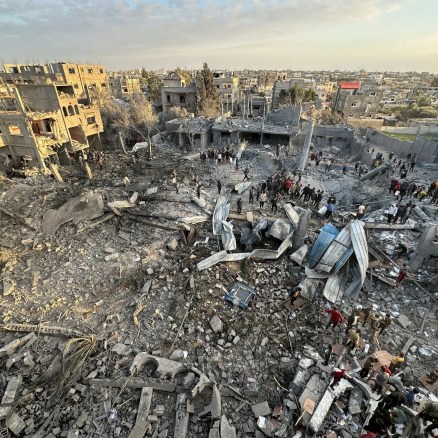
Strikes by the Israeli Defense Forces, like the one that destroyed this Rafah mosque, have contributed to a death toll of more than 26,000 people, according to Gaza’s Hamas-run government. Photo: Reuters Staff
By Sean Frankling, Published in Anglican Journal, March 1, 2024
Dr. Suhaila Tarazi is the director of North Gaza’s Al-Ahli Arab Hospital, which is owned and operated by the Episcopal Diocese of Jerusalem and is a partner of the Primate’s World Relief and Development Fund (PWRDF), the Anglican Church of Canada and the Canadian Companions of Jerusalem. Since the war between Israel and Hamas began Oct. 7, the hospital has continued to serve the people of North Gaza, and at times has been the only hospital still functioning there. It has carried on amid tragedy and disruption; an October explosion in the hospital’s courtyard killed and injured about 500 people who had taken shelter there, and in December, the hospital was raided by the Israel Defense Forces (IDF), who detained most of the hospital’s staff for questioning.
On Jan. 17, with the conflict dragging on, supplies running low and injured Palestinians continuing to pour in, the Anglican Journal spoke with Tarazi about life at Al-Ahli Arab Hospital during the war and its outlook for the future.
This interview has been edited for length and clarity.
Dr. Suhaila Tarazi, director of the Al-Ahli Arab Hospital, spoke to the Journal from Gaza. Photo: Contributed by PWRDF
How are things at the hospital right now? What’s the current situation?
In Gaza, it is a catastrophic situation in general and also at all hospitals since Oct. 7. The bombardment is unbearable. Up till now we have more than 30,000 killed people. Seventy per cent of them are children and women. Plus the total of injured is about 61,000 up until today. [Editor’s note: As this article was being posted online, Gaza’s health agency estimated almost 30,000 people had been killed in the fighting and almost 70,000 had been injured.] And the other problem is displaced people; nearly 80 per cent or 85 per cent of the population now are displaced. They are forced to move from Northern Gaza into the south and they are practicing a very difficult, inhuman life there.
And people, even nowadays, are going through another war: not only the bombardment from air and sea and land—also now they are facing acute food insecurity and a risk of famine is coming very soon. And this situation reflects directly to the work of Ahli Arab Hospital.
Ahli Arab Hospital is a Christian hospital; our aim [is] just to serve, to serve all people without any discrimination. And this is the mission of our Christianity. Unfortunately the hospital passed through two catastrophic situations, the first one on the 17th of October, where because of a bombardment directly into the hospital, 500 children and women were either injured or dead. And that was for us really a very major event
Would that have been the explosion in the courtyard?
Yes, exactly. And when you are among those children and trying to relieve their anxiety and fear and then after two hours somebody phones you and says they are all dead, it’s really something breaking all hearts. Breaking all hearts.
Our Palestinian siblings are urging us to stand with them in Palestine, in front of our own government, and in our communities across the U.S. We are responding boldly, with courage and in faith.
Our “Stones Cry Out” Delegation will gather in Bethlehem, Palestine (February 27–March 3), Washington, D.C. (March 5–6). We are also encouraging congregations, organizations, and communities across the U.S. to plan actions and demonstrations on March 6, in solidarity with our action in D.C.
Friends, we realize the time is short. But we must answer our Palestinian siblings’ urgent plea. Please share this invitation widely with your network.
Delegation Co-Sponsors: Kairos USA, Indiana Center for Middle East Peace, Kairos Global, Episcopal Bishop’s Committee for Justice & Peace in the Holy Land (Diocese of Olympia), Palestinian Christian Alliance for Peace, Samuel DeWitt Proctor Conference, Pax Christi USA, FOSNA (Friends of Sabeel North America)
In these dire days, our Palestinian siblings are crying out to us, urging us to stand in solidarity with them in Palestine, to witness and demonstrate to the world that they are not alone in their struggle for justice. And so we respond boldly, with courage, and in faith.
“The Stones Cry Out” Solidarity Delegation has three actions:
1) Delegation to Palestine — February 27 to March 3 Palestinians are urging us to come and stand with them. A delegation comprised of U.S. church leaders, lay leaders, and representatives from organizations devoted to Palestine will meet with Palestinian religious, political, and NGO leaders in Bethlehem from February 27 to March 3. Visits and meetings will be planned by Kairos Palestine and the Global Kairos for Justice Coalition in Bethlehem, in coordination with the delegation’s organizers. On Sunday, March 3, we will worship with our Palestinian siblings and hope to offer a worship experience that can be shared with congregations at home. Delegation participants are asked to make their own travel arrangements and to arrive in Bethlehem on Tuesday, February 27. Detailed schedules and costs for meetings, in-country transportation, meals, and more are forthcoming.
2) Delegation to D.C. — March 5 & 6 We must speak directly to the U.S. government, which is not only complicit but actively funding Israel’s genocide. We will meet in D.C. with allies from area organizations who are preparing for meetings and actions. Drawing on the power of our having just returned from Palestine, we plan to garner widespread media attention. Those who aren’t able to make the trip to Palestine are welcome to join us in D.C.
3) Action Across the U.S. — March 6 It is important that we publicly demonstrate nationwide support for the urgency of a ceasefire and immediate relief for the people of Gaza, and a sustainable solution that ensures justice for the Palestinian people. We are inviting denominational Palestine-Israel committees (PINs), churches, justice organizations, and individuals across the U.S. to plan actions, including demonstrations, prayer or worship events, and educational events, on Wednesday, March 6, in coordination with our actions in D.C.
Friends, we realize the time is short. But we must answer our Palestinian siblings’ urgent plea. Please share this invitation widely with your network. For complete information about the delegation and to reserve your spot, please contact Michael Spath at Lmichaelspath@gmail.com.
On behalf of the delegation’s sponsors, planning committee, and especially our Palestinian partners,
Michael Spath, Mark Braverman, Doug Thorpe, Don Wagner, & Wendell Griffen
Mark your calendars for upcoming events and actions — meanwhile, keep the pressure on your elected officials by phone, email, letter, and fax.
“Almost 2,000,000 people in Gaza have been thrown out of their homes… 70% of the housing units in Gaza have been damaged or destroyed,” said Senator Bernie Sanders in a recently shared video. “Only 25% of what the people of Gaza need to survive is currently making it through the border checkpoints.”
Our tax dollars are funding this humanitarian disaster. Join us in pressuring our representatives to demand a permanent ceasefire in Gaza, that vital humanitarian aid be delivered to the people of Gaza, and that the United States stop arming Israel’s occupation:
Every Thursday | Churches for Middle East Peace Weekly Briefing
Register to attend weekly briefings, which take places on Thursdays from 10 to 10:30 a.m. ET. Hear current news in Palestine and Israel and participate in a Q&A.
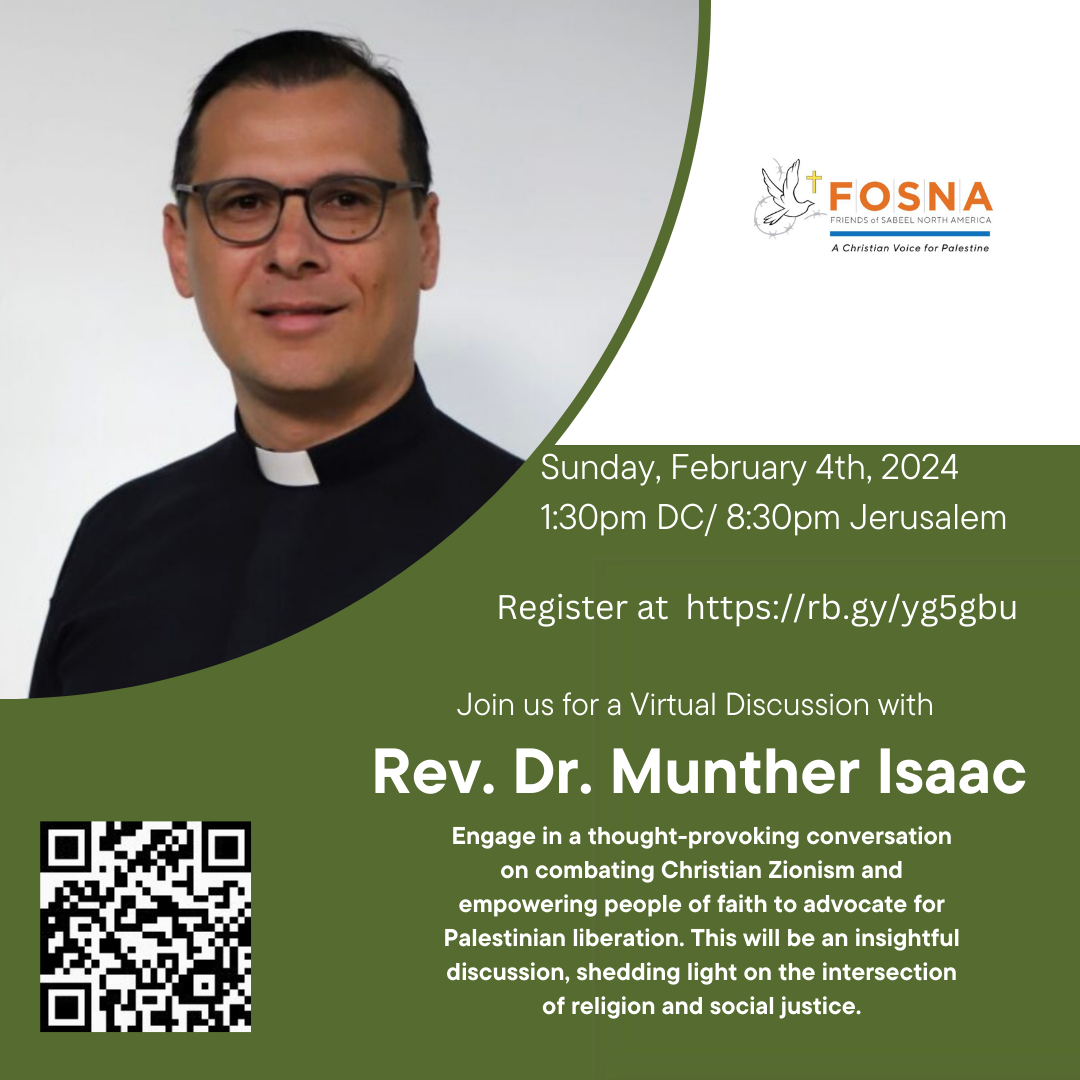
February 4 | Virtual Discussion with Rev. Munther Isaac: Confronting Christian Zionism and Empowering Advocates for Palestinian Liberation
Learn how to combat Christians Zionism and empower people of faith to advocate for Palestinian liberation. This will be an insightful discussion, shedding light on the intersection of religion and social justice.
Sunday, February 4 8:30 p.m. Jerusalem / 1:30 p.m. ET / 10:30 a.m. PT
February 14 | Jewish Day of Advocacy for Peace (JVP Seattle)
Join Jewish Voice for Peace (JVP) Seattle and participating groups from around the state for a Jewish-led advocacy day at the State Capitol in Olympia, WA. Participate in a training and then meet with elected officials in support of “the freedom and collective safety of Jewish and Palestinian communities locally and globally.”
Wednesday, February 14 All day, with options to participate remotely.
February 15 | Mass Mobilization Call: Christians Against Genocide
This is a call to action to our Christian siblings to use your public voice and collective power to advocate for justice, challenge Christian Zionism, and demand an immediate ceasefire.
On December 28, Reverend Dr. Canon Naim Stifan Ateek published an open letter to U.S. President Joe Biden outlining what he calls “a prophetic vision for justice.” His vision is “rooted in the spirit of United Nations Security Council resolution 242” and “based on the formula of land for peace for the two peoples that must live together on the land.”
“Mr. President, let us imagine together the future and let us take bold steps and concrete actions that will actually transform our words into a just peace for all.”
Rev. Dr. Ateek outlines his vision in the letter, in chronological detail. It begins with a permanent ceasefire, recognition of Palestine as a United Nations member state, and a “conclusive end” to Israel’s occupation. He places responsibility for the rebuilding of Gaza with the U.K., U.S., and Israel: “Justice requires that they be found liable and held accountable.” He invites collaboration with the governments and peoples of Ireland and South Africa, and emphasizes the means to establish a sovereign and viable Palestinian state.
“The Palestinians bear no responsibility for the horrors of the Holocaust,” he writes. “But the Palestinian people must now be prepared to live in peace with their Israeli Jewish neighbors. Both peoples may help one another heal from the wounds of the Holocaust, the pain and suffering of the Nakba, and the horrors of the current catastrophe.”
“It was our beloved Archbishop Desmond Tutu, the International Patron of Sabeel, who said, ‘We are prisoners of Hope.’ And so, it is with much hope and anticipation that you will join me in seeing this vision become a reality, one that requires bold actions and a passion for justice, and only justice!”
The following message was released by Presiding Bishop of the Episcopal Church, The Most Rev. Michael Curry, on November 7, 2023
The violence is horrific, and the geopolitics are complex, but my call to love is simple: Stop the killing. Stop all of it. Stop it today.
—The Most Reverend Michael Curry
You may know me as the pastor who is always talking about love, and I am. But today I am mindful that the urgency of love—true, sacrificial love that respects all of humanity—is not just a good feeling, and it is not easy.
We are called to a love that demands much from us. We are called to a love that tells the truth.
The violence is horrific, and the geopolitics are complex, but my call to love is simple: Stop the killing. Stop all of it. Stop it today.
We will not be silent while an entire population is denied food, water, electricity, and fuel needed to run hospitals. We cannot stand by while thousands of civilians die. Our partners in the region tell us they live in terror—that they feel they have died even while alive. They feel that the international community is tacitly sanctioning the killing of civilians and the bombing of schools, hospitals, and refugee camps.
Staying quiet in this moment would be a stain upon our souls and would deepen our complicity.
U.S. leadership must tell Israel to stop bombing civilian areas and allow access for full humanitarian aid to flow freely into Gaza.
Every human child of God—Palestinian and Israeli—deserves safety and security. We need to stop the killing. Today.
Vengeance will not bring back the dead. Retaliation will not repair the harms and the hurt. We are called to love, even and especially when it seems impossible.
We must stop the next 10,000 from being killed. As Episcopalians, we must call upon our leaders—President Biden, members of Congress, and others—to be unequivocal that we need to stop the killing. Today. This is clearly what love demands of us.
—The Most Rev. Michael Curry, presiding Bishop of the Episcopal Church
You must be logged in to post a comment.